Why Do Dogs Lick Our Faces?

why-do-dogs-lick-our-faces

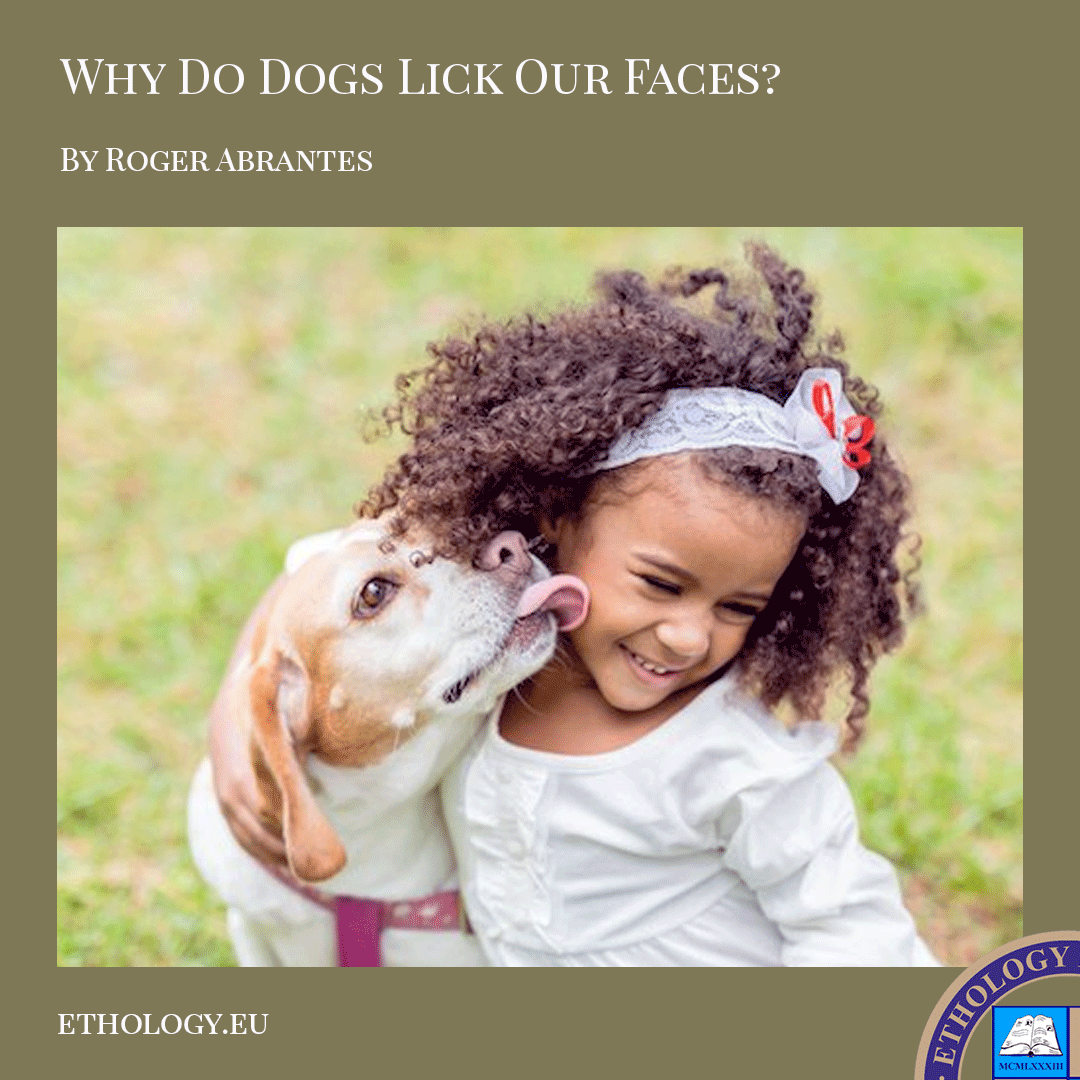
Dogs like to lick our faces—a behavior that can seem disturbing to many, especially non-dog owners. However, this behavior shows friendliness, a pacifying gesture, a hand (though not literally) reaching for peace. It is a compliment in dog language: “I like you; you can be my friend.”

The behavior originates in the neonatal and juvenile periods. Newborn mammals suckle and lick. Pups lick everything as a way of gathering information about their world. Licking our faces may give our dogs details about who we are and how we feel.

Pups lick one another, a behavior that seems to make both donor and recipient relax because it is an undemanding activity. Grooming and self-grooming, licking included, are pleasant social and bonding practices.


friendlywolfbehavior-1-600x600-1

Roger Abrantes and a wolf at the Wolf Park in Battle Ground, Indiana. Licking is one of the many behaviors dogs and wolves share. It signals friendship (picture by Monty Sloan).


Canine mothers lick their pups to keep them clean and to stimulate their urination, defecation, and digestion.

When the pups become a little older and eat solid food, it is common for them to lick the adults’ lips, which may prompt the adults to regurgitate recently consumed food—an excellent source of nutrition for the youngsters. Even though not as widespread as when Canis lupus familiaris were hunters, regurgitation behavior is not uncommon among our more scavenger-like domestic dogs when allowed to live an independent dog life to a certain extent.

The initial function of pacifying behaviors is to assist in the immediate survival and well-being of the organism. Subsequently, though maintaining the same function, they appear in different areas and yield distinctive outcomes. For example, the licking, which initially produced food regurgitation, later produces friendly behavior, thus becoming a pacifying gesture.

Next time a dog licks your face, you need not be too terrified or disgusted. Just close your eyes, yawn, and turn your head away. That shows, in dog language, that you accept its offer of friendship.

By the way, don’t be too afraid either of the germs you may get when your dog licks you—they are not worse than those we get from kissing one another.

 ______________

Featured image: When a dog tries to lick your face, the best you can do is to close your eyes, yawn, and turn your head away. This shows in dog language that you accept its offer of friendship.

______________

References

Abrantes, R. (1997). The evolution of canine social behavior. Naperville, IL: Wakan Tanka Publishers.

Abrantes, R. (2011, December 11). Dominance—Making sense of the nonsense. Roger Abrantes Blog. https://rogerabrantes.com/2011/12/11/dominance-making-sense-of-the-nonsense/

Lopez, B. H. (1978). Of wolves and men. New York, NY: Scribner.

Mech, L. D. (1981). The wolf: The ecology and behavior of an endangered species. University of Minnesota Press.

Zimen, E. (1981). The wolf: His place in the natural world. Souvenir Press Ltd. ISBN 9780285624115. (Original: Zimen, E. (1976). Der Wolf: Verhalten, Ökologie und Mythos. Hamburg: Parey.)

The Confidence Connection in Animal Training

Confidence plays a far greater role in animal training than most people realize. It’s a circular affair: confidence breeds success, and success breeds confidence.

Training often fails—not because the animal doesn’t understand, but because you don’t believe it will work. Doubt is contagious. The moment you hesitate, your body betrays you—and your animal reads you like an open book.

Dogs, horses, cats, even guinea pigs are experts in body language. They sense uncertainty long before you utter a word or make your first move. If you don’t know or aren’t sure of what you want, why should they feel safe following your lead?

So, here’s your plan of action: think it through, then act—with calm determination. Don’t worry about controlling the animal; control yourself. If you do that, the rest usually follows.

And if it still doesn’t work? You may ask. Tough luck—sometimes it doesn’t. In that case, go back to square one, revise your plan, and try again. Each failure sharpens your skill and, if you let it, strengthens your confidence.

Enjoy your training—but above all, enjoy the privilege of sharing time with another living being.

____________________

Note: This article was initially called “The Importance of Confidence in Animal Training.” I changed it in October 2025 while editing it because I realized the title could be ambiguous. It could suggest trusting animal training methods or confidence in the field itself, rather than the trainer’s self-confidence and the animal’s confidence in the trainer (as a result of the former).

Featured video: Credits at the end of the video.

Ilaria Training Italy

Do You Know What the Canine Hip Nudge Behavior Means?

canine hip nudge

The hip nudge is a typical canine behavior. Dog owners often think their dogs are pushy or impolite when they turn their backs to them, sometimes even pushing them. Nothing could be farther from the truth.

A hip nudge is a behavior a dog shows when it nudges another with its hip or rear end. Dogs often use this behavior towards us during greeting ceremonies when we show them passive friendliness by crouching down to it. The dog will walk towards us and turn round. Then it will either nudge us gently with its hip or rear end, or stand passively with its back to us.

caninehipnudgeraa-1-600x600-1

This dog shows a half hip nudge, still a sign of friendliness. Both the human and the dog are relaxed and show their peaceful intentions and trust in one another (photo by Lisa Jernigan Bain).

The hip nudge functions as a pacifying behavior. It signals friendliness. By turning its back to us, the dog shows it doesn’t intend to attack—it directs its teeth away from us. It also indicates it trusts us.

Dogs use a variation of the hip nudge behavior during mating rituals, in which the male nudges the female.

I first described this behavior in 1987, in the original edition of “Dog Language,” after spending several years observing, photographing, and filming dogs (Canis lupus familiaris), wolves (Canis lupus lupus), and foxes (Vulpes vulpes).

There are only minor differences between wolf and dog, which we can describe as dialects. The fox differs because, although it displays many behaviors common to the other two, it is less social than its cousins.

 References

  • Abrantes, R.A. (1992/1997). Dog Language—An Encyclopedia of Canine Behavior. Wakan Tanka Publishers, Naperville, IL.
  • Abrantes, R.A. (1997/2005). The Evolution of Canine Social Behavior. Wakan Tanka Publishers, Naperville, IL.
  • Fox, M.W. (1971). Behaviour of Wolves, Dogs and Related Canids. Harper & Row.
  • McFarland, D. (1999). Animal Behavior. Pearson Prentice Hall, England. 3rd ed.
  • Scott, J.P. and Fuller, J.L. (1965). Genetics and the Social Behavior of the Dog. University of Chicago.
  • Zimen, E. (1981). The Wolf—His Place in the Natural World. Souvenir Press.

Featured image: The hip nudge functions as a pacifying behavior. It signals friendliness (illustration by Alice Rasmussen from “Dog Language” by Roger Abrantes).

Can Animals of Different Species Bond like Conspecifics?

bonding-pupy-duckling

Can animals of different species create relationships and bonds similar to those they have with their own conspecifics? Let me tell you a story.

One winter morning, when I still lived up north, I looked out of the window and saw a white duck right in the middle of the yard. I almost missed it, so well his white plumage faded into the snowy environment.

Daniel, then a teenager, got very excited. “He’s freezing, Daddy. We have to help him,” he exclaimed.

We got dressed warmly and, even before considering breakfast, out we went to tend to this stranger in distress. Our presence didn’t frighten the duck, not even when we came closer. He didn’t show either any evident appreciation for the arrival of our rescue party. He must have been tired and freezing after having spent the whole night roaming around the frozen fields. We didn’t hold his lack of courtesy against him.

We found a wooden crate, duck-sized, grabbed some straw from the horse’s stall, and made him a comfortable refuge near the old water pump. He seemed to like it right away, went inside, tidied it up a bit, and lay down like all ducks do with his beak on his back. We offered him food and water, which he didn’t touch, and so we left him to recover.

“Fine, so now we can grab some breakfast, don’t you think?” I commented to Daniel.

The long and the short of it is that the duck stayed day after day, showing no intention of leaving. We gave him a name, Anders. I don’t know if he also gave us names. The other animals on the farm—horse, cat, and dog—took it as it was. No one bothered him and didn’t show much interest either.

I thought he might die when I first saw him, so miserable he looked, but he was a tough duck. Not only did he survive, but he looked healthier and stronger for each day that passed. He also became increasingly assertive.

If we had any apprehensions about whether the other animals would give him a hard time, our doubts quickly dissipated. In fact, it was the other way around. Anders became the king of the farm. He ate everything—horse, cat, and dog food equally—and he took what he wanted when he fancied it. He would approach Katarina the cat from behind, peck at her tail, and, when she moved away, he would feast on cat food as he pleased.

Indy, the horse, didn’t escape his majesty’s moods either. King Anders would peck at Indy’s hooves until he moved away, giving up his horsey pellets for yet another ducky feast.
He would walk around, tending to his businesses—whatever businesses ducks have—unconcernedly and matter-of-factly. The only concern he showed was birds of prey. He would stand silent, looking up, holding his head sideways, one eye facing the sky, until he was assured that the bird wouldn’t dive on him.

It didn’t take long, though, before we all got accustomed to Anders and him to us. I can’t say that he ever bonded with anyone. He was his own. He wasn’t needy either. At the farm, we were supportive of one another when necessary, but we didn’t intrude on the others’ lives, and we weren’t overprotective either. Milou, the dog, would charge out of the door, furiously growling if she heard that Katarina was in trouble, which she was regularly. The neighborhood tomcats apparently found her too hot and worth risking a sortie into unknown territory.

Sometimes, at night, the fox would venture too close, and Katarina would be the first to detect her, creating some commotion. Anders would quack and shed feathers all the way up to his safe spot. Milou would charge forth fiercely once again as the defender of the kingdom, barking and growling, not knowing why, just in case. Indy, the horse, on the other hand, always kept his cool throughout all ordeals. Daniel and I would come last from our rooms on each end of the farmhouse, armed with our hockey sticks, more than once meeting one another in the yard, only wearing our boxers. I’m glad we lived out in the sticks where nobody could witness our antics!

We had a good life. We didn’t bother one another, shared the space and the resources we had, and we put up with one another’s peculiarities. That was what served us all best, I think we all agreed, but I can’t know what the others thought. We were a family, a herd, a clowder, a pack, and a brace.

We belonged to different species, but, for all intents and purposes, we functioned as any well-functioning group of animals of the same species, except for reproduction. Thus, if you ask me whether animals of different species can create relationships and bonds similar to those they have with their own conspecifics, I wouldn’t hesitate to answer yes (all going down to definitions). Did we have any hierarchy? Oh yes, you needed only to ask Anders, and it wasn’t in any way unsettling for any of us. It even felt natural and reassuring, I dare say. As long as we all knew what we were supposed to do and not to do, all was good.

I got the habit every morning, right after I got up, to look out of the window and be greeted by Anders. He would invariably stand there, in the middle of the yard, looking at my window, always at the right time. It became a ritual, a reassuring one, I guess, for both of us.

One morning, Anders was nowhere to be seen. I knew right away what had happened. The fox had, at last, got the better of Anders, the king.

_______________

Featured image: If you were to ask me whether animals of different species can create relationships and bonds similar to those they have with their own conspecifics, I wouldn’t hesitate to answer yes. Photo by Lifeonwhite.

Can Two Training Methods Be Equally Good?

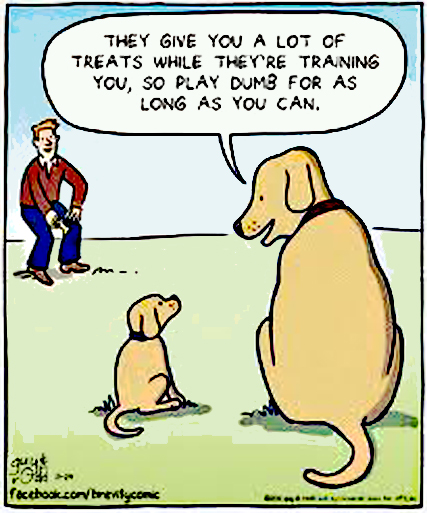
treat training dog cartoon

I receive many emails with questions about animal behavior. Most of them involve practical issues, but, now and then, someone poses a more complex question. Here is my answer to one of the latter, one I’d like to share with you because it addresses crucial issues in our understanding of animal behavior and training.

Dear ….,

Thanks for your comment, which allows me to clarify a few issues. By no means do I see animals as biological robots, nor do I regard the Skinnerian approach as the truth, the only truth, and nothing but the truth; quite the contrary. Please consider the following passages from “Mission SMAF—Bringing Scientific Precision Into Animal Training”.

“In fact, I suspect that [communication] even involves more than what science can describe with the intrinsic limitations of its key concepts and methods, no matter how stringent they are.

It seems to me, therefore, that our goal must not be to oppress or suppress emotions, but rather control them and use them advantageously. Emotional arousal proves to be necessary to learn and the right amount of emotional arousal even shows to increase the efficiency of learning processes.”

A very non-Skinnerian statement, I would say.

As to my own method to analyze learning processes in artificial set-ups (like in animal training), I write: “In a crude sense, SMAF is an oversimplification of complex processes […] certainly not an attempt to reduce complex mechanisms to a few formulas. In the end, [its] value depends solely on its successful application to solving practical problems; beyond that, it has no value.”

Operant conditioning (when we use it correctly) is an efficient model of behavior for animal training because we control the conditionals to some extent (as Pavlov explains in his original writings, not the subsequent translations). Whilst operant conditioning is adequate for analyzing behavior at a particular level, beyond that, it becomes too crude an instrument. To understand behavior in a broader sense, we must turn to evolutionary models and concepts—variation, selection, adaptation, fitness, function, evolutionary strategies, ESS (evolutionarily stable strategy), costs and benefits, and so forth. My approach to behavior is therefore a classical ethological one, in the tradition of von Frisch, Lorenz, and Tinbergen—firmly grounded in evolutionary biology and in philosophically coherent reasoning.

Greetings,

RAA


The core of the argument is reductionism, the view that we can reduce complex processes to the sum of their simpler parts. In a sense, all science is reductionistic. We attempt to explain complex processes with a few notions well organized in little boxes. That is a process that seems to suit our human brain particularly well.

However, we must bear in mind that our interpretations, independently of how good they are, are just our pictures of an elusive reality. They suit our particular umwelten,* but definitely not all of them. They explain parts of it from specific angles so we can make sense of it. Newton and Einstein—the classical example—are (probably) both right, each explaining reality at a different level.

There’s nothing wrong about being a reductionist if only we do not get greedy and attempt to explain far too much with far too little, as in, “That’s it, this is the way things are. Period.” Simplifying often gets us to the point that complicating and oversimplifying have both missed.

In animal training, one theory or method can be as good as another depending on its foundations, approaches, what it attempts to explain, and the practical goals it aims to serve. If both are based on reliable evidence, use well-defined terms, and are logically sound, there’s little to choose between one or the other.

If only animal trainers understood that, I believe we would forgo many senseless disputes. Then again, we can brag about being the most emotional creatures on this big blue marble of ours, can’t we?

___________

* Umwelt (plural umwelten) in ethology means the world as it is experienced by a particular organism.

___________

References

Abrantes, R. (2018). Mission SMAF—Bringing Scientific Precision In to Animal Training. Wanka Tanka Pub.

Lorenz, K. (1937). Über die Bildung des Instinktbegriffes. Naturwissenschaften, 25, 289–300. https://doi.org/10.1007/BF01492648

Павлов, И. П. (1926). Двадцатилетний опыт объективного изучения высшей нервной деятельности (поведения) животных. Ленинград: Научное химико-техническое издательство. (Pavlov, I. P. (1926). Twenty Years of Objective Study of the Higher Nervous Activity (Behavior) of Animals. Leningrad: Scientific Chemical-Technical Publishing House.)

Skinner, B. F. (1938). The Behavior of Organisms: An Experimental Analysis. New York: Appleton-Century-Crofts.

Uexküll, J. von. (1934). Streifzüge durch die Umwelten von Tieren und Menschen: Ein Bilderbuch unsichtbarer Welten. Berlin: Julius Springer. (English translation: A Foray into the Worlds of Animals and Humans: With A Theory of Meaning, translated by Joseph D. O’Neil, University of Minnesota Press, 2010.)

Animal Training—When Doing Nothing is Doing Right

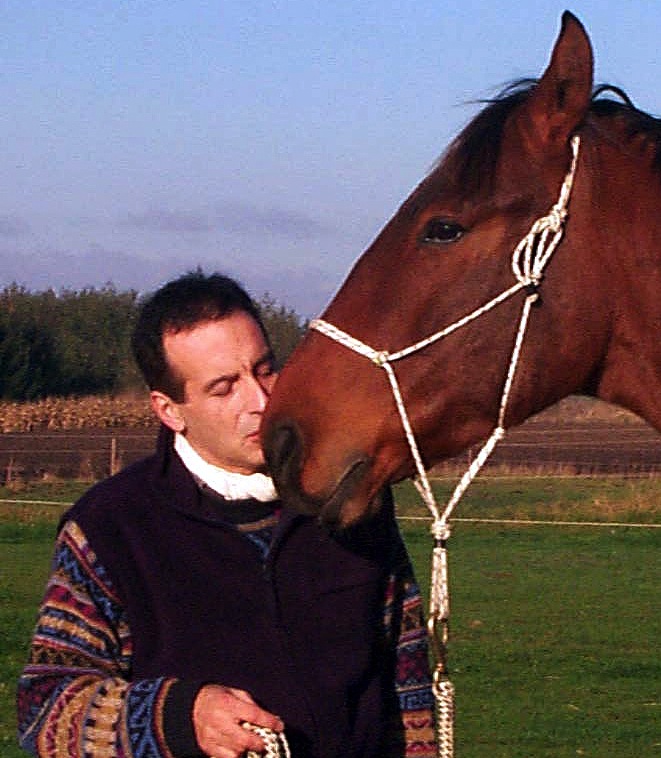
Roger Abrantes talks to horse

After a while, I began “leading the dance,” never used the reins, only changed my position on the saddle slightly. I looked left, and she turned left, I looked right, and she turned right, her ears for a moment turning back to me like asking, “Am I doing well?”

Years ago, my friends in the US asked me to go with them and see a horse they were considering buying for their daughter. A couple of hours drive through Illinois countryside, roads surrounded by never-ending cornfields, took us to a nice, clean and modern kind of an equestrian center where we found the horse and met the owner.

I liked the horse right away, a young, paint, quarter mare. The American quarter horse got its name from being particularly fast on distances up to a quarter-mile. Paint horses are white with spots of black, brown, or reddish. The American Paint is now a breed of its own. Most paints are levelheaded, versatile, and friendly horses. This mare was no exception. She had the looks of being approachable and curious, eager to learn. I don’t remember exactly how old she was, but she couldn’t have been more than three years old. She looked young to me to carry a rider on her back, and I remember asking the owner if they had trained her to it.

“Oh, yes, she is broken to ride, all right,” she answered.

That was not what I asked, but I reckoned I couldn’t get a better answer. What I wanted to know was whether the horse had gone through any particular groundwork to develop the right muscles and movements necessary to carry the extra weight of a rider. By the way, I don”t know about you, but I dislike immensely the term “horse breaking.” If you really break the horse, you shouldn’t even come close to a horse, and that’s my opinion. If you don’t, but instead train it stepwise, wisely and patiently, you should consider using another term altogether—and that’s again my opinion about that.

The young mare was beautiful, but then again, I might have been terribly biased, for my heart always beats a tad faster when I see a gentle, paint quarter (or a friendly English cocker spaniel). These are things of the heart that I can’t explain, and don’t feel I need to either.

The owner proceeded to give us a demonstration of the horse’s abilities under saddle. It was a sad showing. The mare trotted and cantered all right, and turned right and left, and stopped and continued, but she looked miserable.

After having finished, the owner invited my friends’ daughter to go for a ride, but she declined, showing the typical shyness of a teenager of her age.

“You go, Roger, take a ride and tell us what you think,” her mum said to me.

“Yes, uncle Roger, please do it,” my niece begged me with that “horsey” expression only teenagers who have been long around horses can give you. I couldn’t refuse her.

And so, I went for a ride, even though, in my opinion, she was a bit too young and untrained. We trotted and cantered right away and, then, we did figure eights and turns. The young mare was entirely different from earlier. She had regained her spirit, and if not wholly, then closer to the spirit of her ancestors, the proud horses roaming the plains of the new world.

“Wow,” my friends said almost in a choir, “that was impressing.”

“What did you do?” they asked me, “She behaved totally different with you! It was like a different horse altogether.” The owner pretended not to hear that.

“I did nothing,” I answered, and I was entirely honest. After mounting, I started having a long talk with the horse, a silent one, that is, for horses don’t understand English, and what I had to say was as much to her, the mare, as to myself.

“Ok, horsey, here we are the two of us. I’m sorry, we haven’t even been introduced properly,” I said, “Just do what you feel like doing. I’ll try to be as subtle as I possibly can.” And she ran, she trotted and cantered, and I did nothing besides trying not to be a burden, just syncing my movements with hers.

“Go for it, honey,” I thought, “run as much as you fancy, turn whenever you like. You lead, I’ll follow.” And she ran and turned, ears forward one moment, back the next, her mane flying in the wind. “Go, baby, go,” I thought, and she went faster and freer.

After a while, I began “leading the dance,” never used the reins, only changed, slightly, my position on the saddle. I looked left, and she turned left, I looked right, and she turned right, her ears for a moment turning back to me like asking, “Am I doing well?”

Sometimes, doing more does less, doing less does more, and doing nothing does right—and I suspect this is true more often than we reckon.


Featured image: To earn the trust of a horse is the first step toward a good relationship. It takes time to earn it and only one moment to lose it (photo from Ethology Institute files).

“Life of Pi” — Read the Book, Watch the Movie

Life of Pi

“Just beyond the ticket booth Father had painted on a wall in bright red letters the question: DO YOU KNOW WHICH IS THE MOST DANGEROUS ANIMAL IN THE ZOO? An arrow pointed to a small curtain. There were so many eager, curious hands that pulled at the curtain that we had to replace it regularly. Behind it was a mirror.” (1.8.4)

I read Yann Martel’s “Life of Pi” many years ago. I took the book to bed, my intention being to read 10-12 pages before falling asleep. This was one of the few books I’ve read from one end to the other in one go. I went to sleep at five in the morning.

The other day, I revisited “Life of Pi,” not the book from 2001, but the movie from 2012 directed by Ang Lee with screenplay by David Magee.

The movie gets my five stars. It’s a near perfect screenplay adaptation of a book. It misses a bit of the first part of the book that would be too cumbersome to render in pictures anyway, but it presents the second part magnificently. It’s a beautiful 3D movie, a thrilling adventure, an experience for afterthought—you can take it as you wish.

“Life of Pi,” book and movie, is not intrusive, does not force you to think or accept anything in particular. It leaves you with your freedom to draw your conclusions, or ask your questions, as the case may be.

Take a break, read the book and savor it. Yann Martel succeeded in writing a book that you want to read word by word, not by paragraphs.

The following quotations indicate “Part.Chapter.Paragraph.”

The most dangerous animal in the zoo is the human being maybe because of the relationship of danger with unpredictable evil.

“Rank determines whom it can associate with and how; where and when it can eat; where it can rest; where it can drink; and so on. Until it knows its rank for certain, the animal lives a life of unbearable anarchy. It remains nervous, jumpy, dangerous. Luckily for the circus trainer, decisions about social rank among higher animals are not always based on brute force.” (1.13.3)

Here, Pi is (between lines) talking more about human relationships than human-animal relationships, one suspects. He’s also thinking about how to train Richard Parker.  Throughout his misery, Pi comes to see cleverness and willpower as two remarkable human skills, but the question is, do not these skills also bring about evil?

“There are many examples of animals coming to surprising living arrangements. All are instances of that animal equivalent of anthropomorphism: zoomorphism, where an animal takes a human being, or another animal, to be one of its kind.” (1.32.1)

Zoomorphism (in a way, the opposite of anthropomorphism) means that animals treat another species (almost) like their own. Our dogs are great zoomorphists.  This is more philosophical that it may seem and definitely more obscure in the movie than in the book, which, as I’ve mentioned, is more elaborated in its first pre-boat part. One suspects that Pi is talking about his own struggle: Pi the Hindu, Pi the Muslim, and Pi the Christian all in one and the same Pi, not only tolerating one another but living in harmony.

I leave you with one last quote without any comment. Read the book, watch the movie.

“I had to tame him. It was at that moment that I realized this necessity. It was not a question of him or me, but of him and me.” (2.57.8)

As always, I wish you a great day.

Facts and Morality: Tail Docking and Ear Cropping—Is it Right?

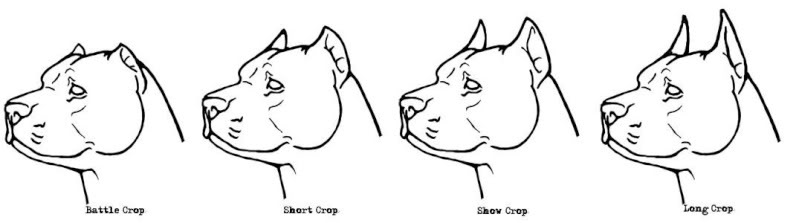
Ear cropping

Cutting off parts of the body of an animal for our vanity is and will always be wrong for me independently of what science may discover.

Whether something is morally right or wrong depends on what you and I or anyone thinks, and it is not imposed on us by any scientific discovery. We need to distinguish between science and morality, between descriptive and normative statements.

Science is a collection of coherent, useful and educated predictions. All science is reductionist and visionary in a sense, but that does not mean that all reductionism is equally useful or that all visions are equally valuable or that one far-out idea is as acceptable as any other.

Greedy reductionism is bound to fail because it attempts to explain too much with too little, classifying processes too crudely, overlooking relevant detail and missing pertinent evidence.

Science sets up rational, reasonable, credible, useful and helpful explanations based on empirical evidence, which is not connected per se. The connections happen via our scientific models, ultimately allowing us to make reliable and educated predictions. A scientist needs to have an imaginative mind to think the unthinkable, discover the unknown and formulate initially far-fetched, but testable, hypotheses that may provide new and unique insights. As Kierkegaard writes, “This, then, is the ultimate paradox of thought: to want to discover something that thought itself cannot think.”

Morality and science are two separate disciplines. I may not like the conclusions and implications of some scientific studies, I may even find their application immoral; yet, my job as a scientist is to report my findings objectively.

Stating a fact does not oblige me to adopt any particular moral stance. The way I feel about a fact is not constrained by what science tells me. It may influence me but, ultimately, my moral decision is independent of the scientific fact. Science tells me men and women are biologically different in some aspects, but it does not say whether or not they should be treated equally in the eyes of the law. Science tells me that evolution is a consequence of the algorithm “the survival of the fittest,” not whether or not I should help those that find it difficult to fit into their environment. Science informs me of the pros and cons of eating animal products, but it does not tell me whether it is right or wrong to be a vegetarian.

If you think that the safest is to base your moral stances on factual events, you are walking on moving sands (and, probably, committing a fallacious appeal to nature).

Let’s say someone asks you, “Why do you believe tail docking to be wrong?” If you answer, “Because it inhibits the dog to communicate adequately since dogs use their tails to communicate,” you are getting into trouble. Say again, the same person asks you,  “Why do you believe ear cropping to be wrong?” You cannot answer, “Because it inhibits the dog to communicate adequately since dogs use their ears to communicate,” for upright ears allow the dogs to display more and easier detectable expressions than drop ears (though no study has proven that cropped ears are better to communicate than uncropped).

That is the hidden danger we run when using matters of fact to validate our moral statements: we may easily run into inconsistent argumentation. Even though seemingly that does not bother some, it certainly bothers me and other fellow thinkers with a certain degree of intellectual integrity.

You could avoid this problem by answering, ”Because I don’t like to cut off parts of an animal.” That would do it because nobody can argue with what you like or don’t like. Even if you neuter your male dog (which means cutting off the testicles of the animal), you are still off the hook because you can say, “I did it, and I don’t like it.” There is no logical contradiction in doing something without liking it. It is only logically contradictory if you infer the premise “we only do what we like.” “I don’t like diets and I’m on a diet” is perfectly all right. You may have a goal, which requires you to do things you don’t like.

Another aspect of this hidden danger of basing your morality on facts is that if science uncovers some new fact relevant to your morality, you’ll be compelled to change it. One moment right, the nest wrong applies to scientific theory, but not necessarily to morality.

For example, if I use the seemingly good argument, “for me, it is wrong to inflict unnecessary pain and distress to any living creature, independently of species,” my morality is at the mercy of scientific discovery.

Thus, the only way I can make my moral rule stick appears to be the subjective argument: for me, it is wrong to cut off parts of an animal’s body because I don’t like it. And if science uncovers some painless, undistressing procedures of docking and cropping, so be it. I still don’t like it and won’t do it. Period.

References

Ayer, A. J. (1936). Language, truth, and logic. Gollancz.

Churchman, C. W. (1961). Prediction and optimal decision. Englewood Cliffs, NJ: Prentice-Hall.

Elqayam, S., & Evans, J. St. B. T. (2011). Descriptivism versus normativism in the study of human thinking. Behavioral and Brain Sciences, 34(5), 233–248.

Hume, D. (1739–1740). A treatise of human nature. (L. A. Selby-Bigge & P. H. Nidditch, Eds., 2nd ed., 1978). Oxford University Press. (Original work published 1739–1740)

Quintelier, K., Van Speybroeck, L., and Braeckman, J. (2010). Normative ethics does not need a foundation: It needs more science. Philosophy, Ethics, and Humanities in Medicine, 5, Article 5. https://pmc.ncbi.nlm.nih.gov/articles/PMC3068523/.

Moore, G. E. (1903). Principia ethica. Cambridge University Press.

Do You Know What the Dog’s Twist Behavior Means?

Canine Twist Behavior by Roger Abrantes

Canine twist behavior—the puppy twists as a pacifying response to the adult’s growling (illustration by Alice Rasmussen from “Dog Language” by Roger Abrantes)


The canine twist behavior is a curious behavior that few dog owners recognize, let alone understand.

It is a characteristic behavior shown by any canine (wolf, dog, African wild dog, and dingo, at least) when it twists one hind leg out to the side. They frequently show it from a sitting position, but they can also do it while standing. In cases where the dog appears very insecure, a half roll culminating with the dog lying on its back and presenting its belly may succeed the twist. Laid-back ears, semi-closed eyes, champing (at times with the tongue protruding out of the mouth), and paw lifting (or vacuum pawing), in various degrees depending on the level of insecurity, usually follow the twist. It’s a reasonably common behavior primarily seen in puppies and youngsters, but insecure adults can also display it.

The function of the twist is to pacify an opponent. As always, behavior happens by chance (or reflex), and if it (the phenotype) proves to have a beneficial function, it will tend to spread in the population, transmitted from one generation to the next (via its genotype).

The twist’s origin is most certainly related to the canine female’s typical maternal behavior of overturning her puppy by pressing her nose against its groin, forcing one of the puppy’s hind legs to the side. The puppy will then fall on its back, and the mother will lick its belly and genital area, facilitating the puppy’s urination and defecation. To start with, the puppy seems to find the experience unpleasant, but it becomes pleasurable once it rests on its back and its mother’s licking starts to function.

Later on, the puppy will perform the same twist movement in the absence of any physical contact with the mother or any other adult. It will do so when it feels threatened or insecure, and with the function to pacify both itself and its opponent, rather than to invite belly-licking.

The transition from urination/defecation to pacifying is a classic of the development of behavior. It happens almost exclusively via a classic conditioning process. Initially, being overturned is unpleasant, but lying on its back, belly up, becomes pleasant (due to the puppy relieving itself). After some repetitions, the puppy will associate lying on its back with ending discomfort and will readily display this behavior whenever necessary.

The strength of the twist behavior (a general characteristic of pacifying behavior) lies in its dual effect (on both parties). The puppy relaxes by doing something that has produced desirable results earlier. The threatening adult relaxes when met with behavior that it recognizes as infantile.

I first described this behavior in the original edition of my book “Dog Language” in 1987. It had no name at the time. I coined the term “twist behavior,” thinking of the sixties’ famous dance, which was very popular in my teenage years. “Twist and Shout” by The Beatles* immortalized it. The Twist, the dance, featured a particular step, where the dancer’s legs made a twisting movement reminiscent of the puppy’s pacifying behavior.


____________________

* “Twist and Shout” was written by Phil Medley and Bert Russell and first released in 1961, featuring The Top Notes. However, it achieved its fame first when The Beatles performed it in 1963 with John Lennon on lead vocals.


Related articles


References

  • Abrantes, R. (1997) The Evolution of Canine Social Behavior. Wakan Tanka Publishers.
  • Abrantes, R. (1997) Dog Language. Wakan Tanka Publishers.
  • Darwin, C. (1872) The Expressions of the Emotions in Man and Animals. John Murray (the original edition).
  • Fox, M. (1972) Behaviour of Wolves, Dogs, and Related Canids. Harper and Row.
  • Lopez, B.H. (1978). Of Wolves and Men. J. M. Dent and Sons Limited.
  • Mech, L.D. (1970) The wolf: the ecology and behavior of an endangered species. Doubleday Publishing Co., New York.
  • Mech, L.D. (1981). The Wolf: The Ecology and Behaviour of an Endangered Species. University of Minnesota Press.
  • Mech, L.D. (1988) The arctic wolf: living with the pack. Voyageur Press, Stillwater, Minn.
  • Mech, L.D. and Boitani, L. (2003) Wolves: Behavior, Ecology, and Conservation. University of Chicago Press.
  • Scott, J.P. and Fuller, J.L. (1998) Genetics and the Social Behavior of the Dog. University of Chicago Press.
  • Trumler, E. (1995) Mit dem Hund auf du: Zum Verständnis seines Wesens und Verhaltens. Piper Taschenbuch; 17. edition. ISBN-10 : 3492211356
  • Zimen, E. (1975) Social dynamics of the wolf pack. In The wild canids: their systematics, behavioral ecology and evolution. Edited by M. W. Fox. Van Nostrand Reinhold Co., New York. pp. 336-368.
  • Zimen, E. (1982) A wolf pack sociogram. In Wolves of the world. Edited by F. H. Harrington, and P. C. Paquet. Noyes Publishers, Park Ridge, NJ.

Laughter is the Shortest Distance Between Two People

Laughter

“Laughter is the shortest distance between two people,” Victor Borge presumably once said.* As you have likely figured out by now, I enjoy discovering evidence that humans are not that different from other forms of life. We share many characteristics with the other living creatures with whom we share our planet. Today, I have one more example for you—laughter.

Laughing is an involuntary reaction in humans consisting of rhythmical contractions of the diaphragm and other parts of the respiratory system. External stimuli, like being tickled, mostly elicit it. We associate it primarily with joy, happiness, and relief, but fear, nervousness, and embarrassment may also cause it. Laughter depends on early learning and cultural factors (Davila-Ross & Palagi, 2022).

The study of humor and laughter is called gelotology (from the Greek gelos, γέλιο, meaning laughter).

Chimpanzees, gorillas, bonobos, and orangutans display laughter-like behavior when wrestling, playing, or tickling. Their laughter consists of alternating inhalations and exhalations that sound to us like breathing and panting (Crepaldi et al., 2024; Ross et al., 2010; Winkler et al., 2025)

Rats display extended, high-frequency, ultrasonic vocalizations during play and when tickled. We can only hear these chirping sounds with proper equipment. They are also ticklish, as are we. Particular areas of their body are more sensitive than others. There is an association between laughter and pleasant feelings. Social bonding occurs with the human tickler, and the rats can even become conditioned to seek the tickling (Panksepp & Burgdorf, 2000).

A dog’s laughter sounds similar to a regular pant. A sonograph analysis of this panting behavior shows that the variation of the bursts of frequencies is comparable with the laughing sound. Playing recorded dog laughter to dogs in a shelter can contribute to promoting play, social behavior, and decreasing stress levels (Simonet et al., 2005).

Laughter is the shortest distance between two people.” Maybe it is simply the shortest distance between any two living creatures.

Keep laughing, my friends!

__________

* Victor Borge is widely credited with this quote, although there is no direct evidence linking it to a specific book, performance, or interview.

Related Articles

The Biggest Difference Between Humans and Dogs

The Single Most Damaging Belief of Ours

We Talk Too Much and Say Too Little

Do Dogs Understand What We Say?

References

Crepaldi, F., Rocque, F., Dezecache, G. et al. Orangutans and chimpanzees produce morphologically varied laugh faces in response to the age and sex of their social partners. Sci Rep 14, 26921 (2024). https://doi.org/10.1038/s41598-024-74089-x.

Davila-Ross, M. and Palagi, E. 2022. Laughter, play faces and mimicry in animals: evolution and social functions. Phil. Trans. R. Soc. B37720210177. http://doi.org/10.1098/rstb.2021.0177.

Panksepp, J., & Burgdorf, J. (2000). Laughing rats? Playful tickling arouses high-frequency ultrasonic chirping in young rodents. Consciousness and Cognition, 9(3), 551-572. https://files.eric.ed.gov/fulltext/EJ1069218.pdf.

Ross, MD, Owren, MJ, Zimmermann, E. The evolution of laughter in great apes and humans. Commun Integr Biol. 2010 Mar;3(2):191-4. doi: 10.4161/cib.3.2.10944. PMID: 20585520; PMCID: PMC2889984.

Simonet, P., Murphy, J., & Scaggs, M. (2005). Dog-laughter: Recorded playback reduces stress-related behaviors in shelter dogs. Animal Welfare, Purdue University Center for Animal Welfare Science. https://caninewelfare.centers.purdue.edu/resource/dog-laughter-recorded-playback-reduces-stress-related-aggression-in-shelter-dogs/.

Winkler, S.L., Laumer, I.B., Lyn, H. et al. Bonobos tend to behave optimistically after hearing laughter. Sci Rep 15, 20067 (2025). https://doi.org/10.1038/s41598-025-02594-8.

How Difficult Can It Be to Be a Dog Owner?

man dog laughing grass

You don’t have to excuse yourself or your dog for the way you are. As long as you’re both happy and you don’t bother anyone, you are entitled to do what you like and be the way you are.

You don’t need to be good at anything, whether it be Obedience, Agility, Musical Free Style, Heel Work to Music, Flyball, Frisbee Dog, Earth Dog, Ski-Joring, Bike-Joring, Earthdog, Rally-O, Weight Pulling, Carting, Schutzhund, Herding, Nose Work, Therapy, Field Trials, Dock Dogs, Dog Diving, Disc Dogs, Ultimate Air Dogs, Super Retriever, Splash Dogs, Hang Time, Lure Course Racing, Sled Dog Racing or Treibball; and you don’t need excuses as to why not.

We are over-swamped by labels because labels sell, but they only sell if you buy them. Should you be a positive, force-free, balanced, R+, R+P-, naturalistic, moralistic, conservative, realistic, progressive, or a clicker dog owner?

Labels are not a guarantee of high morals, quality of life, or scientific correctness. They are trademarks, devised by people who want to sell you a product and control you.

Stop caring about labels. A label is a burden; it restricts you; it limits your freedom. Labels are for insecure people who need to hide behind a mask. Harmony and serenity don’t need labels.

Be skeptical of everything that spreads like fire on the step. Be suspicious of anything with a broad mass appeal. Think, question everything, control your emotions, be open-minded, but constantly use your critical reasoning. Believe in yourself, be yourself. Be the person and the dog owner you want to be, and you won’t need labels.

Forget labels and focus instead on knowledge, empathy, reciprocity, and respect. These are the pillars of any healthy relationship you may develop with any individual, independently of species.

Life is great—enjoy it!

Featured image: Just do whatever you and your dog enjoy, whichever way you like it, so that both of you feel good. It’s as simple as that!

An Invaluable Lesson—a Relationship is a Natural Thing

An Invaluable Lesson—a Relationship is a Natural Thing

Do you think they fight about what positive and negative reinforcers or punishers are? Do you think they waste precious time arguing about dominance and submission? Do you think they care about collars, leashes, harnesses, target sticks, clickers, kongs,—or looking fashionable?

As I have said often, a relationship is a natural thing. Plagued by the sins of the past, the madness of the present, obsessed with political correctness, intoxicated by the gadgets of the cybernetic revolution, and brainwashed by consumerism, we have forgotten how to cultivate genuine relationships. If we wish peace and harmony, it is imperative that we regain this lost ability of ours. These two in the movie can teach us all a priceless lesson—if we just care to pause for a moment, watch them, and listen to their silent message.

This clip has to be one of my all-time favorites.

Keep smiling!

Evolutionary Strategies

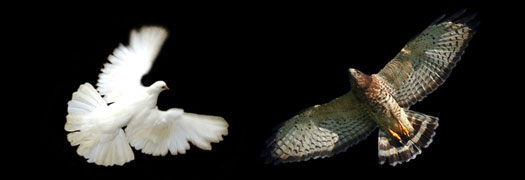
ESS doves hawks

An evolutionarily stable strategy (ESS) is a strategy that no other feasible alternative strategy can better, provided sufficient members of the population adopt it. The best strategy for an individual depends upon the strategies adopted by other members of the population. Since the same applies to all individuals in the population, a mutant gene cannot invade a true ESS successfully.

Evolutionary biologists imagine a time before a particular trait existed. Then, they postulate that a rare gene arises in an individual and ask what circumstances would favor its spread throughout the population. If natural selection favors the gene, then the individuals with the genotypes incorporating that gene will have increased fitness. A gene must compete with the existing members of the gene pool and resist invasion from other mutant genes to become established in a population’s gene pool.

When considering evolutionary strategies that influence behavior, we envision a scenario in which changes in the genotype result in corresponding changes in behavior. By ‘the gene for sibling care’, we mean that genetic differences exist in the population such that some individuals are more likely to aid their siblings than others. Similarly, by ‘dove strategy,’ we mean that animals exist in the population that do not engage in fights and that pass this trait from one generation to the next.

At first sight, it might seem that the most successful evolutionary strategy will always spread through the population and eventually supplant all others. While this may sometimes be the case, it is far from always being so. Sometimes, it may not even be possible to determine the best strategy. Competing strategies may be interdependent. The success of one depends upon the existence of the other and the frequency with which the population adopts the other. For example, the strategy of mimicry has no value if the warning strategy of the model is not efficient.

Game theory belongs to mathematics and economics, and it studies situations where players choose different actions in an attempt to maximize their returns. It is a good model for evolutionary biologists to approach situations in which various decision makers interact. The payoffs in biological simulations correspond to fitness, comparable to money in economics. Simulations focus on achieving a balance that would be maintained by evolutionary strategies. The Evolutionarily Stable Strategy (ESS), introduced by John Maynard Smith in 1973 (and published in 1982), is the most well-known of these strategies. Maynard Smith used the hawk-dove simulation to analyze fighting and territorial behavior. Together with Harper in 2003, he employed an ESS to explain the emergence of animal communication.

An evolutionarily stable strategy (ESS) is a strategy that no other feasible alternative strategy can better, provided sufficient members of the population adopt it.

The traditional way to illustrate this problem is the simulation of the encounter between two strategies, the hawks and the doves. When a hawk meets a hawk, it wins on half of the occasions, and it loses and suffers an injury on the other half. Hawks always beat doves. Doves always retreat against hawks. Whenever a dove meets another dove, there is always a display, and it wins on half of the occasions. Under these rules, populations of only hawks or doves are not an ESS. A hawk can invade a population made up entirely of doves, and a dove can invade a population of hawks only. Both would have an advantage and would spread in the population. A hawk in a population of doves would win all contests. A dove in a population of hawks would never get injured because it wouldn’t fight.

However, it is possible for a mixture of hawks and doves to provide a stable situation when their numbers reach a certain proportion of the total population. For example, with payoffs as winner +50, injury -100, loser 0, display -10, a population consisting of hawks and doves (or individuals adopting hawk and dove strategies) is an ESS whenever 58,3% of the population are hawks and 41,7% doves; or, alternatively, when all individuals behave at random as hawks in 58,3 % of the encounters and doves in 41,7%.

Evolutionarily stable strategies are not artificial constructs. They exist in nature. The Oryx, Oryx gazella, has sharp, pointed horns, which it uses only in defense against predators and never in contests with rivals. They play the dove strategy. Up to 10% per year of MuskoxOvibos moschatus, adult males die as a result of injuries sustained while fighting over females. They play the hawk strategy.

Peer-to-peer file sharing is a good example of an ESS in our modern society. BitTorrent peers use Tit for Tat strategy to optimize their download speed. Cooperation is achieved when upload bandwidth is exchanged for download bandwidth.

Life is a box of wonder and amazement, isn’t it?

 ____________

Featured image: The traditional way to illustrate Evolutionarily Stable Strategies is the simulation of the encounter between two strategies, the hawk and the dove.

References

Dawkins, R. (1980). Good Strategy or Evolutionarily Stable Strategy. In G. W. Barlow & J. Silverberg (Eds.), Sociobiology: Beyond Nature/Nurture (pp. 331-367). Westview Press.
https://doi.org/10.4324/9780429306587-14.

Maynard Smith, J. (1972). Game Theory and the Evolution of Behavior. In R. Lewontin (Ed.), On Evolution (pp. 202–223). Edinburgh: Edinburgh University Press. ISBN: 978-0-85224-248-1.

Maynard Smith, J., & Parker, G. A. (1976). The logic of asymmetric contests. Animal Behaviour, 24(1), 159–175. https://doi.org/10.1016/S0003-3472(76)80110-8

Maynard Smith, J. (1982). Evolution and the theory of games. Cambridge: Cambridge University Press. https://doi.org/10.1017/CBO9780511806292

We Talk Too Much and Say Too Little

We Talk Too Much and Say Too Little

Our dogs, I’m sure, think that we talk too much and say too little. My advice to dog owners is that when you cannot improve on silence, be quiet.

The function of communication is to achieve or maintain any desired outcome. Communication—information, instruction, persuasion, control, motivation, emotional release, and information—is all about change. If we don’t want anything in particular, the best we can do is to keep silent.

Communication happens through signals with different forms, e.g., sound (verbal and non-verbal), body language, facial expression, eye contact, smell, and touch. All organisms communicate: animals, plants, fungi, and even bacteria.

Talking is our primary means of communication because we have developed complex language systems, which is a unique characteristic of our species’ brain. Other animals also communicate, though their methods are supposedly less sophisticated than ours. In addition to speaking to influence or maintain the behavior of others, we also engage in casual conversations, social chatter, and gossip. However, cozy talk is not always as pleasant as it sounds, and social conversations often veer into anti-social territory more than we might like to admit.

Language is a valuable tool for fostering understanding; and it is also the ideal tool to create misunderstanding. Very often, we would be better off remaining silent.

Dogs don’t care for idle chatter or social niceties. They aren’t particularly interested in gossip or emotional outbursts either. Dogs are pragmatic—it’s a “if you don’t bother me and I don’t bother you, all is good.” Dogs are connoisseurs of silence. Instead of excessive talking, I believe your dog would value a loving glance or a simple soothing gesture much more. So, remember: if you don’t have anything important to say to your dog, keep silent.

Have a quiet, peaceful, and beautiful day!

The Single Most Damaging Belief of Ours

wolfmuzzlegrab-1

The single most damaging belief of ours is that everything is one-sidedly good or bad, right or wrong.

Good or bad, right or wrong depend on the conditions. A strategy is only good at a specific time and under particular circumstances. Behavior is dynamic and changeable. An individual displays one behavior at one given moment and another a while later. It is the ability to adopt the most beneficial strategy in the prevailing conditions that ultimately sorts the fittest from the less fit—moral strategies included—and decides whose genes will prevail in the next generation, and which memes will play in the following round.

Opposing strategies—such as honesty versus deception, dominance versus submission, or aggression versus fearfulness—hold one another at bay. Whether it pays off to play one role or the other is ultimately a function of costs and benefits, as well as the number of individuals adopting each particular strategy.

In the game of life, no strategy wins alone.

Featured image: The single most damaging belief of ours is that everything is one-sidedly good or bad, right or wrong. (Photo by Monty Sloan).