Muzzle Grasp Behavior in Canids

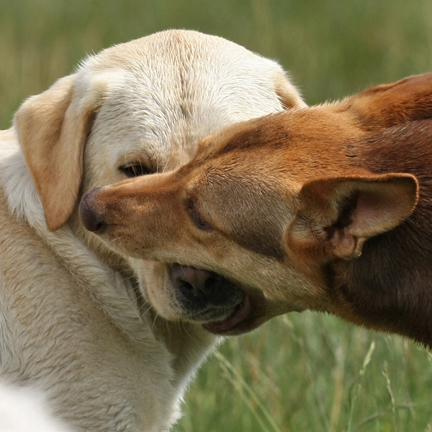
Dog muzzle grab.
Dogs also exhibit the muzzle grasp behavior (photo by Marco de Kloet).

A “Muzzle grasp” (or muzzle grab) is a common behavior shown by social canines, e.g., wolves (Canis lupus lupus), dingoes (Canis lupus dingo), and dogs (Canis lupus familiaris)The primary function of this behavior is to confirm a relationship rather than to settle a dispute. The more self-confident or higher-ranking individual will muzzle-grasp a more insecure or lower-ranking partner to assert its social position. The more insecure individual does not resist the grasp; on the contrary, it often displays submissive behavior, literally inviting its partner to muzzle-grasp it. Even though we sometimes see this behavior at the end of a dispute, wolves and dogs only use it toward individuals they know well—pack members—as a kind of saying, “You’re still a cub (pup).” The dispute itself tends not to be serious, merely a low-key challenge, often over access to a resource. Youngsters, cubs, and pups sometimes solicit adults to muzzle-grasp them. This behavior appears reassuring to them.

The muzzle-grasp behavior emerges early in development. Canine mothers muzzle-grasp their puppies (sometimes accompanied by a growl) to deter them from suckling during weaning. Field observations confirm this mechanism. As Packard, Mech, and Ream (1992, p. 1274) report, “In the context of playing, begging, and sharing, pups did not leave when another wolf muzzled, snapped, or lunged. In contrast, the muzzling by the nurser in the context of suckling terminated the pups’ attempts to gain access to nipples.” This observation illustrates the early communicative value of the muzzle contact as both a mild inhibitory and relational signal. Cubs and pups also muzzle-grasp one another during play, typically between six and nine weeks of age. They probably learn through play that the muzzle-grasp is an effective way of stopping an opponent from doing something, while also learning bite inhibition. If they bite too hard, they elicit a fight and risk injury. A muzzle-grasp, therefore, does not involve biting, only grasping. This behavior helps develop a relationship of trust between both parties—“we don’t hurt one another.”

Similar tactile interactions, including muzzle-to-muzzle contact, also occur in post-conflict and affiliative contexts among wolves. Cordoni and Palagi (2019) describe reciprocal muzzle-licking between adults and immature pack members following mild conflicts—acts that function as “consolation” and reinforce social bonds. Although a muzzle-grasp differs mechanically from muzzle-licking, both share an underlying functional value: the restoration or affirmation of trust within a dyad. These tactile gestures exemplify the nuanced physical vocabulary through which canids maintain cohesion and mitigate tension within the pack.

Classic naturalist observations (Zimen, 1981) describe frequent muzzle-to-muzzle contacts and note adults seizing pups’ muzzles during play and weaning; together with quantitative field data (Packard, Mech, & Ream, 1992), this supports the view that muzzle contact is an early-emerging, ritualised tactile signal rather than an aggressive act.

When used to settle a dispute, a muzzle-grasp may appear more violent and usually ends with the individual being muzzle-grasped exhibiting passive, submissive behavior. Yet participants very seldom, if ever, get hurt, an occurrence that would undermine the behavior’s function.
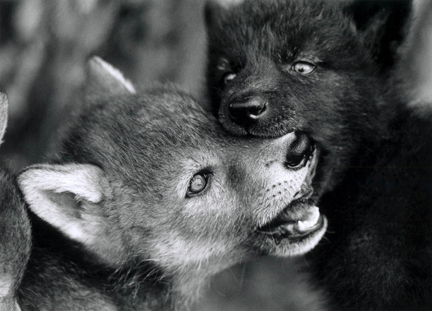
wolf cubs muzzle grasp
Wolf Adult Muzzle Grasp

Left: Cubs and pups muzzle grasp one another during play. Right: Muzzle grasp in adult wolves (photos by Monty Sloan).

A muzzle-grasp requires self-control. Higher-ranking wolves and dogs muzzle-grasp their pack members (teammates) and, by doing so, confirm their rank while displaying restraint. Lower-ranking wolves and dogs often engage in muzzle-grasping behavior to affirm their social position and reassure themselves that they remain included in the group.

The muzzle-grasp behavior probably originated as both a form of maternal (and later paternal) control and as a play behavior among cubs. As it appears to have been beneficial to all parties involved, it may have become a factor favored by natural selection, spreading from generation to generation and evolving as any other trait that enhances the fitness of individuals within cohesive social groups.

In domestic dogs, when puppies are about five to seven weeks old, their mother regularly muzzle-grasps them to deter suckling. At first, her behavior frightens them, and they may whimper excessively, even though she does not harm them. Later, when grasped by the muzzle, the puppy immediately shows passive submissive behavior—lying on its back and exposing its ventral side. Previously, it was assumed that the mother needed to pin the puppy to the ground; however, Packard et al. (1992) observed that, in wolves, in practice, “[…] on the occasions when the nurser winced or muzzled the pups, the pups did not persist” and that “[…] counter-tactics for overcoming nurser rejection did not occur (pp. 1271–1272).” Most puppies submit voluntarily. Over time, this behavior pattern assumes variations. Wolf cubs and puppies often invite the alpha male (the leader of the pack and, in wolves, usually their father) as well as other adults to grasp them by the muzzle, thereby soliciting a demonstration of their elders’ superiority and self-control while simultaneously showing their own acceptance and submissiveness. This is among the most reassuring behaviors an adult can show a youngster.

Domestic dogs sometimes approach their owners puffing gently with their noses. By gently placing a hand around their muzzle, we may reassure them of acceptance, demonstrate self-control, and convey that they can trust us. That is speaking dog-language to the best of our abilities. After being muzzle-grasped for a while, the dog will usually show a nose-lick, perhaps yawn, and then walk calmly away. It is as if the dog were saying, “I’m still your puppy,” and the owner replied, “I know—and I’ll take good care of you.”

The muzzle-grasp behavior can be challenging to classify. Some researchers see it as social or affiliative, others as agonistic, and still others as pacifying. Because its primary function is to confirm and maintain relationships, it may best be considered a social behavior—a ritualized, low-intensity interaction that reinforces trust and cohesion within the group.

Next time your dog gently nudges or invites a muzzle‑grasp, pause for a moment—what you see as a simple dog behavior is, in canine language, a subtle conversation of trust and understanding.

References

Abrantes, R. (1987). Hundesprog. Borgen Forlag, Copenhagen.

Abrantes, R. (1997). The Evolution of Canine Social Behavior. Naperville, IL: Wakan Tanka Publishers.

Abrantes, R. (2011, December 11). Dominance—Making sense of the nonsense. Roger Abrantes Blog. https://rogerabrantes.wordpress.com/2011/12/11/dominance-making-sense-of-the-nonsense/

Cordoni, G., & Palagi, E. (2019). Back to the future: A glance over wolf social behavior to understand dog–human relationship. Animals, 9(11), 991. https://doi.org/10.3390/ani9110991

Packard, J. M., Mech, L. D., & Ream, R. R. (1992). Weaning in an Arctic wolf pack: Behavioral mechanisms. Canadian Journal of Zoology, 70(7), 1269–1275. https://doi.org/10.1139/z92-177. USGS+1 PDF (scanned article, pages shown above): https://www.wolf.org/wp-content/uploads/2013/09/172weaningarcticwolf.pdf

Zimen, E. (1981). The wolf: His place in the natural world. Souvenir Press Ltd. ISBN 9780285624115

Note: I first wrote about the muzzle grasp behavior in canids in my Danish book Hundesprog (1987), where I called it “mund om snuden,” which translates directly as “mouth around the snout.” This term became “muzzle grasp” in the first English edition of the book, titled Dog Language. I later wrote Muzzle Grab Behavior in Canids on April 25, 2012. Two years afterward, on March 13, 2014, I revised it as Canine Muzzle Grasp Behavior—Advanced Dog Language. True to my philosophy of updating articles and papers as new evidence emerges, I have once again revised this work. The latest version, published in November 2025, appears here under the title Muzzle Grasp Behavior in Canids.
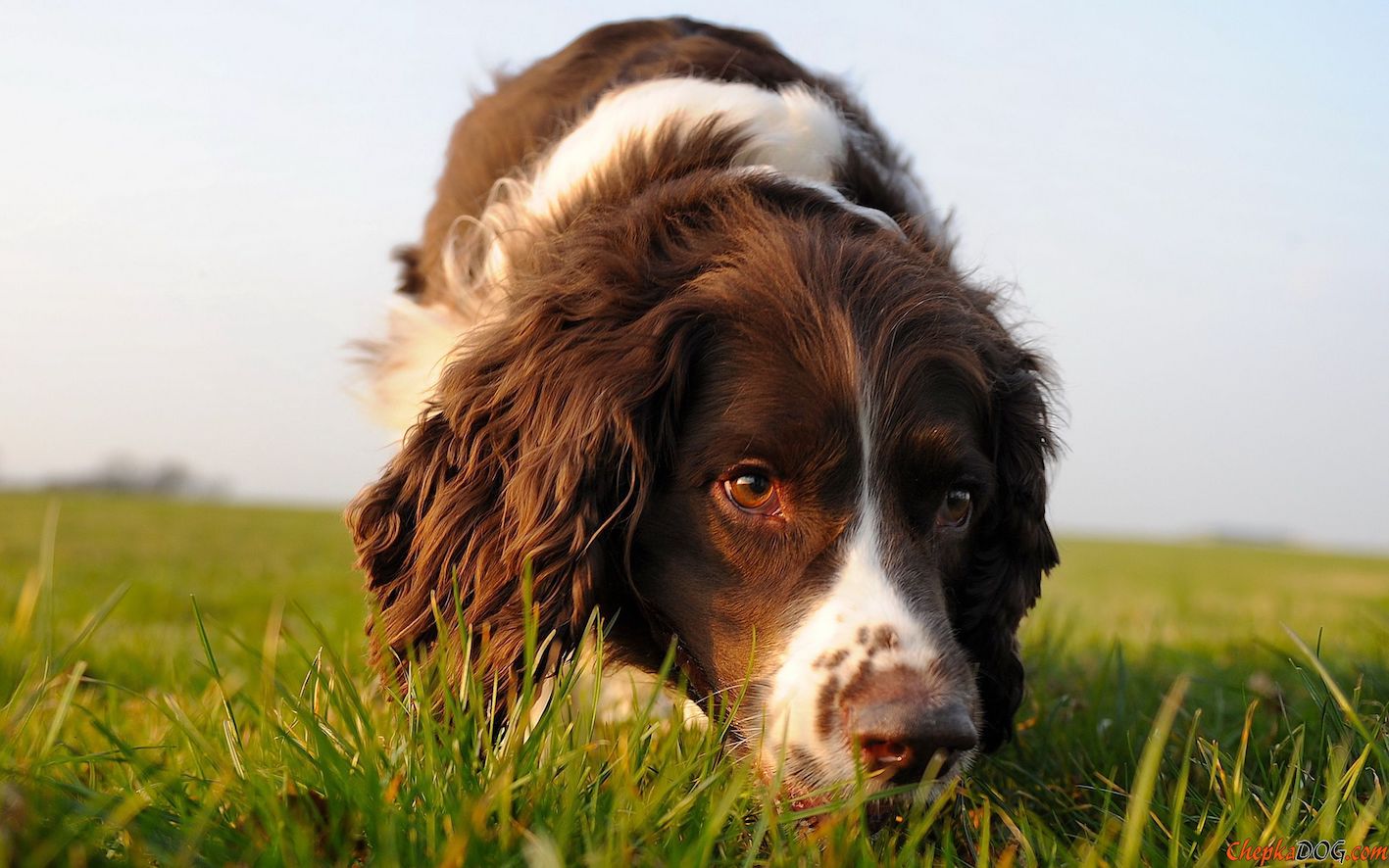
Canine Scent Detection: Reviving the Oldest Mammalian Sense

—A Sniffer Dog is a Happy Dog

English Springer Spaniel On The Trail

Scent detection has fascinated me since my early days as a student of biology, and I was already training detection animals at the beginning of the 1980s. Over the years, I have trained dogs, rats, and guinea pigs to detect narcotics, explosives, blood, vinyl, fungus, landmines, tuberculosis, and tobacco—and they excelled in all these tasks.

What has always intrigued me most is how deeply scent detection seems to be woven into their very being, regardless of species. Indeed, much before dogs became our partners in scent detection, olfaction had already shaped the mammalian brain—including ours. Although humans are often described as “microsmatic,” this view stems mainly from a 19th-century anthropocentric bias. In fact, human olfactory performance—when properly measured—can rival that of many other mammals (McGann, 2017). Fossil endocasts reveal that early mammalia forms possessed disproportionately large olfactory bulbs, suggesting that life for our distant ancestors was guided above all by smell (Rowe, Macrini, & Luo, 2011). The olfactory pathways remain among the most conserved in the mammalian nervous system, closely intertwined with limbic and reproductive circuits (Shipley & Ennis, 1996; Boehm, Zou, & Buck, 2005). As Lledo, Gheusi, and Vincent (2005) observed, “It is clear today that olfaction is a synthetic sense par excellence. It enables pattern learning, storage, recognition, tracking, or localization and attaches emotional and hedonic valence to these patterns” (p. 309). To smell, then, is not merely to detect—it is to think, feel, and remember.

Most of my detection work was carried out for the police, armed forces, SAR teams, or other professional agencies. Yet, I had written about scent detection already in the early 1980s, in my first book, Psychology rather than Force, published in Danish. Back in 1984, I called it “nose work” (a direct translation from the Danish næsearbejde). I recommended that all dog owners stimulate their dogs by giving them detection tasks, beginning with their daily rations. We even conducted some research on this, and the results were highly positive: dogs trained in detection work improved in many aspects of their otherwise problematic behavior. My recommendation remains the same today. Physical exercise is, of course, essential—but do not forget to stimulate your dog’s nose as well, perhaps its primary channel of information about the world.

nosework 1984

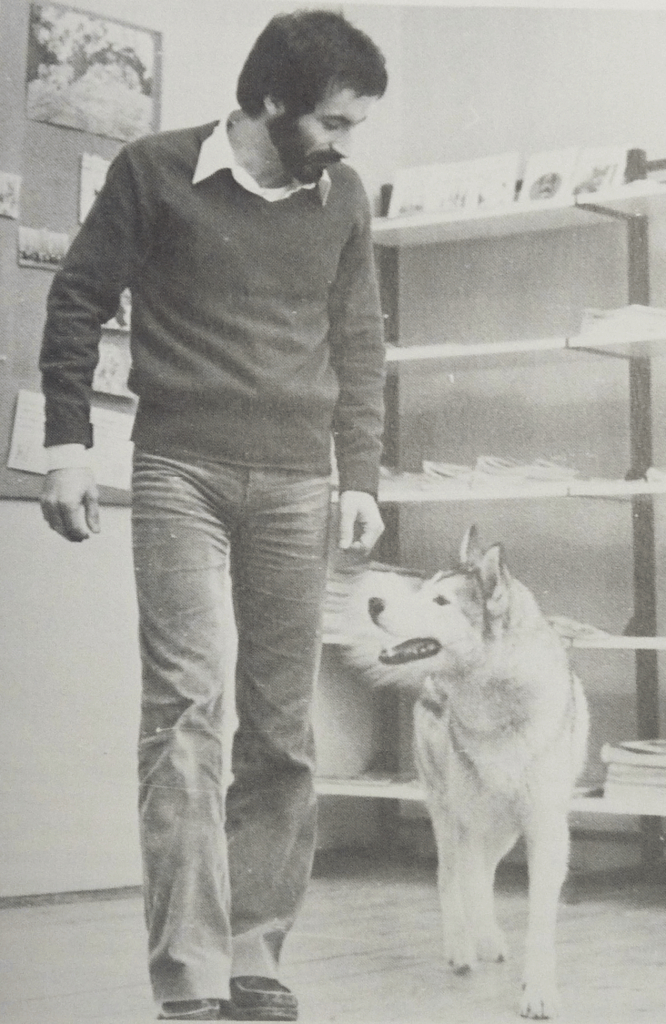
Above: In “Hundesprog” (Dog Language) from 1987, I mention “nose work” with an illustration from Alce Rasmussen. To the right: Yours truly in 1984 with a Siberian Husky, an “untrainable” dog, as everybody used to say. This was when my book “Psychology rather than Force” created a stir. We were then right at the beginning of the animal training revolution. In that book, I mention “nose work” (a direct translation from the Danish “næsearbejde”) and recommend it as an excellent way to stimulate our dogs.

raa and husky in 84

Recent field data illustrate how central olfaction is to the daily lives of canids. Wolves in the Białowieża Forest, for instance, were active on average 45.2 % of every 24 hours—about 10.8 h per day—primarily in movement, travelling, and search behaviours (Theuerkauf et al., 2003, Table 1, p. 247). Monthly patterns (Figure 6, p. 249) suggest that activity levels vary with season, although exact numerical ranges are not provided in the text. Comparable patterns appear in other canids: red foxes spend about 43 % of their observable foraging time sniffing the ground (Wooster et al., 2019), and free-ranging domestic dogs devote substantial portions of their active time to exploratory and searching behaviours—activities guided predominantly by olfaction (Banerjee & Bhadra, 2022). These figures reveal that for a wolf or fox, using the nose is not an occasional act but a continuous occupation, consuming many hours each day.

Measurement%Hours (h)
Time active45.2 %10.8
Time moving35.9 %8.6

Table 1. Average daily activity of wolves in the Białowieża Forest, Poland (1994–1999), showing the proportion of time spent active and moving, both as a percentage of the 24-hour day and in hours. Data from Theuerkauf et al. (2003, Table 1, p. 247).

Note. “Time active” includes periods when wolves were travelling, hunting, or otherwise moving. Observations indicate that these behaviours are predominantly guided by olfaction. Activity was generally higher at night, and seasonal variation appears linked to day length and prey availability. On average, wolves were active roughly half the day (~10.8 h), highlighting that extensive daily searching and tracking is a defining feature of their ecology (Theuerkauf et  al., 2003, Table 1, p. 247).

When I began promoting “nose work” in the early 1980s, I did so from personal experience rather than data. I spent many hours on scent detection with my English Cocker Spaniels. They loved it and were calmer, more focused, and more fulfilled than their peers who were not as nose-stimulated. I quickly discovered that scent detection was so self-reinforcing—in behaviorist terms—that no other reinforcers were needed beyond my approval, which they actively sought. In those moments, I realised that to be a dog is to be a cooperative nose-worker.

Science has since validated that intuition. Scent work is not a modern invention—it is a structured expression of what canids have done for thousands of years: exploring their world through odor cues. When we engage a dog’s nose, we are not merely training a skill; we are restoring a function at the very core of its evolution. Understanding that is perhaps the greatest lesson of scent detection: to educate and enrich a dog’s life, we must first respect the sensory world in which it truly lives.

References

Banerjee, A., & Bhadra, A. (2022). Time–activity budget of urban-adapted free-ranging dogs. Acta Ethologica, 25(1), 15–25. https://doi.org/10.1007/s10211-021-00379-6

Boehm, U., Zou, Z., & Buck, L. B. (2005). Feedback loops link odor and pheromone signaling with reproduction. Cell, 123(4), 683–695. https://doi.org/10.1016/j.cell.2005.09.027

McGann, J. P. (2017). Poor human olfaction is a 19th-century myth. Science, 356(6338), eaam7263. https://doi.org/10.1126/science.aam7263

Lledo, P.-M., Gheusi, G., & Vincent, J.-D. (2005). Information processing in the mammalian olfactory system. Physiological Reviews, 85(1), 281–317. https://doi.org/10.1152/physrev.00008.2004

Rowe, T. B., Macrini, T. E., & Luo, Z.-X. (2011). Fossil evidence on origin of the mammalian brain. Science, 332(6032), 955–957. https://doi.org/10.1126/science.1203117

Shipley, M. T., & Ennis, M. (1996). Functional organization of olfactory system. Journal of Neurobiology, 30(1), 123–176. https://onlinelibrary.wiley.com/doi/10.1002/(SICI)1097-4695(199605)30:1%3C123::AID-NEU11%3E3.0.CO;2-N

Theuerkauf, J., Kamler, J. F., & Jedrzejewski, W. (2003). Daily patterns and duration of wolf activity in the Białowieża Forest, Poland. Journal of Mammalogy, 84(1), 243–253. https://ibs.bialowieza.pl/publications/1396.pdf

Wooster, E., Wallach, A. D., & Ramp, D. (2019). The Wily and Courageous Red Fox: Behavioural analysis of a mesopredator at resource points shared by an apex predator. Animals, 9(11), 907. https://doi.org/10.3390/ani9110907

Featured image: Springer Spaniel, nose down, focused on a search.

Note: This article is a substantially revised and edited version of an earlier article from May 6, 2014, entitled Do You Like Canine Scent Detection? The revisions are extensive enough that the article deserves a new title and is therefore republished as new.

Does Your Dog Show Allelomimetic Behavior?

Does your dog show allelomimetic behavior? I’m sure it does, but don’t worry, it’s not dangerous, except when it is, and yes, it is contagious. Confused? Keep reading.

Allelomimetic behavior is doing what others do. Some behaviors have a strong probability of influencing others to do the same. Animals in constant contact with one another will inevitably develop allelomimetic behavior.

Dogs exhibit various allelomimetic behaviors—walking, running, sitting, lying down, getting up, sleeping, barking, and howling—each of which has a strong tendency to stimulate others to do the same.

Social predators increase their hunting success when they hunt in unison. One individual setting after the prey is likely to trigger the same response in the whole group.

woman with dog by sunvilla-1

More often than we think, it is our own behavior that triggers our dog’s allelomimetic behavior (photo by SunVilla).

The wolf’s howl is allelomimetic, one more behavior our domestic dogs share with their wild cousins. Howling together functions as social bonding. When one wolf howls, the whole pack may join in, especially if a high-ranking wolf started it. I bet that if you go down on your knees, turn your head up, and howl (provided you are a half-decent howler), your dog will join you; then, it will attempt to show its team spirit by licking your face.

Sleeping and eating are examples of allelomimetic behavior. Dogs and cats tend to sleep and eat at the same time. Barking is also contagious. One barking dog can set the whole neighborhood’s dogs barking.

Synchronizing behavior may be a lifesaver. In prey animals like the deer, zebra, or wildebeest, one individual can trigger the whole herd to flee. This trait is so crucial for self-preservation that farm animals like sheep, cows, and horses still keep it. Grazing also occurs at the same time.

child playing puppy

 Running after a running child is more often an example of canine allelomimetic behavior than hunting or herding as many dog owners erroneously presume.

Allelomimetic behavior is not restricted to animals of the same species. Animals of different species that live together often exhibit allelomimetic behavior. Dogs can read body language and respond to certain behaviors of their owners without further instruction. An alerted owner triggers his dog’s alertness more often than not.

Puppies show allelomimetic behavior at about five weeks of age. It is an intrinsic part of your dog’s behavior to adjust to the behavior of its companions. Your behavior influences your dog’s behavior in many more instances than you realize.

At the neurological level, when we watch someone perform an action, our own motor system often “echoes” it—a process known as motor resonance. This effect is made possible by mirror neurons, brain cells that activate both when we do something and when we see another individual doing the same. Research suggests that dogs may share this ability: their tendency to move, look, or react in sync with humans may stem from similar neural mirroring processes (Lamontagne & Gaunet, 2024).

From an evolutionary and behavioral standpoint, because we have selected and bred our dogs to be highly sociable and socially promiscuous, they exhibit extended allelomimetic behavior, i.e., not only copying the behavior of their closest companions but also that of others. Next time you walk in the park and your dog runs after running children, you can casually comment, “Typical instance of allelomimetic behavior.” Not that it will solve any problem, if there is one, but you’ll be right, and I bet you will impress more than a few of your fellow park walkers.

__________________

References

Abrantes, R. (1997). Dog language: An encyclopedia of canine behavior. Wakan Tanka Publishers.

Lamontagne, A., & Gaunet, F. (2024). Behavioural synchronisation between dogs and humans: Unveiling interspecific motor resonance? Animals, 14(4), 548. https://doi.org/10.3390/ani14040548

Scott, J. P., & Marston, M. V. (1950). Social facilitation and allelomimetic behavior in dogs. II. The effects of unfamiliarity. Behaviour, 2(3), 135–143. Retrieved from https://mouseion.jax.org/stfb1950_1959/19/

Vogel, H. H., Scott, J. P., & Marston, M. V. (1950). Social facilitation and allelomimetic behavior in dogs. I. Social facilitation in a non-competitive situation. Behaviour, 2(3), 121–134. Retrieved from https://mouseion.jax.org/stfb1950_1959/24/

__________________

Note: Careful ethological observation sometimes anticipates neurobehavioral discoveries by decades. I described canine allelomimetic behavior in my 1987 book Hundesprog (later published in English as Dog Language, 1997)—a phenomenon that would only gain neurobiological support 34 years later with the findings of Lamontagne and Gaunet (2024), which strongly suggest the potential existence of interspecific motor resonance.

Do You Know What the Canine Hip Nudge Behavior Means?

canine hip nudge

The hip nudge is a typical canine behavior. Dog owners often think their dogs are pushy or impolite when they turn their backs to them, sometimes even pushing them. Nothing could be farther from the truth.

A hip nudge is a behavior a dog shows when it nudges another with its hip or rear end. Dogs often use this behavior towards us during greeting ceremonies when we show them passive friendliness by crouching down to it. The dog will walk towards us and turn round. Then it will either nudge us gently with its hip or rear end, or stand passively with its back to us.

caninehipnudgeraa-1-600x600-1

This dog shows a half hip nudge, still a sign of friendliness. Both the human and the dog are relaxed and show their peaceful intentions and trust in one another (photo by Lisa Jernigan Bain).

The hip nudge functions as a pacifying behavior. It signals friendliness. By turning its back to us, the dog shows it doesn’t intend to attack—it directs its teeth away from us. It also indicates it trusts us.

Dogs use a variation of the hip nudge behavior during mating rituals, in which the male nudges the female.

I first described this behavior in 1987, in the original edition of “Dog Language,” after spending several years observing, photographing, and filming dogs (Canis lupus familiaris), wolves (Canis lupus lupus), and foxes (Vulpes vulpes).

There are only minor differences between wolf and dog, which we can describe as dialects. The fox differs because, although it displays many behaviors common to the other two, it is less social than its cousins.

 References

  • Abrantes, R.A. (1992/1997). Dog Language—An Encyclopedia of Canine Behavior. Wakan Tanka Publishers, Naperville, IL.
  • Abrantes, R.A. (1997/2005). The Evolution of Canine Social Behavior. Wakan Tanka Publishers, Naperville, IL.
  • Fox, M.W. (1971). Behaviour of Wolves, Dogs and Related Canids. Harper & Row.
  • McFarland, D. (1999). Animal Behavior. Pearson Prentice Hall, England. 3rd ed.
  • Scott, J.P. and Fuller, J.L. (1965). Genetics and the Social Behavior of the Dog. University of Chicago.
  • Zimen, E. (1981). The Wolf—His Place in the Natural World. Souvenir Press.

Featured image: The hip nudge functions as a pacifying behavior. It signals friendliness (illustration by Alice Rasmussen from “Dog Language” by Roger Abrantes).

Can Two Training Methods Be Equally Good?

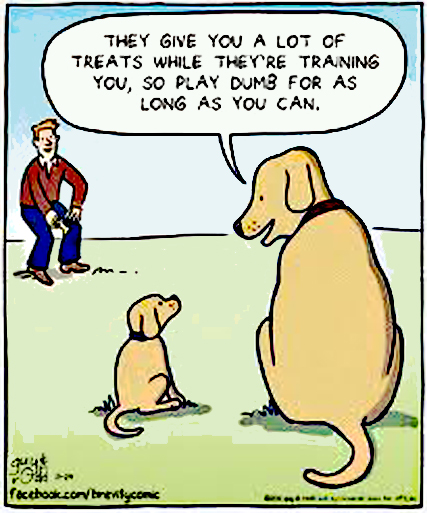
treat training dog cartoon

I receive many emails with questions about animal behavior. Most of them involve practical issues, but, now and then, someone poses a more complex question. Here is my answer to one of the latter, one I’d like to share with you because it addresses crucial issues in our understanding of animal behavior and training.

Dear ….,

Thanks for your comment, which allows me to clarify a few issues. By no means do I see animals as biological robots, nor do I regard the Skinnerian approach as the truth, the only truth, and nothing but the truth; quite the contrary. Please consider the following passages from “Mission SMAF—Bringing Scientific Precision Into Animal Training”.

“In fact, I suspect that [communication] even involves more than what science can describe with the intrinsic limitations of its key concepts and methods, no matter how stringent they are.

It seems to me, therefore, that our goal must not be to oppress or suppress emotions, but rather control them and use them advantageously. Emotional arousal proves to be necessary to learn and the right amount of emotional arousal even shows to increase the efficiency of learning processes.”

A very non-Skinnerian statement, I would say.

As to my own method to analyze learning processes in artificial set-ups (like in animal training), I write: “In a crude sense, SMAF is an oversimplification of complex processes […] certainly not an attempt to reduce complex mechanisms to a few formulas. In the end, [its] value depends solely on its successful application to solving practical problems; beyond that, it has no value.”

Operant conditioning (when we use it correctly) is an efficient model of behavior for animal training because we control the conditionals to some extent (as Pavlov explains in his original writings, not the subsequent translations). Whilst operant conditioning is adequate for analyzing behavior at a particular level, beyond that, it becomes too crude an instrument. To understand behavior in a broader sense, we must turn to evolutionary models and concepts—variation, selection, adaptation, fitness, function, evolutionary strategies, ESS (evolutionarily stable strategy), costs and benefits, and so forth. My approach to behavior is therefore a classical ethological one, in the tradition of von Frisch, Lorenz, and Tinbergen—firmly grounded in evolutionary biology and in philosophically coherent reasoning.

Greetings,

RAA


The core of the argument is reductionism, the view that we can reduce complex processes to the sum of their simpler parts. In a sense, all science is reductionistic. We attempt to explain complex processes with a few notions well organized in little boxes. That is a process that seems to suit our human brain particularly well.

However, we must bear in mind that our interpretations, independently of how good they are, are just our pictures of an elusive reality. They suit our particular umwelten,* but definitely not all of them. They explain parts of it from specific angles so we can make sense of it. Newton and Einstein—the classical example—are (probably) both right, each explaining reality at a different level.

There’s nothing wrong about being a reductionist if only we do not get greedy and attempt to explain far too much with far too little, as in, “That’s it, this is the way things are. Period.” Simplifying often gets us to the point that complicating and oversimplifying have both missed.

In animal training, one theory or method can be as good as another depending on its foundations, approaches, what it attempts to explain, and the practical goals it aims to serve. If both are based on reliable evidence, use well-defined terms, and are logically sound, there’s little to choose between one or the other.

If only animal trainers understood that, I believe we would forgo many senseless disputes. Then again, we can brag about being the most emotional creatures on this big blue marble of ours, can’t we?

___________

* Umwelt (plural umwelten) in ethology means the world as it is experienced by a particular organism.

___________

References

Abrantes, R. (2018). Mission SMAF—Bringing Scientific Precision In to Animal Training. Wanka Tanka Pub.

Lorenz, K. (1937). Über die Bildung des Instinktbegriffes. Naturwissenschaften, 25, 289–300. https://doi.org/10.1007/BF01492648

Павлов, И. П. (1926). Двадцатилетний опыт объективного изучения высшей нервной деятельности (поведения) животных. Ленинград: Научное химико-техническое издательство. (Pavlov, I. P. (1926). Twenty Years of Objective Study of the Higher Nervous Activity (Behavior) of Animals. Leningrad: Scientific Chemical-Technical Publishing House.)

Skinner, B. F. (1938). The Behavior of Organisms: An Experimental Analysis. New York: Appleton-Century-Crofts.

Uexküll, J. von. (1934). Streifzüge durch die Umwelten von Tieren und Menschen: Ein Bilderbuch unsichtbarer Welten. Berlin: Julius Springer. (English translation: A Foray into the Worlds of Animals and Humans: With A Theory of Meaning, translated by Joseph D. O’Neil, University of Minnesota Press, 2010.)