The Evolution of Life in 60 Seconds

rinjani_1994

Today, I have a short film for you—sixty seconds that captures the evolution of life. It puts everything into perspective, doesn’t it?

I remain fascinated by that remarkable algorithm, “the survival of the fittest.” As Daniel Dennett writes (Dennett, 1995, p. 21), “I say if I could give a prize to the single best idea anybody ever had, I’d give it to Darwin—ahead of Newton, ahead of Einstein, ahead of everybody else. Why? Because Darwin’s idea put together the two biggest worlds, the world of mechanism and material, and physical causes on the one hand (the lifeless world of matter), and the world of meaning, purpose, and goals.”

Allow me to quote from my own modest book, Evolution:

“When we say that natural selection favors the fittest, we do not mean the one and only champion, but the fitter (or best-fitted) in the population. How fit they will have to be depends on the environmental circumstances. In times of food abundance, more individuals will be fit enough to survive and play another round. In times of famine and scarce resources, maybe only the champions will have a chance. In any case, the algorithm ‘the fittest’ is always at work.

Most objections to the theory of evolution by natural selection fail to realize the function of time. Given enough time, whenever there is variation, natural selection will come up with all imaginable forms of life—always the fittest for the given environment and period.”

There’s no perfection in evolution, only adaptation—a constant fine-tuning between what is and what works. Evolution is not a march toward perfection, but a dance with circumstance—graceful when time allows, ruthless when it doesn’t.

It’s all rather simple, really. You, reading these lines, are living proof of natural selection’s quiet verdict. How do I know? I’ll let you ponder it.

Keep smiling.

A minute well spent: four billion years of life condensed into a single breath of time. Watch it—and remember how brief, yet extraordinary, our moment in evolution truly is.

Featured image: Simulations of the ‘volcano hypothesis’ were able to create organic molecules. Life could have originated in a ‘warm little pond’ in similar ways. (From “Evolution” by Roger Abrantes. Picture: Mount Rinjani, Indonesia by Oliver Spalt).

References

Abrantes, R. (2010) Evolution. Wakan Tanka Publishers (online book).

Dennett, D. C. (1995). Darwin’s Dangerous Idea: Evolution and the meanings of life. New York, NY: Simon & Schuster. (Original work published 1995)

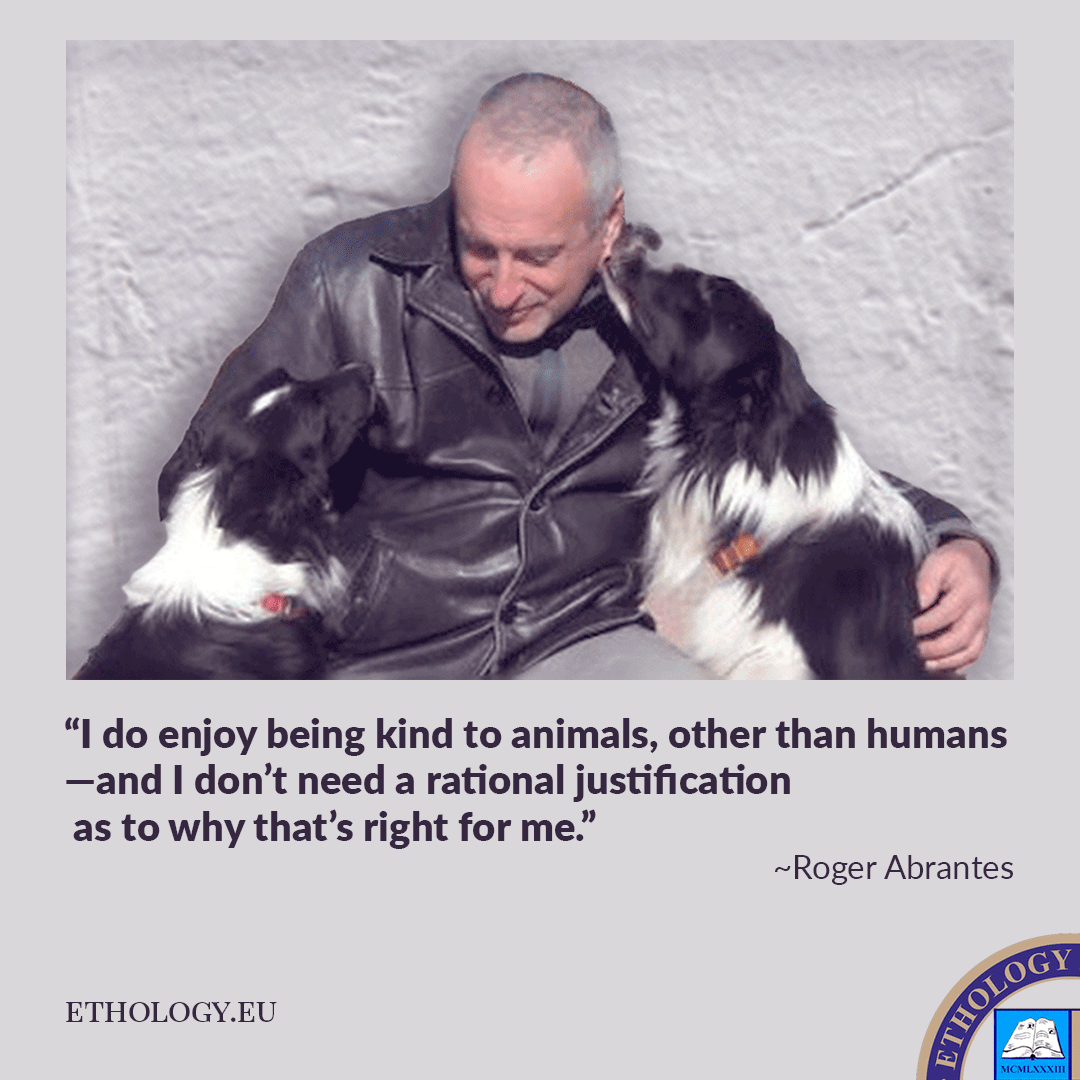
I Do Enjoy Being Kind to Other Animals

(First published April 13, 2014, edited February 26, 2018)


I Do Enjoy Being Kind to Other Animals

I do enjoy being kind to animals, other than humans—and I don’t need a rational justification as to why that feels right for me. I respect them for what they are and interact with them on equal terms. I don’t believe it is right to subjugate them to my will, to control them, to change them.

Yes, I do enjoy being kind to animals, as it brings a sense of harmony to my life. While I can’t force anyone to choose harmony or define it in a specific way, I can demonstrate how bullying does not lead to stability. Because of this, I find it difficult to argue with people who believe that bullying others—whether human or non-human—is acceptable. Nor can I argue with people who think it’s justifiable to hurt others in order to achieve their goals since I find such actions objectionable. I cannot discuss with people who deny or affirm a particular matter of fact to justify their moral decisions, because my mind rejects invalid, unsound arguments.

Morality and science are two separate disciplines. I may not like the conclusions and implications of some scientific studies, and I may even find their application to be immoral; yet, my responsibility as a scientist is to report findings objectively. Stating a fact does not oblige me to adopt any particular moral stance. While science does influence my perceptions, it does not dictate how I feel about that fact. Ultimately, my moral decisions are independent of scientific facts.

G. E. Moore coined the term naturalistic fallacy in 1903 in “Principia Ethica.” In 1739, David Hume described, in “A Treatise of Human Nature,” the ‘is-ought problem,’ also called ‘Hume’s Law’ or ‘Hume’s Guillotine.’ The ‘is-ought fallacy’ consists of deriving an ‘ought’ conclusion from an ‘is’ premise. We cannot deduct ‘ought’ from ‘is.’

As an ethologist, my focus is on understading what is, not what ought to be. Echoing Satoshi Kanazawa, if I conclude something that is not supported by evidence, I commit a logical fallacy, which I must correct, and that’s my problem. However, if my conclusion offends your beliefs, then that’s your problem.

With time, the rational principles that govern my mind and the ethical ones that regulate my conduct may or may not prove to be the fittest. Meanwhile, due to genetic pre-programming, social conditioning, and evolutionary biology, I do enjoy being kind to animals. I respect them for what they are and interact with them on equal terms—and I don’t need a rational justification as to why that feels right for me.

Featured image: I do enjoy being kind to other animals, respecting them for what they are and interacting with them on equal terms.

I’m a Citizen of the World

childdogcatwide-1

I’m a citizen of the World,” I say when asked where I come from—and I am, in mind and heart.

Diogenes, in about 412 BC, was probably the first to use the expression and express the very same sentiment. Socrates (469-399 BC) concurred: “I am not an Athenian or a Greek, but a citizen of the world.” Kaniyan Poongundran, the Tamil poet, wrote (at least 2000 years ago), “To us all towns are one, all men our kin.” Thomas Paine (English-American philosopher, 1737 – 1809), said, “The world is my country, all mankind are my brethren and to do good is my religion.” Albert Einstein (1879-1955) thought of himself as a world citizen, “Nationalism is an infantile disease. It is the measles of mankind.”

I’m a citizen of the world. I’ve traveled over most of our beautiful planet, seen mountains above the clouds with perennial snow tops, and oceans reaching far beyond the eye can see. I’ve lived in temperatures from 40ºC below zero to 40ºC above. I’ve eaten all kinds of food prepared by humans and spent many a day and night enjoying the company of people with the most exceptional cultures and habits.

What’s my favorite place? I don’t have one. Everywhere I’ve been, I’ve discovered new pieces in this amazing puzzle of life. Everywhere I’ve been, from the most glamorous cities to the poorest war-torn areas, I’ve met kind and gentle people. I’ve shared water with the Maasai in the African desert and rice with the Chhetris in the Nepalese mountains. With all of them, I felt a strong kinship: no country, no culture, no language, no divide—we were family, we were humans, we were sentient living beings. Yes, I’m a citizen of the world.

Life is great!


Featured image: Everywhere I’ve been, I’ve discovered new pieces in this amazing puzzle of life.