Canine Maternal Behavior


Maternal Behavior

Canine maternal behavior is more than just feeding the pups. It is also to teach them dog language (Illustration by Alice Rasmussen from “Dog Language” by Roger Abrantes).

Watching dog mothers take care of their pups continues to fascinate me, and the large populations of village dogs in Africa and Thailand, where I spent and spend a great deal of my time, provides me with plenty of opportunities to do it. Village dogs are domestic dogs, not wild dogs. Often classified as stray dogs by the inept, ignorant eye of the western tourist, these dogs perform an important task in their communities of humans and their domestic animals.

Maternal behavior is behavior shown by a mother toward her offspring. In most species, it is the mother that primarily takes care of the youngsters, and the dog is no exception. Natural selection has favored the evolution of this particular behavior of the females.

In wild canids, although it is mostly the female that takes care of the puppies, the father (also called the alpha male) and other adults do become interested in the feeding and raising of the puppies when they begin emerging from the den. In the studies my team did in the 80s, our dogs showed the same pattern in a domestic set-up.

Maternal behavior is, thus, almost identical in wild a canids and domestic dogs. Immediately after birth, the mother dries the puppies, keeps them warm, feeds them and licks them clean. The maternal behavior right after birth is controlled by hormonal processes and problems may occur if the female gives birth too early. On the other hand, pseudo-pregnancy causes females to undergo hormonal changes which may elicit maternal behavior in various degrees. Maternal behavior seems to be self-reinforcing. Studies show that the levels of dopamine increase in the nucleus accumbens (a region of the brain) when a female displays maternal behavior.

When the puppies become older, the mother begins to educate them. She gives them the first lessons in dog language about the time weaning begins. Growling, snarling and the various pacifying behaviors are inborn, but the puppies need to learn their function.

The canine mother has three main tasks: (1) to feed the puppies, first with her own milk, then by regurgitation, (2) to keep them clean and warm, especially when they are very young, and (3) to educate the puppies.

A good canine mother is patient and diligent. When the puppies grow, dog owners often misunderstand the mother’s apparently more violent educational methods. She may growl at them and even attack them, but she never harms them. Muzzle grabbing (see illustrations) is fairly common. Without the mother’s intervention, the puppies would never become capable social animals and would not be able to function properly in a pack (a group of wild dogs living together is in English called a pack). When the puppies are about 8-10 weeks old, the mother seems to lose some of her earlier interest in them. In normal circumstances, the rest of the pack, then, takes over the continuing education of the puppies, their social integration in the group (which probably mostly consists of relatives) and their protection.

Dog owners sometimes report problems, e.g. that the mother has no interest in her puppies, or is too violent towards them. These problems are mainly due to our selective breeding (we select for beauty and utility while nature selects for overall fitness, hereby included adequate maternal behavior) and to our lack of understanding of the mother’s needs during and after birth, which often result in the female showing stress, insecurity or aggressive behavior.

Maternal effect is the mother’s influence on her puppies. It can have such an impact on certain behavior patterns that it can be difficult to distinguish between maternal effect and the effect of genetics. For example, observations have shown that a female reacting too nervously or fearfully toward certain sounds may affect her puppies into developing sound phobias beyond what we would expect given the puppies’ specific genotype. The strong influence of the maternal effect on the behavior of her puppies is the main reason why it is extremely difficult, if not impossible, to assess the hereditary coefficient for particular traits.

Bottom-line: Do not breed females that you suspect will not show reliable maternal behavior. Do not disturb a female with her pups more than absolutely necessary. A good canine mother knows better than you what’s best for her pups.

As always, enjoy a peaceful day,

R~

References

  • Abrantes, R. 1997. The Evolution of Canine Social Behavior. Wakan Tanka Publishers.
  • Abrantes, R. 1997. Dog Language. Wakan Tanka Publishers.
  • Coppinger, R. and Coppinger, L. 2001. Dogs: a Startling New Understanding of Canine Origin, Behavior and Evolution. Scribner.
  • Darwin, C. 1872. The Expressions of the Emotions in Man and Animals. John Murray (the original edition).
  • Fox, M. 1972. Behaviour of Wolves, Dogs, and Related Canids. Harper and Row.
  • Lopez, Barry H. (1978). Of Wolves and Men. J. M. Dent and Sons Limited.
  • Mech, L. D. 1970. The wolf: the ecology and behavior of an endangered species. Doubleday Publishing Co., New York.
  • Mech, L. David (1981). The Wolf: The Ecology and Behaviour of an Endangered Species. University of Minnesota Press.
  • Mech, L. D. 1988. The arctic wolf: living with the pack. Voyageur Press, Stillwater, Minn.
  • Mech. L. D. and Boitani, L. 2003. Wolves: Behavior, Ecology, and Conservation. University of Chicago Press.
  • Scott, J. P. and Fuller, J. L. 1998. Genetics and the Social Behavior of the Dog. University of Chicago Press.
  • Zimen, E. 1975. Social dynamics of the wolf pack. In The wild canids: their systematics, behavioral ecology and evolution. Edited by M. W. Fox. Van Nostrand Reinhold Co., New York. pp. 336-368.
  • Zimen, E. 1982. A wolf pack sociogram. In Wolves of the world. Edited by F. H. Harrington, and P. C. Paquet. Noyes Publishers, Park Ridge, NJ.

El último paseo

Traducido por Lua Gatchan (from the original in English The Final Walk).


El camino a casa desde el muelle es uno de los pequeños placeres de la vida. Normalmente es un paseo de 20 minutos, pero a menudo puedo tardar hasta una hora o incluso dos, ya que me paro a charlar con todo el mundo en el camino, con los comerciantes, con las personas que conozco de vista o incluso con desconocidos. Esta es la costumbre en mi pueblo en el sur de Tailandia, donde encuentras sonrisas y todo el mundo te habla.

Old dog

Bombom was old and tired, ready for his final walk to the temple.

El clima es casi siempre caluroso y soleado, entre 29° y 38°, hoy hace exactamente 32° según mi equipo de buceo. Por supuesto hay lluvias durante la temporada de lluvias, pero sólo duran una hora o dos y todo se seca pronto, dejando una sensación de frescura y olor a tierra mojada en el aire. A veces llueve tanto que las calles se convierten en ríos pequeños, pero todo el mundo se lo toma con calma, con los pantalones arremangados; la vida continúa (literalmente) con una sonrisa.

Después de haber completado tres inmersiones, una de ellas con fuerte oleaje, como de costumbre me muero de hambre. En estos días, mi trabajo en Tailandia consiste en la gestión biológica del medio marino que, básicamente significa bucear, a veces con estudiantes, otras sin, hago fotos a los peces y a los corales que veo, y luego escribo un informe. Sí, ¡esto es lo que yo llamo un trabajo! Me paro en uno de esos extraordinarios vendedores ambulantes en la calle principal para comer algo. La comida en la calle es tan barata y tan buena que no vale la pena ir a casa y cocinar.

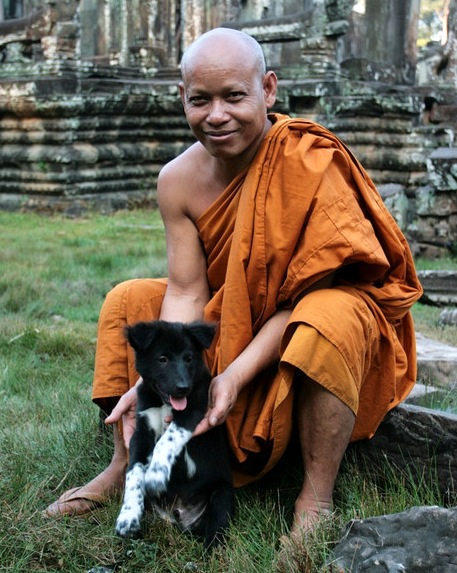
Buddhist Monk and Dog.

Buddhist Monk and Dog (image by John Lander).

Mi restaurante favorito (que se parece más a un garaje abierto) es una empresa familiar, al igual que la mayoría de los negocios en Tailandia. Los dueños viven allí. Tienen un televisor y una cama para los niños en la parte trasera, es decir, detrás de las cuatro mesas para los clientes. Todo está a la vista de todos. Claro, no quieren dejar a los niños solos en una habitación. Los niños (y los perros) son una parte inherente en la vida Tailandesa, los ves en todas partes. Se les permite hacer lo que quieran, pocas veces se les regaña o se les grita, y sorprendentemente son muy educados. Me desconcierta cómo manejan esto, sobre todo cuando pienso en algunos de nuestros mocosos en Occidente, tanto humanos como caninos. Todavía tengo que descubrir su secreto, pero supongo que tiene algo que ver con el hecho de que son parte de la vida cotidiana desde el día en que nacen; están perfectamente integrados sin ningunas construcciones ni zonas artificiales “para niños”. Lo mismo ocurre con los perros; son miembros como todos los demás, sin preocupaciones y sin ninguna atención especial, sin tratar a unos o a otros de una forma especial.

Sawasdee kha khoon, Logel”, Phee Malí me saluda con una gran sonrisa cuando me ve.

Phee significa hermana mayor y Malí significa Jasmine, que es su nombre. Soy Logel porque los tailandeses siempre te llaman por tu nombre de pila. Los apellidos son un invento relativamente nuevo que se les impone por el Gobierno en respuesta al crecimiento de la población y una sociedad más moderna. La guía telefónica está ordenada por el nombre de pila. El Rey Rama VI introdujo los apellidos en 1920 y él, personalmente, inventó apellidos para unas 500 familias. Todos los tailandeses tienen apodos. ¡Te diriges a tus amigos por sus apodos y ni siquiera conoces su nombre real! Soy Logel porque la mayoría de los tailandeses no pueden pronunciar el sonido de la letra “r”, ni siquiera en su propio idioma y sorprendentemente tienen la “r” en el idioma Tailandés.

Dog in Temple

Thais often take the dogs to the local temple so they can die in peace, in the company of the monks, near Buddha.

“¿Estás bien? ¿Has visto algún pez hermoso hoy?” me pregunta Phee Malí en ‘Tenglish’ (inglés-tailandés, que es un lenguaje en sí mismo, encantador y adictivo). En poco tiempo y sin ni siquiera darte cuenta, empiezas a hablar Tenglish. Yo hablo una mezcla de Tailandés y Tenglish con los lugareños. A medida que mejora mi tailandés hablo menos Tenglish, pero el tailandés es difícil porque es una lengua tonal. El tono con el que se pronuncia una palabra cambia su significado, y a veces de una forma dramática. Hay palabras que siempre pronuncio mal y a los tailandeses les da un ataque de risa, ya sea porque estoy diciendo un disparate o digo algo mal. Les encanta cuando se trata de la segunda opción. Incluso me animan a decir una palabra que sé y que ellos saben que no puedo pronunciar bien sólo para divertirse. Pero esa diversión es sana y sin ningún ánimo de faltar el respeto. Por el contrario, me dan un trato preferencial porque hablo tailandés.

Transcribiré a continuación algunas de nuestras conversaciones en inglés, traducido directamente de palabras tailandesas, con el fin de dar a mis lectores una idea.

Sí”, contesto. He visto peces hermosos y corales. El Thale (mar) Andamar estaba muy bien.

“Oh!, estás tan negro!” Exclama con el ceño fruncido y una sonrisa. “Negro” en realidad significa bronceado o quemado por el sol. A las mujeres tailandesas no les gusta estar morenas. A ellos les gusta el blanco, como suelen decir, y se preocupan cuando ven a alguien con lo que en Occidente llamamos un bronceado saludable y atractivo.

“You hung’y ‘ight, gwai teeaw moo pet mak ‘ight? Phee Malí me pregunta riendo. Ella sabe exactamente lo que tengo en mente; me encanta un plato de Gwai teeaw moo, caliente y picante, especialmente después de un día duro de trabajo. Es una sopa de fideos y carne de cerdo o pollo o camarones,  con todo lo que puedas imaginar. Incluso lo sirven con un plato de vegetales frescos que cortas con los dedos y los metes en la sopa como prefieras. Lo mezclas todo tú mismo con chili seco, chili fresco, salsa de chili, salsa de pescado, soja, pimienta, sal y un poco de azúcar (sí, azúcar, pruébalo y verás por qué me encanta). Es delicioso y puedo asegurar que también es muy saludable.

Me como mi Gwai teeaw moo y disfruto de un té verde helado sin azúcar. El sol se pondrá dentro de una media hora; aquí siempre se pone a la misma hora, siete grados al norte del ecuador. No hay lluvia hoy. ¡Disfruto de la vida en el Paraíso!

“Thao THALE SA Baay dee Mai”. Los niños van corriendo a preguntarme sobre los peces y en especial sobre la tortuga marina, su favorita, y es una buena oportunidad para practicar mi tailandés. Me llaman Lung Logel (tío Roger), en deferencia por mi edad. Entonces llega el turno de decir hola a los perros, un idioma que sé, que no tiene ningún acento y se habla igual en todos los continentes.

Thai Child wai.

The wai is the Thai greeting when you raise both hands together to your chin. It still strikes me as the most beautiful greeting I’ve ever seen.

Veo a Ae al otro lado de la calle (AE es un nombre divertido de un juego del escondite de Tailandia). La conozco a ella y a sus padres. Su padre trabaja en uno de los barcos que utilizo con regularidad en mis excursiones de buceo. A menudo le ayudo a atracar el barco cuando llegamos al muelle cuando no hace un clima perfecto y a veces tomamos una cerveza juntos después de haber asegurado el barco, descargarlo, etc. Ae está en cuclillas al lado de su perro, uno de esos perros de Tailandia que se parecen a todos los demás. Los perros de aldea en Tailandia son todos iguales, como si fueran de una raza particular, producto de una reproducción aleatoria a lo largo de los años. Yo los llamo “el perro por defecto”.

“¿Ae está triste, verdad?” Le pregunto a los niños.

“Oh, el perro de Ae está muy viejo. Mañana el padre de Ae llevará al perro al templo”, responde Chang Lek (su nombre es Pequeño Elefante).

Termino mi comida y voy a hablar con Ae, que todavía está en cuclillas junto a su perro, acariciándolo. Puedo ver que Bombom está viejo y cansado. Es un perro bueno y agradable. A menudo se le puede ver paseando por el pueblo tranquilamente por el vecindario. Él increíblemente siempre está muy polvoriento a pesar de que Ae y su madre lo bañan cuidadosamente y con frecuencia. Cuando me acerco a ellos, él a penas levanta la cabeza. Se muestra afable y resignado de sí mismo.

“Sawasdee khrap, Ae”.

“Sawasdee kha,” me responde la niña, y se apresura a mostrarme un wai para mi. El wai es el saludo tailandés, levantando ambas manos a la barbilla. Todavía me parece el saludo más hermoso que he visto nunca.

“Bombom es viejo, verdad?” le pregunto.

“Sí señor”.

“Bombom ha tenido una vida feliz. Tú eres una buena amiga de Bombom”.

“Sí señor”, dice suavemente.

“A Bombom le gustas mucho”, le digo quedándome sin palabras.

“Mamá y papá mañana llevarán a Bombom al templo”, responde ella, y veo que le cae una gran lágrima por su mejilla izquierda.

“Sí, lo sé”, le digo. Otra vez sin palabras, añado “Ae, voy a comprar un helado para que nos sentemos aquí comiendo helado y hablando con Bombom, ¿te gusta la idea?”

“Sí señor, muchísimas gracias señor”, dice ella, y se las arregla para regalarme una sonrisa encantadora.  “A Bombom le gustan mucho los helados”, me dice la niña, y ahora sus ojos están llenos de lágrimas jóvenes, tristes.

En la cultura y creencia tailandesa, todos los seres que viven bajo el mismo sol merecen el mismo respeto. Las especies no importan. Ellos aman a sus mascotas y cuando llegan a la edad de morir, algunos tailandeses los llevan al templo local para que puedan morir en paz, en compañía de los monjes y cerca de Buda. Por eso siempre hay muchos perros alrededor de los templos, y a veces es un problema real. Los templos son pobres. Un monje posee sólo siete artículos. Los vecinos cocinan para ellos y para los perros por la mañana antes de ir a trabajar.

Sawasdee khrap,

ชีวิต ที่ด

La vida es maravillosa.

R—

Related articles

為了讓你跟狗狗可以快樂地在一起 “16件別再這麼做的事情”

譯者 translator: 林明勤 ( Ming Chin Lin) — from the original in English “16 Things You Should Stop Doing In Order To Be Happy With Your Dog

Roger Abrantes in 1986 howling with husky.

Cover photo from the author’s book from 1986 “Hunden, vor ven” (The Dog, Our Friend) (photo by Ole Suszkievicz).


如果您希望與狗兒生活地更開心並且擁有穩固的關係,以下有16件您必須停止再這麼做的事情。會很困難嗎?一點也不。你只需要產生想做的念頭,然後很單純地就去行動。也就是說,閱讀完這篇文章後,您就開始著手進行了!

1.  別再過度挑剔—別擔心,享受過程吧。 Stop being fussy—don’t worry, be happy

如同對於我們生命中的大部分事物來說, 當一個完美主意者是有其優點及其缺點的。當你養了一隻狗,你的生活會傾向莫非定律的模式 。任何會出差錯的事情將會出差錯。因為事情總有變數,也因此事情的發展很少百分之百如你期望的方式進行。您能夠做的也應該做的則是計畫並訓練,但需要做好準備的是,在沒有任何人(狗)會受傷的情況下,接受所有各種變動性、臨時性以及微小的事故。畢竟,在大部分的情況來說,比”完美”差一點點的往往都比”做的好”來的更好,所以為何要擔心做到完美呢?”完美”,這個僅存在於您腦袋裡的概念並不會讓任何人都開心,不論是對您或者您的狗兒來說都是。

2. 別老是太嚴肅—笑一下吧!Stop being too serious—have a laugh

如果你沒有很好的幽默感,那麼就別和狗兒生活在一起。哈哈大笑在很多事故發生時,通常是最好的解決方式,也同時可以讓狗狗與主人的關係升溫。會因事故而感到難堪、尷尬的只有我們的心裡。您的狗甚至不懂尷尬是什麼,而您應該跟隨狗狗這樣的方式。只要沒有任何人、狗受傷,那麼對於您或者您的狗狗犯下的過錯,就一笑置之吧!

3. 停止你想要控制任何事情的慾望—當狀況發生時,接受它。Stop your desire to control everything—take it as it comes

當您用莫非定律來決定您與狗兒的生活方式時,如果您企圖控制您的狗兒的每一個行動, 您最後得到的會是潰瘍或者陷入失望、沮喪之中。放棄您需要控制一切的想法。當然地,您應該要在安全的考量下,有理智地控制管理好狗狗,不過您應該將一些對生活或者死亡無關緊要的事物給拋在腦後。

4. 別再”散撥”你的責罵—繼續前進。 Stop apportioning blame—move on

當事情出了差錯(我可以跟您保證,事情就是會出錯)別浪費你的時間在分送你的責罵。是否是您造成的錯、狗兒造成的錯、還是鄰居的貓害的?誰在乎呀?

向前看,並且如果你發現當下的情況全都令人失望,那麼就試著預先想好未來可能會發生與這次類似的情節,並且避免它的發生。假如不是件很大的事情,那就忘了它吧。

5. 別再去相信關於狗狗的祖先是狼的傳言。 Stop believing in old wives’ tales—be critical

這世界上充滿的許多不合理的、毫無根據的狗狗的狼祖先傳言。這些日子來,網路提供了一個快速及簡易的管道讓我們可以獲得許多珍貴的資訊,同時也有很多是垃圾: 不好的觀點、不好的定義、未經證實的申明、謬論、情緒化的呈述、偽科學、促銷活動、被隱藏的政治議程、宗教道義等。當然,以表達個人言論的自由來說,我相信任何人都可發佈任何自己想要表達的看法,甚至單純地就一派胡言。但您和我都有權不去相信它、有權去漠視它。運用您的批判性思考。不要停止問自己“這怎麼有辦法發生“及“他/她是怎麼得到結論的?“ 直到您有時間好好深深地思考之後,才停止你的批判及行動。如果有必要,則尋求第二或者第三者的看法。如果這個論點非常可靠並且你喜歡,那麼就可以這麼做;如果這個論點很可愛但你不喜歡它,那麼就不要做,並且想的仔細一點;假如那個觀點不可靠,那就拒絕它並且不要再想了;為你自己做下決定並做你認為對的事情。

6. 別在意標籤—別憂慮!Stop caring about labels—be free

因為標籤的販售,我們因而被過度地淹沒在標籤之中,但它們之所以存在而被販賣,只因為你買單。你是否應該是個正向、極度正向、正增強、正正增強、正增強負處罰、達到兩者平衡、自然派、道德派、保守派、實際派、激進派、響片訓練者或者獨裁主意者的飼主呢?停止在意您該被貼上什麼標籤。當您與您的狗狗享受一個完美的時刻,您所被貼的標籤是不相干的。標籤是一個負擔;它會限制您並讓您奪走自由。標籤是給那些需要躲在圖片後並毫無安全感的人用的。請相信你自己,成為你想要成為的飼主,而且你並不需要標籤。

7. 別再去管別人怎麼想—過你自己的!Stop caring about what others think—live your life

在與您碰面的大多數人中,您在這些人身上只會花了非常少的時間;大多數的時間您則是花在家人及親近的朋友身上。所以,當您可能甚至不會再次見到這些人或者只會偶爾見到的人人,為何要在意其他們對您身為一個飼主或者您的狗狗的行為的看法呢?

8. 停止抱怨—不要浪費你的時間。 Stop complaining—don’t waste your time

您只有在一種情況下會有問題,也就是當您期望的事情與事情原貌之間有差異的時候。如果您的期望是很切實的,那就嘗試看看並且做些可以達成期望的事情。如果不是,那就停止抱怨,這浪費的是時間及精力。假如您可以為那件事情做些事,那就做吧!如果不行,那為當下畫個句點後,就向前邁進。

9.  別再為自己找藉口。 Stop excusing yourself—be yourself

您不需要為您的作風或者您的狗兒找合理化的藉口。只要在您不打擾任何人(狗)的狀況下,您有權做您喜歡的方式並且作你自己。您不需要對任何事都非常擅長,不論是服從訓練、敏捷犬、與狗共舞、在音樂中讓狗狗腳側行進、飛球活動、護衛犬、牧羊犬、嗅覺活動、動物輔助治療、雪橇犬比賽、跳水狗活動、Field、Earthdog、Rally-O、Weight Pulling、Carting、Trials、 Dock Dogs、Dog Diving、Disc Dogs、Ultimate Air Dogs、Super Retriever、Hang Time、Lure Course Racing or Treibball; 關於您做不到的事情,您不需為自己解釋不擅長的原因。當然,您也無需說明您的狗沒有標準坐姿的原因。另一方面,針對您想要改變並且能被改變的事物來努力;別把時間跟精力花在去想您不想要的、不需要的或無法改變的事物。無論您與您的狗享受的是什麼,就去做吧!只要您們喜歡,您跟狗狗才可以同時是快樂的。就是這麼簡單!

10. 別再為某些事難受立刻行動。 Stop feeling bad—act now

如果您對於在您與狗狗的生活中的某一項特定的層面而感到不開心,那麼就做一些事情來改變它。辨別問題且立下目標、擬定一個規劃進而實踐它。僅專注於難受的感覺或愧疚對於事情本身、對任何人、您的狗或者那個與您分享生活的可貴的人來說,都無濟於事。

11. 停止您對於擁有的慾望───作伴!Stop your urge to own—be a mate

對於一個生命具備享有權的奴隸制度,很慶幸地早已經被廢除了,因此,別過時地把自己看成是您的狗的所有者。要把您的狗狗當作一個您需要為之負責的伴侶。如同您並不擁有您的孩子、您的父母親或者您的朋友。

12. 停止依賴— 釋放自己。 Stop dependency—untie your self

愛基本上與依賴、著迷或渴望無關,甚至與這三者的必要性關聯是恰恰相反的。您可以愛您的狗但不要建立對彼此的依賴。您要有一個自己的生活並且給您的狗一些空間。您跟您的狗兒是兩個獨立的個體。就像是自由球員一樣,您們享受與彼此一起生活,但不是對彼此著了迷。停止把自己的影子投射在狗狗身上。

13. 別把狗狗當作一個替代品—展現尊重。 Stop turning your dog into a substitute—show respect

每一隻狗都是一隻狗,而他都是一個獨一無二的生命。你要愛他、享受有他的陪伴但不要把他當作任何一個人、朋友、小孩或者另一個配偶的替代品。

期待任何人/狗成為一個替代品對一個人、一個非人類的動物或者對您自己來說都是非常不敬的。別再讓您的狗狗為您扮演一個某一個角色,您必須開始用愛一隻狗的方式來愛你的狗。

14. 別試著合理化—請保持真實。 Stop rationalizing—be truthful

所有的關係如同經貿交易般是有付出與獲得的往來。

只要兩者能取得平衡,那麼就沒有任何問題。要對自己誠實 :

您的狗給了你什麼,而你又為你的狗做了什麼?如果你發現你們其中一個幾乎都是供給者或是接受者,思考這個問題並且調整這個平衡。你的狗需要你,就像你需要你的狗一樣,而且只要你跟狗狗都是有付出及獲得,那麼這之間並沒有任何問題。你不是因為為了拯救這個可憐的小動物而養牠。您養你的狗是因為你們兩個可以一起享受一個美好的豐富的夥伴關係。

15. 別再去奢望那些你不能擁有的事物—對於當下所擁有的要感到開心。 Stop wanting what you can’t have—be happy with what you’ve got

這是十分常見的人類特性。你總是奢望那些你無法得到的;對於您已經擁有的那些美好視而不見。

你的狗已經提供了你一個非常好的交易呢!儘管你的狗狗無法對於每件事情都很擅長,但你們兩個是可以非常完美地開心在一起!當狗主人說著他們多愛自己的狗但卻花著大部分的時間試圖去改變狗兒的行為,這是多令人吃驚的呀!把焦點放在你擁有的事物上,而不是你沒擁有的事物,感受並感恩你所擁有的。

16. 別再打擊你自己—跟著心意走。 Stop fighting yourself—follow your heart

有非常多種不同的方式可以成為一個好的狗主人。你有你自己的方式、別於他人的方式。這是你的人生。只要你不傷害任何人(狗),那就用你覺得自在的方式活著吧!仔細去聆聽專家的建議,好好地思考他們的建議,但最後,做你感覺是對的事情,跟隨你的心。做你自己。

生命是美好的!Life is great!

R—

Related articles

I’m a citizen of the World

I’m a citizen of the World,” I say, when asked where I come from—and I am, in mind and heart.

Woman saving dog from the flood

Woman saving dog from the flood (photo by Dave).


Diogenes, in about 412 BC, was probably the first to use the expression and express the very same sentiment. When asked where he came from, he replied: “I am a citizen of the world (kosmopolitês)”. Socrates (469-399 BC) concurred: “I am not an Athenian or a Greek, but a citizen of the world.” This was indeed a revolutionary thought, because at that time, social identity in Greece was either bound to the city-states, Athens and Sparta, or to the Greeks (the Hellenes). Perhaps it is just as revolutionary today.

Kaniyan Poongundran, the Tamil poet, wrote (at least 2000 years ago), “To us all towns are one, all men our kin.” Thomas Paine (English-American philosopher, 1737 – 1809), said, “The world is my country, all mankind are my brethren and to do good is my religion.” Albert Einstein (1879-1955) thought of himself as a world citizen, “Nationalism is an infantile disease. It is the measles of mankind.”

I’ve travelled over most of our beautiful planet, seen mountains above the clouds with perennial snow tops, and oceans reaching far beyond the eye can see. I’ve lived in temperatures from 40º C below zero to 40º C above. I’ve eaten all kinds of weird and wonderful dishes prepared by humans and spent many a day and night enjoying the company of people with the most peculiar cultures and habits.

Asian child with cat and dog.

Child with cat and dog.


What’s my favorite place? I don’t have one. Everywhere I’ve been, I’ve discovered new pieces in the amazing puzzle of life. Everywhere I’ve been, from the most glamorous cities to the poorest, war-torn areas, I’ve met kind and gentle people. I’ve shared water with the Masai in the African desert and rice with the Chhetris in the Nepalese mountains. I felt a strong kinship with all of them: no country, no culture, no language, no divide—we were family, we were humans, we were sentient living beings.

My blogs are read all over the World. I have readers in places that you may never have heard of: Northern Mariana Islands, Guam, Kyrgyzstan, Brunei, Réunion, Oman, to name just a few. I speak nine languages and understand at least sixteen, but write in English, as it’s the language I feel most comfortable with. I write about matters concerning my profession (biology and ethology) and also about life. My goal is to share the knowledge and experience I’ve been so fortunate to acquire during my life with all those who wish to receive it. My blog site, on which I share blogs, articles and books, is free to everyone.

I write in English, which is fast becoming a lingua franca, understood and spoken by most, allowing my blogs to reach far and wide. However, there are many people who do not speak or understand English and, therefore, from time to time, I publish a translation of one of my blogs in a language other than English. This is the least I can do for my loyal, non-native, English speaking readers from around the world.

Boy and dog sleeping on the street.

Boy and dog sleeping on the street (photo by Gemunu Amarasinghe).


As my blog site is free of charge, I have to keep costs as low as possible. I therefore use the WordPress platform, which is efficient, but has its limitations, one of which is that subscribers cannot be categorized by their native language; which means that all subscribers receive notifications of all my blogs whatever the language. This shouldn’t really be a problem, as, if you receive a blog in a language you don’t understand, you can either click the blue link that takes you directly to the English original, or you can simply discard the notification email. However, this seems to upset some native English speakers to the point where they send me messages asking me to remove them from the subscribers list unless they only receive blogs in English.

Unfortunately, that’s impossible if my blog is to remain free of charge because WordPress doesn’t provide that option. Such readers need to decide whether the inconvenience of receiving a message about a blog entry in a language you can’t read outweighs the benefits of having free access to all the other stuff you can. As of today, I’ve published 49 blogs (including several articles and six small books) of which only eight are in languages other than English. You can do your calculations and decide whether you get enough for your money (the money you don’t pay, that is).

As long as I receive messages like the one below, which overwhelms me, makes my heart beat a little faster and my eyes well up, I’ll continue to offer the sporadic translation.

“Teacher sir Roger I’m not good English I no computer Read from computer shop read your article from dictionary info I like so much I have many dog other animal too I very much appreciate your help very much You long life healthy”

The only regret I have is not being able to write in more languages than I do. Until then, I’ll continue writing in as many languages as I can—and yes, I’m a citizen of the World!

Life is great!

R—

Note: According to the CIA World Fact Book, only 5.6 % of the world’s total population speaks English as a primary language. That number doubles when people who speak English as a second or third language are counted. By conservative estimates, that means that well over four-fifths of the world’s population does not speak English.

Related articles

Les 20 principes que tous les entraîneurs d’animaux doivent connaître

Traduit par Marie-France Langlois (from the original in English “The 20 Principles All Animal Trainers Must Know“).

En supplément : « Seize principes à l’intention des entraîneurs expérimentés » et « Les pratiques exemplaires »

"The 20 Principles" cover.

“The 20 Principles All Animals Trainers Must Know”

C’est la première fois qu’un de mes livres est publié en français et c’est avec grand plaisir que j’offre à mes lecteurs francophones un livre dans leur propre langue.

Ce petit livre de seulement 51 pages comprend des définitions, des explications et des exemples des processus impliqués dans l’entraînement des animaux.  Aux « 20 principes fondamentaux » j’ai ajouté un supplément de 16 principes à l’intention des entraîneurs expérimentés. Bien sûr l’apprentissage chez les animaux ne se réduit pas à ces 36 principes, mais en pratique l’entraîneur qui les comprend et peut les appliquer correctement, réussira sans doute.

Comme toujours, je vais corriger et améliorer ce livre dès que je découvre des erreurs ou de meilleures façons d’expression. Donc, je vous recommande de consulter cette page régulièrement.

Première édition.

J’espère que vous passerez un bon moment avec votre lecture.

R—

PS—Ce livre est gratuit pour votre lecture online sur votre ordinateur. S’il vous plaît, ne me demandez pas d’ajouter la possibilité d’impression; j’aime des livres, mais j’aime aussi bien les arbres de notre planète. Nous prévoyons des versions pour iPad et Kindle bientôt.

Cliquez sur le  « icône mode plein écran » pour une meilleure lisibilité . Zoom avant et arrière comme vous le souhaitez.


Sorry, this book is no longer available here. Please, visit Ethology Institute’s Online Bookstore.


Related articles

Os 20 princípios que todos os treinadores de animais devem conhecer

Traduzido pelo autor e Nor Abrantes (from the original in English “The 20 Principles All Animal Trainers Must Know“).

com os suplementos “Mais 16 princípios para o treinador avançado” e “Melhor prática”

"Os 20 princípios" cover

“Os 20 princípios que todos os treinadores de animais devem conhecer”

É a primeira vez que um livro meu, se bem que pequeno, aparece traduzido em português. É para mim razão de contentamento poder oferecer ao meus leitores um livro na língua dos meus ancestrais.

Este livro é um livro de ciência; não é um livro de moral ou ética. Tudo o que encontrará aqui não reflete uma atitude moral, uma escola de pensamento, nem a minha opinião pessoal. Eu dou-lhe o que a ciência descobriu e sabe sobre a aprendizagem animal tão objetivamente como possível. Cabe a si decidir se intende usar um processo ou outro, formar a sua própria “melhor prática,” resolver os seus conflitos éticos e desenvolver o seu estilo pessoal.

Como sempre, irei corrigir e melhorar este livro assim que descobrir erros ou melhores modos de expressão. Aconselho-o, portanto, a voltar regularmente a esta página.

Esta é a primeira edição.

Espero que passe umas boas horas com a sua leitura.

R—

PS—Este livro é grátis para ler no seu computador online. Por favor, não me peça para adicionar a possibilidade de o imprimir; por muito que goste de livros, também gosto muito das árvores do nosso planeta. Estamos a planear versões para iPad e Kindle para breve.

Clique o “full-screen view icon” para uma melhor leitura. Zoom in and out como deseja.


Sorry, this book is no longer available here. Please, visit Ethology Institute’s Online Bookstore.


Related articles

E così vorresti diventare un buon educatore cinofilo!

Tradotto da Paolo Terrile (from the original in English “So you want to be a good dog trainer!“)

Il lancio dei Guinea Pig Camps ha attirato l’attenzione di molti amanti degli animali, in particolare degli educatori cinofili. Due specifiche domande mi sono state fatte ripetutamente: (1) in che modo addestrare un porcellino d’India mi può far diventare un miglior educatore cinofilo? (2) Cosa c’entrano i porcellini d’India con i cani?

Guinea Pig using the A-frame.

Un porcellino d’India su una palizzata. I porcellini non sono particolarmente agili, ma amano le sfide. Un buon addestratore può insegnare loro parecchi trucchi.


La abilità di base per addestrare un cane solo le stesse che servono per addestrare qualsiasi animale. L’unica differenza è che – evidentemente – un cane è un cane e non un cavallo, o un porcellino d’India. Il che è un aspetto positivo poiché (a motivo della storia che abbiamo in comune con i cani) non c’è animale più facile da addestrare di un cane. Al tempo stesso, proprio perché i cani ci rendono la vita più semplice, c’è un limite a ciò che possiamo imparare se addestriamo solo cani e mai altri animali.

I cani perdonano i nostri errori e sono praticamente sempre disponibili a cooperare con noi. Altre specie animali invece ci considerano con maggior attenzione e esigono che guadagniamo la loro fiducia. Se non si fidano di noi, non seguiranno i  nostri insegnamenti e quindi non potremo addestrarli.

Un cavallo non vi seguirà se non si fida di voi e serve molto per ottenere la fiducia di un cavallo (e solo un attimo per perderla completamente). Potete dargli quante carote volete, ma se decide che non si può fidare di voi, le migliori carote del mondo saranno inutili.

Un gatto ammiccherà a voi ed al cibo che gli state offrendo almeno un paio di volte, prima di considerare persino la possibilità di avvicinarsi. Dopodiché, se considererà la vostra richiesta adeguata in cambio del cibo che gli state offrendo, potrà accettare le vostre attenzioni. Altrimenti, ammiccherà ancora una volta (se siete fortunati), prima di rimettersi a sonnecchiare.

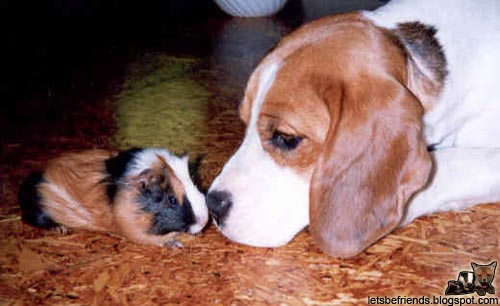
Dog and guinea pig

Un cane e un porcellino d’India insieme. Addestrare un porcellino d’India può farsi diventare un miglior educatore cinofilo (foto letsbefriends.blogspot.com).


Il porcellino d’India – un piccolo animale sociale, di aspetto accattivante – è per natura pauroso e diffidente, essendo la preda favorita di molti predatori, tra cui anche l’uomo. A differenza del cane, l’uomo non condivide col porcellino d’India una comune storia evolutiva e, pertanto, questo animale non vi concederà alcunché senza qualcosa in cambio. Dovrete lavorare per ottenere la fiducia del porcellino d’India e dimostrargli che cooperare con voi è vantaggioso nel breve e nel lungo termine.

Addestrare i porcellini d’India vi insegnerà molte tra le questioni teoriche dell’apprendimento animale, che trovereste noioso leggere in un libro; per contro, le apprenderete in modo divertente poiché ne avrete esperienza immediata e diretta. Dovrete essere precisi ed applicare i metodi corretti per ottenere il giusto comportamento. Avrete inoltre la possibilità di applicare l’intera gamma del condizionamento operante, migliorando quindi le vostre capacità pratiche.

I cani sono animali eccezionali e siamo fortunati perché sono (quasi) sempre attenti a ciò che facciamo e sono ottimi osservatori. Come diceva a lezione il Professor Lorenz, “i cani sono etologi migliori di quanto lo siamo noi”. Non è invece questo il caso dei porcellini d’India, che non hanno una storia di co-evoluzione comune con noi. Hanno certamente ottime capacità di osservazione, ma non sono particolarmente attenti al nostro comportamento. Dovrete essere quindi voi stessi degli osservatori molto attenti per individuare il momento giusto per mettere in atto il metodo corretto per ottenere il comportamento desiderato; in questo modo, potrete sviluppare la vostra capacità di osservazione, il che indubbiamente farà di voi un miglior educatore cinofilo.

Siamo così abituati alla presenza dei cani che tendiamo ad interpretarne il comportamento come se fossero umani, commettendo così un grave errore per il quale, spesso, non subiamo conseguenze. Con i porcellini d’India, impariamo invece ad osservare, analizzare ed interpretare il comportamento in maniera oggettiva.

Puppy and guinea pig.

Animali di specie diverse possono sviluppare ottime relazioni e vivere tra loro in armonia (foto Dashawk).


Potete insegnare molte cose ai cani anche senza aver prima pianificato l’addestramento. Sono infatti così attivi e desiderosi di compiacere che, prima o poi, faranno qualcosa che vi piace e che potrete rinforzare. Questo però non accade invece con i porcellini d’India. Dovrete pianificare in anticipo l’addestramento, definire in modo chiaro i vostri obiettivi and preparare un piano di intervento. Con i cani, possiamo andare a braccio, ma ciò non è possibile con altri animali. Addestrare porcellini d’India vi insegnerà inoltre ad essere pronti per gli imprevisti, a preparare piani alternativi, predisponendo un piano B quando il piano A non funziona nel modo atteso. Una volta che avrete appreso questa capacità, il vostro cane sarà il primo a ringraziarvi se condurrete per le vostre sessioni di addestramento definendo in anticipo il piano di intervento.

Siete certamente consapevoli che il senso del tempo è essenziale quando educate il vostro cane, ma – in modo abbastanza sorprendente – avrete comunque risultati accettabili anche quando il rinforzo non arriva al momento giusto. Con i cani è come canticchiare alla buona un motivetto, che i vostri amici riconosceranno comunque. Con i porcellini d’India bisogna essere intonati e cantare senza errori, o altrimenti vi suggeriranno di prepararvi meglio, prima di ripresentarvi. Dopo aver addestrato i porcellini d’India, il vostro senso del tempo sarà molto più preciso.

Molte persone non riescono a percepire completamente quello che accade intorno a loro, perché sono eccessivamente preoccupate dei loro sentimenti ed emozioni. Possiamo permetterci questo tipo di distrazioni con i cani, ma non invece con altri animali e, quindi, addestrare i porcellini d’India vi aiuterà a focalizzare la vostra attenzione sull’animale che state addestrando ed a sviluppare una maggiore attenzione per i particolari. Ciò aumenterà anche la consapevolezza di voi stessi, il che vi renderà non solo un ottimo addestratore di porcellini d’India, ma anche un educatore cinofilo migliore – influendo positivamente sulla vostra vita in senso più generale.

Nei nostri seminari, lavorerete in squadre di tre. Ciascuna squadra pianificherà un piano di intervento, che sarà stilato in anticipo, verrà ripreso in video durante la sua esecuzione, analizzato successivamente, modificato e quindi eseguito. I membri della squadra si avvicenderanno nell’addestramento, nella registrazione delle sessioni e nelle riprese. Migliorerete le vostre capacità di lavorare in gruppo, una capacità che vi sarà utile non soltanto quando tornerete ad educare i cani, ma in tutti i settori della vostra vita.

Adesso potete comprendere come addestrare un piccolo e piacevole porcellino d’India potrà farvi diventare un miglior educatore cinofilo, di cani, di gatti o addirittura un miglior collega di lavoro migliorando la vostra capacità di osservazione, il senso del tempo e l’abilità di lavorare in gruppo. Mentre i vostri colleghi potranno metterci un po’ per apprezzare i miglioramenti, il vostro cane se ne accorgerà subito, ve lo prometto. Potreste anche un fumetto sopra la sua testa, mentre dice “Che bello! Cosa ho fatto per meritarmi ciò? È come avere un proprietario nuovo di zecca!”

Police guinea pig? Not exactly yet, but who knows.  You could be the trainer of the first Guinea Pig tobacco and gunpowder detector.

Se vi piace il lavoro di discriminazione olfattiva, addestrare un porcellino d’India è la cosa migliore che possiate fare e vi insegnerà molto. Hanno un buon senso dell’olfatto, ma dovrete essere bravi a motivarli e ad avere un ottimo senso del tempo.


In un certo senso, un guinea pig camp è un mini corso di etologia (la scienza del comportamento animale). La maggior parte dei proprietari e anche molti addestratori non sono in grado di distinguere tra le quattro categorie di comportamenti che gli animali sociali hanno sviluppato nel corso dell’evoluzione: i c.d. comportamenti aggressivi, di paura, dominanti e di sottomissione. Confondere il comportamento aggressivo con quello dominante, come pure quello di paura con quello di sottomissione è uno spiacevole errore, peraltro ancora troppo comune, nonostante il fatto che ciascuno di questi comportamenti possiede funzioni ed espressioni specifiche.

Quando addestrate un porcellino d’India, non è importante che riusciate o meno a distinguere i comportamenti dominanti e di sottomissione dai comportamenti aggressivi o di paura, anche se si tratta di comportamenti normali per i porcellini d’India. Tuttavia, non esiste alcuna possibilità che voi entriate a far parte del branco dei porcellini d’India. Sarete sempre lo straniero, ma potrete decidere se essere uno straniero amichevole e meritevole di fiducia, oppure uno straniero angosciante e inaffidabile. Sarà una vostra scelta, che non è difficile da mettere in pratica, ma che richiede di pensare attentamente a quello che state facendo.

Così come i cavali, anche i porcellini d’India nel dubbio reagiscono con paura (un comportamento chiave per la loro sopravvivenza nella storia della loro evoluzione). Mostrare un atteggiamento composto e sicuro di sé funziona bene, ma ogni comportamento maggiormente assertivo può essere controproducente. I cani, animali sempre più sorprendenti, vi daranno sempre una seconda possibilità (e vi perdoneranno l’accento strano con cui parlate il loro linguaggio); un cavallo o un porcellino d’India difficilmente lo faranno. Se pensate di poter in qualche modo costringere un porcellino d’India a fare quello che voi volete, reagirà con paura e si immobilizzerà persino per mezz’ora, un disastro per qualsiasi aspirante addestratore.

Imparerete presto che la coercizione non è assolutamente il modo giusto di procedere. Così, imparerete i segreti della motivazione e la bellezza di saperla utilizzare (anche nel vostro ambiente), piuttosto che cercare di controllarla; e ciò, da solo, potrà condurvi a risultati inattesi e molto ben accetti.

Se potessero, sono sicuro che il vostro cane e il vostro cavallo ringrazierebbero i porcellini d’India per quello che vi insegneranno mentre li addestrate, perché senza dubbio diventerete un addestratore molto più attento e preciso. Avrete un maggior controllo di voi stessi piuttosto che dell’animale, imparerete a motivare piuttosto che a costringere, a mostrare ciò che volete piuttosto che arrivarci per caso, a raggiungere risultati intervenendo in misura minima (e talvolta persino impercettibile) sul normale comportamento del vostro animale preferito.

La vita è meravigliosa, non è vero?

R—

Related articles

So you want to be a good dog trainer!

The launch of Guinea Pig Camps has attracted the attention of many animal lovers, particularly dog trainers. I have been asked repeatedly two particular questions: (1) how can training guinea pigs make me a better dog trainer? (2) What have guinea pigs got to do with dogs?

Guinea Pig using the A-frame.

Guinea Pig using the A-frame. They are not especially agile but enjoy challenges. A good trainer can teach them lots of tricks.

The basic skills you need to train a dog are the same as those you need to train any other animal. The only difference is a dog is a dog and not a horse, or a cat, or a guinea pig, as you well know. This is good news for you as (mainly due to our common history) there is no other animal as easy to train as a dog. On the other side, and precisely because dogs makes it easy for us, there is a limit to how much we learn if we only train dogs and never other animals.

Dogs forgive our mistakes and are nearly always motivated to cooperate with us. Other species scrutinize us far more thoroughly and demand that we earn their trust. If they don’t trust us, they will not follow our teaching, and we’ll have a problem.

A horse will not follow you if it doesn’t trust you and it takes a lot to earn the trust of a horse (and only a moment to lose it completely). You can offer it as many carrots as you like, but if it decides you are not someone to be trusted, the best carrots in the world will be redundant.

A cat will blink at you and the treat you offer at least twice, before even considering moving into your direction. Then, if it deems your request reasonable in exchange for food, it may just indulge you. Otherwise, it will just blink again, if you’re lucky, before resuming its catnap.

Dog and guinea pig

Dog and guinea pig together. Training a guinea pig can make you a better dog trainer (photo letsbefriends.blogspot.com).

The guinea pig, a small, rather cute, social animal, is fearful by nature, as it is a favorite prey of many predators, including humans. Humans don’t share a common evolutionary history with the guinea pig like with the dog, so you won’t get anything for free. You’ll have to work to gain your guinea pig’s trust and show it that co-operating with you is profitable in both the short and long term.

Training guinea pigs will teach you many of the theoretical aspects of animal learning that you may find boring to read in a book; and will do so in a fun way because you will be learning hands-on. You’ll have to be very precise and apply the right methods to produce the right behavior. You’ll explore the whole spectrum of operant conditioning and thus improve your practical skills.

Dogs are exceptional animals and as trainers we are lucky because they are (almost) always attentive to what we’re doing and they are great observers. As Professor Lorenz once said in a class, “dogs are better ethologists than we are.” This is not the case with guinea pigs as they lack that common evolutionary history with us. They have good observational skills, they’re just not particularly attuned to human behavior. You’ll have to be a keen observer your self to determine the right moment to implement the right method to achieve the right behavior; thus, you will develop your own observational skills, which in itself will undoubtedly make you a better dog trainer.

We are so familiar with dogs that we tend to interpret their behavior as if they were humans, a grave mistake indeed, but we mostly get away with it. With guinea pigs, you learn to observe, analyze and interpret behavior objectively.

Puppy and guinea pig.

Animals of different species can develop good relationships and live together in harmony (photo by Dashawk).

You can teach dogs many things without a proper plan. They are so active and eager to please that, sooner or later, they will do something you like, which you can then reinforce. However, this is not the case with guinea pigs. You’ll need to plan in advance, clearly defining your goal and drawing up a plan of action. With dogs, we can play by ear and sing along, but this is not sufficient with other animals. Training guinea pigs teaches you to be prepared for eventualities, to plan alternatives, to prepare a plan B for when plan A doesn’t work as you expect. Once you’ve learned this skill, your dog will be the first to thank you for having a plan for your training sessions.

You are aware that timing is important when you train your dog, but surprisingly enough, you’ll still achieve acceptable results even if the reinforcer is not precisely timed. With dogs, it’s like singing a melody out of tune and your friends still recognizing it. With guinea pigs, you’d better sing in tune or they will tacitly suggest you get your act together before going back to them. After training guinea pigs, your sense of timing will be much more precise.

Some people have problems registering what’s happening around them because they are overly preoccupied with their own feelings and emotions. We can afford this kind of distraction with our dogs, but not with other animals and so training guinea pigs will help you focus on the animal you train and develop your eye for detail. This will increase your self-awareness, which will not only turn you into a successful guinea pig trainer, but also a much better dog trainer—and will perhaps help you in your life beyond dog training too.

At our guinea pig camps, you work in a team of three. Each team designs a plan of action, which they then register, film, analyze, modify and implement. All three members of the team will take turns at training, registering and filming the sessions. You’ll improve your ability to work in a team, a skill that will be helpful, not only when you go back to training dogs, but in all spheres of your life.

So now you see how training a cute, little guinea pig can make you a better dog trainer, horse trainer, cat trainer or even a better work colleague due to your improved  observational skills, refined sense of timing and finer team work. Your colleagues may take a little time to realize that you have improved but your dog will notice it right away, I promise you. You might even be able to see a bubble above your dog’s head saying, “Wow, what have I done to deserve this? This is like having a completely new owner!”

Police guinea pig? Not exactly yet, but who knows.  You could be the trainer of the first Guinea Pig tobacco and gunpowder detector.

If you like nose work with dogs, training a guinea to do detection work is the right thing for you and will teach you a lot. They have a good nose, but you’ll have to be good at motivating them and have a great sense of timing.

In a sense, a guinea pig camp is a mini course in ethology (the science of animal behavior). Most animal owners, and many trainers too, can’t distinguish between four fundamental behaviors that social animals have evolved: the so-called aggressive, fearful, dominant and submissive behaviors. Confusing aggressive and dominant behavior, as well as fearful and submissive behavior is unfortunate, yet only too common despite the fact each of these behaviors has its own particular function and expressions.

When training guinea pigs, it is not important whether or not you can distinguish dominant and submissive behavior from aggressive and fearful behavior, even though they are common guinea pig behaviors. There’s no way you can be part of a guinea pig herd. You will always be the stranger, but you can choose whether you’ll be a nice, trustful stranger, or a distressing, unreliable one. It’s up to you and it’s not difficult but it requires you think carefully about what you do.

Much like horses, guinea pigs tend to react fearfully when in doubt (the key to their survival throughout their evolutionary history). Displaying composed, self-confident behavior works well, but anything more assertive than that will backfire on you. Dogs, these evermore amazing animals, give you a second chance (and understand our bad “accents” in dog language); a horse or a guinea pig hardly ever do so. If you as much as think of trying to bully a guinea pig into doing what you want, it will react fearfully and can freeze for up to 30 minutes, which is a disaster for any aspiring trainer.

You’ll soon learn that coercion is not the way to go at all. Thus, you’ll learn the secrets of motivation and the beauty of working within and with your environment, rather than attempting to control it; and that in itself will lead you to unexpected and welcomed results.

If they could, I’m sure your dog and your horse would thank the guinea pigs for what they teach you when you train them, for you will be, undoubtedly, a much more subtle and balanced trainer. You’ll be in control of yourself rather than the animal, motivating rather than forcing, showing the way rather than fumbling about, achieving results with the least (sometimes even imperceptible) amount of intrusion into your favorite animal’s normal behavior.

Isn’t life beautiful?

R—

Related articles

The 20 Principles All Animal Trainers Must Know

with “16 More Principles For The Advanced Animal Trainer” and “Best Practice”

"The 20 Principles" cover.

“The 20 Principles All Animals Trainers Must Know”

This is the first edition of “The 20 Principles That All Animal Trainers Must Know.” This booklet is in a way a super concentrated course in animal learning and, although only 28 pages long, it will take you time to read and digest. Don’t rush thru it.

I wrote “The 20 Principles” in plain English so it should be accessible to all readers. Of course, I use technical terms, but they shouldn’t pose any problem for any reader because I define them all carefully and with examples.

I will update this booklet as necessary. Come back regularly to check if there are any updates.

v. 3 uploaded 09.03.13: clarification of the difference between conditional/unconditional and conditioned/unconditioned.

v. 2 uploaded 04.03.13: new cover and back cover, minor text improvements to improve clarity.

First edition v. 1 uploaded 04.02.13

Enjoy your reading!

R—

PS—This is a free e-book for you to read on your computer. Please, don’t ask me for the possibility to print it, for as much as I love books, I also care for the trees of our planet. We’re planning versions for iPad and Kindle to be available soon.

Click the full-screen view icon for better reading. Zoom in and out as you please.


Sorry, this book is no longer available here. Please, visit Ethology Institute’s Online Bookstore.


Related articles

Guinea Pig Camps, los talleres de entrenamiento con cobayas

Traducido por Victor Ros Pueo.

Bienvenidos a los Guinea Pig Camps, los talleres de entrenamiento con cobayas!

Las cobayas, Cavia porcellus, son comúnmente conocidos como “conejillos de indias”.

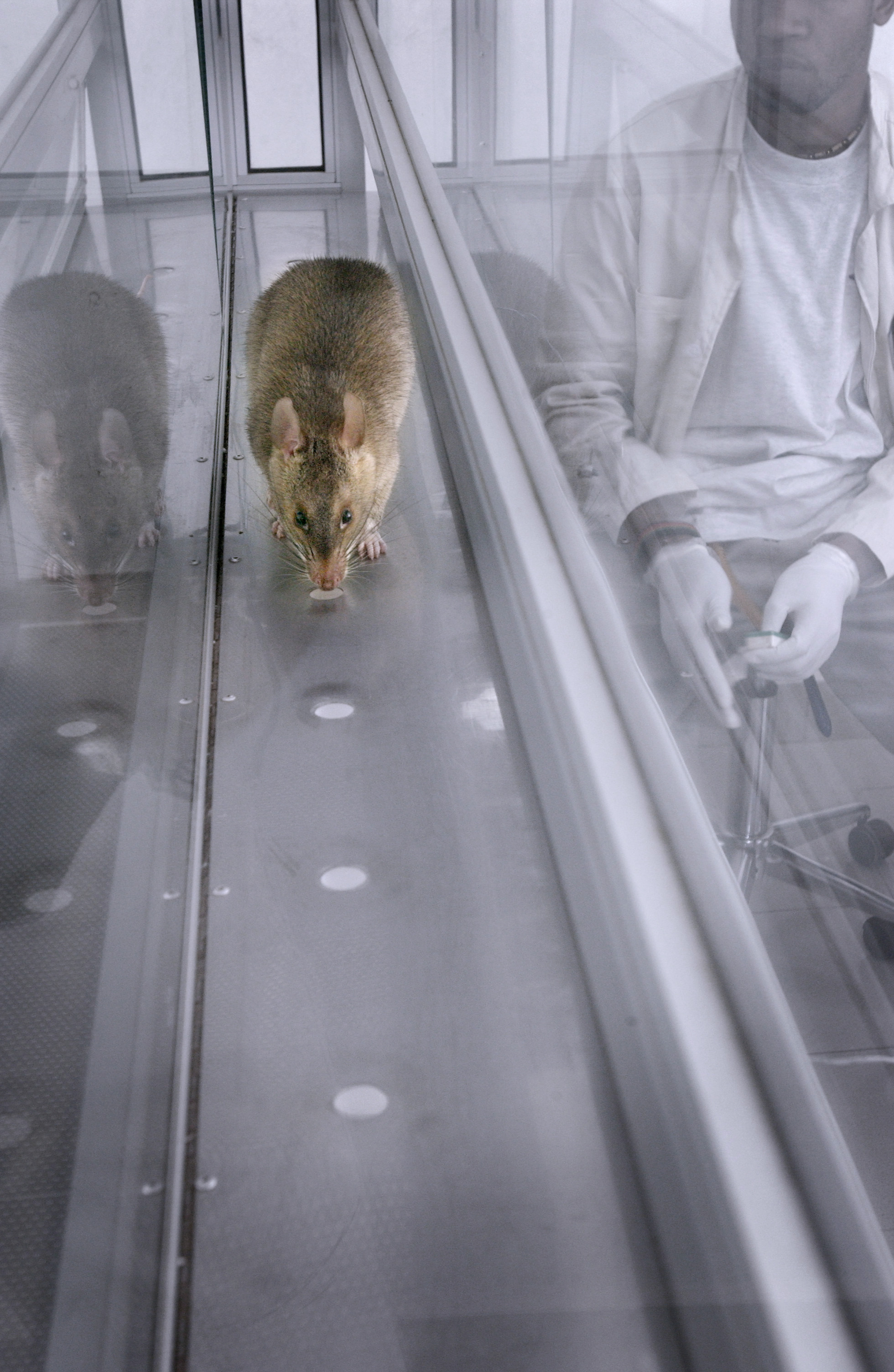
Así que te gusta el trabajo de detección y los trucos de agility, que está fascinado por la detección de minas terrestres de los “Hero Rats”,  y te gustaría aprender algunos trucos para mejorar como entrenador de perros. No te voy a enseñar a entrenar un perro de detección de la policía, o una rata para la detección de minas, eso está reservado para los profesionales en esas áreas, pero te indicará cómo entrenar a una cobaya para detectar el tabaco y pólvora, y para realizar trucos de agility.

Police guinea pig

Guinea pig policía ? Todavía no, pero quién sabe! Puedes ser el entrenador del primero guinea pig detector de tabaco y pólvora.


¿Por qué deberían los entrenadores de perros entrenar cobayas?

Entrenar perros es fácil comparado con entrenar otros especies debido a la especial relación entre los seres humanos y perros. Los perros tienden a pasar por alto la mayor parte de nuestros errores y nos suelen dar una segunda oportunidad. Los animales que no tienen una relación tan estrecha con los seres humanos son mucho menos tolerantes por lo que es una alta prioridad ser precisos, para planificar su entrenamiento, para desarrollar tus habilidades de observación y de tener un plan B disponible. Entrenando cobayas te ayudará ser mejor entrenador de perros; más atento a los perros, más atento a los detalles y más receptivo a la retroalimentación que su perro le ofrece.

Otra ventaja de entrenar cobayas es que no tendrá un fuerte vínculo con la cobaya que entrena y por lo tanto serás más objetivo que en el entrenamiento de tu perro. No se han desarrollado malos hábitos, ya que el entrenamiento de cobayas será nuevo para ti. No te identificaras con la cobaya de la misma manera que los dueños de perros se identifican con sus perros, por lo que no te sentirás avergonzado si tu cobaya comete un error.

El entrenamiento de cobayas mejorará tus conocimientos teóricos, así como tus habilidades mecánicas. Te sorprenderás de lo mucho que se puede enseñar a una cobaya en apenas cuatro días!


Guinea Pig, Cavia porcellus, also called Cavies.

El Guinea Pig, Cavia porcellus, es un animal social. Su vista no es tan buena como la nuestra, pero tiene buen sentido del oído, el olfato y el tacto.


Las Cobayas y equipos

Cada equipo de tres estudiantes tendrá una cobaya para entrenar, una caja de entrenamiento, los obstáculos de agility, golosinas y un silbato (o clicker). Cada estudiante dentro de su equipo se turnará para ser entrenador, observador y operador de cámara. Los entrenadores entrenan, el observador registra la sesión y asegura que sigue el previamente diseñado POA (Plan de Acción), y el operador de cámara graba todas las sesiones. Puesto que los tres seguirán un plan cuidadosamente diseñado, no hay ningún problema para que los tres puedan tunarse para entrenar la misma cobaya.

El entrenamiento del equipo será en su mayoría consistente, pero, en caso de producirse pequeñas variaciones, los vamos a considerar como una ventaja, y una oportunidad de comparar factores que pueden haber influido en el entrenamiento. Es por eso que todas las sesiones son filmadas.

Un día en el campamento

Un día comienza a las 9 am y termina a las 17:00. El almuerzo será 12:00-13:00. Los equipos decidirán cuándo tomar un descanso.

Alrededor del 60% del curso se compone de una formación práctica y el 40%  restante es dedicado a los problemas teóricos tales como el diseño de los POA, la revisión de las sesiones de entrenamiento, estudiando videos, briefing y debriefing equipos.

El número máximo de alumnos es de treinta (diez equipos).

Requisitos previos

Haber leído “Los 20 principios que todos los entrenadores de animales deben saber.” Haga clic en el enlace (próximamente) para acceder al manual gratuito (traducciones al francés, español e italiano estará disponible en breve).


Guinea Pig: vocalization is their primary means of communication.

La vocalización es el principal medio de comunicación del conejillo de Indias. En nuestro campo se aprende a distinguir entre diferentes sonidos.


Honorarios

Como queremos ofrecer a todos la oportunidad de asistir a un campamento de Guinea Pig, mantenemos los honorarios bajos: 395 euros (en Europa), USD 495 (en los EE.UU.), AUS 495 (en Australia), CND 495 (en Canadá) y JPY 44,500 (en Japón). Esta tarifa no incluye el alojamiento, el transporte o las comidas.

Los organizadores del evento puede que necesiten ajustar estas tasas ligeramente para adaptarse a las condiciones locales (por favor, ver sus sitios web individuales).

Fechas, lugares y registro

Para registrarse, por favor, utilice los datos de contacto de abajo.

Hasta pronto

Nuestros Guinea Pig Camps es algo que tendrás que experimentar. Es increíble lo mucho que estas pequeñas y lindas criaturas pueden aprender, y lo mucho que nos pueden enseñar. No te preocupes si te enamoras con tu cobaya, te lo podrás llevar a casa después del taller, es decir, si te lo permiten sus compañeros de equipo.

En los Guinea Pig Camps se trata de aprender, disfrutar del trabajo en equipo y divertirse!

Roger Abrantes 


Campo de treino de porquinhos da Índia

Bem-vindo ao campo dos porquinhos da Índia!

Gosta de trabalho de detecção e de agility e acha fascinante o trabalho dos “Hero Rats” que detectam minas terrestres e tuberculose? Gostaria de aprender pormenores que o poderiam ajudar a tornar-se um melhor treinador de animais? Não irei ensinar-lhe a treinar um cão de policia ou um rato de detecção—o que é reservado aos profissionais nessas áreas—mas ensinár-lhe-ei a treinar um porquinho da Índia a detectar tabaco e pólvora e habilidades de agility.

Police guinea pig

Porquinho da Índia policial? Ainda não, mas quem sabe! Poderá ser o treinador do primeiro porquinho da Índia detector de tabaco e pólvora.


Que benefícios terão treinadores de cães em treinar porquinhos da Índia?

Treinar cães é fácil comparado com treinar outras espécies devido à relação especial que temos com o cão. O cão tende a ignorar a maioria dos nossos erros e dá-nos uma segunda oportunidade. Os animais que não têm a mesma relação intima connosco são bem menos flexíveis, o que implica que devemos ser mais exactos, planear bem o nosso treino, desenvolver a nossa capacidade de observação e ter um plano B à nossa disposição. O treino dos porquinhos da Índia contribuirá para melhorar o seu poder de observação; ensinar-lhe-á a estar mais atento a pormenores e mais receptivo a feedback do animal que treina.

Treinar porquinhos da Índia tem várias vantagens. Uma deriva do facto da sua relação com este animal não ser tão forte como a que tem com o seu cão; em princípio, será mais objectivo do que no seu treino de cães. Não terá, também, criado hábitos maus porque o treino de porquinhos da Índia será uma área nova para si. Não se identificará com o porquinho da Índia do mesmo modo como os donos de cães se identificam com os seus cães; e os erros do seu porquinho da Índia não serão embaraçosos para si.

Treinar porquinhos da Índia melhorará o seu conhecimento teórico assim como a sua mecânica em aplicar os princípios de aprendizagem. Ficará surpreendido com a capacidade de aprendizagem deste animal!


Guinea Pig, Cavia porcellus, also called Cavies.

O porquinho da Índia, Cavia porcellus, é um animal social. A sua vista não é tão boa como a nossa, mas possui bons sentidos de audição, olfacto e tacto.


Os porquinhos da Índia e as equipas

Cada equipa consiste num porquinho da Índia e três participantes, que terão à sua disposição uma mesa de treino, equipamento de agility e detecção, comida para reforços e um apito ou clíquer. Cada participante funcionará, em turnos, como treinador, observador e operador de câmara. O treinador treina, o observador registra a sessão e confere que o treino segue o plano de acção prèviamente desenhado e o operador de câmara filma a sessão. Todos os três aplicam o mesmo plano de acção anteriormente desenhado em detalhe; não existirá, assim, problema nenhum a serem três treinadores a treinar o mesmo animal. Os métodos aplicados pelos três companheiros de equipa serão consistentes, mas caso ocorram variações, serão um bónus e a nossa possibilidade de comparar factores que possam influenciar os resultados—por isso a razão de filmarmos as sessões.

Um dia no campo de treino

Um dia começa às 10 e termina as 18 horas. O almoço será entre as 13 as 14 horas. As equipas decidem quando tomar o almoço.

Aproximadamente 60% do curso será trabalho prático com os restantes 40% dedicados ao desenho de planos de acção, estudo de filmes e briefing/debriefing.

O número máximo de participantes é trinta (dez equipas).

Pré requisitos

É obrigatório a leitura de “Os 20 princípios que todos os treinadores de animais devem conhecer.” Clique link para ter acesso (disponível em breve).

Guinea Pig: vocalization is their primary means of communication.

A vocalização é o primeiro meio de comunicação do porquinho da Índia. No nosso campo aprenderá a distinguir entre os diversos sons.


Preço

O nosso objectivo é dar a todos os interessados a possibilidade de participar, o que se reflecte nos baixos preços que seguem: EUR 395 (na Europa, excepto Portugal EUR 295), USD 495 (nos EUA), AUS 495 (na Austrália), CND 495 (no Canadá) e JPY 44,500 (no Japão). Este preço não inclui acomodação, transporte e refeições.

Os organizadores poderão ser obrigados a ajustar ligeiramente os seus preços devido a condições locais (visite, por favor, as suas respectivas páginas na web).

Datas, locais e registro

Para se registrar, contacte por favor o organizador da sua escolha.

Até breve

O nosso campo de porquinhos da Índia não se pode contar, tem que ser vivido. É espantoso o quanto estas pequenas e mimosas criaturas conseguem aprender e quanto o nos conseguem ensinar. Não se preocupe: se se apaixonar pelo seu porquinho da Índia, poderá levá-lo para casa depois do curso—quer dizer, se os seus companheiros de equipa o permitirem).

Nos campos dos porquinhos da Índia é tudo sobre aprendizagem, desfrutar de bom trabalho de equipa e divertir-se.

Roger Abrantes

Guinea Pig Camp—migliora le tue capacità di addestratore di animali

Tradotto da Paolo Terrile.

BENVENUTI AL GUINEA PIG CAMP!

Ti piacciono il lavoro di ricerca olfattiva e gli esercizi di agilità, sei affascinato dagli ‘Hero Rats’ che scoprono le mine antiuomo, e vorresti imparare alcune accortezze che possono farti diventare un miglior addestratore cinofilo? Non ti insegnerò come si addestra un cane poliziotto o un topo che localizza le mine antiuomo – è un lavoro riservato ai professionisti che si occupano di queste attività – ma ti insegnerò come addestrare un porcellino d’India a segnalare la presenza di tabacco e polvere da sparo e ad eseguire esercizi di agilità.

Police guinea pig

Porcellino d’India poliziotto? Non ancora, ma chi può dire? Potresti essere tu l’addestratore del primo porcellino d’India impiegato nella ricerca di tabacco e polvere da sparo.


PERCHÉ UN ADDESTRATORE CINOFILO DOVREBBE ADDESTRARE UN PORCELLINO D’INDIA?

È più facile addestrare i cani che altri animali, a motivo della relazione speciale tra il cane e l’uomo. I cani ci perdonano la maggior parte degli errori, dandoci una seconda possibilità. Gli animali con cui non abbiamo una relazione così stretta sono meno inclini a perdonare gli errori: è quindi importante essere precisi, progettare l’addestramento, sviluppare ottime capacità di osservazione ed avere sempre pronto un piano alternativo. Addestrare i porcellini d’India ti aiuterà a diventare un addestratore cinofilo migliore e più attento, più concentrato sui dettagli e pronto a recepire i feedback del tuo cane.

Un altro vantaggio di addestrare i porcellini d’India è l’assenza di un legame col porcellino che addestrerai, il che ti permetterà di essere più obiettivo di quanto saresti addestrando il tuo cane. Poiché l’addestramento del porcellino sarà un’esperienza nuova, non avrai abitudini errate da correggere. Non ti sentirai in imbarazzo quando il porcellino sbaglierà, poiché non ti identificherai con lui nel modo in cui i proprietari si identificano col loro cane.

Addestrare un porcellino d’India migliorerà le tue conoscenze teoriche e le tue abilità pratiche. Ti sorprenderai di quante cose si possano insegnare ad un porcellino d’India in soli quattro giorni.

Guinea Pig, Cavia porcellus, also called Cavies.

I porcellini d’India, Cavia porcellus, chiamati anche cavie, sono roditori sociali. La loro vista non è paragonabile a quella dell’uomo, ma i sensi dell’udito, dell’olfatto e del tatto sono molto ben sviluppati.


I PORCELLINI D’INDIA

Ogni gruppo di tre persone addestrerà un porcellino, utilizzando una cassa per l’addestramento (training box), ostacoli per gli esercizi di agilità, premi alimentari ed un fischietto (o un clicker). I membri del gruppo assumeranno a turno il ruolo di addestratore, osservatore e videoperatore. L’addestratore addestrerà il porcellino, l’osservatore registrerà la sessione e si assicurerà che sia rispettato il piano di addestramento, mentre il videoperatore riprenderà la sessione. Poiché tutti e tre membri del gruppo seguiranno un piano di addestramento pianificato in anticipo, avvicendarsi nell’addestramento non creerà inconvenienti. L’addestramento compiuto dal gruppo sarà quindi per la maggior parte coerente ma, ove si verificassero piccole variazioni, le stesse saranno un vantaggio ed un’opportunità di esaminare i fattori che possono influenzare l’addestramento. Questa è tra l’altro la ragione per cui tutte le sessioni di lavoro verranno filmate.

UNA GIORNATA AL CAMP

La giornata inizierà alle 9 e finisce alle 17, con pranzo dalle 12 alle 13. Ogni gruppo potrà decidere quando fare le pause. Snack, acqua, bibite, thè e caffè saranno a disposizione dei partecipanti.

Il corso si concentrerà per il 60% sulle attività pratiche di addestramento e per il 40% su aspetti teorici, come la progettazione dei piani di addestramento, la revisione delle sessioni di addestramento, l’esame dei video, la discussione all’interno di ciascun gruppo prima e dopo ciascuna sessione.

Il numero massimo di partecipanti è 30 suddivisi (10 gruppi).

PREREQUISITI

I partecipanti devono aver letto il manuale  “Mission SMAF—Bringing Scientific Precision Into Animal Training.” Fai click sul link per accedere gratuitamente al manuale in inglese (la traduzione in francese, spagnolo ed italiano sarà presto disponibile).

Guinea Pig: vocalization is their primary means of communication.

La vocalizzazione è il principale mezzo di comunicazione del porcellino d’India. Potrai imparare la differenza tra i diversi segnali vocali con cui questi animali comunicano.


QUOTA DI ISCRIZIONE

Poiché vogliamo offrire al maggior numero di persone l’opportunità di partecipare al Guinea Pig Camp, abbiamo contenuto la quota di iscrizione in EUR 395 (In Europa), USD 495 (negli USA), AUS 495 (in Australia), CND 495 (in Canada), JPY 44.500 (in Giappone). La quota di iscrizione non comprende l’alloggio, i trasporti e i pasti prima delle 9 e dopo le 17.

Gli organizzatori dei singoli Camp potrebbero modificare lievemente la quota di iscrizione (verifica le informazioni pubblicate dai singoli organizzatori).

DATE, LOCALITÀ E ISCRIZIONI

CI VEDIAMO PRESTO!

Il Guinea Pig Camp è un’esperienza che devi provare. È sorprendente quante cose possano imparare queste piccole simpatiche creature e quante ne possano insegnare. Non preoccuparti se ti dovessi innamorare del tuo porcellino d’India – alla fine del Camp potrai portarlo a casa con te, sempre che i tuoi compagni di gruppo siano d’accordo!

I Guinea Pig Camp sono un’occasione di apprendimento, di lavoro di gruppo e di divertimento!

Roger Abrantes 


Guinea Pig Camp

Welcome to Guinea Pig Camp!

So you like detection work and agility tricks, you are fascinated by the Hero Rats detecting landmines and you’d like to learn some tricks that could make you a better dog trainer. I’m not going to teach you to train a police detection dog or a landmine-detecting rat—that is reserved for the professionals in those areas—but I will instruct you how to train a guinea pig to detect tobacco and gunpowder, and to perform agility tricks.

Police guinea pig

Police guinea pig? Not just yet, but who knows. You could be the trainer of the first tobacco and gunpowder detecting guinea pig.


Why should dog trainers train guinea pigs?

Training dogs is easy compared to training other species due to the special relationship between humans and dogs. Dogs tend to overlook most of our mistakes and give us a second chance. Animals that don’t have such a close relationship with humans are far less forgiving so it is a high priority to be precise, to plan your training, to develop your observation skills and to have a plan B available. Training guinea pigs will help make you a better, more observant dog trainer; more attentive to detail and more receptive to the feedback your dog gives you.

Another advantage of training guinea pigs is that you won’t have a strong bond with the guinea pig you train and you will therefore be more objective than in your dog training. You will not have developed any bad habits, as training guinea pigs will be novel to you. You won’t identify with the guinea pig you train in the same way dog owners identify with their dogs, so you will not feel embarrassed if your guinea pig makes a mistake.

Training a guinea pig will improve your theoretical knowledge as well as your mechanical skills. You will be amazed at how much you can teach a guinea pig in just four days!


Guinea Pig, Cavia porcellus, also called Cavies.

Guinea pigs, Cavia porcellus, also called cavies, are social rodents. Their sight is not as good as that of humans, but they have well-developed senses of hearing, smell and touch.


The Guinea Pigs

Each team of three students will have a guinea pig to train, a training box, agility obstacles, food treats and a whistle (or clicker). Each student within a team will take turns to be trainer, observer and camera operator. The trainer trains, the observer registers the session and ensures it follows the previously designed POA (Plan Of Action), and the camera operator films the session. Since all three will follow a carefully designed plan, there is no problem in taking turns at training the same guinea pig. The team’s training will be mostly consistent but, should small variations occur, we will regard them as a bonus and an opportunity to compare factors that may influence training. That’s why all the sessions are filmed.

A day at camp

A day starts at 9am and ends at 5pm. Lunch will be between 12pm and 1pm. Teams decide when to take a break.

About 60% of the coursework comprises of hands-on training and 40% of theoretical issues such as designing POAs, reviewing training sessions, studying videos, briefing and debriefing teams.

The maximum number of students is thirty (ten teams).

Prerequisites

You must have read “The 20 Principles that All Animal Trainers Must Know.” Click the link (available soon, also in French, Spanish, Portuguese and Italian) to access the free manual.

Guinea Pig: vocalization is their primary means of communication.

Vocalization is the guinea pig’s primary means of communication. At Guinea Pig Camp, you’ll learn the differences between a wheek, purring, rumbling, whining, chattering, squealing and chirping.


Fees

As we want to offer everyone the opportunity to attend a Guinea Pig Camp, we keep the fees low: EUR 395 (in Europe, except Portugal EUR 295), USD 495 (in the USA), AUS 495 (in Australia), CND 495 (in Canada) and JPY 44,500 (in Japan). This fee does not include accommodation, transportation and meals.

Event organizers may need to adjust these fees slightly to accommodate particular local conditions (please see their individual websites).

Dates, locations and registration

To register, please use the contact details below.

See you soon

Our Guinea Pig Camp is something you’ll have to experience. It’s amazing how much these cute, little creatures can learn and how much they can teach us. Don’t worry if you fall in love with your guinea pig—you can take it home after the workshop, that is, if your teammates allow you.

Guinea Pig Camps are about learning, enjoying teamwork and having fun!

Roger Abrantes 


Dog Training—Let Reason Prevail Over Force!

Roger Abrantes and Boxer doing retrieve

“Whether you (or I) follow a particular line of morality is not a necessary consequence of any model of social behavior. Moral stances are solely your (or my) decision” (Picture by Lisa J. Bains).

The dog trainers’ dispute about training methods blazes on unabated, with the erroneous and emotive use of terms such as dominance, punishment and leadership only adding fuel to the fire. There is no rational argumentation between the two main factions, one of which advocates a “naturalistic” approach and the other a “moralistic” stance. The term ‘dominance’ generates particular controversy and is often misinterpreted. We can detect, in the line of arguing about this topic, the same fundamental mistakes committed in many other discussions. By taking the controversy over dominant behavior as my example, I shall attempt to put an end to the feud by proving that neither side is right and by presenting a solution to the problem. Plus ratio quam vis—let reason prevail over force!

I shall demonstrate that the dispute is caused by:

(1) Blurring the boundaries between science and ethics. While ethics and morality deal with normative statements, science deals with factual, descriptive statements. Scientific statements are not morally right or wrong, good or bad.

(2) Unclear definitions. We cannot have a rational discussion without clear definitions of the terms used. Both sides in the dispute use unclear, incomplete definitions or none at all.

(3) Logical fallacies. The opposing sides commit either the ‘naturalistic fallacy,’ ‘the moralistic fallacy,’ or both. We cannot glean normative statements from descriptive premises, nor can we deduce facts from norms. The fact that something is does not imply that it ought to be; conversely, just because something ought to be does not mean that it is.

(4) Social conditioning and emotional load. As a result of inevitable social conditioning and emotional load, some terms develop connotations that can affect whether we like or dislike, accept or reject them, independent of their true meaning.

(5) Unclear grammar. The term dominance (an abstract noun) leads us to believe it is a characteristic of certain individuals, not an attribute of behavior. The correct use of the term in the behavioral sciences is as an adjective to describe a behavior, hence dominant behavior.

Bottom line: We need to define terms clearly and use them consistently; otherwise rational discussion is not possible. We must separate descriptive and normative statements, as we cannot derive what is from what ought to be or vice versa. Therefore, we cannot use the scientific concept of dominant behavior (or any descriptive statement) to validate an ethical principle. Our morality, what we think is right or wrong, is a personal choice; what is, or is not, is independent of our beliefs and wishes (we don’t have a choice).

Solution to the problem: The present dispute focuses on whether we believe it is right or wrong to dominate others (as in, totally control, have mastery over, command). It is a discussion of how to achieve a particular goal, about means and ends. It is a moral dispute, not a scientific quest. If both sides have similar goals in training their dogs, one way of settling the dispute is to prove that one strategy is more efficient than the other. If they are equally efficient, the dispute concerns the acceptability of the means. However, if either side has different goals, it is impossible to compare strategies.

My own solution of the problem: I cannot argue with people who believe it is right to dominate others (including non-human animals) as, even though I can illustrate how dominating others does not lead to harmony, I can’t make anyone choose harmony or define it in a particular way. I cannot argue with people who think it acceptable to hurt others in order to achieve their goals because such means are inadmissible to me. I cannot argue with people who deny or affirm a particular matter of fact as a means of justifying their moral conduct, because my mind rejects invalid, unsound arguments. With time, the rational principles that govern my mind and the moral principles that regulate my conduct may prove to be the fittest. Meanwhile, as a result of genetic pre-programming, social conditioning and evolutionary biology, I do enjoy being kind to other animals, respecting them for what they are and interacting with them on equal terms; I don’t believe it is right to subjugate them to my will, to command them, to change them; and I don’t need a rational justification as to why that’s right for me*.

Roger Abrantes and Bulldog

“I do enjoy being kind to other animals, respecting them for what they are and interacting with them on equal premises; I don’t find it right to subjugate them to my will and dispositions, to command them, to change them; and I don’t need a rational justification for why that’s right for me” (Picture by Lisa J. Bain).

Argument

1 Science and ethics are not the same

Science is a collection of coherent, useful and probable predictions. All science is reductionist and visionary in a sense, but that does not mean that all reductionism is equally useful or that all visions are equally valuable or that one far-out idea is as acceptable as any other. Greedy reductionism is bound to fail because it attempts to explain too much with too little, classifying processes too crudely, overlooking relevant detail and missing pertinent evidence. Science sets up rational, reasonable, credible, useful and usable explanations based on empirical evidence, which is not connected per se. Any connections are made via our scientific models, ultimately allowing us to make reliable and educated predictions. A scientist needs to have an imaginative mind in order to think the unthinkable, discover the unknown and formulate initially far-fetched but verifiable hypotheses that may provide new and unique insights; as Kierkegaard writes, “This, then, is the ultimate paradox of thought: to want to discover something that thought itself cannot think.”

There are five legitimate criteria when evaluating a scientific theory or model: (1) evidence, (2) logic, (3) compatibility, (4) progression, and (5) flexibility.

(1)  Evidence: a scientific theory or model must be based on credible and objective evidence. If there is credible evidence against it, we dismiss it. It must be testable and falsifiable.

(2)  Logic: If a theory or model is based on logically invalid arguments or its conclusion are logically unsound, e.g. drawing valid conclusions from false premises, we must also dismiss it.

(3)  Compatibility:  If a theory or model shows crucial incompatibility with the whole body of science, then it is probably incorrect. If it is incompatible with another model, then we have a paradox. Paradoxes are not to be discarded, instead worked on and solved (or not solved as the case may be). Since “Paradoxes do not exist in reality, only in our current models of reality,  […] they point the way to flaws in our current models. They therefore also point the way to further research to improve those models, fix errors, or fill in missing pieces.” In short, “scientists love paradoxes,” in the words of Novella.

(4)  Progression: A scientific theory or model must explain everything that has already been explained by earlier theories, whilst adding new information, or explaining it in simpler terms.

(5)  Flexibility: A theory or model must be able to accept new data and be corrected. If it doesn’t, then it is a dogma, not a scientific theory. A dogma is a belief accepted by a group as incontrovertibly true.

Science provides facts and uncovers important relationships between these facts. Science does not tell us how we should behave or what we ought to do. Science is descriptive, not normative. In other words: we decide what is right or wrong, good or bad, not necessarily depending on what science tells us.

Morality and science are two separate disciplines. I may not like the conclusions and implications of some scientific studies, I may even find their application immoral; yet, my job as a scientist is to report my findings objectively. Reporting facts does not oblige me to adopt any particular moral stance. The way I feel about a fact is not constrained by what science tells me. I may be influenced by it but, ultimately, my moral decision is independent of scientific fact. Science tells me men and women are biologically different in some aspects, but it does not tell me whether or not they should be treated equally in the eyes of the law. Science tells me that evolution is based on the algorithm “the survival of the fittest,” not whether or not I should help those that find it difficult to fit into their environment. Science informs me of the pros and cons of eating animal products, but it does not tell me whether it is right or wrong to be a vegetarian.

Ethologists study behavior on a biological and evolutionary basis, define the terms they use, find causal relationships, construct models for the understanding of behavior and report their findings. Ethologists are not concerned with morality. They simply inform us that the function of x behavior is y. They don’t tell us that because animal x does y, then y is right or wrong, good or bad, or that we ought or ought not do y.

The model I present in “Dominance—Making Sense of the Nonsense” is a scientific model that complies with all five of the requirements listed above.

(1)  It is based on overwhelming data, i.e. given my definition of ‘dominant behavior,’ one cannot argue that it does not exist.

(2)  The conclusions are logically consistent with the premises.

(3)  It is consistent with our body of knowledge, particularly in the fields of biology and evolutionary theory.

(4)  It explains what has been explained before and in more carefully defined terms.

(5)  It accepts new data, adjustments and corrections (the current version is an updated version of my original from 1986). The model tells us nothing about morality. No single passage suggests that we should classify any particular relationship with our dogs as morally right or wrong. You will have to decide that for yourself. As an ethologist, I’m not concerned with what ought to be, only with what is. Echoing Satoshi Kanazawa, if I conclude something that is not supported by evidence, I commit a logical fallacy, which I must correct, and that’s my problem, but if my conclusion offends your beliefs, then that’s your problem.

Therefore, whether you (or I) follow a particular line of morality is not a consequence of any model of social behavior. Moral stances are solely your (or my) decision. It is not correct to draw normative judgments from descriptive claims. If you do so, you either commit the ‘naturalistic fallacy,’ the ‘moralistic fallacy’ or both, as I shall explain below (see point 3).

2 Unclear definitions

Having just pointed out the rigors of science, I must concede that the scientific community does bear some responsibility for the present dispute in as much as definitions and use of terms have sometimes been sloppy. Some researchers use particular terms (in this case ‘dominance’) without defining them properly and with slightly different implications from paper to paper.

Wikipedia writes: “Dominance (ethology) can be defined as an ‘individual’s preferential access to resources over another’ (Bland 2002). Dominance in the context of biology and anthropology is the state of having high social status relative to one or more other individuals, who react submissively to dominant individuals. This enables the dominant individual to obtain access to resources such as food or access to potential mates, at the expense of the submissive individual, without active aggression. The opposite of dominance is submissiveness. […] In animal societies, dominance is typically variable across time, […] across space […] or across resources. Even with these factors held constant, perfect dominant hierarchies are rarely found in groups of any size” (Rowell 1974 and Lorenz 1963).

It explains a dominance hierarchy as follows: “Individuals with greater hierarchical status tend to displace those ranked lower from access to space, to food and to mating opportunities. […] These hierarchies are not fixed and depend on any number of changing factors, among them are age, gender, body size, intelligence, and aggressiveness.”

Firstly, defining ‘dominance’ instead of ‘dominant behavior’ seems somewhat imprudent for a science that is intrinsically based on observational facts. It suggests we are dealing with an abstract quality when in fact we are referring to observable behavior (see point 5 below). Secondly, it implicitly equates ‘dominance’ with hierarchy (social status), which is misleading because some hierarchies may be supported by conditions other than dominant behavior. The use of the term ‘dominance hierarchy’ creates a false belief. Clearly, the terms dominance and dominant behavior are attributed with varying meanings, a highly unadvisable practice, particularly in stringently scientific matters.

As John Locke wrote in 1690 (An Essay Concerning Human Understanding),  “The multiplication and obstinacy of disputes, which have so laid waste the intellectual world, is owing to nothing more than to this ill use of words. For though it be generally believed that there is great diversity of opinions in the volumes and variety of controversies the world is distracted with; yet the most I can find that the contending learned men of different parties do, in their arguings one with another, is, that they speak different languages. ”This has contributed […] to perplex the signification of words, more than to discover the knowledge and truth of things.”

To remedy this, I propose in “Dominance—Making Sense of the Nonsense” a set of carefully constructed definitions that are compatible with behavioral science and evolutionary theory, whilst paying special attention to the logical validity and consistency of the arguments. I’m convinced that we would avoid many pointless disputes if all those dealing with the behavioral sciences were to adopt such definitions.

Roughly speaking, there are currently two main schools of thought in dog training. For our present purpose, we shall call them ‘Naturalistic Dog Training’ and ‘Moralistic Dog Training.’ Of course, there are various other stances in between these two extremes, including a significantly large group of bewildered dog owners who do not adhere to any particular ideology, not knowing which way to turn.

Naturalistic Dog Training (aka the old school) claims their training echoes the dog’s natural behavior. They don’t provide a proper definition of dominance, but use it with connotations of ‘leader,’ ‘boss,’ ‘rank,’ implying that dominance is a characteristic of an individual, not of a behavior. In their eyes, some dogs are born dominant, others submissive, but all dogs need to be dominated because their very nature is to dominate or be dominated. They use this belief to justify their training methods that often involve punishment, flooding, coercion, and even shock collars, if deemed necessary, by the more extreme factions. For them, a social hierarchy is based on (assertive) dominance and (calm) submission, the leader being the most dominant. Their willingness to accept the existence of dominant behavior is motivated by their desire to validate their training theories, but their interpretation of the term is far from what ethologists understand by it.

Moralistic Dog Training (aka positive reinforcement training) distances itself from punishment, dominance, and leadership. They don’t define ‘dominance’ properly either, but use it with connotations of ‘punishment,’  ‘aggression,’  ‘coercion,’  ‘imposition.’ They claim dominance does not exist and regard it as a mere construct of philosophers and ethologists aimed at justifying the human tendency to dominate others. Their view is that we should nurture our dogs as if they were part of our family and should not dominate them. Therefore, they also distance themselves from using and condoning the use of terms like ‘alpha,’  ‘leader’ and ‘pack.’ The more extreme factions claim to refrain from using any aversive or signal that might be slightly connected with an aversive (like the word ‘no’) and deny their using of punishers (which, given the consensually accepted scientific definition of punishment, is a logical impossibility). Their refusal to accept the existence of dominant behavior is motivated by their desire to validate their training morality, but their interpretation of the term is again far from what ethologists understand by it.

An ethological definition of ‘dominant behavior’ is (as I suggest in “Dominance—Making Sense of the Nonsense”): “Dominant behavior is a quantitative and quantifiable behavior displayed by an individual with the function of gaining or maintaining temporary access to a particular resource on a particular occasion, versus a particular opponent, without either party incurring injury. If any of the parties incur injury, then the behavior is aggressive and not dominant. Its quantitative characteristics range from slightly self-confident to overtly assertive.”

This is a descriptive statement, a classification of a class of behaviors, so we can distinguish it from other classes of behaviors, based on the observable function of behavior (according to evolutionary theory). It is clearly distinguishable from the statements of both opposing mainstream dog-training groups in that it does not include any normative guidance.

3 Logical fallacies

logical fallacy is unsound reasoning with untrue premises or an illogical conclusion. Logical fallacies are inherent in the logic structure or argumentation strategy and suit irrational desires rather than actual matters of fact.

An argument can be valid or invalid; and valid arguments can be sound or unsound. A deductive argument is valid if, and only if, the conclusion is entailed by the premises (it is a logical consequence of the premises). An argument is sound if, and only if, (1) the argument is valid and (2) all of its premises are true. The pure hypothetical syllogism is only valid if it has the following forms:

If P ⇒ Q and Q ⇒ R, then P ⇒ R

If P ⇒ ~R and ~R ⇒ ~Q, then P ⇒ ~Q

This mixed hypothetical syllogism has two valid forms, affirming the antecedent or “modus ponens” and denying the consequent or “modus tollens”:

If P ⇒ Q and P, then Q (modus ponens)

If P ⇒ Q and ~Q, then ~P (modus tollens)

It has two invalid forms (affirming the consequent and denying the antecedent).

The naturalistic fallacy is the mistake of identifying what is good with a natural property. In this fallacy, something considered natural is usually considered to be good, and something considered unnatural is regarded as bad. The structure of the argument is “P is natural, therefore P is moral” or “P is natural and non-P is unnatural, natural things are moral and unnatural things immoral, therefore P is moral and non-P immoral.” G. E. Moore coined the term naturalistic fallacy in 1903 in “Principia Ethica.” It is related to the ‘is-ought problem,’ also called ‘Hume’s Law’ or ‘Hume’s Guillotine,’ described for the first time by David Hume in 1739 in “A Treatise of Human Nature.” The ‘is-ought fallacy’ consists of deriving an ought conclusion from an is premise. The structure of the argument is “P is, what is ought to be, therefore P ought to be.”

The moralistic fallacy is the reverse of the naturalistic fallacy. It presumes that what ought to be preferable is what is, or what naturally occurs. In other words: what things should be is the way they are. E. C. Moore used the term for the first time in 1957 in “The Moralistic Fallacy.” The structure of the argument is, “P ought to be, therefore P is.”

Roger Abrantes and Shakira

“There is no evidence that dogs attempt to dominate others or that they don’t. On the contrary, all evidence suggests that dogs (as most animals) use different strategies depending on conditions including costs and benefits. Sometimes they display dominant behavior, other times they display submissive behavior, and yet other times they display some other behavior” Picture by (L’Art Au Poil École).

The line of argumentation of Naturalistic Dog Training is: Dogs naturally attempt to dominate others; therefore, we ought to dominate them. We can transcribe this argument in two ways (argument 1a and 1b):

Argument 1a

(A) If the nature of dogs is to attempt to dominate others, then I ought to train dogs according to their nature. (P⇒Q)

(B) It is the nature of dogs to attempt to dominate others. (P)

Therefore: I ought to train dogs by attempting to dominate them. (Q)

Argument 1b

(A) If dogs dominate others, then it’s right to dominate others. (P⇒Q)

(B) If it’s right to dominate others, then I have to do the same to be right. (Q⇒R)

Therefore: If dogs dominate others, then I have to do the same to be right. (P⇒R)

We cannot derive ‘ought’ from ‘is.’ Arguments 1a and 1b commit the ‘naturalistic fallacy.’ Both arguments seem formally valid, except that they derive a norm from a fact. There is no logical contradiction in stating, “I ought not to train dogs according to their nature.” They are also unsound (the conclusions are not correct) because premises P are not true.

There is no evidence that dogs attempt to dominate others or that they don’t. On the contrary, all evidence suggests that dogs (like most animals) use different strategies depending on conditions, which include costs and benefits. Sometimes they display dominant behavior, other times they display submissive behavior, and other times they display other behavior. Even when particular dogs are more prone to use one strategy rather than another, we are not entitled to conclude that this is the nature of dogs.

Conclusion: whether science proves that dogs display or don’t display dominant behavior has nothing to do with whether or not it is morally right for us to dominate our dogs.

The line of argumentation of Moralistic Dog Training is: We ought not to attempt to dominate our dogs; therefore, dogs do not attempt to dominate us. We can transcribe this argument in two ways (argument 2a and 2b):

Argument 2a

(A) Dominance is bad. (P⇒Q)

(B) Dogs are not bad. (R⇒~Q)

Therefore: Dogs do not dominate. (R⇒~P)

Argument 2b

(A) If [dominance exists], it is . (P⇒Q)

(B) If it is , [dogs don’t do it]. (Q⇒R)

Therefore: if [dominance exists], [dogs don’t do it]. (P⇒R)

We cannot derive ‘is’ from ‘ought.’ Arguments 2a and 2b commit the ‘moralistic fallacy.’ Argument 2a is formally invalid even if the premises were true because the conclusion is not entailed in the premises (it is the same as saying red is a color, blood is not a color, so blood is not red). Argument 2b sounds a bit odd (in this form), but it is the only way I have found of formulating a valid argument from the moralistic trainers’ argument. It is formally valid but it is unsound because it commits the moralistic fallacy: in its second line, it derives a fact from a norm. It assumes that nature doesn’t do wrong (or what is good is natural), but there is no contradiction in assuming the opposite.

Conclusion: the fact we believe it is morally wrong to dominate our dogs does not mean that dogs do not display dominant behavior. We are entitled to hold such a view, but it does not change the fact that dogs display dominant behavior.

4 Social conditioning and emotional load

The choice of word by ethologists to coin the behavior in English, i.e. ‘dominant,’ also contributes to the dispute. Curiously enough, the problem does not exist in German where dominant and submissive behaviors are ‘überlegenes verhalten’ and ‘unterlegenes verhalten.’

All words we use have connotations due to accidental social conditioning and emotional load. A scientist knows he** cannot afford his judgment to be clouded by his own accidental social conditioning or emotions. A defined term means that and only that. It’s not good, not bad, not right, not wrong, and the issue of whether he likes it or not does not even enter the equation. As an individual he may have his own personal opinion and moral viewpoint, but he does not allow them to affect his scientific work. As individuals, we all have our own likes and dislikes because we are constantly being conditioned by our environment. Culture, trends, movements, environments, relationships and moods, all bias our attitudes towards particular terms. Nowadays, for reasons I will leave to historians and sociologists to analyze, the words ‘dominance’ and ‘submission’ have negative connotations for many people. When people, all of whom are subject to social conditioning, fail to distinguish between the scientific meaning of the words and their everyday connotations, they repudiate them, which is understandable.

Conclusion: a class of behavior that animals use to solve conflicts without harming one another is what ethologists call dominant and submissive behavior. This behavior, in the way I describe and define, exists (see above). You may not like the terms or indeed the behaviors, but that doesn’t mean they don’t exist. ‘Red’ is a characteristic of an object that provides particular information to our eyes as a result of the way it reflects or emits light. We can argue (and we do) about the definition of ‘red,’ what is red, what is not, when it becomes orange, but we do not deny that red exists. You may object to the name ‘red’ but objects will continue to reflect or emit light in a particular way that produces what we call red (or whatever we choose to call it). A ‘red flower’ (or a display of ‘dominant behavior’) is not an abstract concept, but a real, detectable thing, whilst the concept of ‘redness’ is an abstract notion, as are the concepts of ‘dominance,’  ‘height,’  ‘weight,’  ‘strength,’ etc…

5 Unclear grammar

Another problem is that we use the word dominance as a noun (an abstract noun in contrast to a concrete noun) when in this case it is (or should be) a ‘disguised adjective.’ Adjectives don’t make sense without nouns (except for adjectival nouns). Dominance is an abstract noun, something that by definition does not exist (otherwise it wouldn’t be abstract), except as an abstract notion of ‘showing dominant behavior’ and as in ‘dominant allele,’  ‘dominant trait,’  ‘dominant ideology,’ ‘dominant eye,’ etc. However, the behavior of alleles, traits, ideologies and eyes, which we call dominant or classify as dominant, exists. For example, the question “Do dogs show dominance towards humans?” uses the abstract noun ‘dominance’ as an adjectival noun instead of the more correct ‘dominant behavior’. This can be confusing for some as it suggests that dominance is an intrinsic quality of the individual, not the behavior. Therefore, I suggest that, in the behavioral sciences, we henceforth drop the adjectival noun and only use the term as an adjective to behavior. This is a very important point and a source of many misunderstandings and misconceptions regarding the character of behavior.

Behavior is dynamic and changeable. An individual displays one behavior at one given moment and another a while later. The popular view maintains the notion of a ‘dominant individual’ as the one that always shows dominant behavior and the ‘submissive individual’ as the one that always shows submissive behavior, which is not true. Dominant and submissive (dominance and submission) are characteristics of behavior, not individuals. Individuals may and do change strategies according to a particular set of conditions, although they may exhibit a preference for one strategy rather than another.

It is the ability to adopt the most beneficial strategy in the prevailing conditions that ultimately sorts the fittest from the less fit—moral strategies included.

Have a great day,

R

______________

* This is my normative judgment and as such no one can contest it.

** The most correct form would be ‘he/she,’ or ‘he or she,’ but since I find it extremely ugly from a linguistic point of view (my normative judgment) to use this expression repeatedly, I chose to write, ‘he’ though not by any means neglecting the invaluable and indisputable contribution of my female colleagues.

References

  • Abrantes, R. 1986. The Expression of Emotions in Man And Canid. Waltham Symposium, Cambridge, 14th-15th July 1986.
  • Abrantes, R. 1997. The Evolution of Canine Social Behavior. Wakan-Tanka Publishers (2nd ed.  2005).
  • Abrantes, R. 2011. Dominance—Making Sense Of The Nonsense.
  • Ayer, A. J. 1972. Probability and Evidence. Macmillan, London.
  • Bekoff, M. & Parker, J. 2010. Wild Justice: The Moral Lives of Animals. Univ. Of Chicago Press.
  • Bland J. 2002 About Gender: Dominance and Male Behaviour.
  • Copi, I. M. and Cohen, C. 1990. Introduction to Logic (8th ed.). Macmillan.
  • Dennet, D. 1996. Darwin’s Dangerous Idea: Evolution and the Meanings of Life. Simon & Schuster.
  • Dennet, D. 2003. Freedom Evolves. Viking Press 2003.
  • Futuyma, D. J. 1979. Evolutionary Biology. Sinauer Assoc.
  • Galef, J. 2010. Hume’s Guillotine.
  • Hewitt, S. E., Macdonald, D. W., & Dugdale, H. L. 2009. Context-dependent linear dominance hierarchies in social groups of European badgers, Meles melesAnimal Behaviour, 77, 161-169.
  • Hume, D. 1739. A Treatise of Human Nature. Oxford University Press, Oxford, 1967, edition.
  • Locke, J. 1690. An Essay Concerning Human Understanding
  • Kanazawa, S. 2008. Two Logical Fallacies That We Must Avoid.
  • Kierkegaard, S. 1844. Philosophiske Smuler eller En Smule Philosophi (Philosophical Fragments). Samlede Værker, Nordisk Forlag, 1936.
  • Lorenz, K. 1963. Das sogenannte Böse. Zur Naturgeschichte der Aggression. Wien, Borotha-Schoeler Verlag, 1969.
  • Moore, E. C. 1957. The Moralistic Fallacy. The Journal of Philosophy 54 (2).
  • Moore, G. E. 1903. Principia Ethica.
  • Novella, S. 2012. The Paradox Paradox.
  • Pinker, S. How the Mind Works. New York: W. W. Norton & Company, 1997.
  • Popper, K. 1963. Conjectures and Refutations.  Routledge and Kegan Paul, London, UK.
  • Popper, K. Objective Knowledge: An Evolutionary Approach. Oxford University Press.
  • Rachels, J. 1990. Created From Animals. Oxford University Press.
  • Rowell, T. E. 1974. The Concept of Social Dominance. Behavioral Biology, 11, 131-154.
  • Ruse, M. 1986. Taking Darwin seriously: a naturalistic approach to philosophy. Prometheus Books.

Thanks to Anabela Pinto-Poulton (PhD, Biology), Simon Gadbois (PhD, Biology), Stéphane Frevent (PhD, Philosophy), Victor Ross (Graduate Animal Trainer EIC), Parichart Abrantes (MBA), and Anna Holloway (editor) for their suggestions to improve this article. The remaining flaws are mine, not theirs.
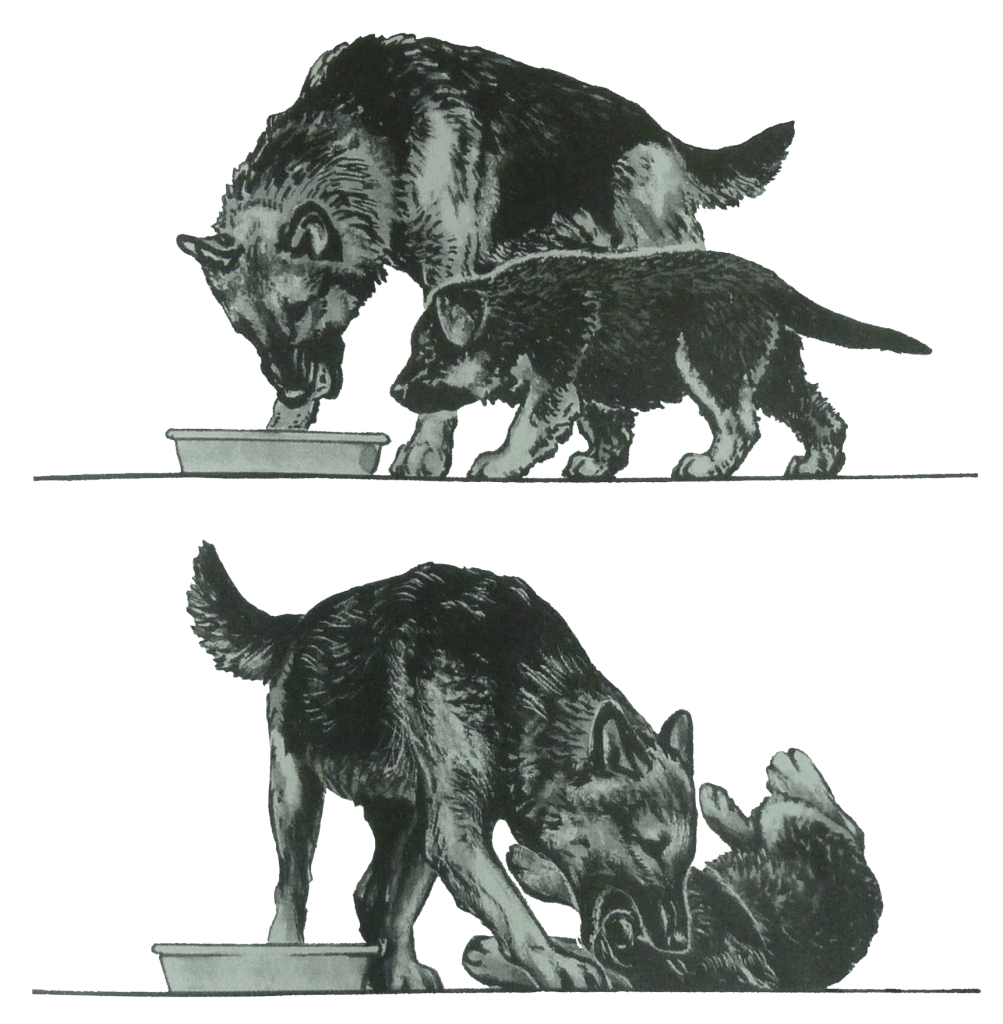
The Mathematician Rat—An Evolutionary Explanation

Giant Gambian Pouched By Xavier Rossi

Giant Gambian Pouched finds a landmine (photo by Xavier Rossi).

JG is a rat, a Cricetomys gambianus or Giant Gambian Pouched Rat; she is also a Hero Rat, a landmine detector at Apopo in Tanzania. In December 2009, she performed uncharacteristically badly and puzzled everybody as Hero Rats don’t make mistakes. What was the problem with JG? Had she lost it? Had the trainers made a crucial mistake?

Apopo in Morogoro, Tanzania, trains rats to detect landmines and tuberculosis and the little fellows are very good at what they do. In Mozambique, Apopo has so far cleared 2,063,701 square meters of Confirmed Hazardous Areas, with the destruction of 1866 landmines, 783 explosive remnants of war and 12,817 small arms and ammunitions. As for tuberculosis, up until now the rats have analyzed 97,859 samples, second-time screened 44,934 patients, correctly diagnosed 7,662 samples and discovered 2,299 additional cases that were previously missed by the DOTS centers (Direct Observation of Treatment, Short Course Centers in Tanzania). More than 2,500 patients have since been treated for tuberculosis after having been correctly diagnosed by the rats.

In December 2009, I was working full time at Apopo in Morogoro. I wrote their training manual, trained their rat trainers, supervised the training of the animals and analyzed standard operating procedures. At the time of writing, I still do consultancy work for Apopo and instruct new trainers from time to time. Back then, one of my jobs was to analyze and monitor the rats’ daily performance and that’s when I came across the peculiar and puzzling behavior of JG in the LC3 cage.

Problem

LC3 is a cage with 10 sniffing holes in a line and the rats run it 10 times. On average, 21 holes, randomly selected by computer, will contain TNT samples. We train rats in LC3 everyday, recording and statistically analyzing each session. We normally expect the rats to find and indicate the TNT samples with a success rate of 80-85%. Whenever the figures deviate from the expected results, we analyze them and try to pinpoint the problem.

On December 19, we came across a rat in LC3 that did not indicate any positive samples placed from Holes 1 to 6. She only indicated from Holes 7 to 10. In fact, from Hole 1 to 6, Jane Goodall (that’s the rat’s full name) only once bothered to make an indication (which was false, by the way). From Hole 7 to 10, JG indicated 10 times with 9 correct positives, only missing one, but also indicated 11 false positives. Her score was the lowest in LC3 that day and the lowest for any rat for a long time. What was the problem with JG? She seemed fine in all other aspects and seemed to know what she was doing. Why then did she perform so poorly?

Giant Gambian Pouched Rat By Silvain Piraux

Giant Gambian Pouched Rat searching TNT in a line cage (photo by Silvain Piraux).

Analysis of searching strategies

Whenever an animal shows such a behavior pattern, and it appears purposeful rather than emotional, I become suspicious and suspect that there is a rational explanation.

In order to analyze the problem, I constructed simulations of two searching strategies: (1) searching ALL HOLES, and (2) SKIPPING Holes 1 to 5 (I didn’t want to be as radical in my simulation as JG). In addition, I ran simulations with two different sample placement configurations: (1) evenly distributed between the two halves, i.e. two positives in Holes 1 to 5 and two positives in Holes 6 to 10; and (2) unevenly distributed — one positive in the first five holes and two positives in Holes 6 to 10.

In order to run the simulation, I needed to assign values to the different components of the rat’s behavior. I chose values based on averages measured with different rats.

  • Walking from feeding hole to first hole (back walk) = 3 seconds.
  • Walking from covered hole to covered hole = 1 second.
  • Walking from uncovered hole to uncovered hole = 2 seconds.
  • Analyzing a hole = 2 seconds.
  • Indicating a positive = 4 seconds.
  • Walking from last hole to feeding hole = 1 second.
  • Eating the treat = 4 seconds.

All time variables were converted into energy expenditure in the calculation of energy payoff for the two strategies and the different configurations. Also the distance covered was converted into energy expenditure. The reinforcers (treats) amounted to energy intake. In my simulation I used estimated values for both expenditure and intake. However, we could measure all values accurately and convert all energy figures into kJ. 

The results

RatTable1
In terms of energy,  (in this simulation I make several assumptions based on reasonable values, e.g. the total energy spent is a function of distance covered and time spent), the results show that when the value of each treat is high (E gain is close to the sum of all treats amounting to the sum of energy spent for searching all holes), it pays off to search all holes (the loss of -5.50 versus -7.88). The higher the energetic value of each treat, the higher the payoff of the ALL HOLES strategy.This is a configuration with four positives (x) and six negatives (0). The results show that neither strategy is significantly better than the other. On average, when sniffing all holes, the rat receives a treat every 31 seconds, while skipping the first five holes will produce a treat every 31.5 seconds. However, there is a notable difference in how quickly the rat gets to the treat depending on which strategy the rat adopts. ALL HOLES produces a treat on average 5.75 seconds after a positive indication. SKIPPING produces a treat 3.5 seconds after a positive indication. This could lead the rat to adopt the SKIPPING strategy, but it’s not an unequivocally convincing argument.

RatTable2

However, when the energetic value of each treat is low, skipping holes will reduce the total loss (damage control), making it a better strategy (-17.88 versus -25.50).

RatTable3
However, if we run a simulation based on an average of three positives per run, with one in the first half and two in the second half  (which is closest to what the rat JG was faced with on December 12), we obtain completely different results. This first analysis does not prove conclusively that the SKIPPING strategy is the best. On the contrary, it shows that, all things considered, ALL HOLES will confer more advantages.

RatTable4
The energy advantage is also detectable in this configuration, even when each treat has a high energetic value (a gain of 3.13 versus a loss of -0.75).With this configuration, the strategy of SKIPPING is undoubtedly the best. On average, it produces a reinforcer every 27.5 seconds (versus 28.7 for ALL HOLES) and 2.5 seconds after an indication (versus 5 seconds).

RatTable5
Conclusion

This second simulation proves that JG’s strategy was indeed the most profitable in principle. However, the actual results for JG are completely different from the ones shown above, as they also have to take into account the amount of energy spent indicating false positives (which are expensive).

It is now possible to conclude that the most advantageous strategy is as follows. Whenever the possibilities of producing a reinforcer are evenly distributed, search all holes. It takes more time, but on average you’ll get a reinforcer a bit quicker than if you skip holes. In addition, you either gain energy by searching all holes, or you limit your losses, depending on the energetic value of each reinforcer. Don’t be fooled by the fact you get a treat sooner after your indication when searching all holes then when skipping.

Whenever the possibilities of producing a reinforcer are not evenly distributed, with a bias towards the second half of the line, skip the first half. It doesn’t pay off to even bother searching the first half. By skipping it, you’ll get a lower total number of reinforcers, but you’ll get them quicker than searching all holes and, more importantly, you’ll end up gaining energy instead of losing it.

Finally, avoid making mistakes by indicating false positives. They cost as much as true positives in spent energy, but you don’t gain anything.          

An evolutionary explanation

Of course, no rat calculates energetic values and odds for certain behaviors that are reinforced, nor do they run simulations prior to entering a line cage. Rats do not do this in their natural environment either. They search for food using specific patterns of behavior, which have proven to be the most adequate throughout the history and evolution of the species. A certain behavior in certain conditions, depending on temperature, light, humidity, population density, as well as internal conditions such as blood sugar level etc., will produce a slightly better payoff than any other behavior. Behaviors with slightly better payoffs will tend to confer slight advantages in terms of survival and reproduction and they will accumulate and spread within a population; they will spread slowly, for the time factor is unimportant in the evolution of a trait. Eventually, we will come across a population of individuals with what seems an unrivalled ability to make the right decision in circumstances with an amazing number of variables, and it puzzles us because we forget the tremendous role of evolution by natural selection. Those individuals who took the ‘most wrong decisions’ or ‘slightly wrong’ decisions inevitably decreased their chances of survival and reproduction. Those who took ‘mostly right’ or ‘slightly righter’ decisions gained an advantage in the struggle for survival and reproduction and, by reproducing more often or more successfully, they passed their ‘mostly right’ or ‘slightly righter’ decisions genes to their offspring.

This is a process that the theory of behaviorism cannot explain, however useful it is for explaining practical learning in specific situations. In order to explain such seemingly uncharacteristic behaviors, we need to recur to the theory of evolution by natural selection. This behavior is not the result of trial and error with subsequent reinforcers or punishers. It is an innate ability to recognize parameters and behave in face of them. It is an ability that some individuals possess to recognize particular situations and particular elements within those situations, and correlate them with specific behavior. What these elements are, or what this ability exactly amounts to, we do not know; only that it has been perfected throughout centuries and millennia, and innumerable generations that accumulate ‘mostly right’ or ‘slightly righter’ decisions—and that is indeed evolution by means of natural selection.

Have a great day!

R—

Related articles

References

  • Catania, A. C. (1997) Learning. Upper Saddle River, NJ: Prentice-Hall. 4th ed.
  • Chance, P. (2008) Learning and Behavior. Wadsworth-Thomson Learning, Belmont, CA, 6th, ed.