Canine Ethogram—Social and Agonistic Behavior

Natural selection favors behaviors that prolong the life of an animal and increase its chance of reproducing; over time, a particularly advantageous behavior spreads throughout the population. The disposition (genotype) to display a behavior is innate (otherwise the phenotype would not be subject to natural selection and evolution), although it requires maturation and/or reinforcement for the organism to be able to apply it successfully. Behavior is, thus, the product of a combination of innate dispositions and environmental factors. Some behaviors require little conditioning from the environment for the animal to display it while other behaviors requires more.

Behavior is the response of the system or organism to various stimuli, whether internal or external, conscious or subconscious, overt or covert, and voluntary or involuntary.

Behavior does not originate as a deliberate and well-thought strategy to control a stimulus. Initially, all behavior is probably just a reflex, a response following a particular anatomical or physiological reaction. Like all phenotypes, it happens by chance and evolves thereafter.
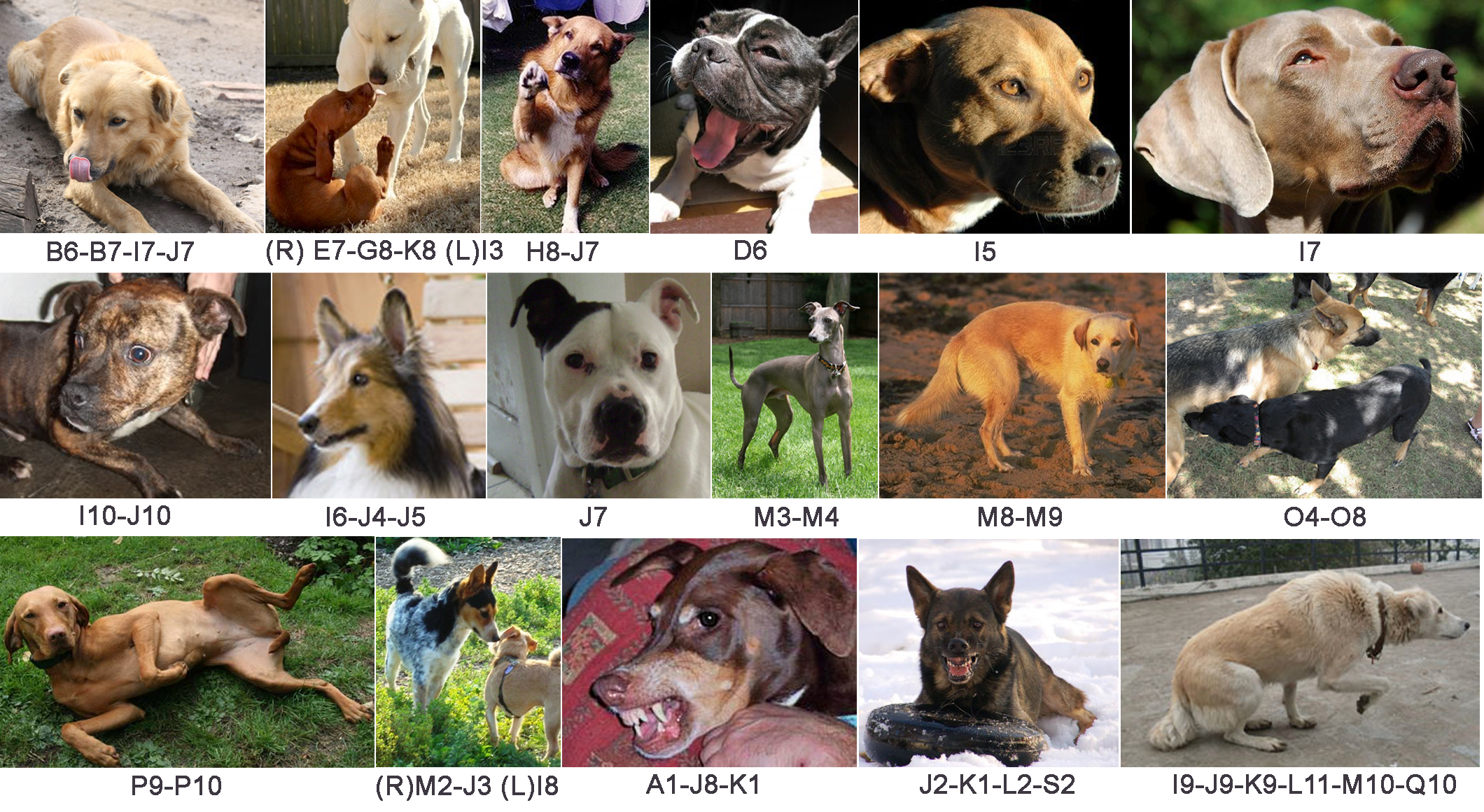
 

Canine Ethogram Social Agonistic Photos
Pictures illustrating canine social and agonistic behavior. For the classification of the behavior, please see ethogram below. Behavior is dynamic (not static). All interpretations are therefore only approximate and as pictures allow.


An organism can forget a behavior if it does not have the opportunity to display it for a period of a certain length, or the behavior can be extinguished if it is not reinforced for a period.

Evolution favors a systematic bias, which moves behavior away from maximization of utility and towards maximization of fitness.

Social behavior is behavior involving more than one individual with the primary function of establishing, maintaining, or changing a relationship between individuals, or in a group (society).

Most researchers define social behavior as the behavior shown by members of the same species in a given interaction. This excludes behavior such as predation, which involves members of different species. On the other hand, it seems to allow for the inclusion of everything else such as communication behavior, parental behavior, sexual behavior, and even agonistic behavior.

Sociologists insist that behavior is an activity devoid of social meaning or social context, in contrast to social behavior, which has both. However, this definition does not help us much because all above mentioned behaviors do have a social meaning and a context unless ‘social’ means ‘involving the whole group’ (society) or ‘a number of its members.’ In that case, we should ask how many individuals are needed in an interaction to classify it as social. Are three enough? If so, then sexual behavior is not social behavior when practiced by two individuals, but becomes social when three or more are involved, which is not unusual in some species. We can use the same line of arguing for communication behavior, parental behavior, and agonistic behavior. It involves more than one individual and it affects the group (society), the smallest possible consisting of two individuals.

Agonistic behavior includes all forms of intraspecific behavior related to aggression, fear, threat, fight or flight, or interspecific when competing for resources. It explicitly includes behaviors such as dominant behavior, submissive behavior, flight, pacifying, and conciliation, which are functionally and physiologically interrelated with aggressive behavior, yet fall outside the narrow definition of aggressive behavior. It excludes predatory behavior.

Dominant behavior is a quantitative and quantifiable behavior displayed by an individual with the function of gaining or maintaining temporary access to a particular resource on a particular occasion, versus a particular opponent, without either party incurring injury. If any of the parties incur injury, then the behavior is aggressive and not dominant. Its quantitative characteristics range from slightly self-confident to overtly assertive.

Dominant behavior is situational, individual and resource related. One individual displaying dominant behavior in one specific situation does not necessarily show it on another occasion toward another individual, or toward the same individual in another situation.

Dominant behavior is particularly important for social animals that need to cohabit and cooperate to survive. Therefore, a social strategy evolved with the function of dealing with competition among mates, which caused the least disadvantages.

Aggressive behavior is behavior directed toward the elimination of competition while dominance, or social-aggressiveness, is behavior directed toward the elimination of competition from a mate.

Fearful behavior is behavior directed toward the elimination of an incoming threat.

Submissive behavior, or social-fear, is behavior directed toward the elimination of a social-threat from a mate, i.e. losing temporary access to a resource without incurring injury.

Resources are what an organism perceives as life necessities, e.g. food, mating partner, or a patch of territory. What an animal perceives to be its resources depends on both the species and the individual; it is the result of evolutionary processes and the history of the individual.

Mates are two or more animals that live closely together and depend on one another for survival.

Aliens are two or more animals that do not live close together and do not depend on one another for survival.

A threat is everything that may harm, inflict pain or injury, or decrease an individual’s chance of survival. A social-threat is everything that may cause the temporary loss of a resource and may cause submissive behavior or flight, without the submissive individual incurring injury. Animals show submissive behavior by means of various signals, visual, auditory, olfactory and/or tactile.

Canine Ethogram
Canine ethogram covering social and agonistic behavior.


The diagram does not include a complete list of behaviors.

As always, have a great day!

R—

PS—I apologize if by chance I’ve used one of your pictures without giving you due credit. If this is the case, please e-mail me your name and picture info and I’ll rectify that right away.

References

Dogs And Children

Dogs And ChildrenDogs And Children

Children and dogs in the same household equals many moments of joy for the whole family, dogs included. There are a few considerations that parents should bear in mind and a few rules that children and dogs must learn. These rules are simple and easy to learn.

This book contains sound advice for parents and dog owners.

This little book was published in Danish by Borgen Publishers in 1986 as one in a series of five booklets that dealt with the most common questions asked by dog owners and the problems they ran into. It was never reprinted after the first edition of 25,000 copies sold out. It became since then a bit of a collector’s item.

“Dogs and Children” was published in Danish, Norwegian and Italian, and never translated into English until now. I have often been asked to write about dogs and children and I have done so occasionally in short articles and blogs, but the advice has never been published as a book, except for this booklet. The other day, whilst dusting off my books, I came across the five booklets and thought it would be a good idea to translate the original “Hund og Barn” into English. I have kept the original photos and layout and it is now available free of charge as a flip-page E-book.

The intention of this little book was to provide dog owners with sound advice that would help them prevent accidents from happening and, as such, I believe that it can still perform the same role today as it did 26 years ago.

Click the full-screen view icon for better reading. Zoom in and out as you please.


Sorry, this book is no longer available here. Please, visit Ethology Institute’s Online Bookstore.


Related articles

Life’s All About Food And Sex

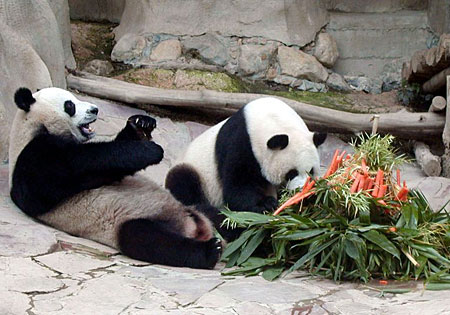
Pandas at the Chiang Mai Zoo in northern Thailand.

To offer food to females in exchange for sex works well for most males in various species, except when one eats too much of it. At the Chiang Mai Zoo in Northern Thailand, the male panda, is apparently too fat to have sex and his partner, the female Lin Hui, has lost interest. Zoo keepers have done everything to spice up their sex life including showing them movies of other pandas having sex!... (photo from Chiang Mai Zoo).

The other day I went to my favorite bar (and yes, of course it’s Irish) to drink a couple of beers, play some pool and have a bit of fun. The regulars, my mates, are an eclectic mix of professions, trades, ages, economic status, ethnic backgrounds and sexual orientations, all with very different interests in life. Mostly, we just have fun, drink beers and martinis, play pool, discuss football and holidays, complain about how everything got to be so expensive and the incompetence of politicians, and we laugh at a good as well as a bad joke. Sometimes, someone throws in a kind of provocation, a more complex question.

“Cheers, mate!” someone shouts to me from across a table. “You’re a biologist, so you may be able to answer my question for the day: what’s life all about?”

Fruit Fly Boozing

Sex-deprived fruit fly males drink alcohol four times more than others (photo from Geekologie).

“Cheers to you too, mate. You can’t ask a thing like that. That’s not a bar question,” I say. “But, no problem there. Life is all about food and sex,” I add, taking a slug of my wonderfully cold beer and confirming my view that the first beer always tastes the best.

“Hey, I’m asking a serious question,” he protests, “gimme a serious answer!”

“I’m giving you a serious answer. Everything living organisms do is to get either food or sex. Food is a great thing. Firstly, it is necessary to survive and you need to survive in order to have sex, because, if you’re dead, you can’t have sex. Secondly, females in particular love food because they need food to survive, so they can have sex, so they can have progeny; and their progeny needs food, lots of food.”

“Maybe for other animals,” he argues. “But for us humans, there’s more to life than food and sex. What about science, for one?”

“Very simple—science is a means to an end. Why do you think there are many more male scientists than female? Because they need to invent easy ways to get food to give to females, because the females then get all crazy about them and they have sex. Then, they get more progeny who need more food, which implies more science, more sex…”

“You’re far out, mate, we’re more than that. We have a soul, we produce great art!”

“Most good art is produced by unhappy males. How often do  you hear of a great, happy artist? Do you know why they are unhappy? Because they don’t get the sex they want. That’s why they produce art. Females like beauty because the more beautiful sons or daughters they have, depending on the species, the more grandchildren they will have. Also, artists are normally safe, they are sensitive and it is unlikely they will kill their progeny. So, males produce all the art they can to impress the females so they have sex with them. Then, they get more progeny, and the progeny needs more food, which…”

“OK, I got it,” he says, “artists are sensitive, but what about power?  I guess you’ll say it’s another way of getting sex.”

“You’re right. You’re a quick learner. Powerful males can in theory provide better for their progeny so females like powerful males. For the males, this is good news because if they don’t have a clue about art, they can always try to become rich or powerful, which are basically the same thing. Power means more sex because progeny that are well provided for survive longer, have more sex and have their own progeny, which means grandchildren. This means they need more food, more science…”

“What if I’m not good at art or at the power game?”

“Then, mate, you are in deep s… in terms of sex, but don’t worry, it happens to most males in most species. You can always bluff. Most males do.”

“Well, that’s maybe why I’m here drinking with my mates…”

“Could be. Fruit fly males deprived of sex drink four times more than their mates that have sex.”

“You’re kidding me!” he exclaims.

“No, I’m not, that’s scientific proven. It’s all a question of maintaining the levels of a neuropeptide in the brain and if you can’t have sex, booze seems to do it—for fruit files, that is. Fruit flies don’t play pool though, so no worries about that,” I say.

“Doesn’t sound fair to me,” he replies, “but who programmed this bloody thing anyway? Don’t tell me it was…”

“Nobody. Genes have only one goal, which is to reproduce, no matter what genes we’re talking about. It’s all about surviving and reproducing, eating and copulating. It’s like an algorithm, a very simple one indeed.”

“Not that I’m complaining, mate, not too much anyway, but it does bother me. It seems like the females control everything.”

“They do. In most species they choose the males. Virtually all females will mate and reproduce. For the males, it’s a lot more difficult. Competition is fierce and females are picky. Many males never get a chance. That’s why they have to trick the females with all their cunning, but food is the best and most direct way. Males try desperately to improve their chances, in some species by means of attractive exteriors, in others by appearing powerful. Basically, it’s all a bluff to impress the females.”

“So, the females are picky so they can get the best progeny and the best progeny of the progeny. Did I get that right?’

“Too right, mate. Males bluff, but females get better and better at calling their bluff because their main concern is to produce good progeny.”

“OK, I understand that and I can see what the females get, but one things beats me: what about the males, what do they get?”

“Sex.”

Have a beautiful day!

R-

Should We Reinforce the Effort or the Results?

Dog using its nose to search a target scent (photo from http://www.houndcrazy.com).

If you ask, “should we reinforce effort or the results?” you are liable to get as many answers supporting one idea as the other. Supporters of reinforcing effort sustain that reinforcing results creates emotional problems when one doesn’t succeed and decreases the rate of even trying. Supporters of reinforcing results maintain that reinforcing effort encourages sloppiness and cheating.

I shall proceed to argue for and against both theories and prove that it is not a question of either/or, rather of defining our criteria, processes and goals clearly.

I shall compare the learning of some skills in dogs and humans because the principles are the same. The difference between them and us is one “of degree, not of kind,” in the words of Darwin.

I will use SMAF to accurately describe some of the processes whenever I consider it advantageous. If you are not proficient in SMAF, you can read the free SMAF manual at http://wp.me/p1J7GF-8Y.

The main difficulty in some learning processes is reinforcing the right behavior at the right time, which bad teachers, bad parents and bad trainers do not master (here bad means inefficient, it is not a moral judgment).

Much of my personal work with dogs (and rats) is and has been detection work, mainly of narcotics and explosives, but also of people tobacco and other items. One of the first signals I teach the animals is a disguised reinforcer.

With dogs, I use the sound ‘Yes’ (the English word) and with rats a ‘bip….bip….bip’ sound produced on their backpacks and triggered by me.The signal part of this signal/reinforcer means “continue what you’re doing” and the reinforcer part “we’re OK, mate, doing well, keep up.” This is a signal that becomes a reinforcer: Continue,sound(yes) that becomes a “!+sound”(yes).

The difference between the most used “!±sound”(good-job) and “!+sound”(yes) is that the former is associated and maintained with “!-treat”(small food treat) and “!-body(friendly body language) and the latter with a behavior that will eventually produce “!-treat”. The searching behavior does not produce a treat, but continuing searching does, eventually (find or no find). This is why “!+sound”(yes) is a disguised Continue,sound(yes), or the other way around.

Why do I need this interbreeding between a signal and a reinforcer?

Because the signal ‘Search’ (Search,sound) does not mean ‘Find the thing.’ Sometimes (most of the time) there’s nothing to find, which is a relief for all of us (airports and the likes are not that full of drugs and explosives).

So, what does Search,sound mean? What am I reinforcing? The effort?

No, I’m not. We have to be careful because if we focus on reinforcing the effort, we may end up reinforcing the behavior of the animal just strolling around, or any other accidental and/or coincidental behavior.

I am still reinforcing the result. ‘Search’ means, “Go and find out whether there is a thing out there.” ‘Thing’ is everything that I have taught the dog to search and locate for me, e.g. cocaine, hash, TNT, C4.

“Go and find out whether there is a thing out there” leaves us with two options that are equally successful: ‘here’ and ‘clear.’ When there is a thing present, the dog answers ‘here’ by sitting as close to it as possible, or pointing to it (I have taught it those behaviors). When there is no thing, I want the animal to tell me exactly that: the dog answers ‘clear’ by coming back to me (again because I have taught it to do that). We have two signals and two behaviors:

Thing,scent => dog sits (‘here’ behavior).

∅Thing,scent => dog comes back to me (‘clear’ behavior).

The signals are part of the environment, they are not given by me, which does not matter: a signal (SD) is a signal*. An SD is a stimulus associated with a particular behavior and a particular consequence or class of consequences. When we have two of them, we expect two different behaviors and when there is none, we expect no behavior. What fools us here is that in detection work we always have one and only one SD, either a scent or the absence of one. It is not possible to have none. Either we have a scent or we don’t, which means that either we have Thing,scent or we have ∅Thing,scent, each requiring two different behaviors as per usual. The one SD is the absence of the other.

Traditionally, we don’t reinforce a search that doesn’t produce a find. To avoid extinguishing the behavior, we use ‘controlled finds’ (a drug or an explosive, we know it is there because we have placed it there to give the animal a possibility to obtain a reinforcer).

This solution is correct, except that it teaches the dog that the criterion for success is ‘to find’ and not ‘not to find,’ which is not true. ‘Not to find’ (because there is no thing out there) is as good as ‘to find.’ The tricky part is, therefore, to reinforce the ‘clear’ and how to do it to avoid sloppiness (strolling around) and cheating.

Let us analyze the problem systematically.

The following process does not give us any problems:

{Search,sound ⇒ b1(dog searches) => “!+sound”(yes) or Continue,sound(yes) ⇒ b1(dog searches) ⇒ dog finds thing (Thing,scent) ⇒ b2(dog sits=’here’ behavior) => “!+sound” + “!-treat”};

No problem, but what about when there is no thing (∅Thing,scent)? If I don’t reinforce the searching behavior, I might extinguish it. Then, I reinforce the searching with “!+sound”(yes):

{“Search,sound” ⇒ b1(dog searches) => “!+sound”(yes) ⇒ b1(dog searches) => ∅Thing,scent ⇒ b3(dog comes back to me=’clear’ behavior) => “!+sound” + “!-treat”};

It all looks good, but it poses us some compelling questions:

How do I know the dog is searching versus strolling around (sloppiness)?

How do I know I am reinforcing the searching behavior?

If I reinforce the dog coming back to me, then next time I risk the dog having a quick sniff round and coming straight back to me. That’s the problem. I want the dog to come back to me only when it finds nothing (as in it didn’t find anything).

Problems:

Reinforcing the searching behavior.

Identifying the searching behavior versus strolling around (sloppiness). How can I make sure that the dog always searches and never just strolls around?

Solution:

Reinforcing the searching behavior with “!+sound”(yes) works. OK.

Remaining problem:

I have to reinforce the ‘clear’ behavior (coming back to me), but how can I ensure the dog always searches and never just strolls around (avoid sloppiness)?

How can I make sure the dog has no interest in being sloppy or cheating me?

Solution:

To teach the dog that reinforcers are only available if and only if:

1. the dog finds the thing. {Thing,scent ⇒ b2(dog sits) => “!+sound” + “!-treat”};

2. the dog does not ever miss a thing. {∅Thing,scent ⇒ b3(dog comes back to me) => “!+sound” + “!-treat”};

Training:

I gradually teach the dog to find things until I reach a predetermined low concentration of scent (my goal). In this phase of training, there is always one thing to find. After 10 consecutive successful finds (my criterion and quality control measure), all producing reinforcers for both the searching (“!+sound”(yes)) and the finding (“!+sound” + “!-treat”), I set up a situation with no thing present (∅Thing,scent). The dog searches and doesn’t find anything. I reinforce the searching and the finding (no-thing) as previously. Next set-up: I make sure there is a thing to find and I reinforce both searching and finding.

I never reinforce not-finding a thing that is there, nor finding a thing that is not there.

Consequence: the only undesirable situations for a dog is

(1) not-finding a thing that is there (the dog did not indicate Thing,scent), or (2) indicating a thing that is not there (the dog indicates ∅Thing,scent).

(1) {Thing,scent ⇒ b3(dog comes back to me=‘clear’ behavior) => [?+sound] + [?-treat]};

Or:

(2) {∅Thing,scent ⇒ b2(dog sits=‘here’ behavior) => [?+sound] + [?-treat]};

This is (negatively) inhibiting negligence, but since it proves to increase the intensity of the searching, we cannot qualify it as an inhibitor (earlier punisher). Therefore, we call it a non-reinforcer: “∅+sound”, “∅-treat”.

In the first case: Thing,scent => Dog comes back to me => [?+sound] + [?-treat].

Becomes:

Thing,scent => Dog comes back to me => “∅+sound”, “∅-treat”.

Then:

{Thing,scent ⇒ b3(dog comes back to me) => “∅+sound”, “∅-treat” ⇒ b1(dog searches–more intensively) => Thing,scent ⇒ b2(dog sits=‘here’ behavior) => “!+sound” + “!-treat”};

In the second case, I have to be absolutely sure that there is indeed no thing. The training area must be free from any scent remotely similar to the scent we are training (Thing,scent). This is an imperative, especially in the first phases of the training process, and the trainer that misses this point is committing major negligence.

Nevertheless, should the dog, show ‘here’ for ∅Thing,scent, then we can use the same procedure as above:

{∅Thing,scent ⇒ b2(dog shows ‘here’ behavior) => “∅+sound”, “∅-treat” ⇒ b1(dog searches–more intensively) => ∅Thing,scent ⇒ b3(dog comes back to me=‘clear’ behavior) => “!+sound” + “!-treat”}.

What if later the dog doesn’t find a thing that is there in a lower concentration than the one I used for training, or is masked by other scents?

That’s no problem, it’s not the dog’s fault. I didn’t train for it. The dog doesn’t know that it is making a mistake by giving me a wrong ‘clear.’ As far as the dog is concerned, the room is clear: {∅Thing,scent ⇒ b3(dog comes back to me => “!+sound” + “!-treat”}; The dog was not strolling around and is not cheating me.

A human example:

I reinforce the child trying to solve a math problem. ‘Well done, but you got it wrong because…” The solution is wrong, but the method was correct. Therefore, it is all a question of training. The ‘wrong’ will be eliminated with more or better training, or maybe it was caused by an excessive increase in the difficulty curve of the problem (the teacher’s problem). We are not reinforcing trying; we are reinforcing the correct use of a method.

Why reinforce the process?

We must reinforce the process because of its emotional and motivational consequences. The dog and the child must accept the challenge, must want to be challenged, and be able to give their best in solving the problem. The exercise in itself will eventually end up being self-reinforcing.

Are we reinforcing the effort rather than the success?

No, we are not. Reinforcing the effort rather than the result can even lead to false positives. The animal indicates something that it is not there because it associates the reinforcer with the behavior, not the thing. Children give us three-four quick, consecutive, wrong answers if we reinforce the trying, not the process (thinking before answering).

We reinforce result (success) only.

When the dog doesn’t find because there’s nothing to find, that is success. When the dog doesn’t find because the concentration was too low, that is also success because ‘too low’ is here equal to ‘no thing.’ When the child gets it wrong, it is because the exercise exceeded the capacity of the child (he or she has not been taught to that level).

We are still reinforcing success and exactly what we trained the dog and the child to do. We don’t say to the child, “Well, you tried hard enough, good.”

We say, ” Well done, you did everything correctly, you just didn’t get it right because you didn’t know that x=2y-z and there was no way of you knowing.”

Next time, the child gets it right because she now knows it; and if not, it is because x=2y-z exceeds the capacity of that particular child in which case there’s nothing you can do about it.

The same goes for the dog: the dog doesn’t indicate 0.01g of cocaine because I trained it to indicate as low as 0.1g. When I reinforce the dog’s ‘clear,’ I say, “Well done, you did everything correctly, you just didn’t get it right because you didn’t know that 0.01g cocaine is still the thing.”

Now, I train the dog that ‘thing’ means ‘as low as 0.01g cocaine’ and either the dog can do it or it cannot. If it can, good; if it cannot, there’s nothing you or I, the dog or the child can do about it.

Conclusion:

We reinforce result, success, not the effort, not the trying. We must identify success, have clear criteria for success, plan a successive approach to our goal and gradually increase difficulty. We must be able to recognize limits and limitations in ourselves, in the species we work with, in the individuals we tutor, in the particular skill we teach. We must know when we cannot improve a skill any further and when an individual cannot give us more than what we are getting; and be satisfied with that.

Have a great day!

R-

Footnote: * Strictly speaking, the scent that the detection dog searches is not a signal, but a cue, because it is not intentional. In this context, however, it is and SD because we have conditioned it to be so and, therefore, we can call it a signal. Please, see “Signal and Cue—What is the Difference?” at http://wp.me/1J7GF.

SMAF Manual

SMAF Cover Page

SMAF Cover Page

Mission SMAF—Bringing Scientific Precision Into Animal Training

This is the SMAF manual, latest update. The SMAF manual is in a way a super concentrated course in animal learning. This is only a booklet, but it will take you time to read and digest. Don’t rush thru it.

We update this manual regularly, sometimes even daily. Come back often to check if there are any new updates. Each manual has a version number (v.YYMMDD).

Changes in this version v.120302:

  • Updated and improved syntax with some new symbols.
  • Updated examples of how to transcribe the teaching of skills in SMAF.
  • New Chapter 4 “Quick guide to designing a POA in SMAF.”

Enjoy your reading!

R-

Click the full-screen view icon for better reading. Zoom in and out as you please.

Related articles

Updates

Changes in version v.111023:

  • Definition of command with example, page 10: “While a signal is everything that intentionally changes the behavior of the receiver, a cue is everything that unintentionally changes the behavior of the receiver. A command is a signal that changes the behavior of the receiver in a specific way with no variations or only extremely minor variations.”
  • SMAF syntax corrected, page 22: “25.2. Example 1: Sit,sound + Sit,hand + γSit,treat  ⇒ The dog sits ⇒ “!+sound” + “!-food”.” (The second ⇒ was missing).
  • Minor typos corrected.

Changes in version v.111017:

  • Semi-conditioned reinforcers have their own code.
  • Non-SD has its own code.
  • New code for reinforcers and punishers.
  • Signal and cue slightly redefined.
  • A new POA example (POA example 3).
  • New photos.

Signal and Cue—What is the Difference?

Male Lion (Panthera leo) and Cub eating a Cape...

Secondary sexual traits, as the mane of the male lion, are powerful cues (Image via Wikipedia).

In the behavioral sciences, there is some confusion about the meaning of the terms signal and cue (as with so many other terms) and some authors use it interchangeably. To make it even more difficult, communication theory also uses the same terms with slightly different meanings and in the theatre and movies world a ‘cue’ is actually a ‘signal.’

However, in behavioral sciences, the general consensus (see references below) is that signal and cue have the following meanings.

signal is a perceivable behavior or feature that has evolved and has acquired the specific characteristic of conveying information about the signaler or the signaler’s environment. Information (communication) changes the behavior or the beliefs of the receiver.

This definition of signal implies that if a signal changes the behavior of an organism, this change of behavior must be profitable to both sender and receiver more often than not, or otherwise, signalers would cease to send the signal and receivers would cease to respond. This definition distinguishes, in principle, a signal from coercion, although some signals may be coercive, e.g. threats.

In general, signals must be honest and reliable, or otherwise they cease to have any effect (receivers don’t behave appropriately) and they undermine communication (honest senders will not benefit from sending the signals). However, some signals can tolerate a certain degree of dishonesty, all depending on the costs and benefits for all parties. H. W. Bates discovered in 1861 that some (palatable) butterflies had an advantage in mimicking (Batesian mimicry) poisonous butterflies, which is detrimental to the poisonous butterflies inasmuch as it turns their signals of unpalatability less reliable. On the other side, some species use the same signals to convey the same information and they all benefit from it (Mullerian mimicry).

cue is any feature that an organism can use as a guide to display a particular behavior or series of behaviors. The classical example is the mosquito seeking a mammal to bite and flying up wind when it detects CO2. The CO2 is a cue for the mosquito, but it is surely not a signal sent by the mammal, which would prefer to remain undetected and not be bitten. Intentionality is the key element to distinguish signals from cues.

A cue is a regularity, a pattern that either is permanently ‘on,’ or is ‘on’ and ‘off” depending on specific conditions, e.g. a rock, a tree, or the position of the sun in the sky cues us of directions, and dark clouds cues us of impending rain. The rock, the tree, the sun and the clouds are not there to give us information, but they do if we interpret them correctly. A signal is more malleable, more intentional and we can turn it ‘on’ and ‘off’ in response to relevant cues in the environment, e.g. the warning cry that many species (signal) issue in response to the appearance (cue) of a feared predator.

Cues are traits or actions that benefit the receiver exclusively. The sun and the rock do not profit from us getting our bearings. When a mouse by accident makes a rustling sound in the leaves and attracts a predator increasing the risk of being killed, the sound is a cue for the predator about the location of its prey. When an alert animal deliberately gives a warning call to a stalking predator resulting in the predator giving up the hunt, this sound, the alert call, is a signal both for conspecifics and the predator. Different species can, thus, communicate by means of signals which both recognize and behave accordingly.

Secondary sexual traits are features that distinguish the two sexes of a species, but that are not directly part of the reproductive system. They are probably the product of sexual selection for traits, which give an individual an advantage over its rivals in courtship and competitive interactions. Secondary sexual traits are also cues for the opposite sex. They are not directly related to a better production of offspring, but are normally good indicators of better sperm quality or egg production, e,g, manes of male lions (Panthera leo) and long feathers of male peacocks (Pavo cristatus). In humans, visible secondary sexual traits include enlarged breasts of females and facial hair on males.

The study of signals and cues is more complex that it may appear at first sight. Cues can become signals. In 1952, Niko Tinbergen described ritualization as the evolutionary process whereby a cue may be converted into a signal, e.g. the canine behavior of baring teeth. In 1975, Zahavi described the handicap principle where the reliability of some signals is ensured because they advertise greater costs than absolutely necessary, e.g. the exaggerated plumage of the peacock.

We must understand correctly what the intentionality of signals means and not to confound the intentionality of the signal itself with its origin, development and evolution. Signals do not origin by design with a determined purpose. Some features or behaviors just happen at a certain time to be efficient for an organism in generating in another organisms the right behavior at the right time. If they convey an advantage to these organisms in their struggle for survival (and reproduction), they will spread in the population (provided these organisms reproduce). With time, they gain intentionality and become true signals, but their origin was accidental like everything else. This is the reason why I had to modify (some extensively) the definitions I use in this text and I had to create new ones—to make them compatible with the Darwinian theory of evolution.

Applying the principle of simplicity, as always, I suggest the following definitions:

signal is everything that intentionally changes the behavior of the receiver. A cue is everything that unintentionally changes the behavior of the receiver.

These definitions open for the possibility to better distinguish between the intentional signals (proper signals) we send and the unintentional ones (which are cues). For example, many dog owners say “no” to their dogs meaning “stop what you are doing,” but their (unintentional) body language (cue) says “yes.”

In conclusion: signal is the most correct term to denominate what we use when we communicate with our animals; and signals may assume many forms, auditory (the words we use), visual (the hand movements and body language we use), olfactory (in canine detection work), tactile (a touch, very common in horse training) and probably also palatable.

So, enjoy the consequence of your (intentional) signals and be careful with any cues you may be (inadvertently) sending to your favorite animal. Enjoy as well your further studies of this fascinating topic: animal communication.

Keep smiling!

R-


References and further readings

  • Dawkins, M. S., and T. Guilford (1991). The corruption of honest signalling. Animal Behaviour 41:865–873.
  • Donath, J. (2007). Signals, cues and meaning (February draft for Signals, Truth and Design. MIT Press)
  • Hasson, Oren (1997). Towards a general theory of biological signaling. Journal of Theoretical Biology 185: 139-156.
  • Hauser, Marc D. and Mark Konishi, eds. (1999). The design of animal communication. Cambridge: Bradford/MIT Press.
  • Maynard Smith, John and David Harper (1995). Animal signals: Models and terminology. Journal of Theoretical Biology 177: 305-311.
  • Maynard Smith, John and David Harper (2003). Animal signals. Oxford University Press, UK.
  • McFarland, D. (1999). Animal Behaviour. Pearson Education Limited, UK.
  • Otte, D. (1974). Effects and functions in the evolution of signaling systems. Annual Review of Ecology and Systemat- ics 5:385–417.
  • Saleh, N et al. (2007) Distinguishing signals and cues: bumblebees use general footprints to generate adaptive behaviour at flowers and nest. Arthropod-Plant Interactions, 2007, 1:119–127
  • Schaefer, H. M. and  Braun, J. (2009). Reliable cues and signals of fruit quality are contingent on the habitat in black elder (Sambucus nigra). Ecology, 90(6), 2009, pp. 1564–1573.
  • Searcy, W. A., and S. Nowicki (2005). The evolution of animal communication. Princeton University Press, Princeton, New Jersey, USA.
  • Tinbergen, N. (1952). The curious behavior of the stickleback. Scientific American December 1952.
  • Zahavi, A. (1975). Mate selection: a selection for a handicap. Journal of Theoretical Biology 53:204–214.


Related articles

Commands or Signals, Corrections or Punishers, Praise or Reinforcers

An Australian Shepherd doing agility at the Ro...

Do you use signals or commands to communicate with your dog? (Image via Wikipedia)

Commands or signals, corrections or punishers, praise or reinforcers—does it matter what we call them?

If you think it doesn’t matter, there’s no need to read any further. If you think it does matter, please continue reading because I’d like to help you. I noticed some inconsistencies in contemporary dog training terminology  and will proceed to argue that they need correcting.  Trainers use too many terms that either are badly defined, not defined at all or already exist and mean something else.

Why is it important to agree on one single terminology? Because only then can we have a meaningful discussion and avoid falling out with people with whom we might otherwise like to cooperate.

For example, the majority of “positive” dog trainers have no problems using the word command and yet a command means “an authoritative direction or instruction to do something,” or “a line of code written as part of a computer program.” To command means “to exercise authoritative control or power over.” The word has connotations of the military, the police and of authority in general. Of course, we may use the word command but it beats me why we ban the terms dominance (without defining it properly) and punisher (whilst disregarding the correct, technical definition of the term) and use command with no concern whatsoever.

Personally, I have a problem with the use of command in dog training for several reasons. A command implies the obligation to execute a behavior in a very precise way. We give computers commands to execute actions in exactly the same way every single time, no variations allowed (that’s what we want from our computers). Army officers issue commands they want obeyed with no questions asked and disobedience is severely punished.

Is this what we want from our dogs? No, it is not. We want them to perform a behavior within a particular class of behaviors where variations are both inevitable and acceptable. There are many ways to sit correctly, but not many ways to “copy” or “paste”. The authoritarian aspect also bothers me; it implies subjugation. I don’t want my dog so much to obey me as to understand what I want him to do. The essence of communication is to convey information, not to enforce it. When we communicate, we use signals, and signals are understood, not obeyed and not commanded. I can’t say “I command you to understand.” A command is a signal before becoming a command, only we don’t need to issue commands to our dogs if we’ve done our job properly.

Signal seems to me undoubtedly the right term and has much better connotations than command. Your dog is not a computer, nor a soldier (PS—I have nothing against computers nor soldiers).

The same goes for the term punisher. You’ll find “positive” trainers using the word command without blinking, but demonizing you if you dare as much as whisper the word punisher, which doesn’t make any sense at all to me. If we are sensitive about the connotations of one term, it seems that we would also be sensitive about those of the other. Whilst blithely employing the word command, some trainers substitute punisher with correction, which doesn’t make any difference, it still means the same and is interchangeable with punisher in some senses.

Then, there is praisePraise means “an expression of approval and commendation,” “applaud,” “pay tribute to,” “compliment.” It is true that praise can influence learning in humans, but I doubt it very much that it has any value in animal training. Praise and reinforcer are two different things. We use reinforcers in dog training, not praise. “Positive” animal training claims to be a more humane way of training animals (meaning showing compassion or benevolence), to be more scientific than the “old-fashioned” training, and to know all about “classical conditioning” and “operant conditioning.” If this is true, why don’t we show it and educate people accordingly? Why don’t we use the proper scientific terms?

Some claim that the right scientific terms are too difficult. I fail to see what’s more difficult in reinforcer than in reward, in signal than in command, but even if it were true, this appears to me to be one of the situations where the end justifies the means. It would be a small price to pay in order to gain more clarity and avoid misunderstandings. Using technical terms instead of everyday words would also help people fully understand and use the various learning tools correctly. Sometimes, in trying to simplify things, we miss the point completely. Most dog owners don’t know that praise in dog training means “everything that increases the frequency, intensity and/or duration of a behavior when presented simultaneously or immediately after the behavior takes place” (= reinforcer). Dog owners are not more stupid than dog trainers and if the latter can learn it, so can the former. It’s up to us to motivate them. We were all dog owners before we became dog trainers. Did we like condescending dog trainers back then?

As far as I can see, we only have two options: (1) to claim that it doesn’t matter what we call things, in which case nobody should be labelled for using terms such as punisher, dominance, etc., and we can all be “positive” nevertheless; (2) to use, teach, encourage and propagate the use of correct, well-defined terms, starting with ourselves, in order to be consistent with ideology and methodology.

Personally, I am not worried by the terms you use and I will not label you solely on your choice of words. The only concern I have is that (unless I know you) when you say command I’m not so sure you know about the intricacies of signals, and when you say praise I’m not certain that you fully appreciate the function of reinforcers (and punishers). I understand that you don’t like the word punisher because you are a good person, but I’m not sure that this is the right way to manifest it. Changing a term doesn’t change an attitude. Sometimes, quite on the contrary, if you used the word punisher, you’d have an opportunity and a reason to emphasize that it has nothing to do with violence and abuse.

On the other side, I do have worries that we label good, humane, “positive” dog trainers otherwise because of their correct use of the scientific terms; and that we label good, humane, “old-fashioned” trainers abusive due to their ignorance of the terminology that is fashionable nowadays. Before you even think of labeling me on the basis of my comments here, I would like to remind you that my first book on dog training, published in 1984 and entitled “The Dog, Our Friend—Psychology rather than Power,” was a revolution in dog training at the time; it was the first book (as far as I know) to describe exactly how to teach a dog sit, stand, down, come, heel, jump, slalom, treat-on-the-nose, retrieve, etc., without the use of any force at all. I showed even pictures of the clicker (except that we used a whistle) and of the precursor of these so fashionable toys that you fill with treats to stimulate the dog. Since then, many have followed in the same spirit: respect for the dog as a species and as an individual.

The bottom-line is that we should define terminology and implement it consistently. As it stands now, I’m afraid we’ll lose many good people for our cause of “a better world for dogs and dog owners” because of fashionable trends and pettiness.

Think about it.

Keep smiling,

R-

Unveiling the Myth of Reinforcers and Punishers

Cute Dog

Positive and negative reinforcerspositive and negative punishment— these terms are no doubt familiar to you but the definitions are confusing or you may be unsure of how and when to use each. I shall endeavor to explain. As a biologist and an ethologist, I study and explain such topics irrespective of political correctness, commercial interests, or fashion trends.

Except for reflexes, the behavior of all living creatures changes as a result of its consequences; and there are only two ways in which behavior can change: there can be more of it or less of it. Even what we call new behavior is nothing more than an increase in frequency, intensity and/or duration of components of an individual’s behavioral repertoire. New behavior sometimes amounts to the recombination of well-practiced elements. We may alter its frequency, its intensity, its duration and we may associate it with new stimuli, but if that particular element of behavior is not present in the behavioral repertoire of the animal, it will not be displayed.

As most people know, reinforced behavior tends to increase in frequency, intensity and/or duration and punished behavior tends to do exactly the opposite, i.e. it decreases in frequency, intensity and/or duration.

As most people should also know, a reinforcer is not a reward, like the bonus our boss gives us at the end of the year because he earned a lot of money. A reinforcer is anything that somehow increases a certain behavior. It may not increase the behavior of every individual, or every behavior. A reinforcer is thus only a reinforcer in relation to a specific behavior and a particular individual. It may also work, as reinforcers often do, in circumstances other than those originally envisaged, and on a class of individuals, but this is incidental (an added extra), not a requirement.

In contrast, a punisher tends to decrease the frequency, intensity and/or duration of a behavior. Again, punishers are particular to specific behaviors and individuals, and need not operate on various individuals or behaviors. There is a tendency to relate punishers to violence, but a punisher is simply an aversive, i.e. something, one would like to avoid in a specific context, and does not necessarily have anything to do with violence. For example, I immensely dislike mayonnaise, which implies that any restaurant that serves me a sandwich with mayo will decrease the frequency of my visits to that specific restaurant. Unbeknown to him, the chef is actually punishing me (or rather my behavior of visiting his restaurant). When I open a window and am almost blown away by gale force wind, I hasten to shut it again. The natural elements punished me for my opening-the-window-behavior.

In short, reinforcers and punishers are everywhere and we are exposed to them by simply living and interacting in this world. There’s no way of avoiding them completely. You can learn how to control them, by controlling your behavior, so you are reinforced more often than you are punished if that’s what you want, but even experienced people, wolves, bears, wombats, jellyfish and, of course, dogs, sometimes display behaviors, which are instantly and duly punished. Behavior punished and behavior reinforced—that is how we all learn and it’s a fact of life whether we like it or not.

In terms of learning theory, the scientific definitions of reinforcers and punishers are:

reinforcer is everything that increases the frequency, duration, and/or intensity of a particular behavior when presented or removed simultaneously or immediately after that behavior takes place. Reinforcement is the presentation of a positive reinforcer or the withdrawal of a positive punisher (an aversive).

punisher is everything that decreases the frequency, duration, and/or intensity of a particular behavior when presented or removed simultaneously or immediately after that behavior takes place. Punishment is the presentation of a positive punisher or the withdrawal of a positive reinforcer.

Bottom line: in principle reinforcers and punishers are neither good nor bad, they are not things we like or don’t like, they are just stimuli that either increase or decrease the frequency, intensity and/or duration of a behavior. A reinforcer may be a punisher one day and a reinforcer another, whilst a reinforcer for you may be a punisher for me. Consider the following example: your dog is standing in front of you and you hold a treat in front of his eyes. You look at the dog and you say ‘sit’. The dog doesn’t sit; he just plays around and barks at you. You then, you put your serious face on, emit a grunting sound, and remove the treat. The dog sits and looks as innocent as ever. You hasten to say ‘good’, you get rid of your serious face and present the dog with your friendliest expression of the day, and give the dog the treat you were holding in front of his eyes, the one you removed when he was being silly. This is a situation that I’m sure all dog owners and trainers have experienced countless times. Is there anything wrong with it? Not at all, right? Ok, let’s take a closer look at it. You say ‘sit’, the dog doesn’t sit, and you remove the treat and put on your serious face. The technical term for the removal of the treat is negative punishment and the serious face is a positive punisher. The dog then sits; you remove your serious face and give the dog a ‘good’ and the treat. The removal of your serious face is negative reinforcement and the presentation of ‘good’ and the treat are positive reinforcements. In two seconds you’ve used all four tools (correctly).

Reinforcers and punishers must have the right intensity in order to function. This is a key feature of both. A stimulus of too low an intensity will not increase or decrease a behavior. Hence, such a stimulus is not a reinforcer or punisher. Conversely, a reinforcer with too high an intensity may create another behavior. If it does, it is no longer a reinforcer for the behavior you wanted to reinforce. For example, showing the dog a treat increases its sitting behavior, but if the treat is too good (particularly yummy or the dog is very hungry), it may overexcite the dog and produce jumping up behavior. Equally, a punisher of too high an intensity will not decrease the behavior you want to decrease and instead may produce a completely different behavior. If this is the case, what you thought was a punisher for a particular behavior becomes instead a reinforcer for another, undesired behavior. For example, saying, “stop” to your dog with an unpleasant tone of voice and stern face decreases its barking behavior, but if you shout or become violent, you may produce fleeing or aggressive behavior.

Reinforcers and punishers are stimuli that have a determined window of opportunity and sometimes this window is very narrow. You have to adjust them to the individual animal you are working with, the environmental conditions and the behavior in question. Remember that you never ever reinforce or punish the animal, only its behavior. For example, you still love your dog equally, independently of whether the dog displays a behavior to your liking or not. If it does, fine. If it doesn’t, you’ll have to work a bit more on that.

If you don’t like the terms reinforcer and especially punisher, we can change them.  I once suggested calling them increasers and decreasers, positive reinforcers thus becoming add-on increasers and negative reinforcers turning into take-away increasers. What do you think about using add-on decreasers and take-away decreasers? They certainly don’t have the same connotations as punishers, do they? If you’re a good dog trainer, I’m sure you use these techniques. If we substitute the terms reinforcer, punisher, positive and negative with my suggestions, the famous table for the four operant procedures looks like this:

Operant Behavior Table

So, life is all about learning how to control the consequences of our behavior—and this is a very apt description of our job as dog trainers. We must help our dogs to learn how to control the consequences of their behavior, which is not the same as avoiding them. If, as a rule, we either only reinforce or only punish everything they do, we are indeed doing a poor job, and we are certainly not preparing them for real life where both reinforcers and punishers (increasers and decreasers) are a reality, depending on circumstances and one’s behavior. If you like my table with the alternative names, you’re welcome to use it. A warning though: the terminology doesn’t make any difference to the dog. It may make a difference, however for dog owners and dog trainers with no, or only rudimentary, knowledge of learning theory. I believe it is our duty to educate dog owners and dog trainers to distinguish between the various stimuli and teach them how to use them correctly.

Learning is changing behavior according to its consequences, and as simple as it may seem, it proves undeniably more complicated in a practical learning situation. To be a good animal trainer, or teacher, we need to master the science of learning theory and behavior modification, as well as the art of applying it at the right time, in the right dose, for the right reason. We need to be able to exercise reason and manage our emotions.

Enjoy your training session!

R—

FAQ

Q. Can I train my dog without punishers at all?

A. Yes, you can, (we have tried it) but it is extremely difficult if not unrealistic. Sooner or later something will disturb you and your dog and you’ll at least have to withdraw the positive reinforcer, which amounts to negative punishment.

Q. Can I at least avoid using positive punishers?

A. Yes you can, but you might not get as reliable a behavior. If there is no consequence for not displaying a behavior and the dog is not interested in what you can offer as reinforcers, there is no reason for the dog to display the behavior you want. It’s up to you, but don’t expect something that you have not taught the dog.

Q. Are punishers bad things?

A. No. Punishers just decrease a behavior. A reinforcer may be a punisher another day and vice versa.

Q. Do punishers hurt?

A. No. Punishers and violence and two different things. Violence may decrease a behavior, but may also result in increased intensity of the same behavior. You should never recur to violence in animal training.

Q. Are reinforcers good for the dog?

A. Reinforcers are neither good nor bad, they simply increase the behavior in one way or another. We presume the dog likes them, but that is not the essence of a reinforcer.

Q. What happens if I use too many punishers, can I hurt my dog?

A. Yes, you can. You should always teach your dog the desired behavior as a first option by reinforcing it. A punisher is a last resort, a necessity, not a choice. Life is not fun if you’re punished all the time (even if it has nothing to do with violence). Punishers inhibit your behavior. Reinforcers enhance your repertoire of behaviors.

Q. What about reinforcers, can I also hurt my dog if I reinforce everything?

A. Yes, you can. Life is not a bed of roses. Your dog must also learn to cope with adversity. It’s all a question of balance and for you as an educator to use the right tool for the right job.

Q. How do I use what we know about reinforcers and punishers to plan my training?

A. When planning your training, you should devise ways of motivating your dog to display the behavior you want and reinforce its behavior. Your dog’s motivation to do what you wish is your most efficient tool. Punishment should only be an emergency measure. If you plan your training properly, you may not need to use punishers at all, which is the optimal strategy.

Further reading

Abrantes R A. 1997. Dog Language – An Encyclopedia of Canine Behavior.

Abrantes R A. 2011. Animal Trainers Handbook (not published yet).

Bailey J. S. & Burch M R. 1999. How Dogs Learn.

Catania C.1975. Learning.

Chance P. 1999. Learning and Behavior (4th ed.)

Dickinson A. 1980. Contemporary Animal Learning Theory.

Donaldson J. 1999. The Culture Clash.

Dunbar I. 1998. How to Teach an Old Dog New Tricks.

Holland J G & Skinner B F. 1961. The Analysis of Behavior.

Lindsay S. 2000. Handbook of Applied Dog Behavior and Learning.

Pryor K. 1999. Don’t Shoot the Dog.

Ramirez K. 1999. Animal training: Successful animal management through positive reinforcement (don’t get fooled by the title, just read the foreword).

Reid P. 1996. Excel-Erated Learning.

McFarland D. 1987. Animal Behaviour.

Wilkes G. 1993. On Target!
Related articles

The Spectrum of Behavior

Behavior Spectrum

The conundrum of the behavioral sciences is that they are not exact sciences in the same sense as physics or mathematics. Behavior is like the spectrum of light: it is as difficult to say when yellow turns into orange as when one behavior turns into another. It is a continuum of quantity, perceptible throughout its duration, describable only when quantity turns into quality.

Friendly, insecure, pacifying, submissive, and fearful behaviors are a continuum of quantity, as are content, self-confident, assertive, dominant, and aggressive behaviors. The distinction between any two behaviors is a matter of function; the borderline separating one category from the next is a matter of observational skill, contextual parameters, and convention; the way we understand it all is a matter of definition.

Our brain likes to tidy up information into neat little boxes, but once in a while, I enjoy turning them upside down. It’s good mental exercise, and it helps me maintain a clear sense of perspective.

© Illustration by Roger Abrantes with drawings from Alice Rasmussen.

Teach Your Dog to Be Home Alone in Five Steps

Puppy on its bed.
Dogs are social animals; they enjoy company and dislike being alone. We must teach our puppies to be home alone to avoid serious problems later
(photo by Roger Abrantes).

You can teach your dog to be home alone in five steps. The earlier you begin, the better.

Number one canine problem behavior is “home alone.” Don’t panic if someone tells you that your dog suffers from separation anxiety. It’s probably not the case. Anxiety is a severe disorder, and most dogs don’t have any anxiety when left alone. They are either under-stimulated and burn their surplus energy by wrecking the furniture, they’re having fun and don’t know that it is wrong to destroy human possessions, or the owners have not taught them the desired routines when left home alone. There is a good chance that you can solve the problem with my five-step program.

You’re not alone. Problems with dogs that can’t be home alone (I call it CHAP=Canine Home Alone Problem) are the most common issue worldwide when we keep dogs as pets. Everybody seems to have a different idea of how to solve the problem. Remember the principle: too many cooks spoil the broth. If you choose to follow some other method, please do it and don’t even bother reading the following. If you decide to follow my five-step method, stick to it and don’t listen to what others tell you.

Teach your dog to be home alone in five steps:

  • DLO means desired learning objective.
  • QC stands for Quality Control and refers to the number of consecutive times (or similar criteria) you must successfully complete your DLO before advancing to the next step.

1. Teach the dog to associate the bed (crate, blanket, spot, or whatever you have chosen) with positive experiences.

DLO: The dog likes to lie down on the bed. 

QC: The dog often and voluntarily goes to its bed.

  • Throw a couple of treats on the dog’s bed (without the dog seeing it) whenever there are none left.
  • Whenever the dog lies on the bed, reinforce it verbally (don’t exaggerate, so that the dog gets up).
  • Sometimes, pet the dog when it lies on the bed (calmly).
  • Send the dog to bed with a specific signal, such as “bed,” 10-20 times daily.
  • Send the dog to its bed often when you watch TV, read the news, do computer work, etc.

2. Teach the dog the meaning of the word “bed.”

DLO: The dog goes to the bed after you say “bed” without any problems.

QC: Ten successive correct behaviors.

  • Send the dog to the bed by saying “bed” and pointing to it or throwing a treat on it.
  • Use only the word “bed.” Don’t say anything else.
  • Reinforce it verbally, calmly, so it remains on the bed.

3. The dog lies down on the bed even if you walk away.

DLO: The dog lies down on the bed even if you walk away. 

QC: Ten successive correct behaviors.

  • Tell the dog to go to the bed with the word “bed.”
  • Reinforce it verbally, calmly, so it remains on the bed.
  • Stop reinforcing it immediately if it should leave within 10 seconds, and ignore it for a couple of minutes. (Important: those two minutes must be particularly boring for the dog).
  • Start over until the dog stays on the bed even when you walk away.

4. Teach the dog to stay on the bed.

DLO: The dog lies on the bed for three minutes after you leave the room.

QC: Ten successive correct behaviors.

  • Reinforce the dog verbally as soon as it lies on the bed after you say “bed.” Be calm.
  • When the dog lies quietly on the bed, leave the room for two seconds, then come back.
  • Repeat, leaving the room at irregular intervals and for irregular periods, e.g., 5 s, 30 s, 4 s, 1 minute, etc.
  • If the dog remains on the bed, do nothing.
  • Should the dog leave its bed, send it back and start all over.

5.  Teach the dog to stay on the bed when you leave the room and close the door.

DLO: You can leave the dog and close the door without any problem.

QC:  Ten successive correct behaviors.

  • As soon as you can leave the room for three minutes without the dog leaving its bed, repeat procedures in point 4, but begin to close the door.
  • The first few times, don’t close the door; just touch it.
  • The following times, leave the door ajar.
  • Then, leave the room, close the door for two seconds, open it, and enter the room. If all is all right, ignore the dog. Otherwise, start all over with point 5.
  • Finally, leave the room, close the door, stay out for irregular periods, open it, and enter the room. If all is all right, ignore the dog.

Maintaining good behavior

  • Even when you’re home, you sometimes leave the dog alone. Do not constantly pay attention to it.
  • Always stimulate the dog properly before leaving. Remember: too little and too much are equally wrong.
  • Give the dog something to do when you leave. You don’t even need to invest in expensive toys. A plastic bottle full of treats will keep the dog busy for a while, figuring out how to take them out (watch the dog the first couple of times and encourage it, if necessary, to toss the bottle around and not bite it).
  • Place the dog’s bed in a central place in the house (living room). Most dogs don’t like to feel isolated.
  • Continue using “bed” and continue making the bed attractive with occasional treats, verbal reinforcement, and petting (all very calmly).
  • Make sure the bed is not too clean (most dogs don’t appreciate our fragrance-drenched laundry), nor too dirty, and is doggy-comfortable.
  • Pick up your keys often (or put on your shoes, cap, or whatever you usually do before you leave) so that the dog disassociates these cues with being left alone.

Here is some explanation for those of you interested in the principles of the five-step method:

  • We create a positive association with the bed so that the dog will often and voluntarily go to its bed.
  • We get the dog used to lying on the bed when we are at home, either relaxing or doing our homework. After all, the ideal dog is the dog that is quiet at home and active when out.
  • We teach the dog the meaning of the word “bed.”
  • We got the dog used to us leaving the room and coming back as part of our regular routine.
  • We teach the dog to associate the door with a regular routine.
  • We create a routine for the dog so that, when there’s nothing to do at home, the best thing is to go to bed.

You maximize your chances of speedy success if:

  • The dog sleeps on its bed at night, and (even better) if it doesn’t sleep in the same room as you.
  • The dog is routinely well stimulated (under-stimulated dogs are more challenging to teach to be home alone)
  • The dog is not hyperactive or overstimulated (overstimulated dogs have difficulties remaining in the same spot for long periods).

Important for you:

  • Be calm, no matter what you do.
  • Advance step by step.
  • Be patient.
  • Control your emotions and behavior when you succeed as well as when you fail.
  • If you haven’t anything important to say to the dog, be quiet.
  • It’s your responsibility alone to understand and implement this five-step program and to adjust it if needed, not the dog’s.
  • If my five-step method doesn’t seem to solve the problem, it may be that your dog shows genuine separation anxiety, in which case you must contact a competent specialist.

Enjoy training your dog and remember that you train your dog primarily for the dog’s sake, not yours!

R~