Your Dog Understands Your Yawn

Yawn1

Abstract

Yawning is a simple, evolutionarily conserved behavior with physiological and social functions. In both humans and dogs, yawns can be contagious, reflecting motor and social resonance rather than necessarily empathic processes. Evidence indicates that dogs are more likely to yawn in response to familiar humans, particularly their owners, and that such yawning serves a pacifying and communicative function. Contagious yawning in dogs appears to facilitate social attunement, reduce tension, and signal peaceful intent. This paper reviews current research on canine yawning, its neural and behavioral underpinnings, and its role in interspecific communication, highlighting the ways dogs use yawning and related behaviors to maintain harmonious interactions with humans.

Your dog understands your yawn

A yawn is a simple behavior, a reflex with specific physiological functions. We are not the only ones yawning. Chimpanzees, bonobos, macaques, and dogs, among others, yawn (Guggisberg, Mathis, Schnider, & Hess, 2010; Joly-Mascheroni, Senju, & Shepherd, 2008; Ake & Kutsukake, 2023). Although a simple behavior, yawning also performs social functions. It is contagious not only within groups of individuals of the same species but also across species, including between humans and dogs (Joly-Mascheroni et al., 2008; Romero, Konno, & Hasegawa, 2013; Norscia & Palagi, 2011).

Because yawning is both widespread and multifunctional, several explanations have been proposed for its original biological role. One classic hypothesis suggests that yawning increases the influx of oxygen into the blood when carbon dioxide levels rise; however, this explanation is now widely considered unsupported (Guggisberg et al., 2010). Another hypothesis proposes that yawning stretches the muscles of the tongue and neck (Provine, 2012). A further interpretation emphasizes the need to maintain alertness, a crucial condition for predators (Provine, 2012). Given that social predators depend on one another, yawning may have evolved to be contagious through natural selection because of the cooperative advantages it confers. Additionally, yawning may help regulate brain temperature (Gallup & Gallup, 2007; Gallup & Eldakar, 2013; Gallup, 2022).

Pharmacological and neurochemical research shows that yawning is regulated by a network of neurotransmitters. Dopamine (via D₂/D₃ receptors) and serotonin both modulate yawning, and oxytocin may also play a role (Wani & Agarwal, 2025; Argiolas & Melis, 1998). These interactions suggest that yawning reflects changes in arousal, social state, and internal regulation—consistent with its role as a pacifying or self-soothing behaviour.

A widely proposed explanation for contagious yawning is that mirror-neuron systems in the frontal cortex of various vertebrates, including humans and dogs, activate corresponding motor representations in others. Neuroimaging studies in humans support this interpretation (Platek, Mohamed, & Gallup, 2005; Schürmann et al., 2005). Further neural evidence indicates that the ventromedial prefrontal cortex—a region associated with social processing—is also involved in contagious yawning, reinforcing the notion that the phenomenon is both motor-resonant and socially relevant (Nahab, Hattori, Saad, & Hallett, 2009).

Studies have found that dogs are more prone to yawn when their owners yawn than when strangers do (Romero et al., 2013; Silva, Bessa, & de Sousa, 2012). In the Tokyo study, researchers monitored the dogs’ heart rate and found no significant change across conditions, suggesting that the yawns were not merely a stress response (Romero et al., 2013). In one auditory-yawn study from Porto University, dogs yawned more to familiar than unfamiliar human yawns, and their stress-related behavior did not differ by condition—indicating that increased yawning was not simply a stress response (Silva et al., 2012). Meanwhile, an experiment at Birkbeck College (University of London) demonstrated that live human yawning triggers yawning in many dogs (Joly-Mascheroni et al., 2008).

Taken together, current behavioral evidence in dogs suggests that a form of interspecific resonance exists: dogs and humans can synchronize their actions during shared activities, and such coordination may emerge from motor-resonance mechanisms analogous to mirror-neuron systems (Lamontagne & Gaunet, 2024). Developmental evidence shows that contagious yawning in puppies emerges gradually, suggesting a maturational component to this resonance (Madsen & Persson, 2013). Mirror neurons may thus provide a neural basis not only for imitation but also for allelomimetic behavior.

However, whether contagious yawning reflects empathy remains debated. One recent Bayesian re-analysis of canine studies concluded that although contagious yawning is present in dogs, it does not display the familiarity, gender, or prosociality biases that an empathy model predicts (Neilands, Claessens, & Ren, 2020). Comparative research likewise cautions that contagious yawning cannot be taken as direct evidence of empathic capacity without more stringent criteria (Massen & Gallup, 2017).

wolfyawning-1

Wolf yawning, a behavior shared by wolves and dogs and also common in other species (photo by Monty Sloan, Wolf Park, Indiana, USA).

The dog’s yawn is much like ours. It often precedes the same characteristic sound. While we commonly associate yawning with tiredness or boredom, it can also express embarrassment, insecurity, excitement, and relief. Some people even yawn when they’re in love—which, if misinterpreted, might be embarrassing.

Dogs may yawn when tired, but yawning usually serves a pacifying function, both for themselves and for others. As with many behaviors, what may have started as one function can evolve into others. Over time, yawning appears to have become a signal of peaceful intentions. For example, a male dog may yawn when a female snarls during courtship, signaling deference rather than aggression; or a confident dog may yawn at an insecure opponent to reassure it.

Dogs yawn at us with the same functions and results. They may also yawn as a displacement activity. An owner scolding his dog is a typical situation in which we see a dog yawn. In critical training cases prone to error, such as the so-called ‘stay,’ the owner’s behavior often causes the dog to feel insecure. A yawn is likely to follow, together with licking and muzzle-nudging. As soon as the owner changes behavior, say, by using a friendlier tone or more relaxed body posture, the dog ceases to display those pacifying behaviors.

Conclusion

Yawning is a ubiquitous behavior with ancient biological roots. While its original function remains debated, evidence supports multiple physiological and social roles—including thermoregulation, alertness maintenance, and behavioral synchronization. In dogs, as in humans, contagious yawning reflects a form of motor and social resonance, though not necessarily empathy in the strict scientific sense. Research consistently shows that dogs are more likely to yawn in response to familiar humans, particularly their owners, and such responses are not simply manifestations of stress. Rather, they appear to facilitate social attunement, reduce tension, and communicate peaceful intent.

Thus, when your dog yawns at you, it is unlikely to be random. It most likely expresses comfort and trust, and it invites the maintenance of social harmony. Your dog yawns at you to show it is friendly and peaceful—and you may safely yawn back, confirming the same. Yawning, along with champing (chomping), lip-licking, eye-squeezing, a pouty mouth, and the canine muzzle-grasp—all common elements of intraspecific canine social interaction—functions equally effectively in interspecific communication.

Featured Picture: Human and dog yawning (composition by Roger Abrantes).

References

Ake, K., & Kutsukake, N. (2023). Contagious yawning in African painted dogs (Lycaon pictus). Animal Cognition, 26(4), 1191–1198. https://doi.org/10.1007/s10071-023-01766-1

Argiolas, A., & Melis, M. R. (1998). The neuropharmacology of yawning. European Journal of Pharmacology, 343, 1–16. https://doi.org/10.1016/S0014-2999(97)01538-0

Gallup, A. C. (2022). The causes and consequences of yawning in animal groups. Animal Behaviour, 187, 209–219. https://doi.org/10.1016/j.anbehav.2022.03.011

Gallup, A. C., & Eldakar, O. T. (2013). The thermoregulatory theory of yawning: What we know from over five years of research. Frontiers in Neuroscience, 6, Article 188. https://doi.org/10.3389/fnins.2012.00188

Gallup, G. G. Jr., & Gallup, A. C. (2007). Yawning as a brain-cooling mechanism: Nasal breathing and forehead cooling diminish the incidence of contagious yawning. Evolutionary Psychology, 5(1), 92–101. https://doi.org/10.1177/147470490700500109

Guggisberg, A. G., Mathis, J., Schnider, A., & Hess, C. W. (2010). Why do we yawn? Neuroscience & Biobehavioral Reviews, 34(8), 1267–1276. https://doi.org/10.1016/j.neubiorev.2010.03.008

Joly-Mascheroni, R. M., Senju, A., & Shepherd, A. J. (2008). Dogs catch human yawns. Biology Letters, 4(5), 446–448. https://doi.org/10.1098/rsbl.2008.0333

Lamontagne, A., & Gaunet, F. (2024). Behavioural synchronisation between dogs and humans: Unveiling interspecific motor resonance? Animals, 14(4), 548. https://doi.org/10.3390/ani14040548

Madsen, E. A., & Persson, T. (2013). Contagious yawning in domestic dog puppies (Canis lupus familiaris): The effect of ontogeny and emotional closeness on low-level imitation. Animal Cognition, 16(2), 233–240. https://doi.org/10.1007/s10071-012-0568-9

Massen, J. J. M., & Gallup, A. C. (2017). Why contagious yawning does not (yet) equate to empathy. Neuroscience & Biobehavioral Reviews, 80, 573–585. https://doi.org/10.1016/j.neubiorev.2017.07.006

Nahab, F. B., Hattori, N., Saad, Z. S., & Hallett, M. (2009). Contagious yawning and the frontal lobe: An fMRI study. Human Brain Mapping, 30(5), 1744–1751. https://doi.org/10.1002/hbm.20638

Neilands, P., Claessens, S., & Ren, I. (2020). Contagious yawning is not a signal of empathy: No evidence of familiarity, gender or prosociality biases in dogs. Proceedings of the Royal Society B: Biological Sciences, 287(1920), 20192236. https://doi.org/10.1098/rspb.2019.2236

Norscia, I., & Palagi, E. (2011). Yawn contagion and empathy in Homo sapiens. PLOS ONE, 6(12), e28472. https://doi.org/10.1371/journal.pone.0028472

Platek, S. M., Mohamed, F. B., & Gallup, G. G. Jr. (2005). Contagious yawning and the brain. Brain Research: Cognitive Brain Research, 23(2–3), 448–452. https://doi.org/10.1016/j.cogbrainres.2004.11.011

Provine, R. R. (2012). Curious behavior: Yawning, laughing, hiccupping, and beyond. Harvard University Press.

Romero, T., Konno, A., & Hasegawa, T. (2013). Familiarity bias and physiological responses in contagious yawning by dogs support link to empathy. PLOS ONE, 8(8), e71365. https://doi.org/10.1371/journal.pone.0071365

Schürmann, M., Hesse, M. D., Stephan, K. E., Saarela, M., Zilles, K., Hari, R., & Fink, G. R. (2005). Yearning to yawn: The neural basis of contagious yawning. NeuroImage, 24(4), 1260–1264. https://doi.org/10.1016/j.neuroimage.2004.10.022

Silva, K., Bessa, J., & de Sousa, L. (2012). Auditory contagious yawning in domestic dogs (Canis lupus familiaris): First evidence for social modulation. Animal Cognition, 15(4), 721–724. https://doi.org/10.1007/s10071-012-0473-2

Wani, P. D., & Agarwal, M. (2025). The science of yawning: Exploring its physiology, evolutionary role, and behavioral impact. Journal of Family Medicine and Primary Care, 14(8), 3115–3120. https://doi.org/10.4103/jfmpc.jfmpc_1677_24

Do Dogs Understand What We Say?

roger abrantes and rottweiler

“Do dogs understand what we say?” is one of the most frequent questions people ask me.

My answer is, “yes and no. They do, and they don’t. It all comes down to what you mean by understanding.”

Dogs do not understand English or any other human-created language. They do understand words (or rather, sounds) in any language. After hearing the sound “sit” many times, the dog associates it with a particular behavior and with some consequences, and will end up sitting more often than not when it hears that sound. It all depends on the consequences and on the competing stimuli at that precise moment. If the dog has something better to do, offering more attractive consequences, or the consequences for not sitting are not that unpleasant, then it won’t sit. In that respect, it is exactly like us: “I hear perfectly well what you are saying, I just don’t want to do it.” It is all a question of costs and benefits, as we say in ethology.

Dogs do not understand sentences. Most dogs get excited and run to the door when we say, “Let’s go for a walk.” That does not prove the dog understands the sentence; it only shows that it associates one sound in the sentence—probably the word walk—with one particular behavior. If we say, “Banana ping-pong walk,” we will very likely get the same response.

Tone matters. We don’t need any experiments to verify that. Observing casual dog owners provides us with all the necessary evidence. “Don’t do that, sweetie, we don’t like that at all,” with a gentle voice, is no way to prevent a dog from doing whatever it is doing. Better be quiet if so, because all we say in that tone will only reinforce the behavior we don’t want. Curious, isn’t it, how things can work just the opposite of what we intend?

cocker spaniel and owl

There is a universal language comprising terms that all animals understand, such as peace, danger, companionship, fear, safety, and mutuality. Partnerships exist between animals across species (photo by unknown).

If you want your dog to keep on doing what it is doing, you’d better say something in a mellow tone. It does not matter what you say, but it will be more efficient if you always use the same word (read sound). Personally, my favorite is dygtig (Danish for clever). It has a good doggy sound, gives me a friendly, doggy face, and I can modulate it for the occasion, e.g., make it long, short, etc.

If you don’t want your dog to do something, you’d better say it in a serious tone (I said serious, not yelling). I use “Stop” or “Phooey” in an assertive tone, and that does the trick (usually). I never use “No” for this purpose. “No” conveys important information, i.e., “What you’re doing is not adequate, try something else.” Of course, you don’t need to do as I do. You do what works for you, and I do what works for me.

Body language is essential, and even more decisive in our dogs’ behavior than sounds and tones. If you doubt it, watch my movie “Animal Training My Way.” I barely talk to the dog, and we understand one another perfectly well. Self-confident body language will induce your dog to follow your instructions more readily. Insecure body language will either make your dog nervous or alert it to take control of the situation since you seem to be in no position to do anything about it.

Does it help to try to speak dog language, even with an awful accent? Yes, definitely. Dogs respond well to our yawning, champing (chomping), licking our lips, squeezing our eyes shut, pouty mouth, the canine muzzle grasp, and many other signals. You need to be a keen observer and practice, and to be completely uninhibited and unconcerned about others laughing at you. I like doing it, and I get excellent results. Then again, I speak nine languages (doguese, catese, and horsish not counted), some with a poor accent—and I do get rewarded for my effort. It works for me, but again, you do what works best for you.

Do dogs create relationships with us like they do with other dogs? Not exactly, but does it matter? Dogs are uncomplicated. When they live with other animals, including humans, they adapt (as do many other animals). They don’t regard us as dogs, and I believe they don’t even speculate about that. They communicate with us in their language, and they seem to appreciate it when we answer them in something that resembles their language. There’s nothing special about that. It works for and with most animals (if not all). You respect their ways, and you get some results—you don’t, and you get different results.

It’s all a question of communication. When I’m diving with rookie students, their way of moving around and gesticulating far too much attracts the attention of the local fauna. When I’m there with one of my usual diving buddies (we always dive in buddy pairs), they don’t even seem to notice us. The body language of the rookie signals “alarm,” “intruder”—and ours, more experienced as we are, signals “all is good.”

It’s really that simple. I still can’t grasp how anyone can argue that meeting the other party halfway is pointless. The usual defense is that dogs are dogs and humans are humans—a remarkable justification that flies in the face of everything we know about interspecies communication—hence, my commitment to “knowledge to everyone everywhere.”

All I can say to you is that it works well for me. With all my human inadequacies—and within certain limits—when in Rome, I do as the Romans do; when underwater, I do as the fish do; and when I’m with a dog, I do as dogs do. You don’t have to, of course. Yet, I tell you, every time we manage to bridge that gap, even for an instant, we glimpse something larger than ourselves—the rudiments of a language that might well be universal.

 ____________

Featured image: Dogs communicate with us in the ways of their species, and they seem to appreciate it when we answer them in something that resembles their language (photo by Lisa Jernigan Bain).

Do You Want to Become a Better Dog Trainer?

When we ran our traditional on-campus programs at the Ethology Institute, the new students would invariably divide into two groups: those who wanted to become dog trainers and those who wanted to become horse trainers. Every year, I told them the same: “If you want to become good trainers of your favorite species, you must also train other species—you must gain perspective.”

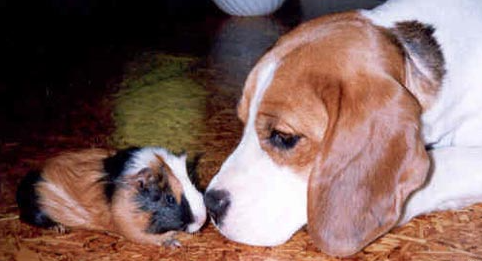
In principle, it doesn’t matter which other animals you train. Cats, rats, parrots—each offers its own valuable lessons. However, there is one small and charming creature that stands out to me as the almost ideal teacher. It is social, curious, shy, and relatively easy to train. You have probably guessed it: the guinea pig (Cavia porcellus).

Today, I’m going to share how these little, cute animals can help you become a better dog trainer, a better horse trainer, a better animal trainer—and, most importantly, a more complete individual. Please, keep reading.

The basic skills you need to train a dog are the same as those you need to train any other animal. One difference—and this is good news for you—is that (mainly due to our common history) there is no other animal as easy to train as a dog. On the other hand, there is a limit to how much you learn if you only train dogs.

Dogs forgive our mistakes and are nearly always motivated to cooperate. Other species scrutinize us far more thoroughly. We must earn their trust—if they don’t trust us, they won’t cooperate with us. A horse will not follow you if it doesn’t trust you, and it takes a lot to earn the trust of a horse (and only a moment to lose it). You can offer as many carrots as you like, but if it decides you are not someone to be trusted, the best carrots in the world will be to no avail. A cat will blink, at least twice, at you and the treat you offer it before even considering moving in your direction. Then, if it deems your request reasonable, it may just indulge you—otherwise, no deal.

The guinea pig, a favorite prey of many predators, including humans, is social and fearful by nature. We don’t share a common evolutionary history with it, as we do with the dog. You won’t get anything for free. You’ll have to work to gain your guinea pig’s trust and show it that cooperating with you is profitable in both the short and the long term.

Training guinea pigs will teach you the theory of animal learning. You’ll have to be precise and follow the correct procedures to produce the desired behavior. You’ll explore the whole spectrum of operant conditioning, but you’ll be left gasping for more. You’ll find yourself desperately attempting to think like a guinea pig, thus entering the realm of ethology.

A guinea pig trained in scent detection, completing the double-blind test after four hours of efficient training spread over three consecutive days. We also trained it to perform well in a mini-agility course (see credits in the video).

You can teach dogs many things without a proper plan. They are so active and eager to please that, sooner or later, they will do something you like, which you can reinforce. With dogs, you can play by ear and sing along, but with other animals, you’ll need to plan. Timing is essential when you train your dog, but surprisingly enough, you’ll still achieve acceptable results even if your timing is off. With dogs, it’s like singing a melody out of tune and your friends still recognizing it. With guinea pigs, you’d better sing in tune, or they will tacitly suggest you get your act together before going back to them. It’s tough, but it’s also a good lesson about life.

Much like horses, guinea pigs tend to react fearfully when in doubt (a trait that has helped them survive throughout their evolutionary history). Displaying composed, self-confident behavior works well, but anything more assertive than that will backfire on you. Dogs, these ever amazing animals, give you a second chance (and understand our bad “accents” in dog language); a horse or a guinea pig hardly ever do so. If you even think of trying to bully a guinea pig into doing what you want, it will probably freeze for up to 30 minutes, which is a real stopper for any aspiring trainer.

You’ll learn soon enough that coercion is not the way to go at all. Thus, you’ll learn the secrets of motivation and the beauty of working within and with your environment, rather than attempting to control it, and that in itself will lead you to unexpected and welcomed results.

If they could, I’m sure your dog and your horse would thank the guinea pigs for what they teach you when you train them, for you become, undoubtedly, a much more subtle and balanced trainer. You’ll be in control of yourself rather than the animal, motivating rather than forcing, showing the way rather than fumbling about, achieving results with the least (sometimes even imperceptible) amount of intrusion into your favorite animal’s normal behavior.

If you have a chance, give it a try. We can never learn too much, can we?

Featured image: Dog and guinea pig together. Training a guinea pig can make you a better dog trainer (photo letsbefriends.blogspot.com).

Why Do Dogs Lick Our Faces?

why-do-dogs-lick-our-faces

Dogs like to lick our faces—a behavior that can seem disturbing to many, especially non-dog owners. However, this behavior shows friendliness, a pacifying gesture, a hand (though not literally) reaching for peace. It is a compliment in dog language: “I like you; you can be my friend.”

The behavior originates in the neonatal and juvenile periods. Newborn mammals suckle and lick. Pups lick everything as a way of gathering information about their world. Licking our faces may give our dogs details about who we are and how we feel.

Pups lick one another, a behavior that seems to make both donor and recipient relax because it is an undemanding activity. Grooming and self-grooming, licking included, are pleasant social and bonding practices.


friendlywolfbehavior-1-600x600-1

Roger Abrantes and a wolf at the Wolf Park in Battle Ground, Indiana. Licking is one of the many behaviors dogs and wolves share. It signals friendship (picture by Monty Sloan).


Canine mothers lick their pups to keep them clean and to stimulate their urination, defecation, and digestion.

When the pups become a little older and eat solid food, it is common for them to lick the adults’ lips, which may prompt the adults to regurgitate recently consumed food—an excellent source of nutrition for the youngsters. Even though not as widespread as when Canis lupus familiaris were hunters, regurgitation behavior is not uncommon among our more scavenger-like domestic dogs when allowed to live an independent dog life to a certain extent.

The initial function of pacifying behaviors is to assist in the immediate survival and well-being of the organism. Subsequently, though maintaining the same function, they appear in different areas and yield distinctive outcomes. For example, the licking, which initially produced food regurgitation, later produces friendly behavior, thus becoming a pacifying gesture.

Next time a dog licks your face, you need not be too terrified or disgusted. Just close your eyes, yawn, and turn your head away. That shows, in dog language, that you accept its offer of friendship.

By the way, don’t be too afraid either of the germs you may get when your dog licks you—they are not worse than those we get from kissing one another.

 ______________

Featured image: When a dog tries to lick your face, the best you can do is to close your eyes, yawn, and turn your head away. This shows in dog language that you accept its offer of friendship.

______________

References

Abrantes, R. (1997). The evolution of canine social behavior. Naperville, IL: Wakan Tanka Publishers.

Abrantes, R. (2011, December 11). Dominance—Making sense of the nonsense. Roger Abrantes Blog. https://rogerabrantes.com/2011/12/11/dominance-making-sense-of-the-nonsense/

Lopez, B. H. (1978). Of wolves and men. New York, NY: Scribner.

Mech, L. D. (1981). The wolf: The ecology and behavior of an endangered species. University of Minnesota Press.

Zimen, E. (1981). The wolf: His place in the natural world. Souvenir Press Ltd. ISBN 9780285624115. (Original: Zimen, E. (1976). Der Wolf: Verhalten, Ökologie und Mythos. Hamburg: Parey.)

The Confidence Connection in Animal Training

Confidence plays a far greater role in animal training than most people realize. It’s a circular affair: confidence breeds success, and success breeds confidence.

Training often fails—not because the animal doesn’t understand, but because you don’t believe it will work. Doubt is contagious. The moment you hesitate, your body betrays you—and your animal reads you like an open book.

Dogs, horses, cats, even guinea pigs are experts in body language. They sense uncertainty long before you utter a word or make your first move. If you don’t know or aren’t sure of what you want, why should they feel safe following your lead?

So, here’s your plan of action: think it through, then act—with calm determination. Don’t worry about controlling the animal; control yourself. If you do that, the rest usually follows.

And if it still doesn’t work? You may ask. Tough luck—sometimes it doesn’t. In that case, go back to square one, revise your plan, and try again. Each failure sharpens your skill and, if you let it, strengthens your confidence.

Enjoy your training—but above all, enjoy the privilege of sharing time with another living being.

____________________

Note: This article was initially called “The Importance of Confidence in Animal Training.” I changed it in October 2025 while editing it because I realized the title could be ambiguous. It could suggest trusting animal training methods or confidence in the field itself, rather than the trainer’s self-confidence and the animal’s confidence in the trainer (as a result of the former).

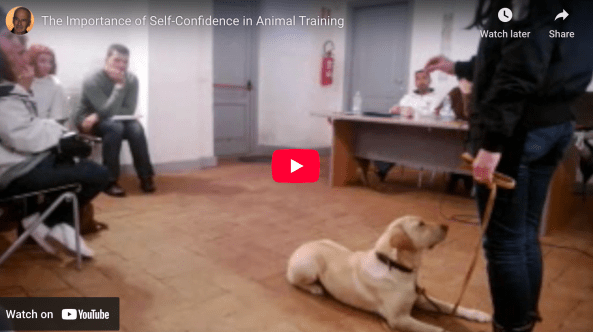
Featured video: Credits at the end of the video.

Ilaria Training Italy

Can Animals of Different Species Bond like Conspecifics?

bonding-pupy-duckling

Can animals of different species create relationships and bonds similar to those they have with their own conspecifics? Let me tell you a story.

One winter morning, when I still lived up north, I looked out of the window and saw a white duck right in the middle of the yard. I almost missed it, so well his white plumage faded into the snowy environment.

Daniel, then a teenager, got very excited. “He’s freezing, Daddy. We have to help him,” he exclaimed.

We got dressed warmly and, even before considering breakfast, out we went to tend to this stranger in distress. Our presence didn’t frighten the duck, not even when we came closer. He didn’t show either any evident appreciation for the arrival of our rescue party. He must have been tired and freezing after having spent the whole night roaming around the frozen fields. We didn’t hold his lack of courtesy against him.

We found a wooden crate, duck-sized, grabbed some straw from the horse’s stall, and made him a comfortable refuge near the old water pump. He seemed to like it right away, went inside, tidied it up a bit, and lay down like all ducks do with his beak on his back. We offered him food and water, which he didn’t touch, and so we left him to recover.

“Fine, so now we can grab some breakfast, don’t you think?” I commented to Daniel.

The long and the short of it is that the duck stayed day after day, showing no intention of leaving. We gave him a name, Anders. I don’t know if he also gave us names. The other animals on the farm—horse, cat, and dog—took it as it was. No one bothered him and didn’t show much interest either.

I thought he might die when I first saw him, so miserable he looked, but he was a tough duck. Not only did he survive, but he looked healthier and stronger for each day that passed. He also became increasingly assertive.

If we had any apprehensions about whether the other animals would give him a hard time, our doubts quickly dissipated. In fact, it was the other way around. Anders became the king of the farm. He ate everything—horse, cat, and dog food equally—and he took what he wanted when he fancied it. He would approach Katarina the cat from behind, peck at her tail, and, when she moved away, he would feast on cat food as he pleased.

Indy, the horse, didn’t escape his majesty’s moods either. King Anders would peck at Indy’s hooves until he moved away, giving up his horsey pellets for yet another ducky feast.
He would walk around, tending to his businesses—whatever businesses ducks have—unconcernedly and matter-of-factly. The only concern he showed was birds of prey. He would stand silent, looking up, holding his head sideways, one eye facing the sky, until he was assured that the bird wouldn’t dive on him.

It didn’t take long, though, before we all got accustomed to Anders and him to us. I can’t say that he ever bonded with anyone. He was his own. He wasn’t needy either. At the farm, we were supportive of one another when necessary, but we didn’t intrude on the others’ lives, and we weren’t overprotective either. Milou, the dog, would charge out of the door, furiously growling if she heard that Katarina was in trouble, which she was regularly. The neighborhood tomcats apparently found her too hot and worth risking a sortie into unknown territory.

Sometimes, at night, the fox would venture too close, and Katarina would be the first to detect her, creating some commotion. Anders would quack and shed feathers all the way up to his safe spot. Milou would charge forth fiercely once again as the defender of the kingdom, barking and growling, not knowing why, just in case. Indy, the horse, on the other hand, always kept his cool throughout all ordeals. Daniel and I would come last from our rooms on each end of the farmhouse, armed with our hockey sticks, more than once meeting one another in the yard, only wearing our boxers. I’m glad we lived out in the sticks where nobody could witness our antics!

We had a good life. We didn’t bother one another, shared the space and the resources we had, and we put up with one another’s peculiarities. That was what served us all best, I think we all agreed, but I can’t know what the others thought. We were a family, a herd, a clowder, a pack, and a brace.

We belonged to different species, but, for all intents and purposes, we functioned as any well-functioning group of animals of the same species, except for reproduction. Thus, if you ask me whether animals of different species can create relationships and bonds similar to those they have with their own conspecifics, I wouldn’t hesitate to answer yes (all going down to definitions). Did we have any hierarchy? Oh yes, you needed only to ask Anders, and it wasn’t in any way unsettling for any of us. It even felt natural and reassuring, I dare say. As long as we all knew what we were supposed to do and not to do, all was good.

I got the habit every morning, right after I got up, to look out of the window and be greeted by Anders. He would invariably stand there, in the middle of the yard, looking at my window, always at the right time. It became a ritual, a reassuring one, I guess, for both of us.

One morning, Anders was nowhere to be seen. I knew right away what had happened. The fox had, at last, got the better of Anders, the king.

_______________

Featured image: If you were to ask me whether animals of different species can create relationships and bonds similar to those they have with their own conspecifics, I wouldn’t hesitate to answer yes. Photo by Lifeonwhite.

Animal Training—When Doing Nothing is Doing Right

Roger Abrantes talks to horse

After a while, I began “leading the dance,” never used the reins, only changed my position on the saddle slightly. I looked left, and she turned left, I looked right, and she turned right, her ears for a moment turning back to me like asking, “Am I doing well?”

Years ago, my friends in the US asked me to go with them and see a horse they were considering buying for their daughter. A couple of hours drive through Illinois countryside, roads surrounded by never-ending cornfields, took us to a nice, clean and modern kind of an equestrian center where we found the horse and met the owner.

I liked the horse right away, a young, paint, quarter mare. The American quarter horse got its name from being particularly fast on distances up to a quarter-mile. Paint horses are white with spots of black, brown, or reddish. The American Paint is now a breed of its own. Most paints are levelheaded, versatile, and friendly horses. This mare was no exception. She had the looks of being approachable and curious, eager to learn. I don’t remember exactly how old she was, but she couldn’t have been more than three years old. She looked young to me to carry a rider on her back, and I remember asking the owner if they had trained her to it.

“Oh, yes, she is broken to ride, all right,” she answered.

That was not what I asked, but I reckoned I couldn’t get a better answer. What I wanted to know was whether the horse had gone through any particular groundwork to develop the right muscles and movements necessary to carry the extra weight of a rider. By the way, I don”t know about you, but I dislike immensely the term “horse breaking.” If you really break the horse, you shouldn’t even come close to a horse, and that’s my opinion. If you don’t, but instead train it stepwise, wisely and patiently, you should consider using another term altogether—and that’s again my opinion about that.

The young mare was beautiful, but then again, I might have been terribly biased, for my heart always beats a tad faster when I see a gentle, paint quarter (or a friendly English cocker spaniel). These are things of the heart that I can’t explain, and don’t feel I need to either.

The owner proceeded to give us a demonstration of the horse’s abilities under saddle. It was a sad showing. The mare trotted and cantered all right, and turned right and left, and stopped and continued, but she looked miserable.

After having finished, the owner invited my friends’ daughter to go for a ride, but she declined, showing the typical shyness of a teenager of her age.

“You go, Roger, take a ride and tell us what you think,” her mum said to me.

“Yes, uncle Roger, please do it,” my niece begged me with that “horsey” expression only teenagers who have been long around horses can give you. I couldn’t refuse her.

And so, I went for a ride, even though, in my opinion, she was a bit too young and untrained. We trotted and cantered right away and, then, we did figure eights and turns. The young mare was entirely different from earlier. She had regained her spirit, and if not wholly, then closer to the spirit of her ancestors, the proud horses roaming the plains of the new world.

“Wow,” my friends said almost in a choir, “that was impressing.”

“What did you do?” they asked me, “She behaved totally different with you! It was like a different horse altogether.” The owner pretended not to hear that.

“I did nothing,” I answered, and I was entirely honest. After mounting, I started having a long talk with the horse, a silent one, that is, for horses don’t understand English, and what I had to say was as much to her, the mare, as to myself.

“Ok, horsey, here we are the two of us. I’m sorry, we haven’t even been introduced properly,” I said, “Just do what you feel like doing. I’ll try to be as subtle as I possibly can.” And she ran, she trotted and cantered, and I did nothing besides trying not to be a burden, just syncing my movements with hers.

“Go for it, honey,” I thought, “run as much as you fancy, turn whenever you like. You lead, I’ll follow.” And she ran and turned, ears forward one moment, back the next, her mane flying in the wind. “Go, baby, go,” I thought, and she went faster and freer.

After a while, I began “leading the dance,” never used the reins, only changed, slightly, my position on the saddle. I looked left, and she turned left, I looked right, and she turned right, her ears for a moment turning back to me like asking, “Am I doing well?”

Sometimes, doing more does less, doing less does more, and doing nothing does right—and I suspect this is true more often than we reckon.


Featured image: To earn the trust of a horse is the first step toward a good relationship. It takes time to earn it and only one moment to lose it (photo from Ethology Institute files).

Do You Know What the Dog’s Twist Behavior Means?

Canine Twist Behavior by Roger Abrantes

Canine twist behavior—the puppy twists as a pacifying response to the adult’s growling (illustration by Alice Rasmussen from “Dog Language” by Roger Abrantes)


The canine twist behavior is a curious behavior that few dog owners recognize, let alone understand.

It is a characteristic behavior shown by any canine (wolf, dog, African wild dog, and dingo, at least) when it twists one hind leg out to the side. They frequently show it from a sitting position, but they can also do it while standing. In cases where the dog appears very insecure, a half roll culminating with the dog lying on its back and presenting its belly may succeed the twist. Laid-back ears, semi-closed eyes, champing (at times with the tongue protruding out of the mouth), and paw lifting (or vacuum pawing), in various degrees depending on the level of insecurity, usually follow the twist. It’s a reasonably common behavior primarily seen in puppies and youngsters, but insecure adults can also display it.

The function of the twist is to pacify an opponent. As always, behavior happens by chance (or reflex), and if it (the phenotype) proves to have a beneficial function, it will tend to spread in the population, transmitted from one generation to the next (via its genotype).

The twist’s origin is most certainly related to the canine female’s typical maternal behavior of overturning her puppy by pressing her nose against its groin, forcing one of the puppy’s hind legs to the side. The puppy will then fall on its back, and the mother will lick its belly and genital area, facilitating the puppy’s urination and defecation. To start with, the puppy seems to find the experience unpleasant, but it becomes pleasurable once it rests on its back and its mother’s licking starts to function.

Later on, the puppy will perform the same twist movement in the absence of any physical contact with the mother or any other adult. It will do so when it feels threatened or insecure, and with the function to pacify both itself and its opponent, rather than to invite belly-licking.

The transition from urination/defecation to pacifying is a classic of the development of behavior. It happens almost exclusively via a classic conditioning process. Initially, being overturned is unpleasant, but lying on its back, belly up, becomes pleasant (due to the puppy relieving itself). After some repetitions, the puppy will associate lying on its back with ending discomfort and will readily display this behavior whenever necessary.

The strength of the twist behavior (a general characteristic of pacifying behavior) lies in its dual effect (on both parties). The puppy relaxes by doing something that has produced desirable results earlier. The threatening adult relaxes when met with behavior that it recognizes as infantile.

I first described this behavior in the original edition of my book “Dog Language” in 1987. It had no name at the time. I coined the term “twist behavior,” thinking of the sixties’ famous dance, which was very popular in my teenage years. “Twist and Shout” by The Beatles* immortalized it. The Twist, the dance, featured a particular step, where the dancer’s legs made a twisting movement reminiscent of the puppy’s pacifying behavior.


____________________

* “Twist and Shout” was written by Phil Medley and Bert Russell and first released in 1961, featuring The Top Notes. However, it achieved its fame first when The Beatles performed it in 1963 with John Lennon on lead vocals.


Related articles


References

  • Abrantes, R. (1997) The Evolution of Canine Social Behavior. Wakan Tanka Publishers.
  • Abrantes, R. (1997) Dog Language. Wakan Tanka Publishers.
  • Darwin, C. (1872) The Expressions of the Emotions in Man and Animals. John Murray (the original edition).
  • Fox, M. (1972) Behaviour of Wolves, Dogs, and Related Canids. Harper and Row.
  • Lopez, B.H. (1978). Of Wolves and Men. J. M. Dent and Sons Limited.
  • Mech, L.D. (1970) The wolf: the ecology and behavior of an endangered species. Doubleday Publishing Co., New York.
  • Mech, L.D. (1981). The Wolf: The Ecology and Behaviour of an Endangered Species. University of Minnesota Press.
  • Mech, L.D. (1988) The arctic wolf: living with the pack. Voyageur Press, Stillwater, Minn.
  • Mech, L.D. and Boitani, L. (2003) Wolves: Behavior, Ecology, and Conservation. University of Chicago Press.
  • Scott, J.P. and Fuller, J.L. (1998) Genetics and the Social Behavior of the Dog. University of Chicago Press.
  • Trumler, E. (1995) Mit dem Hund auf du: Zum Verständnis seines Wesens und Verhaltens. Piper Taschenbuch; 17. edition. ISBN-10 : 3492211356
  • Zimen, E. (1975) Social dynamics of the wolf pack. In The wild canids: their systematics, behavioral ecology and evolution. Edited by M. W. Fox. Van Nostrand Reinhold Co., New York. pp. 336-368.
  • Zimen, E. (1982) A wolf pack sociogram. In Wolves of the world. Edited by F. H. Harrington, and P. C. Paquet. Noyes Publishers, Park Ridge, NJ.