Do You Want to Become a Better Dog Trainer?

When we ran our traditional on-campus programs at the Ethology Institute, the new students would invariably divide into two groups: those who wanted to become dog trainers and those who wanted to become horse trainers. Every year, I told them the same: “If you want to become good trainers of your favorite species, you must also train other species—you must gain perspective.”

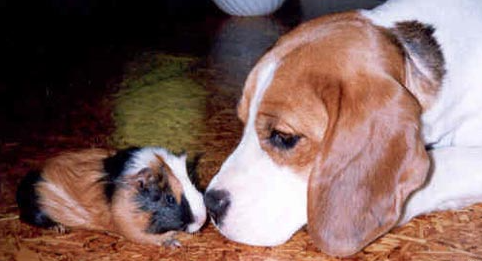
In principle, it doesn’t matter which other animals you train. Cats, rats, parrots—each offers its own valuable lessons. However, there is one small and charming creature that stands out to me as the almost ideal teacher. It is social, curious, shy, and relatively easy to train. You have probably guessed it: the guinea pig (Cavia porcellus).

Today, I’m going to share how these little, cute animals can help you become a better dog trainer, a better horse trainer, a better animal trainer—and, most importantly, a more complete individual. Please, keep reading.

The basic skills you need to train a dog are the same as those you need to train any other animal. One difference—and this is good news for you—is that (mainly due to our common history) there is no other animal as easy to train as a dog. On the other hand, there is a limit to how much you learn if you only train dogs.

Dogs forgive our mistakes and are nearly always motivated to cooperate. Other species scrutinize us far more thoroughly. We must earn their trust—if they don’t trust us, they won’t cooperate with us. A horse will not follow you if it doesn’t trust you, and it takes a lot to earn the trust of a horse (and only a moment to lose it). You can offer as many carrots as you like, but if it decides you are not someone to be trusted, the best carrots in the world will be to no avail. A cat will blink, at least twice, at you and the treat you offer it before even considering moving in your direction. Then, if it deems your request reasonable, it may just indulge you—otherwise, no deal.

The guinea pig, a favorite prey of many predators, including humans, is social and fearful by nature. We don’t share a common evolutionary history with it, as we do with the dog. You won’t get anything for free. You’ll have to work to gain your guinea pig’s trust and show it that cooperating with you is profitable in both the short and the long term.

Training guinea pigs will teach you the theory of animal learning. You’ll have to be precise and follow the correct procedures to produce the desired behavior. You’ll explore the whole spectrum of operant conditioning, but you’ll be left gasping for more. You’ll find yourself desperately attempting to think like a guinea pig, thus entering the realm of ethology.

A guinea pig trained in scent detection, completing the double-blind test after four hours of efficient training spread over three consecutive days. We also trained it to perform well in a mini-agility course (see credits in the video).

You can teach dogs many things without a proper plan. They are so active and eager to please that, sooner or later, they will do something you like, which you can reinforce. With dogs, you can play by ear and sing along, but with other animals, you’ll need to plan. Timing is essential when you train your dog, but surprisingly enough, you’ll still achieve acceptable results even if your timing is off. With dogs, it’s like singing a melody out of tune and your friends still recognizing it. With guinea pigs, you’d better sing in tune, or they will tacitly suggest you get your act together before going back to them. It’s tough, but it’s also a good lesson about life.

Much like horses, guinea pigs tend to react fearfully when in doubt (a trait that has helped them survive throughout their evolutionary history). Displaying composed, self-confident behavior works well, but anything more assertive than that will backfire on you. Dogs, these ever amazing animals, give you a second chance (and understand our bad “accents” in dog language); a horse or a guinea pig hardly ever do so. If you even think of trying to bully a guinea pig into doing what you want, it will probably freeze for up to 30 minutes, which is a real stopper for any aspiring trainer.

You’ll learn soon enough that coercion is not the way to go at all. Thus, you’ll learn the secrets of motivation and the beauty of working within and with your environment, rather than attempting to control it, and that in itself will lead you to unexpected and welcomed results.

If they could, I’m sure your dog and your horse would thank the guinea pigs for what they teach you when you train them, for you become, undoubtedly, a much more subtle and balanced trainer. You’ll be in control of yourself rather than the animal, motivating rather than forcing, showing the way rather than fumbling about, achieving results with the least (sometimes even imperceptible) amount of intrusion into your favorite animal’s normal behavior.

If you have a chance, give it a try. We can never learn too much, can we?

Featured image: Dog and guinea pig together. Training a guinea pig can make you a better dog trainer (photo letsbefriends.blogspot.com).
The Confidence Connection in Animal Training

Confidence plays a far greater role in animal training than most people realize. It’s a circular affair: confidence breeds success, and success breeds confidence.

Training often fails—not because the animal doesn’t understand, but because you don’t believe it will work. Doubt is contagious. The moment you hesitate, your body betrays you—and your animal reads you like an open book.

Dogs, horses, cats, even guinea pigs are experts in body language. They sense uncertainty long before you utter a word or make your first move. If you don’t know or aren’t sure of what you want, why should they feel safe following your lead?

So, here’s your plan of action: think it through, then act—with calm determination. Don’t worry about controlling the animal; control yourself. If you do that, the rest usually follows.

And if it still doesn’t work? You may ask. Tough luck—sometimes it doesn’t. In that case, go back to square one, revise your plan, and try again. Each failure sharpens your skill and, if you let it, strengthens your confidence.

Enjoy your training—but above all, enjoy the privilege of sharing time with another living being.

____________________

Note: This article was initially called “The Importance of Confidence in Animal Training.” I changed it in October 2025 while editing it because I realized the title could be ambiguous. It could suggest trusting animal training methods or confidence in the field itself, rather than the trainer’s self-confidence and the animal’s confidence in the trainer (as a result of the former).

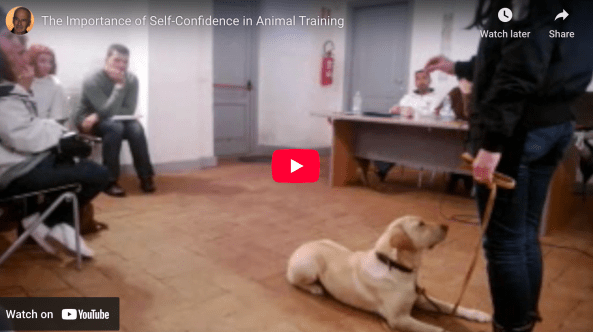
Featured video: Credits at the end of the video.

Ilaria Training Italy

Can Two Training Methods Be Equally Good?

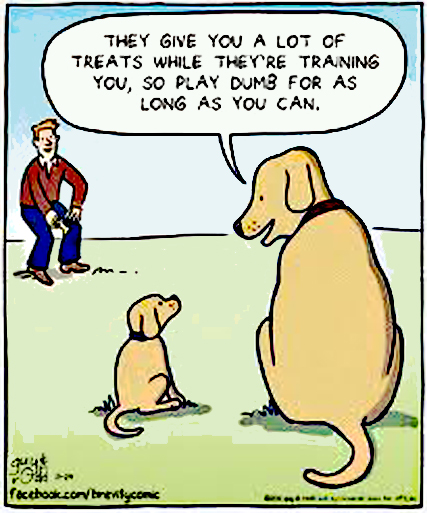
treat training dog cartoon

I receive many emails with questions about animal behavior. Most of them involve practical issues, but, now and then, someone poses a more complex question. Here is my answer to one of the latter, one I’d like to share with you because it addresses crucial issues in our understanding of animal behavior and training.

Dear ….,

Thanks for your comment, which allows me to clarify a few issues. By no means do I see animals as biological robots, nor do I regard the Skinnerian approach as the truth, the only truth, and nothing but the truth; quite the contrary. Please consider the following passages from “Mission SMAF—Bringing Scientific Precision Into Animal Training”.

“In fact, I suspect that [communication] even involves more than what science can describe with the intrinsic limitations of its key concepts and methods, no matter how stringent they are.

It seems to me, therefore, that our goal must not be to oppress or suppress emotions, but rather control them and use them advantageously. Emotional arousal proves to be necessary to learn and the right amount of emotional arousal even shows to increase the efficiency of learning processes.”

A very non-Skinnerian statement, I would say.

As to my own method to analyze learning processes in artificial set-ups (like in animal training), I write: “In a crude sense, SMAF is an oversimplification of complex processes […] certainly not an attempt to reduce complex mechanisms to a few formulas. In the end, [its] value depends solely on its successful application to solving practical problems; beyond that, it has no value.”

Operant conditioning (when we use it correctly) is an efficient model of behavior for animal training because we control the conditionals to some extent (as Pavlov explains in his original writings, not the subsequent translations). Whilst operant conditioning is adequate for analyzing behavior at a particular level, beyond that, it becomes too crude an instrument. To understand behavior in a broader sense, we must turn to evolutionary models and concepts—variation, selection, adaptation, fitness, function, evolutionary strategies, ESS (evolutionarily stable strategy), costs and benefits, and so forth. My approach to behavior is therefore a classical ethological one, in the tradition of von Frisch, Lorenz, and Tinbergen—firmly grounded in evolutionary biology and in philosophically coherent reasoning.

Greetings,

RAA


The core of the argument is reductionism, the view that we can reduce complex processes to the sum of their simpler parts. In a sense, all science is reductionistic. We attempt to explain complex processes with a few notions well organized in little boxes. That is a process that seems to suit our human brain particularly well.

However, we must bear in mind that our interpretations, independently of how good they are, are just our pictures of an elusive reality. They suit our particular umwelten,* but definitely not all of them. They explain parts of it from specific angles so we can make sense of it. Newton and Einstein—the classical example—are (probably) both right, each explaining reality at a different level.

There’s nothing wrong about being a reductionist if only we do not get greedy and attempt to explain far too much with far too little, as in, “That’s it, this is the way things are. Period.” Simplifying often gets us to the point that complicating and oversimplifying have both missed.

In animal training, one theory or method can be as good as another depending on its foundations, approaches, what it attempts to explain, and the practical goals it aims to serve. If both are based on reliable evidence, use well-defined terms, and are logically sound, there’s little to choose between one or the other.

If only animal trainers understood that, I believe we would forgo many senseless disputes. Then again, we can brag about being the most emotional creatures on this big blue marble of ours, can’t we?

___________

* Umwelt (plural umwelten) in ethology means the world as it is experienced by a particular organism.

___________

References

Abrantes, R. (2018). Mission SMAF—Bringing Scientific Precision In to Animal Training. Wanka Tanka Pub.

Lorenz, K. (1937). Über die Bildung des Instinktbegriffes. Naturwissenschaften, 25, 289–300. https://doi.org/10.1007/BF01492648

Павлов, И. П. (1926). Двадцатилетний опыт объективного изучения высшей нервной деятельности (поведения) животных. Ленинград: Научное химико-техническое издательство. (Pavlov, I. P. (1926). Twenty Years of Objective Study of the Higher Nervous Activity (Behavior) of Animals. Leningrad: Scientific Chemical-Technical Publishing House.)

Skinner, B. F. (1938). The Behavior of Organisms: An Experimental Analysis. New York: Appleton-Century-Crofts.

Uexküll, J. von. (1934). Streifzüge durch die Umwelten von Tieren und Menschen: Ein Bilderbuch unsichtbarer Welten. Berlin: Julius Springer. (English translation: A Foray into the Worlds of Animals and Humans: With A Theory of Meaning, translated by Joseph D. O’Neil, University of Minnesota Press, 2010.)

Your Most Powerful Animal Training Tool

Roger Abrantes and wolf cub Silas in 1985.

Your most powerful animal training tool is yourself. The featured picture shows yours truly in 1985 with Silas, the wolf cub. Notice the whistle hanging around my neck. I used it to produce a sound as a conditioned positive reinforcer (yes, the precursor of the click sound from Karen Pryor’s clicker). Silas preferred, though, my personal verbal reinforcer (dygtig)* because I always associated it with friendly body language and facial expressions. Thus, ‘dygtig’ meant acceptance. For wolves, more sensitive to social situations than dogs, being accepted is the ultimate social reinforcer; for the cubs, it is vital.

These were the first observations leading me to suspect that verbal and mechanical conditioned positive reinforcers had different applications. Parts of the verbal reinforcer (the body language and facial expression) do not require conditioning. Therefore, I later coined the term semi-conditioned reinforcer.

I’ll say without hesitation that our most powerful animal training tool is ourselves. If we control ourselves, our body language, our facial expressions, and the little that we say, we’ll achieve what we pretend and more.

Interacting with someone is, after all, not merely conditioning a series of behaviors—it is creating a relationship.

* “Dygtig” [ˈdøgdi] is a Danish word that means “capable,” “skilled,” or “competent,” and can also mean “clever” depending on context. It is, apparently, a good sound as a reinforcer, as I discovered many years ago.

Featured image: Roger Abrantes in 1985 interacting with Silas, the wolf cub—creating a relationship.