Your Dog Understands Your Yawn

Yawn1

Abstract

Yawning is a simple, evolutionarily conserved behavior with physiological and social functions. In both humans and dogs, yawns can be contagious, reflecting motor and social resonance rather than necessarily empathic processes. Evidence indicates that dogs are more likely to yawn in response to familiar humans, particularly their owners, and that such yawning serves a pacifying and communicative function. Contagious yawning in dogs appears to facilitate social attunement, reduce tension, and signal peaceful intent. This paper reviews current research on canine yawning, its neural and behavioral underpinnings, and its role in interspecific communication, highlighting the ways dogs use yawning and related behaviors to maintain harmonious interactions with humans.

Your dog understands your yawn

A yawn is a simple behavior, a reflex with specific physiological functions. We are not the only ones yawning. Chimpanzees, bonobos, macaques, and dogs, among others, yawn (Guggisberg, Mathis, Schnider, & Hess, 2010; Joly-Mascheroni, Senju, & Shepherd, 2008; Ake & Kutsukake, 2023). Although a simple behavior, yawning also performs social functions. It is contagious not only within groups of individuals of the same species but also across species, including between humans and dogs (Joly-Mascheroni et al., 2008; Romero, Konno, & Hasegawa, 2013; Norscia & Palagi, 2011).

Because yawning is both widespread and multifunctional, several explanations have been proposed for its original biological role. One classic hypothesis suggests that yawning increases the influx of oxygen into the blood when carbon dioxide levels rise; however, this explanation is now widely considered unsupported (Guggisberg et al., 2010). Another hypothesis proposes that yawning stretches the muscles of the tongue and neck (Provine, 2012). A further interpretation emphasizes the need to maintain alertness, a crucial condition for predators (Provine, 2012). Given that social predators depend on one another, yawning may have evolved to be contagious through natural selection because of the cooperative advantages it confers. Additionally, yawning may help regulate brain temperature (Gallup & Gallup, 2007; Gallup & Eldakar, 2013; Gallup, 2022).

Pharmacological and neurochemical research shows that yawning is regulated by a network of neurotransmitters. Dopamine (via D₂/D₃ receptors) and serotonin both modulate yawning, and oxytocin may also play a role (Wani & Agarwal, 2025; Argiolas & Melis, 1998). These interactions suggest that yawning reflects changes in arousal, social state, and internal regulation—consistent with its role as a pacifying or self-soothing behaviour.

A widely proposed explanation for contagious yawning is that mirror-neuron systems in the frontal cortex of various vertebrates, including humans and dogs, activate corresponding motor representations in others. Neuroimaging studies in humans support this interpretation (Platek, Mohamed, & Gallup, 2005; Schürmann et al., 2005). Further neural evidence indicates that the ventromedial prefrontal cortex—a region associated with social processing—is also involved in contagious yawning, reinforcing the notion that the phenomenon is both motor-resonant and socially relevant (Nahab, Hattori, Saad, & Hallett, 2009).

Studies have found that dogs are more prone to yawn when their owners yawn than when strangers do (Romero et al., 2013; Silva, Bessa, & de Sousa, 2012). In the Tokyo study, researchers monitored the dogs’ heart rate and found no significant change across conditions, suggesting that the yawns were not merely a stress response (Romero et al., 2013). In one auditory-yawn study from Porto University, dogs yawned more to familiar than unfamiliar human yawns, and their stress-related behavior did not differ by condition—indicating that increased yawning was not simply a stress response (Silva et al., 2012). Meanwhile, an experiment at Birkbeck College (University of London) demonstrated that live human yawning triggers yawning in many dogs (Joly-Mascheroni et al., 2008).

Taken together, current behavioral evidence in dogs suggests that a form of interspecific resonance exists: dogs and humans can synchronize their actions during shared activities, and such coordination may emerge from motor-resonance mechanisms analogous to mirror-neuron systems (Lamontagne & Gaunet, 2024). Developmental evidence shows that contagious yawning in puppies emerges gradually, suggesting a maturational component to this resonance (Madsen & Persson, 2013). Mirror neurons may thus provide a neural basis not only for imitation but also for allelomimetic behavior.

However, whether contagious yawning reflects empathy remains debated. One recent Bayesian re-analysis of canine studies concluded that although contagious yawning is present in dogs, it does not display the familiarity, gender, or prosociality biases that an empathy model predicts (Neilands, Claessens, & Ren, 2020). Comparative research likewise cautions that contagious yawning cannot be taken as direct evidence of empathic capacity without more stringent criteria (Massen & Gallup, 2017).

wolfyawning-1

Wolf yawning, a behavior shared by wolves and dogs and also common in other species (photo by Monty Sloan, Wolf Park, Indiana, USA).

The dog’s yawn is much like ours. It often precedes the same characteristic sound. While we commonly associate yawning with tiredness or boredom, it can also express embarrassment, insecurity, excitement, and relief. Some people even yawn when they’re in love—which, if misinterpreted, might be embarrassing.

Dogs may yawn when tired, but yawning usually serves a pacifying function, both for themselves and for others. As with many behaviors, what may have started as one function can evolve into others. Over time, yawning appears to have become a signal of peaceful intentions. For example, a male dog may yawn when a female snarls during courtship, signaling deference rather than aggression; or a confident dog may yawn at an insecure opponent to reassure it.

Dogs yawn at us with the same functions and results. They may also yawn as a displacement activity. An owner scolding his dog is a typical situation in which we see a dog yawn. In critical training cases prone to error, such as the so-called ‘stay,’ the owner’s behavior often causes the dog to feel insecure. A yawn is likely to follow, together with licking and muzzle-nudging. As soon as the owner changes behavior, say, by using a friendlier tone or more relaxed body posture, the dog ceases to display those pacifying behaviors.

Conclusion

Yawning is a ubiquitous behavior with ancient biological roots. While its original function remains debated, evidence supports multiple physiological and social roles—including thermoregulation, alertness maintenance, and behavioral synchronization. In dogs, as in humans, contagious yawning reflects a form of motor and social resonance, though not necessarily empathy in the strict scientific sense. Research consistently shows that dogs are more likely to yawn in response to familiar humans, particularly their owners, and such responses are not simply manifestations of stress. Rather, they appear to facilitate social attunement, reduce tension, and communicate peaceful intent.

Thus, when your dog yawns at you, it is unlikely to be random. It most likely expresses comfort and trust, and it invites the maintenance of social harmony. Your dog yawns at you to show it is friendly and peaceful—and you may safely yawn back, confirming the same. Yawning, along with champing (chomping), lip-licking, eye-squeezing, a pouty mouth, and the canine muzzle-grasp—all common elements of intraspecific canine social interaction—functions equally effectively in interspecific communication.

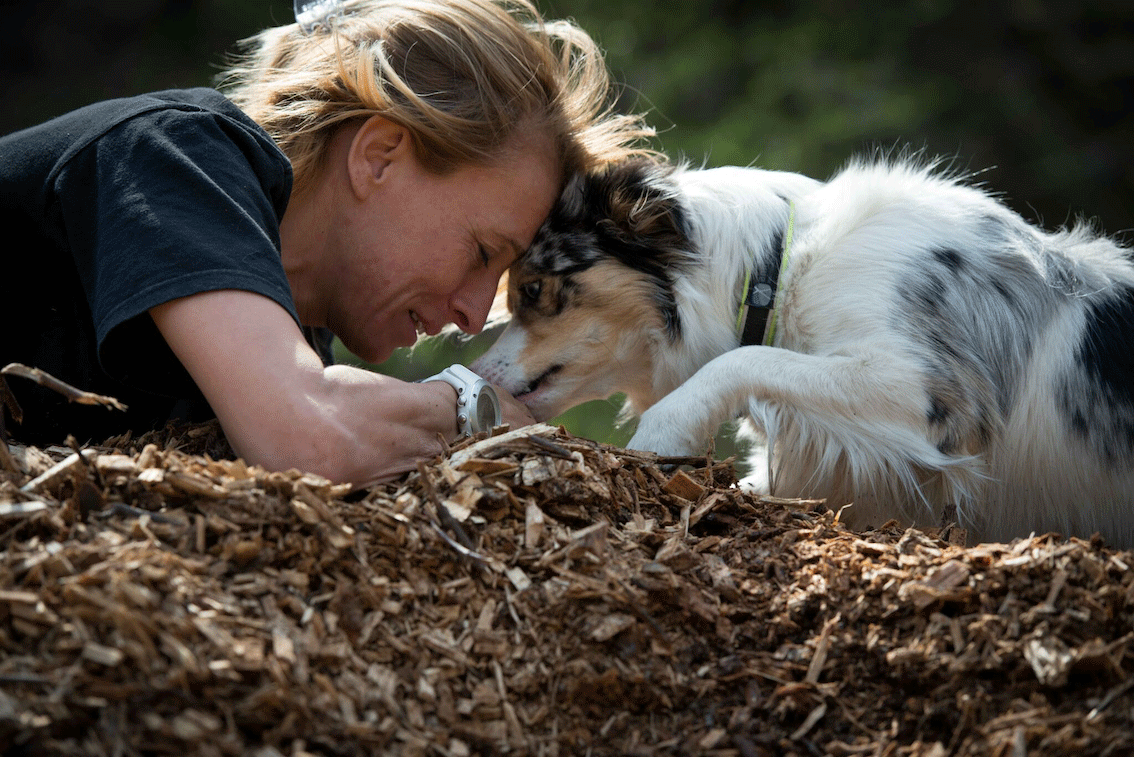
Featured Picture: Human and dog yawning (composition by Roger Abrantes).

References

Ake, K., & Kutsukake, N. (2023). Contagious yawning in African painted dogs (Lycaon pictus). Animal Cognition, 26(4), 1191–1198. https://doi.org/10.1007/s10071-023-01766-1

Argiolas, A., & Melis, M. R. (1998). The neuropharmacology of yawning. European Journal of Pharmacology, 343, 1–16. https://doi.org/10.1016/S0014-2999(97)01538-0

Gallup, A. C. (2022). The causes and consequences of yawning in animal groups. Animal Behaviour, 187, 209–219. https://doi.org/10.1016/j.anbehav.2022.03.011

Gallup, A. C., & Eldakar, O. T. (2013). The thermoregulatory theory of yawning: What we know from over five years of research. Frontiers in Neuroscience, 6, Article 188. https://doi.org/10.3389/fnins.2012.00188

Gallup, G. G. Jr., & Gallup, A. C. (2007). Yawning as a brain-cooling mechanism: Nasal breathing and forehead cooling diminish the incidence of contagious yawning. Evolutionary Psychology, 5(1), 92–101. https://doi.org/10.1177/147470490700500109

Guggisberg, A. G., Mathis, J., Schnider, A., & Hess, C. W. (2010). Why do we yawn? Neuroscience & Biobehavioral Reviews, 34(8), 1267–1276. https://doi.org/10.1016/j.neubiorev.2010.03.008

Joly-Mascheroni, R. M., Senju, A., & Shepherd, A. J. (2008). Dogs catch human yawns. Biology Letters, 4(5), 446–448. https://doi.org/10.1098/rsbl.2008.0333

Lamontagne, A., & Gaunet, F. (2024). Behavioural synchronisation between dogs and humans: Unveiling interspecific motor resonance? Animals, 14(4), 548. https://doi.org/10.3390/ani14040548

Madsen, E. A., & Persson, T. (2013). Contagious yawning in domestic dog puppies (Canis lupus familiaris): The effect of ontogeny and emotional closeness on low-level imitation. Animal Cognition, 16(2), 233–240. https://doi.org/10.1007/s10071-012-0568-9

Massen, J. J. M., & Gallup, A. C. (2017). Why contagious yawning does not (yet) equate to empathy. Neuroscience & Biobehavioral Reviews, 80, 573–585. https://doi.org/10.1016/j.neubiorev.2017.07.006

Nahab, F. B., Hattori, N., Saad, Z. S., & Hallett, M. (2009). Contagious yawning and the frontal lobe: An fMRI study. Human Brain Mapping, 30(5), 1744–1751. https://doi.org/10.1002/hbm.20638

Neilands, P., Claessens, S., & Ren, I. (2020). Contagious yawning is not a signal of empathy: No evidence of familiarity, gender or prosociality biases in dogs. Proceedings of the Royal Society B: Biological Sciences, 287(1920), 20192236. https://doi.org/10.1098/rspb.2019.2236

Norscia, I., & Palagi, E. (2011). Yawn contagion and empathy in Homo sapiens. PLOS ONE, 6(12), e28472. https://doi.org/10.1371/journal.pone.0028472

Platek, S. M., Mohamed, F. B., & Gallup, G. G. Jr. (2005). Contagious yawning and the brain. Brain Research: Cognitive Brain Research, 23(2–3), 448–452. https://doi.org/10.1016/j.cogbrainres.2004.11.011

Provine, R. R. (2012). Curious behavior: Yawning, laughing, hiccupping, and beyond. Harvard University Press.

Romero, T., Konno, A., & Hasegawa, T. (2013). Familiarity bias and physiological responses in contagious yawning by dogs support link to empathy. PLOS ONE, 8(8), e71365. https://doi.org/10.1371/journal.pone.0071365

Schürmann, M., Hesse, M. D., Stephan, K. E., Saarela, M., Zilles, K., Hari, R., & Fink, G. R. (2005). Yearning to yawn: The neural basis of contagious yawning. NeuroImage, 24(4), 1260–1264. https://doi.org/10.1016/j.neuroimage.2004.10.022

Silva, K., Bessa, J., & de Sousa, L. (2012). Auditory contagious yawning in domestic dogs (Canis lupus familiaris): First evidence for social modulation. Animal Cognition, 15(4), 721–724. https://doi.org/10.1007/s10071-012-0473-2

Wani, P. D., & Agarwal, M. (2025). The science of yawning: Exploring its physiology, evolutionary role, and behavioral impact. Journal of Family Medicine and Primary Care, 14(8), 3115–3120. https://doi.org/10.4103/jfmpc.jfmpc_1677_24

Psychology Rather Than Power—for the Umpteenth Time, Reinforcers Are Not Rewards

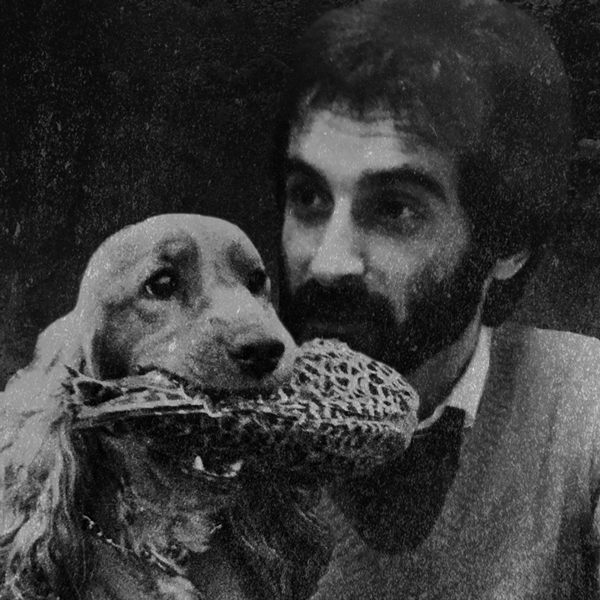
The author, Roger Abrantes, and Petrine, English Cocker Spaniel, in 1984.
“A reinforcer is not a reward.” Some things must be said again—and again.

For the umpteenth time, a reinforcer is not a reward. When I hear “Force-Free” trainers say, “dogs like to work to earn rewards,”1 I suspect and fear they miss by a mile and a half the essence and function of reinforcers in learning theory (and so also of inhibitors).

I’m not splitting hairs. There is a crucial difference between reinforcing a particular behavior and rewarding an individual. I suspect ignorance hereof is also the cause of the many incorrect statements on inhibitors2 from the “Radical Force-Free” camp (emphasis on radical).3


When terminology goes wrong

Look, I shouldn’t care less because reinforcers and the like are behaviorist things, and I’m an ethologist, not a behaviorist. But I do care, because my mind becomes strangely uneasy whenever I hear or see something fundamentally flawed and inconsistent.

If you claim the mantle of behaviorism, the least you can do is use its language correctly.

If you’re a behaviorist—and that’s what trainers in the “Radical Force-Free” camp are supposed to be—then at least be fair to the founding fathers of your learning philosophy and use the right terminology. All the rest seems to me an affront, disrespectful, and proof of unforgivable ignorance. Forgive the bluntness, but someone had to say it.


Back to the 1980s

“Dogs like to work to earn rewards” reminds me of the 1980s, when I opposed the old-school, military-style approach to dog training. The classes had all the charm of a drill parade: straight lines, sharp commands, leash jerks, and very little interest in what the dogs themselves thought of the matter—or whether they understood what we wanted of them. After ten minutes of marching back and forth, the instructor would say:

“And halt! Now, praise your dogs.”

Yes, I went to that kind of dog training with the first dog I had as an adult. That was the training we had back then.

I walked out in disgust with the sort of calm determination only youthful indignation can fuel. I decided there and then that Petrine, my dog, and I would train on our own and show them. We did.


Discovering training through ethology

I substituted praise with reinforcers—the real thing, not rewards—including my dygtig⁴ and a few treats given at strategic times and points. I stopped using a leash and started using a lead. Again, not splitting hairs—it makes a huge difference what you think of, and how you use, that piece of rope or leather that connects you to your dog.

A leash leashes; a lead leads. It’s as simple as that.

Leash jerks gave way to “No,” immediately followed by “dygtig,” when Petrine, not me, corrected the mistake. She seemed almost pleased to catch her own slips, as if this strange little team sport of ours finally made sense. She visibly enjoyed being my “teammate,” a role she took with disarming seriousness.


Learning from the giants

I was, then, a student of ethology, and I knew about social animals and social canines, including our domestic dog, and how contact, social acceptance, and feeling safe functioned as unconditioned, primary reinforcers (‘benefits of group living’ in ethology jargon). The social canines were among my favorites; I studied them diligently, inspired by my fellow senior students: Eberhard Trumler, Erich Klinghammer, Thomas Althaus, and Erik Zimen—alas, all gone now.

Old, venerable Professor Lorenz’s words rang in our ears by then (they still do):

“To understand an animal, first you have to become a partner.”

And so I did, applying to my training the best principles of ethology that I had learned from the great teachers—Lorenz, Tinbergen, von Frisch—and from my prominent elder colleagues. Later, I would even incorporate selected elements of behaviorism into what eventually became Animal Training My Way, but that is another story for another time.


Winning where no one expected us to

At the end of the term, I signed up for the final “obedience” competition at the club, a hunting dog club run by real green-clad hunters, and we won with max points. That a young long-haired fellow in faded Levi’s and clogs had won created some agitation—and to add insult to injury, my dog was a little, red, seven-month-old English Cocker Spaniel (a genuine one, not one of those oddballs we see in the US today), female on top of all.

Petrine was intelligent, beautiful, charming, a workaholic, and a sweetie-pie—though I suppose I was already helplessly devoted to her.

Our performance raised eyebrows and drew more humming than the establishment would have wished. At the prizes-and-punch social function, a few civilians asked me in a whisper whether I would help train their fidos (read: companion dogs).


And just like that, I was in deeper than I thought

The following Saturday, we were training on a grassy field across the road from where I lived, which is now the local firemen’s station. That was 1982, the summer before my son Daniel was born, and that’s how dog training came into my life. I never planned it.

Two years later, in 1984, I wrote my first book, Psychology Rather than Force, with far too little experience but loads of good ideas, including force-free, hands-free, reinforcement-based training—alas, all terms used as slogans these days—with as few inhibitors as possible; and it even included a whistle (the precursor of the clicker).

I was positive dog training would change. It did, and the rest is history.

And if this story has a punch line, it is this: reinforcers do the work—rewards are just the icing.


Notes

  1. This is an actual quote from a document published online by a confessed “Force-Free” trainer.
    Note that Skinner writes about reinforcers and rewards, “The strengthening effect is missed, by the way, when reinforcers are called rewards. People are rewarded, but behavior is reinforced. If, as you walk along the street, you look down and find some money, and if money is reinforcing, you will tend to look down again for some time, but we should not say that you were rewarded for looking down. As the history of the word shows, reward implies compensation, something that offsets a sacrifice or loss, if only the expenditure of effort. We give heroes medals, students degrees, and famous people prizes, but those rewards are not directly contingent on what they have done, and it is generally felt that the rewards would not be deserved if they had been worked for” (Skinner, 1986, p. 569). ↩︎
  2. In 2013, I suggested we change punisher and derivatives to inhibitor and derivatives to avoid the moral and religious connotations of the former, particularly in Latin languages, and to emphasize their function and use as a learning tool. ↩︎
  3. “Radical Force-Free dog trainers” is my denomination for those trainers adhering to the positive or force-free movement, but having extreme views like claiming positive reinforcers are the only learning tool one needs, they never use aversive stimuli, one should never say “no,” everyone else but them is wrong, and other absurdities. Please do not confuse with the non-radical positive, force-free dog trainers who are equally force-free but sensible, open-minded, prudent in their claims, and polite and considerate to other thinkers. ↩︎

Reference List (First Editions in Original Language)

A tribute to my great teachers and senior fellow students:

Althaus, T. (1982). Verhaltensontogenese beim Siberian Husky [Dissertation, Universität Bern]. Institut für Zoologie.

Klinghammer, E. (Hrsg.). (1979). The behavior and ecology of wolves. Garland STPM Press.
(Original language: English; this edited volume was first published in English.)

Lorenz, K. (1949). Er redete mit dem Vieh, den Vögeln und den Fischen. Borotha-Schoeler.
(First German edition; this is the original form of what later became known in English as King Solomon’s Ring.)

Tinbergen, N. (1948). De natuur van het dier. Het Spectrum.
(First Dutch edition; predates the 1951 English The Study of Instinct.)

Trumler, E. (1961). Der Hund. Georg Müller Verlag.
(His earliest and most influential dog-ethology book; later expanded works followed.)

von Frisch, K. (1927). Aus dem Leben der Bienen. Springer.
(First German edition; foundational to his later Tanzsprache works.)

Zimen, E. (1971). Wolfsfibel. Kosmos Gesellschaft der Naturfreunde.
(Zimen’s first book-length publication in German; precedes later major works such as Der Wolf.)


References mentioned in the blog

Abrantes, R. (1984). Psykologi Fremfor Magt (Psychology Rather Than Force). Lupus Forlag.

Abrantes, R. (2015). Animal Training My Way. Wakan Tanka Publishers.

Abrantes. R. (2013). The 20 Principles All Animal Trainers Must Know. Wakan Tanka Publishers.

Skinner, B. F. 1986. What is wrong with daily life in the Western world? American Psychologist, 41(5), 568-574. https://doi.org/10.1037/0003-066X.41.5.568. Retrieved Jun. 29, 2019.


Featured photo: Roger Abrantes and Petrine in 1984 by Annemarie Abrantes.


📦 Glossary

Reinforcer

A consequence that increases the likelihood of a behavior being repeated.
In learning theory, a reinforcer is defined functionally, not emotionally: it works because it strengthens behavior, not because it feels like a “reward.”


Reward

A colloquial, subjective term for something the giver believes is pleasant to the recipient.
Unlike reinforcers, rewards do not have to change behavior—and often don’t.
This is why “reward” ≠ “reinforcer.”


Inhibitor

A consequence that reduces the likelihood that a behavior will recur.
The functional opposite of a reinforcer. Inhibitors are not “punishment” in the everyday sense—they can be as subtle as social disengagement or loss of access.


Dygtig (Danish)

Pronounced roughly “Dö-gtee.”
Literally “skilled” or “good,” introduced as a conditioned (or semi-conditioned) reinforcer in training (Abrantes, 1984). The “dygtig,” delivered with timing and consistency, and a friendly facial expression/body language, signals to the dog: “That was correct—keep doing it.” It embodies applied ethology at its best.


Lead vs. Leash

Lead: A tool intended to guide the dog; used with communication in mind.
Leash: A tool that often defaults to restraint.
The distinction reflects mindset more than equipment—a leash leashes; a lead leads.


Force-Free (in practice)

A training approach aiming to avoid aversive physical force.
Initially grounded in learning theory, but currently used in ways that often blur terminology and introduce inconsistencies between science and practice.


Primary Reinforcer

A stimulus that is naturally reinforcing without learning (conditioning)—for example, food, social contact, safety, and touch (in most circumstances).


Conditioned Reinforcer

A neutral stimulus (e.g., dygtig, a whistle, a click) that becomes reinforcing through association with a primary reinforcer.


Do Dogs See Colors? What Does It Mean for Our Training?

Do Dogs See Colors

Do dogs see colors? Does that affect our dog training in any way?

In the early 1980s, we conducted tests at the Ethology Institute to determine whether dogs were colorblind, as popular opinion held. The conclusion of our experiments was that they could distinguish some colors but could not discriminate others. They were not completely color blind (seeing only shades of gray). They were more like some people who see colors, though not the whole spectrum. However, at the time, we could not determine whether the dogs’ color discrimination was due to distinguishing between real colors or to distinguishing between various shades of gray. Meanwhile, more modern research has cast some light on these questions.

dogcolor4-1

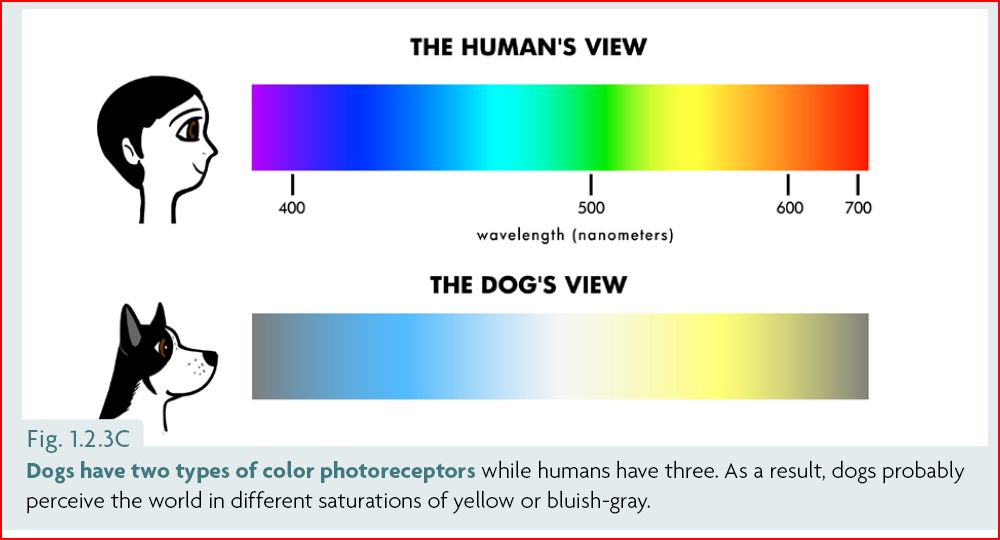
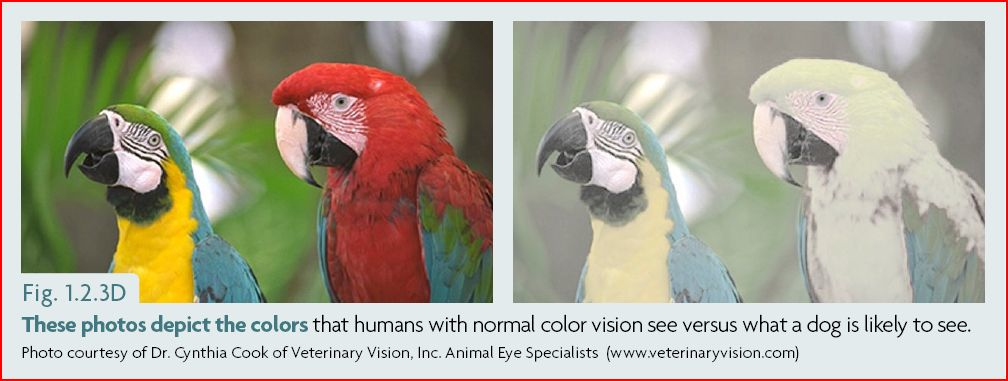
Eyes contain light-catching cells (cones) that respond to color. Canines have fewer cones than humans, which implies that, in principle, their color vision cannot be as good as ours. To see colors, we need different types of cones that detect different wavelengths of light. We have three types of cones, which allow us to register the full range of color vision. Dogs, in contrast, have only two types of cones.

Researchers at the University of California, Santa Barbara, tested dogs’ color vision in the late 1980s. Their studies confirm that dogs see color, though not as well differentiated as humans do. For us, the rainbow looks violet, blue, blue-green, green, yellow, orange, and red. For a dog, we presume it looks dark blue, light blue, gray, light yellow, darker yellow, and very dark gray. Violet and blue are both perceived largely within the blue range (Neitz, Geist, & Jacobs, 1989).

Studies performed by Russian scientists demonstrated that dogs tend to discriminate real color rather than brightness cues (Kasparson, Badridze & Maximov, 2013). They match any color they register with no more than two pure spectral lights.

dogcolors5-1

Dogs are dichromatic, as are most placental mammals. The ability to see long wavelengths necessary to distinguish red from green seems to have disappeared during evolution, probably during early mammalian evolution in the Mesozoic, likely under strong nocturnal selection pressures (Jacobs, 2009). Dichromatic vision, though, is good at distinguishing colors in dim light, favoring the most nocturnal animals.

Trichromats, like most humans, have three color-detecting cones (blue, green, and red) and can distinguish a vastly expanded range of color discriminations compared with dichromats. Trichromacy in humans is not ancestral to mammals. It is a derived re-evolution in Old World primates, an adaptation to a foraging ecology in which red–green discrimination provides a direct foraging advantage (Dulai et al., 1999). So human trichromacy is an exception produced by a very specific ecological niche, not the mammalian norm. Humans are visual outliers among mammals. When we treat human color perception as ‘normal,’ we are committing a deep phylogenetic bias.

Similar ecological pressures have shaped trichromatic vision independently in other, very distant lineages. The honeybee, Apis mellifera, is also trichromatic, seeing ultraviolet, blue, and green instead of blue, green, and red. Honeybee trichromacy is an adaptation shaped by the coevolution of pollinators and flowering plants, as many floral signals are specifically tuned to ultraviolet patterns invisible to human vision (Peitsch et al., 1992).

dogcolor6-1
Human = A and C. Dog = B and D. It is difficult for the dog to discriminate between red and green.

The term “colorblind” is therefore misleading. Dogs are not deficient humans—they retain the ancestral mammalian visual condition. Some animals developed the ability to see certain colors, and others to see others, all depending on ecological pressures, mutations, and the subsequent costs and benefits each strategy implied for their struggle for survival (Jacobs, 1993).

What does this mean for our communication and training of our dogs? Since dogs find it difficult to distinguish between certain reds and greens (like some humans do), we should choose toys and training aids in other colors. For example, light blue or yellow are much easier colors for a dog to detect (Neitz, Geist, & Jacobs, 1989). On the other hand, when training them in any scent-detection discipline (Gazit & Terkel, 2003; Horowitz, 2009), we should use colors for targets that are difficult for them to see to compel them to use their noses rather than their eyes.

Training an animal entails altering its behavior, a process that can profoundly affect the individual and, if misapplied, lead to unintended and undesirable side effects. It is therefore sound practice to examine how the animal perceives and interacts with its world, as well as the evolutionary mechanisms that have shaped both the species and the individual under consideration. In other words, we should strive to see the world through the animal’s eyes—however imperfect that vision of ours may be. Only then can training be both effective and respectful for the animal and for us.

References

Dulai, K. S., von Dornum, M., Mollon, J. D., & Hunt, D. M. (1999). The evolution of trichromatic colour vision by opsin gene duplication in New World and Old World primates. Genome Research, 9(7), 629–638. https://doi.org/10.1101/gr.9.7.629

Gazit, I., & Terkel, J. (2003). Domination of olfaction over vision in explosives detection by dogs. Applied Animal Behaviour Science, 82(1), 65–73. https://doi.org/10.1016/S0168-1591(03)00051-0

Horowitz, A. (2009). Inside of a dog: What dogs see, smell, and know. Scribner.

Jacobs, G. H. (1993). The distribution and nature of colour vision among the mammals. Biological Reviews, 68(3), 413–471. https://doi.org/10.1111/j.1469-185X.1993.tb00738.x

Kasparson, A. A., Badridze, J., & Maximov, V. V. (2013). Colour cues proved to be more informative for dogs than brightness. Proceedings of the Royal Society B, 280(1766), 20131356. https://doi.org/10.1098/rspb.2013.1356

Neitz, J., Geist, T., & Jacobs, G. H. (1989). Color vision in the dog. Visual Neuroscience, 3(2), 119–125. https://doi.org/10.1017/S0952523800004430

Peitsch, D., Fietz, A., Hertel, H., de Souza, J., Ventura, D. F., & Menzel, R. (1992). The spectral input systems of hymenopteran insects and their receptor-based colour vision. Journal of Comparative Physiology A, 170, 23–40. https://doi.org/10.1007/BF00190398

_________________

Featured image: Since dogs find it difficult to distinguish between certain reds and greens (like some humans do), we should choose toys and training aids in other colors (photo by Oleghz). Other illustrations from Dr. Cynthia Cook of Veterinary Vision Inc.

The Little Boy and His Dog

This is a beautiful recording of a lovely moment. What strikes me most in this clip is the peace emanating from both the little boy and the dog. It is but an elusive instant in the infinite history of time, but, for all they care, the world could be in flames. That one moment they share, nothing can take from them, it is all they have there and then. It will never be undone, it will never be any different, frozen as it is for all eternity. They are what they are, and they are no different. Peace comes not from striving and desiring, but from being—no conditions, no expectations, no questioning the past or querying the future. Life is what it is, and any relationship is unique because it involves unique individuals and unique conditions.

The magic of life lies not in living against, but in living with.

__________

As much as I would like to credit the author of this clip, unfortunately, his or her name remains unknown to me. Thanks for allowing us to share this beautiful, private moment.

__________

PS— At 1730 hrs GMT, 10 hours after I published my blog, I received a message from my Facebook friend Joeson Hsu in Taiwan with the information I had missed. Thanks, Joeson. The author of this movie is Ana, the mother of Herman, the little boy, and the dog is Himalaya.  Thank you so much, Ana, for sharing with us. Indeed, communication is a will, not a question of language or species, and a relationship is a natural thing.

__________

PPS from October 27, 2025—Meanwhile, Juan Cardoza uploaded the clip with all the information I had missed when I first published my blog on May 12, 2014, and this is the link I have now embedded in this blog. 

__________

Little Boy And His Dog

Children and Dogs—How to Avoid Problems

daniel and rassi sit

Too many misunderstandings between children and dogs end in tragedy, with the dog biting. The dog is then rehomed or destroyed, and the child may carry physical or emotional scars for life.

We must treat any problem between children and dogs with the utmost seriousness. Ideally, we should act preventively—setting measures in place before accidents occur. Allow me to be blunt: when a dog bites a child, the responsibility always lies with the adults. If such a grave misunderstanding arises, it is because we have failed—failed to teach the child how dogs perceive and interpret human behavior, and failed as dog owners to ensure our dogs always and unconditionally respect children. Subsequent apologies and explanations are of little use.

A child must never pay the price for his or her parents’ ignorance, nor for a dog owner’s negligence—and neither should a dog.

Even if you are not a parent and have no plans to become one, you must still teach your dog to accept children and behave calmly in their presence. Every child deserves our protection, and a bitten child is a mark of shame for all of us who share our lives with dogs.

daniel rassi scent detection

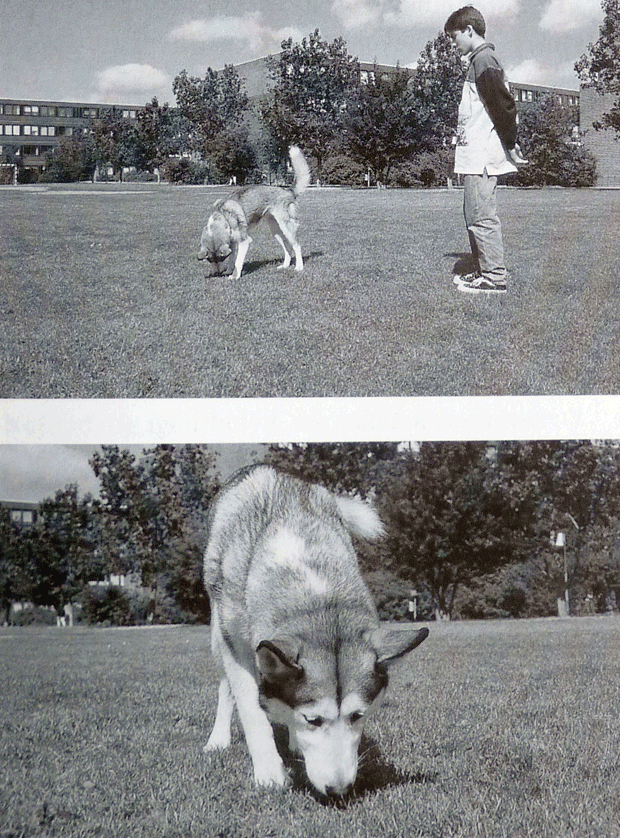
 Daniel and Rassi doing scent detection in 1997. Scent detection games are excellent for teaching children and dogs to work together. In the feature picture, they demonstrate a good communication exercise for both the child and the dog: having the dog sit, stand, and lie down without touching the dog.

A growing body of research suggests that children’s emotional bonds with their pets play a significant role in their psychosocial development. Stronger attachment to companion animals, particularly dogs, has been linked to greater self-compassion and empathy toward others (Bosacki et al., 2022). The quality of the child–pet relationship also appears crucial: positive interactions promote emotional regulation and healthy behavioural outcomes, whereas negative patterns may have the opposite effect (Wright et al., 2022). Cross-cultural studies reinforce these findings; for instance, among Chinese schoolchildren, higher attachment to pets correlated with increased self-efficacy and empathy (Song et al., 2019). Overall, pet ownership—especially when based on close, supportive bonds—can contribute positively to children’s emotional, social, cognitive, and behavioural development, although evidence remains somewhat mixed and further research is required (Purewal et al., 2017).

When it comes to health concerns, the evidence remains somewhat mixed. Some studies suggest that early exposure to animals—even sharing sleeping environments—may strenghten the immune system and reduce the risk of developing allergies (Hesselmar et al., 1999). Others indicate that, once sensitization has occurred, continued exposure can aggravate symptoms (Ji et al., 2022). From an allergological standpoint, Liccardi et al. (2025) note that “the negative aspects resulting from exposure to domestic and non-domestic animals outweigh the positive ones,” and emphasize the need to find better ways to balance these risks to ensure healthy coexistence between allergic individuals and companion animals.

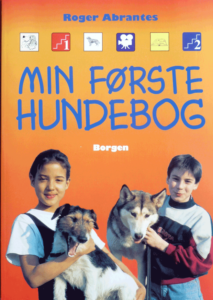
My First Dog Book,” published in Danish in 1997—the book I wrote with the children, for the children.

“Dogs and Children,” the book included in the online course of the same name.

my first dog book cover
dogs and children book coverdogs and children book cover

All in all, the research so far reminds us—parents, pet owners, and researchers alike—to stay attentive and reflective. The relationships our children build with animals, whether pets or otherwise, bring both gifts and challenges. It is our task to weigh these with care, resisting impulsive choices and allowing reason and understanding to guide our affection.

Playing it safe is always the wisest course. In particular, pay attention to the following potentially risky situations:

  • Never allow the dog to pick up the child’s toys. If this happens, instruct the child not to take the toy back, but to tell you—or another adult—immediately.
  • Avoid rough play between child and dog, as it can easily lead to unintended consequences.
  • Teach the child not to run near the dog, since sudden movement may trigger chasing behaviour.
  • Discourage the dog from jumping up at the child; most children find this frightening.
  • Do not allow the child and the dog to sleep together. A sudden startle in either could result in an accident.
  • Do not feed the dog and child at the same time or in close proximity. The presence of food can increase vigilance or competitiveness in some dogs.
  • Finally, teach the child the basic principles of understanding the dog so that teasing, provocation, or cruelty are never even an option. Encourage them to cooperate in peaceful, controlled activities like those shown in the illustrations above.

References

Abrantes, R. (2014). Dogs and Children. Wakan Tanka Publishers (online flipbook).

Bosacki, S., Tardif-Williams, C. Y., & Roma, R. P. S. (2022). Children’s and adolescents’ pet attachment, empathy, and compassionate responding to self and others. Adolescents, 2(4), 493-507. https://doi.org/10.3390/adolescents2040039

Hawkins, R. D., Robinson, C., & Brodie, Z. P. (2022). Child–dog attachment, emotion regulation and psychopathology: The mediating role of positive and negative behaviours. Behavioral Sciences, 12(4), 109. https://doi.org/10.3390/bs12040109

Hesselmar, B., Åberg, N., Åberg, B., Eriksson, B., & Björkstén, B. (1999). Does early exposure to cat or dog protect against later allergy development? Clinical & Experimental Allergy, 29(5), 611-617. https://doi.org/10.1046/j.1365-2222.1999.00534.x

Ji, X., Yao, Y., Zheng, P., & Hao, C. (2022). The relationship of domestic pet ownership with the risk of childhood asthma: A systematic review and meta-analysis. Frontiers in Pediatrics, 10, 953330. https://doi.org/10.3389/fped.2022.953330

Liccardi, G., Martini, M., Bilò, M. B., Cecchi, L., Milanese, M., Musarra, A., Puxeddu, E., & Rogliani, P. (2025). A narrative review on allergy and exposure to domestic and non-domestic animals: Favorable and unfavorable effects. European Annals of Allergy and Clinical Immunology, 57(3), 99–106. https://doi.org/10.23822/EurAnnACI.1764-1489.372. PDF (open access): https://www.eurannallergyimm.com/wp-content/uploads/2025/05/6.AAIITO-57_3_2025.pdf

Purewal, R., Christley, R., Kordas, K., Joinson, C., Meints, K., Gee, N., & Westgarth, C. (2017). Companion animals and child/adolescent development: A systematic review of the evidence. International Journal of Environmental Research and Public Health, 14(3), 234. https://doi.org/10.3390/ijerph14030234

Song, Y., Hirose, T., & Koda, N. (2019). Psychosocial impact of pet keeping on schoolchildren in China. People and Animals: The International Journal of Research and Practice, 2(1), Article 4. https://docs.lib.purdue.edu/paij/vol2/iss1/4Purdue e-Pubs

Do You Know What the Canine Hip Nudge Behavior Means?

canine hip nudge

The hip nudge is a typical canine behavior. Dog owners often think their dogs are pushy or impolite when they turn their backs to them, sometimes even pushing them. Nothing could be farther from the truth.

A hip nudge is a behavior a dog shows when it nudges another with its hip or rear end. Dogs often use this behavior towards us during greeting ceremonies when we show them passive friendliness by crouching down to it. The dog will walk towards us and turn round. Then it will either nudge us gently with its hip or rear end, or stand passively with its back to us.

caninehipnudgeraa-1-600x600-1

This dog shows a half hip nudge, still a sign of friendliness. Both the human and the dog are relaxed and show their peaceful intentions and trust in one another (photo by Lisa Jernigan Bain).

The hip nudge functions as a pacifying behavior. It signals friendliness. By turning its back to us, the dog shows it doesn’t intend to attack—it directs its teeth away from us. It also indicates it trusts us.

Dogs use a variation of the hip nudge behavior during mating rituals, in which the male nudges the female.

I first described this behavior in 1987, in the original edition of “Dog Language,” after spending several years observing, photographing, and filming dogs (Canis lupus familiaris), wolves (Canis lupus lupus), and foxes (Vulpes vulpes).

There are only minor differences between wolf and dog, which we can describe as dialects. The fox differs because, although it displays many behaviors common to the other two, it is less social than its cousins.

 References

  • Abrantes, R.A. (1992/1997). Dog Language—An Encyclopedia of Canine Behavior. Wakan Tanka Publishers, Naperville, IL.
  • Abrantes, R.A. (1997/2005). The Evolution of Canine Social Behavior. Wakan Tanka Publishers, Naperville, IL.
  • Fox, M.W. (1971). Behaviour of Wolves, Dogs and Related Canids. Harper & Row.
  • McFarland, D. (1999). Animal Behavior. Pearson Prentice Hall, England. 3rd ed.
  • Scott, J.P. and Fuller, J.L. (1965). Genetics and the Social Behavior of the Dog. University of Chicago.
  • Zimen, E. (1981). The Wolf—His Place in the Natural World. Souvenir Press.

Featured image: The hip nudge functions as a pacifying behavior. It signals friendliness (illustration by Alice Rasmussen from “Dog Language” by Roger Abrantes).

The Biggest Difference Between Humans and Dogs

The Biggest Difference Between Humans and Dogs

The biggest difference between humans and dogs is not that we reason, and they don’t. To observe rational behavior, look to the dog. To see an emotional response, watch the owner.

Some animals, other than humans, do reason. They have well-developed brains and are goal-seeking. They acquire, store, retrieve, and process information. Additionally, research shows that other animals, besides humans, understand rules. In other words, they know that a series of events must happen in a particular sequence to produce a specific effect.

Animals of many species are capable of solving a wide range of problems that involve abstract reasoning. The problem is that most of our research projects into animal cognition either adopt a behaviorist approach—its conditioning methods nearly turning other species, except our own, into automatons—or focus on particular human characteristics, such as speaking and counting.

The standard depiction of the ladder of nature, on which the various species occupy successively higher levels, places humans at the top. However, species exhibit distinct cognitive processes, depending on how they have adapted to their different ecological niches.

That brings us back to Darwin—the difference between humans and other animals is “[…] one of degree and not of kind.” (1871 in “The Descent of Man, and Selection in Relation to Sex.”)

Featured image: The biggest difference between them and us is not that we reason, and they don’t (by D. Myers).

References

de Waal, F. B. M. (2016). Are We Smart Enough to Know How Smart Animals Are? W.W. Norton & Company.

Frederick R. News feature: The search for what sets humans apart. Proc Natl Acad Sci U S A. 2015 Jan 13;112(2):299-301. doi: 10.1073/pnas.1423320112. PMID: 25587106; PMCID: PMC4299222.

Suddendorf, T. (2013). The gap: The science of what separates us from other animals. Basic Books/Hachette Book Group.

Zentall, T. R. (2023). Comparative Cognition Research Demonstrates the Similarity between Humans and Other Animals. Animals13(7), 1165. https://doi.org/10.3390/ani13071165.

We All Say We Love Dogs but Do We?

We All Say We Love Dogs but Do We?

Today, my friends, I have a very short blog post for you—to wonder and ponder!

We all say we love dogs, and yet we spend most of the time changing them. We change their appearance and their natural behavior, domesticate, civilize, and humanize them. We neuter and sterilize, crop their ears, and dock their tails. We have a thriving industry and commerce of accessories and gadgets, and a zillion dog trainers to turn our dogs into something they are not.

How is that compatible with any definition of love?

Dogs Are Better Trainers Than We Are

Dogs Are Better Trainers Than We Are

Dogs are better trainers than we are. They may know nothing about learning theory, but get along perfectly well with whom they want. Dogs don’t get too upset by a growl; they don’t become overconfident with a “yes,” nor do they get depressed by a “no.” They force us to get up early and go to bed late so they can go sniffing other dogs’ urine. We pay them for expensive food and medical care. And we do all that just because they sit and stand and look silly at us when we ask them to.

I remember, as a young student, listening to Professor Lorenz tell us that dogs were better ethologists than we were because they paid more attention to our body language than we did ourselves. That stuck with me then… and still does.

Featured image: Dogs are better trainers than we are (by A. Jones).

El último paseo

Traducido por Lua Gatchan (from the original in English The Final Walk).


El camino a casa desde el muelle es uno de los pequeños placeres de la vida. Normalmente es un paseo de 20 minutos, pero a menudo puedo tardar hasta una hora o incluso dos, ya que me paro a charlar con todo el mundo en el camino, con los comerciantes, con las personas que conozco de vista o incluso con desconocidos. Esta es la costumbre en mi pueblo en el sur de Tailandia, donde encuentras sonrisas y todo el mundo te habla.

Old dog

Bombom was old and tired, ready for his final walk to the temple.

El clima es casi siempre caluroso y soleado, entre 29° y 38°, hoy hace exactamente 32° según mi equipo de buceo. Por supuesto hay lluvias durante la temporada de lluvias, pero sólo duran una hora o dos y todo se seca pronto, dejando una sensación de frescura y olor a tierra mojada en el aire. A veces llueve tanto que las calles se convierten en ríos pequeños, pero todo el mundo se lo toma con calma, con los pantalones arremangados; la vida continúa (literalmente) con una sonrisa.

Después de haber completado tres inmersiones, una de ellas con fuerte oleaje, como de costumbre me muero de hambre. En estos días, mi trabajo en Tailandia consiste en la gestión biológica del medio marino que, básicamente significa bucear, a veces con estudiantes, otras sin, hago fotos a los peces y a los corales que veo, y luego escribo un informe. Sí, ¡esto es lo que yo llamo un trabajo! Me paro en uno de esos extraordinarios vendedores ambulantes en la calle principal para comer algo. La comida en la calle es tan barata y tan buena que no vale la pena ir a casa y cocinar.

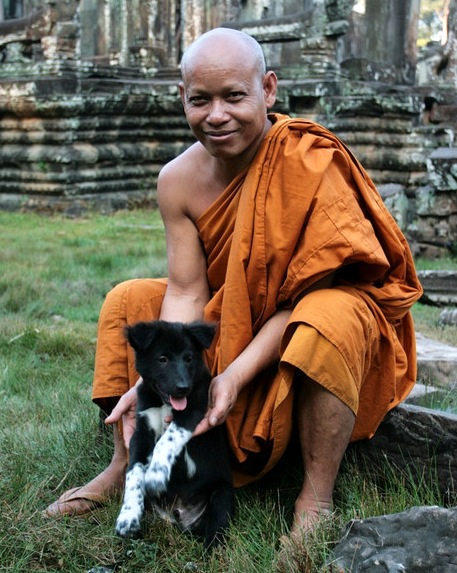
Buddhist Monk and Dog.

Buddhist Monk and Dog (image by John Lander).

Mi restaurante favorito (que se parece más a un garaje abierto) es una empresa familiar, al igual que la mayoría de los negocios en Tailandia. Los dueños viven allí. Tienen un televisor y una cama para los niños en la parte trasera, es decir, detrás de las cuatro mesas para los clientes. Todo está a la vista de todos. Claro, no quieren dejar a los niños solos en una habitación. Los niños (y los perros) son una parte inherente en la vida Tailandesa, los ves en todas partes. Se les permite hacer lo que quieran, pocas veces se les regaña o se les grita, y sorprendentemente son muy educados. Me desconcierta cómo manejan esto, sobre todo cuando pienso en algunos de nuestros mocosos en Occidente, tanto humanos como caninos. Todavía tengo que descubrir su secreto, pero supongo que tiene algo que ver con el hecho de que son parte de la vida cotidiana desde el día en que nacen; están perfectamente integrados sin ningunas construcciones ni zonas artificiales “para niños”. Lo mismo ocurre con los perros; son miembros como todos los demás, sin preocupaciones y sin ninguna atención especial, sin tratar a unos o a otros de una forma especial.

Sawasdee kha khoon, Logel”, Phee Malí me saluda con una gran sonrisa cuando me ve.

Phee significa hermana mayor y Malí significa Jasmine, que es su nombre. Soy Logel porque los tailandeses siempre te llaman por tu nombre de pila. Los apellidos son un invento relativamente nuevo que se les impone por el Gobierno en respuesta al crecimiento de la población y una sociedad más moderna. La guía telefónica está ordenada por el nombre de pila. El Rey Rama VI introdujo los apellidos en 1920 y él, personalmente, inventó apellidos para unas 500 familias. Todos los tailandeses tienen apodos. ¡Te diriges a tus amigos por sus apodos y ni siquiera conoces su nombre real! Soy Logel porque la mayoría de los tailandeses no pueden pronunciar el sonido de la letra “r”, ni siquiera en su propio idioma y sorprendentemente tienen la “r” en el idioma Tailandés.

Dog in Temple

Thais often take the dogs to the local temple so they can die in peace, in the company of the monks, near Buddha.

“¿Estás bien? ¿Has visto algún pez hermoso hoy?” me pregunta Phee Malí en ‘Tenglish’ (inglés-tailandés, que es un lenguaje en sí mismo, encantador y adictivo). En poco tiempo y sin ni siquiera darte cuenta, empiezas a hablar Tenglish. Yo hablo una mezcla de Tailandés y Tenglish con los lugareños. A medida que mejora mi tailandés hablo menos Tenglish, pero el tailandés es difícil porque es una lengua tonal. El tono con el que se pronuncia una palabra cambia su significado, y a veces de una forma dramática. Hay palabras que siempre pronuncio mal y a los tailandeses les da un ataque de risa, ya sea porque estoy diciendo un disparate o digo algo mal. Les encanta cuando se trata de la segunda opción. Incluso me animan a decir una palabra que sé y que ellos saben que no puedo pronunciar bien sólo para divertirse. Pero esa diversión es sana y sin ningún ánimo de faltar el respeto. Por el contrario, me dan un trato preferencial porque hablo tailandés.

Transcribiré a continuación algunas de nuestras conversaciones en inglés, traducido directamente de palabras tailandesas, con el fin de dar a mis lectores una idea.

Sí”, contesto. He visto peces hermosos y corales. El Thale (mar) Andamar estaba muy bien.

“Oh!, estás tan negro!” Exclama con el ceño fruncido y una sonrisa. “Negro” en realidad significa bronceado o quemado por el sol. A las mujeres tailandesas no les gusta estar morenas. A ellos les gusta el blanco, como suelen decir, y se preocupan cuando ven a alguien con lo que en Occidente llamamos un bronceado saludable y atractivo.

“You hung’y ‘ight, gwai teeaw moo pet mak ‘ight? Phee Malí me pregunta riendo. Ella sabe exactamente lo que tengo en mente; me encanta un plato de Gwai teeaw moo, caliente y picante, especialmente después de un día duro de trabajo. Es una sopa de fideos y carne de cerdo o pollo o camarones,  con todo lo que puedas imaginar. Incluso lo sirven con un plato de vegetales frescos que cortas con los dedos y los metes en la sopa como prefieras. Lo mezclas todo tú mismo con chili seco, chili fresco, salsa de chili, salsa de pescado, soja, pimienta, sal y un poco de azúcar (sí, azúcar, pruébalo y verás por qué me encanta). Es delicioso y puedo asegurar que también es muy saludable.

Me como mi Gwai teeaw moo y disfruto de un té verde helado sin azúcar. El sol se pondrá dentro de una media hora; aquí siempre se pone a la misma hora, siete grados al norte del ecuador. No hay lluvia hoy. ¡Disfruto de la vida en el Paraíso!

“Thao THALE SA Baay dee Mai”. Los niños van corriendo a preguntarme sobre los peces y en especial sobre la tortuga marina, su favorita, y es una buena oportunidad para practicar mi tailandés. Me llaman Lung Logel (tío Roger), en deferencia por mi edad. Entonces llega el turno de decir hola a los perros, un idioma que sé, que no tiene ningún acento y se habla igual en todos los continentes.

Thai Child wai.

The wai is the Thai greeting when you raise both hands together to your chin. It still strikes me as the most beautiful greeting I’ve ever seen.

Veo a Ae al otro lado de la calle (AE es un nombre divertido de un juego del escondite de Tailandia). La conozco a ella y a sus padres. Su padre trabaja en uno de los barcos que utilizo con regularidad en mis excursiones de buceo. A menudo le ayudo a atracar el barco cuando llegamos al muelle cuando no hace un clima perfecto y a veces tomamos una cerveza juntos después de haber asegurado el barco, descargarlo, etc. Ae está en cuclillas al lado de su perro, uno de esos perros de Tailandia que se parecen a todos los demás. Los perros de aldea en Tailandia son todos iguales, como si fueran de una raza particular, producto de una reproducción aleatoria a lo largo de los años. Yo los llamo “el perro por defecto”.

“¿Ae está triste, verdad?” Le pregunto a los niños.

“Oh, el perro de Ae está muy viejo. Mañana el padre de Ae llevará al perro al templo”, responde Chang Lek (su nombre es Pequeño Elefante).

Termino mi comida y voy a hablar con Ae, que todavía está en cuclillas junto a su perro, acariciándolo. Puedo ver que Bombom está viejo y cansado. Es un perro bueno y agradable. A menudo se le puede ver paseando por el pueblo tranquilamente por el vecindario. Él increíblemente siempre está muy polvoriento a pesar de que Ae y su madre lo bañan cuidadosamente y con frecuencia. Cuando me acerco a ellos, él a penas levanta la cabeza. Se muestra afable y resignado de sí mismo.

“Sawasdee khrap, Ae”.

“Sawasdee kha,” me responde la niña, y se apresura a mostrarme un wai para mi. El wai es el saludo tailandés, levantando ambas manos a la barbilla. Todavía me parece el saludo más hermoso que he visto nunca.

“Bombom es viejo, verdad?” le pregunto.

“Sí señor”.

“Bombom ha tenido una vida feliz. Tú eres una buena amiga de Bombom”.

“Sí señor”, dice suavemente.

“A Bombom le gustas mucho”, le digo quedándome sin palabras.

“Mamá y papá mañana llevarán a Bombom al templo”, responde ella, y veo que le cae una gran lágrima por su mejilla izquierda.

“Sí, lo sé”, le digo. Otra vez sin palabras, añado “Ae, voy a comprar un helado para que nos sentemos aquí comiendo helado y hablando con Bombom, ¿te gusta la idea?”

“Sí señor, muchísimas gracias señor”, dice ella, y se las arregla para regalarme una sonrisa encantadora.  “A Bombom le gustan mucho los helados”, me dice la niña, y ahora sus ojos están llenos de lágrimas jóvenes, tristes.

En la cultura y creencia tailandesa, todos los seres que viven bajo el mismo sol merecen el mismo respeto. Las especies no importan. Ellos aman a sus mascotas y cuando llegan a la edad de morir, algunos tailandeses los llevan al templo local para que puedan morir en paz, en compañía de los monjes y cerca de Buda. Por eso siempre hay muchos perros alrededor de los templos, y a veces es un problema real. Los templos son pobres. Un monje posee sólo siete artículos. Los vecinos cocinan para ellos y para los perros por la mañana antes de ir a trabajar.

Sawasdee khrap,

ชีวิต ที่ด

La vida es maravillosa.

R—

Related articles

為了讓你跟狗狗可以快樂地在一起 “16件別再這麼做的事情”

譯者 translator: 林明勤 ( Ming Chin Lin) — from the original in English “16 Things You Should Stop Doing In Order To Be Happy With Your Dog

Roger Abrantes in 1986 howling with husky.

Cover photo from the author’s book from 1986 “Hunden, vor ven” (The Dog, Our Friend) (photo by Ole Suszkievicz).


如果您希望與狗兒生活地更開心並且擁有穩固的關係,以下有16件您必須停止再這麼做的事情。會很困難嗎?一點也不。你只需要產生想做的念頭,然後很單純地就去行動。也就是說,閱讀完這篇文章後,您就開始著手進行了!

1.  別再過度挑剔—別擔心,享受過程吧。 Stop being fussy—don’t worry, be happy

如同對於我們生命中的大部分事物來說, 當一個完美主意者是有其優點及其缺點的。當你養了一隻狗,你的生活會傾向莫非定律的模式 。任何會出差錯的事情將會出差錯。因為事情總有變數,也因此事情的發展很少百分之百如你期望的方式進行。您能夠做的也應該做的則是計畫並訓練,但需要做好準備的是,在沒有任何人(狗)會受傷的情況下,接受所有各種變動性、臨時性以及微小的事故。畢竟,在大部分的情況來說,比”完美”差一點點的往往都比”做的好”來的更好,所以為何要擔心做到完美呢?”完美”,這個僅存在於您腦袋裡的概念並不會讓任何人都開心,不論是對您或者您的狗兒來說都是。

2. 別老是太嚴肅—笑一下吧!Stop being too serious—have a laugh

如果你沒有很好的幽默感,那麼就別和狗兒生活在一起。哈哈大笑在很多事故發生時,通常是最好的解決方式,也同時可以讓狗狗與主人的關係升溫。會因事故而感到難堪、尷尬的只有我們的心裡。您的狗甚至不懂尷尬是什麼,而您應該跟隨狗狗這樣的方式。只要沒有任何人、狗受傷,那麼對於您或者您的狗狗犯下的過錯,就一笑置之吧!

3. 停止你想要控制任何事情的慾望—當狀況發生時,接受它。Stop your desire to control everything—take it as it comes

當您用莫非定律來決定您與狗兒的生活方式時,如果您企圖控制您的狗兒的每一個行動, 您最後得到的會是潰瘍或者陷入失望、沮喪之中。放棄您需要控制一切的想法。當然地,您應該要在安全的考量下,有理智地控制管理好狗狗,不過您應該將一些對生活或者死亡無關緊要的事物給拋在腦後。

4. 別再”散撥”你的責罵—繼續前進。 Stop apportioning blame—move on

當事情出了差錯(我可以跟您保證,事情就是會出錯)別浪費你的時間在分送你的責罵。是否是您造成的錯、狗兒造成的錯、還是鄰居的貓害的?誰在乎呀?

向前看,並且如果你發現當下的情況全都令人失望,那麼就試著預先想好未來可能會發生與這次類似的情節,並且避免它的發生。假如不是件很大的事情,那就忘了它吧。

5. 別再去相信關於狗狗的祖先是狼的傳言。 Stop believing in old wives’ tales—be critical

這世界上充滿的許多不合理的、毫無根據的狗狗的狼祖先傳言。這些日子來,網路提供了一個快速及簡易的管道讓我們可以獲得許多珍貴的資訊,同時也有很多是垃圾: 不好的觀點、不好的定義、未經證實的申明、謬論、情緒化的呈述、偽科學、促銷活動、被隱藏的政治議程、宗教道義等。當然,以表達個人言論的自由來說,我相信任何人都可發佈任何自己想要表達的看法,甚至單純地就一派胡言。但您和我都有權不去相信它、有權去漠視它。運用您的批判性思考。不要停止問自己“這怎麼有辦法發生“及“他/她是怎麼得到結論的?“ 直到您有時間好好深深地思考之後,才停止你的批判及行動。如果有必要,則尋求第二或者第三者的看法。如果這個論點非常可靠並且你喜歡,那麼就可以這麼做;如果這個論點很可愛但你不喜歡它,那麼就不要做,並且想的仔細一點;假如那個觀點不可靠,那就拒絕它並且不要再想了;為你自己做下決定並做你認為對的事情。

6. 別在意標籤—別憂慮!Stop caring about labels—be free

因為標籤的販售,我們因而被過度地淹沒在標籤之中,但它們之所以存在而被販賣,只因為你買單。你是否應該是個正向、極度正向、正增強、正正增強、正增強負處罰、達到兩者平衡、自然派、道德派、保守派、實際派、激進派、響片訓練者或者獨裁主意者的飼主呢?停止在意您該被貼上什麼標籤。當您與您的狗狗享受一個完美的時刻,您所被貼的標籤是不相干的。標籤是一個負擔;它會限制您並讓您奪走自由。標籤是給那些需要躲在圖片後並毫無安全感的人用的。請相信你自己,成為你想要成為的飼主,而且你並不需要標籤。

7. 別再去管別人怎麼想—過你自己的!Stop caring about what others think—live your life

在與您碰面的大多數人中,您在這些人身上只會花了非常少的時間;大多數的時間您則是花在家人及親近的朋友身上。所以,當您可能甚至不會再次見到這些人或者只會偶爾見到的人人,為何要在意其他們對您身為一個飼主或者您的狗狗的行為的看法呢?

8. 停止抱怨—不要浪費你的時間。 Stop complaining—don’t waste your time

您只有在一種情況下會有問題,也就是當您期望的事情與事情原貌之間有差異的時候。如果您的期望是很切實的,那就嘗試看看並且做些可以達成期望的事情。如果不是,那就停止抱怨,這浪費的是時間及精力。假如您可以為那件事情做些事,那就做吧!如果不行,那為當下畫個句點後,就向前邁進。

9.  別再為自己找藉口。 Stop excusing yourself—be yourself

您不需要為您的作風或者您的狗兒找合理化的藉口。只要在您不打擾任何人(狗)的狀況下,您有權做您喜歡的方式並且作你自己。您不需要對任何事都非常擅長,不論是服從訓練、敏捷犬、與狗共舞、在音樂中讓狗狗腳側行進、飛球活動、護衛犬、牧羊犬、嗅覺活動、動物輔助治療、雪橇犬比賽、跳水狗活動、Field、Earthdog、Rally-O、Weight Pulling、Carting、Trials、 Dock Dogs、Dog Diving、Disc Dogs、Ultimate Air Dogs、Super Retriever、Hang Time、Lure Course Racing or Treibball; 關於您做不到的事情,您不需為自己解釋不擅長的原因。當然,您也無需說明您的狗沒有標準坐姿的原因。另一方面,針對您想要改變並且能被改變的事物來努力;別把時間跟精力花在去想您不想要的、不需要的或無法改變的事物。無論您與您的狗享受的是什麼,就去做吧!只要您們喜歡,您跟狗狗才可以同時是快樂的。就是這麼簡單!

10. 別再為某些事難受立刻行動。 Stop feeling bad—act now

如果您對於在您與狗狗的生活中的某一項特定的層面而感到不開心,那麼就做一些事情來改變它。辨別問題且立下目標、擬定一個規劃進而實踐它。僅專注於難受的感覺或愧疚對於事情本身、對任何人、您的狗或者那個與您分享生活的可貴的人來說,都無濟於事。

11. 停止您對於擁有的慾望───作伴!Stop your urge to own—be a mate

對於一個生命具備享有權的奴隸制度,很慶幸地早已經被廢除了,因此,別過時地把自己看成是您的狗的所有者。要把您的狗狗當作一個您需要為之負責的伴侶。如同您並不擁有您的孩子、您的父母親或者您的朋友。

12. 停止依賴— 釋放自己。 Stop dependency—untie your self

愛基本上與依賴、著迷或渴望無關,甚至與這三者的必要性關聯是恰恰相反的。您可以愛您的狗但不要建立對彼此的依賴。您要有一個自己的生活並且給您的狗一些空間。您跟您的狗兒是兩個獨立的個體。就像是自由球員一樣,您們享受與彼此一起生活,但不是對彼此著了迷。停止把自己的影子投射在狗狗身上。

13. 別把狗狗當作一個替代品—展現尊重。 Stop turning your dog into a substitute—show respect

每一隻狗都是一隻狗,而他都是一個獨一無二的生命。你要愛他、享受有他的陪伴但不要把他當作任何一個人、朋友、小孩或者另一個配偶的替代品。

期待任何人/狗成為一個替代品對一個人、一個非人類的動物或者對您自己來說都是非常不敬的。別再讓您的狗狗為您扮演一個某一個角色,您必須開始用愛一隻狗的方式來愛你的狗。

14. 別試著合理化—請保持真實。 Stop rationalizing—be truthful

所有的關係如同經貿交易般是有付出與獲得的往來。

只要兩者能取得平衡,那麼就沒有任何問題。要對自己誠實 :

您的狗給了你什麼,而你又為你的狗做了什麼?如果你發現你們其中一個幾乎都是供給者或是接受者,思考這個問題並且調整這個平衡。你的狗需要你,就像你需要你的狗一樣,而且只要你跟狗狗都是有付出及獲得,那麼這之間並沒有任何問題。你不是因為為了拯救這個可憐的小動物而養牠。您養你的狗是因為你們兩個可以一起享受一個美好的豐富的夥伴關係。

15. 別再去奢望那些你不能擁有的事物—對於當下所擁有的要感到開心。 Stop wanting what you can’t have—be happy with what you’ve got

這是十分常見的人類特性。你總是奢望那些你無法得到的;對於您已經擁有的那些美好視而不見。

你的狗已經提供了你一個非常好的交易呢!儘管你的狗狗無法對於每件事情都很擅長,但你們兩個是可以非常完美地開心在一起!當狗主人說著他們多愛自己的狗但卻花著大部分的時間試圖去改變狗兒的行為,這是多令人吃驚的呀!把焦點放在你擁有的事物上,而不是你沒擁有的事物,感受並感恩你所擁有的。

16. 別再打擊你自己—跟著心意走。 Stop fighting yourself—follow your heart

有非常多種不同的方式可以成為一個好的狗主人。你有你自己的方式、別於他人的方式。這是你的人生。只要你不傷害任何人(狗),那就用你覺得自在的方式活著吧!仔細去聆聽專家的建議,好好地思考他們的建議,但最後,做你感覺是對的事情,跟隨你的心。做你自己。

生命是美好的!Life is great!

R—

Related articles

I’m a citizen of the World

I’m a citizen of the World,” I say, when asked where I come from—and I am, in mind and heart.

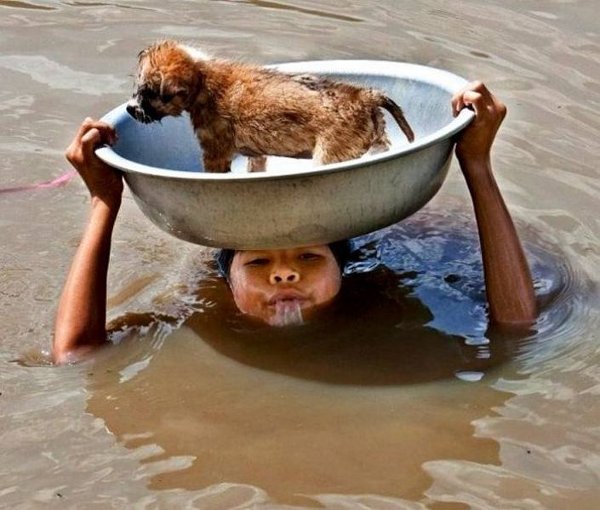
Woman saving dog from the flood

Woman saving dog from the flood (photo by Dave).


Diogenes, in about 412 BC, was probably the first to use the expression and express the very same sentiment. When asked where he came from, he replied: “I am a citizen of the world (kosmopolitês)”. Socrates (469-399 BC) concurred: “I am not an Athenian or a Greek, but a citizen of the world.” This was indeed a revolutionary thought, because at that time, social identity in Greece was either bound to the city-states, Athens and Sparta, or to the Greeks (the Hellenes). Perhaps it is just as revolutionary today.

Kaniyan Poongundran, the Tamil poet, wrote (at least 2000 years ago), “To us all towns are one, all men our kin.” Thomas Paine (English-American philosopher, 1737 – 1809), said, “The world is my country, all mankind are my brethren and to do good is my religion.” Albert Einstein (1879-1955) thought of himself as a world citizen, “Nationalism is an infantile disease. It is the measles of mankind.”

I’ve travelled over most of our beautiful planet, seen mountains above the clouds with perennial snow tops, and oceans reaching far beyond the eye can see. I’ve lived in temperatures from 40º C below zero to 40º C above. I’ve eaten all kinds of weird and wonderful dishes prepared by humans and spent many a day and night enjoying the company of people with the most peculiar cultures and habits.

Asian child with cat and dog.

Child with cat and dog.


What’s my favorite place? I don’t have one. Everywhere I’ve been, I’ve discovered new pieces in the amazing puzzle of life. Everywhere I’ve been, from the most glamorous cities to the poorest, war-torn areas, I’ve met kind and gentle people. I’ve shared water with the Masai in the African desert and rice with the Chhetris in the Nepalese mountains. I felt a strong kinship with all of them: no country, no culture, no language, no divide—we were family, we were humans, we were sentient living beings.

My blogs are read all over the World. I have readers in places that you may never have heard of: Northern Mariana Islands, Guam, Kyrgyzstan, Brunei, Réunion, Oman, to name just a few. I speak nine languages and understand at least sixteen, but write in English, as it’s the language I feel most comfortable with. I write about matters concerning my profession (biology and ethology) and also about life. My goal is to share the knowledge and experience I’ve been so fortunate to acquire during my life with all those who wish to receive it. My blog site, on which I share blogs, articles and books, is free to everyone.

I write in English, which is fast becoming a lingua franca, understood and spoken by most, allowing my blogs to reach far and wide. However, there are many people who do not speak or understand English and, therefore, from time to time, I publish a translation of one of my blogs in a language other than English. This is the least I can do for my loyal, non-native, English speaking readers from around the world.

Boy and dog sleeping on the street.

Boy and dog sleeping on the street (photo by Gemunu Amarasinghe).


As my blog site is free of charge, I have to keep costs as low as possible. I therefore use the WordPress platform, which is efficient, but has its limitations, one of which is that subscribers cannot be categorized by their native language; which means that all subscribers receive notifications of all my blogs whatever the language. This shouldn’t really be a problem, as, if you receive a blog in a language you don’t understand, you can either click the blue link that takes you directly to the English original, or you can simply discard the notification email. However, this seems to upset some native English speakers to the point where they send me messages asking me to remove them from the subscribers list unless they only receive blogs in English.

Unfortunately, that’s impossible if my blog is to remain free of charge because WordPress doesn’t provide that option. Such readers need to decide whether the inconvenience of receiving a message about a blog entry in a language you can’t read outweighs the benefits of having free access to all the other stuff you can. As of today, I’ve published 49 blogs (including several articles and six small books) of which only eight are in languages other than English. You can do your calculations and decide whether you get enough for your money (the money you don’t pay, that is).

As long as I receive messages like the one below, which overwhelms me, makes my heart beat a little faster and my eyes well up, I’ll continue to offer the sporadic translation.

“Teacher sir Roger I’m not good English I no computer Read from computer shop read your article from dictionary info I like so much I have many dog other animal too I very much appreciate your help very much You long life healthy”

The only regret I have is not being able to write in more languages than I do. Until then, I’ll continue writing in as many languages as I can—and yes, I’m a citizen of the World!

Life is great!

R—

Note: According to the CIA World Fact Book, only 5.6 % of the world’s total population speaks English as a primary language. That number doubles when people who speak English as a second or third language are counted. By conservative estimates, that means that well over four-fifths of the world’s population does not speak English.

Related articles

16 cosas que debería dejar de hacer para tener una vida más feliz con tu perro

Roger Abrantes in 1986 howling with husky.

Foto de la portada del libro del autor de 1986 “Hunden, vor ven” (“El Perro, Nuestro Amigo”) (foto de Ole Suszkievicz). 

16 Things You Should Stop Doing In Order To Be Happy With Your Dog” traducido del Inglés por Victor Ros.

Aquí tienes una lista de 16 cosas que debería dejar de hacer para tener una vida con tu perro más feliz y una relación más fuerte. ¿Difícil? Para nada. Sólo necesitas querer hacerlo y, a continuación, simplemente hacerlo. Puede comenzar tan pronto como termines de leer esto.

1. Deja de ser quisquilloso—No te preocupes y sé feliz (don’t worry, be happy)

Como la mayor parte de cosas en la vida, ser un perfeccionista tiene sus ventajas y desventajas. Cuando posees un perro, tiendes a vivir según la Ley de Murphy. Cualquier cosa que puede ir mal irá mal. Hay tantos variables que las cosas rara vez van 100% la manera esperada. Puedes y debes planear y entrenar, pero tienes que estar preparado para aceptar todo tipo de variaciónes, improvisaciones y pequeños percances a lo largo del camino, siempre que nadie se haga daño, por supuesto. ¿Después de todo, en la mayor parte de situaciones, menos que perfecto es mejor que bueno, entonces, por qué la preocupación sobre la perfección, un concepto que sólo existe en tu cabeza y no hace a nadie feliz, ni a ti, ni a tu perro?

2. Deja de ser demasiado serioRíete (have a laugh)

Si no tienes buen sentido del humor, no vivas con un perro. Ser propietario de perro da ocasión a contratiempos donde la risa es la mejor salida. Los contratiempos sólo son embarazosas en nuestras mentes. Tu perro no sabe siquiera lo que quiere decir verguenza, deberias seguir su ejemplo. Mientras nadie se haga daño, riete de los errores que cometeis tu y tu perro.

3. Deten tu deseo de controlarlo todo—Tomarlo como viene (take it as it comes)

Cuando la vida con un perro es a menudo dictada por la ley de Murphy, si intenta controlar cada movimiento de tu perro, acabara con una úlcera o caeras en una depresión. Renuncie tu necesidad de control. Por supuesto, debe tener un control razonable sobre tu perro por razones de seguridad, pero debe dejar ir todo aquello que no es una cuestión de vida o muerte. Reglas razonables sirven un propósito, pero el control total es innecesaria y contraproducente. Tomarlo como viene y seguir sonriendo!

4. Deja de imputar la culpa—Avanzar (move on)

Cuando las cosas van mal, y lo harán, les aseguro, no pierda el tiempo repartiendo culpas. ¿Fue tu culpa, culpa del perro, o culpa del gato del vecino? ¿A quién le importa? Sigue adelante aunque toda la escena te produjo tristeza, intenta prever una situación similar en el futuro y como evitarlo. Si no ha sido gran cosa, olvidate del asunto.

5. Deja de creer en los cuentos de vieja crítico (be critical)

El mundo está lleno de cuentos de viejas, irracionales y sin fundamento. Hoy día, el Internet nos proporciona rápido y fácil acceso a mucha información valiosay tambien un montón de basura: malos argumentos, malas definiciones, reclamaciones infundadas, falacias, estados emocionales, pseudociencia, promociones de ventas, agendas políticas ocultas, predicaciónes religiosos, etc… Por supuesto, en nombre de la libertad de expresión, creo todos deberían poder publicar cualquierles gusta, incluso la bazofia más pura y más refinada, pero tanto yo como tu también tenemos el derecho a no creernoslo, haciendo caso omiso de ello. Utilice tu pensamiento crítico. No deje de preguntar “¿Cómo puede ser?” y “¿Cómo llegó a esa conclusión?” Suspende el juicio y la acción hasta que hayas tenido tiempo para reflexionar, si es necesario, busca una segunda o tercera opinión. Si el argumento es sólido y le gusta, entonces hágalo. Si el argumento es sólido pero no te gusta, no hacerlo y pensar más sobre ello. Si el argumento es poco sólido, rechazalo y no pienses más sobre ello. Convencete a ti mismo y haz lo que piensas es correcto.

6. Deja de preocuparte por etiquetas—Sé libre (be free)

Estamos sobre-inundados por las etiquetas porque las etiquetas venden, pero sólo venden si los compramos. ¿Deberias ser positivo, ultra-positivo, R+, R++, R+ P-, equilibrado, naturalista, moralista, conservador, realista, progresivo, o dueño clickeriano o autoritario del perro? Deje de preocuparte sobre qué etiqueta debe portar. Cuando disfrutas de un gran momento con tu perro, la etiqueta que llevas es irrelevante. Una etiqueta es una carga; te restringe y te quita tu libertad. Las etiquetas son para personas inseguras que necesitan esconderse detrás de una imagen. Cree en ti mismo, sea el tipo de propietario de perro que quieres ser y no necesitará etiquetas.

7. Deja de preocuparte sobre lo que piensan los demás—Vive tu vida (live your life)

Pasas muy poco tiempo con la mayoría de la gente que conoces, significativamente más con la familia y amigos cercanos, pero vives toda la vida contigo mismo. Así que, ¿qué importa lo que otras personas piensan acerca de su habilidad como propietario de perro, o del comportamiento de tu perro, cuando es probable que no les veas de nuevo o sólo les veremos esporádicamente? Si les gusta tu y tu perro, bien. Si no, realmente no es tu problema.

8. Deja de quejarte—No pierdas tu tiempo (don’t waste your time)

Sólo tienes un problema cuando hay una discrepancia entre la forma en que las cosas son y lo que esperas que sean. Si tus expectativas son realistas, probar de hacer algo para alcanzarlas. Si no lo son, deja de quejarte, es un desperdicio de tiempo y energía. Si puede hacer algo al respecto, hazlo. Si no puedes, sigue adelante. Punto.

9. Deja de pedir disculpas—Sé tu mismo (be yourself)

No tienes que pedir disculpas ni por ti ni por tu perro por la forma en que sois. Mientras no molesteis a nadie, podeis hacer lo que querais y ser quien quereis ser. No tienes que ser bueno en nada, como Obedience, Agility, Musical Free Style, Heel Work to Music, Flyball, Frisbee Dog, Earth Dog, Ski-Joring, Bike-Joring, Earthdog, Rally-O, Weight Pulling, Carting, Schutzhund, Herding, Nose Work, Therapy, Field Trials, Dock Dogs, Dog Diving, Disc Dogs, Ultimate Air Dogs, Super Retriever, Splash Dogs, Hang Time, Lure Course Racing, Sled Dog Racing or Treibball; y no necesitas excusarte por ello. No hay que escusarse tampoco si tu perro no sabe sentar bien. Cambia lo que quieras y puedas cambiar y no pierdas tiempo y energia pensando sobre lo que no quieres, no necesitas o no puedas cambiar. Haz lo que tu y tu perro os gusta, como querais hacerlo, asi los dos resultais contentos. Es tan simple como eso!

10. Deja de sentirte mal—Actua ahora (act now)

Si no estás conforme con algún aspecto de tu vida con tu perro, haz algo para cambiarlo. Identifique el problema y establezca un objetivo, haz un plan e implementalo. Sentirse mal y culpable no ayuda a nadie—esto no te ayudara ni a ti, ni a tu perro, o los que mas quieres y con quienes compartes tu vida.

11. Pare tu impulso de poseer—Sé un compañero (be a mate)

La propiedad de los seres vivos es esclavitud; y afortunadamente la esclavitud ha sido abolido No te consideres como el dueño de tu perro. Piensa en tu perro como un compañero del cual eres responsable. No posees a tus hijos, tu pareja y tampoco tus amigos.

12. Detener la dependencia—Desatate (untie your self)

Amor nada tiene que ver con la dependencia, obsesión y el deseo, sino todo lo contrario. Ame su perro, pero no creas una dependencia mutua. Tenga vida propia y dé a su perro algún espacio. Tu perro y tu sois dos individuos independientes. Disfrute de vivir juntos como personas independientes, no siendo enviciado el uno al otro. Deje de proyectarse en su perro.

13. Deja de convertir tu perro en un sustituto—Muestra respeto  (show respect)

Un perro es un perro y en efecto es un notable ser vivo. Ámelo, disfrute de su compañía, pero no le haga un sustituto para un compañero humano, un amigo, un hijo o un cónyuge. Esperar que cualquiera pueda ser un sustituto es el mayor desrespeto que pueda cometer tanto hacia otro humano como hacia cualquier animal no humano, y a ti mismo. Dejarle cesar al perro en seguirte tu guion y comienza a amarlo como el perro que es.

14. Deja de racionalizar—Sé sincero (be truthful)

Todas las relaciones son intercambios: das y tomas. No hay nada malo con esto mientras hay equilibrio. Tienes que ser honesto contigo mismo: Que te da tu perro y que le das a tu perro? Si ves que uno de los dos es mayoritariamente uno que da o recibe, piensalo y reestablece el equilibrio. Tu perro te necesita tanto como tu a el, y no hay nada malo en ello, mientras los dos daís y recibís. No teneis el perro solo para salvar el pobre, pequeña criatura. Tienes el perro para que ambos podais gozar de una relacion solida y fructifera.

15. Deja de querer lo que no puede tenerSé feliz con lo que tiene (be happy with what you’ve got)

Esto es una característica humana muy común: siempre quiere lo que no tiene y es ciego a todo el bien que realmente tiene. Tu perro ya te da muchisimo y los dos podeis ser absolutamente felices juntos, aun cuando tu perro no es particularmente bueno en algo. Es asombroso como los dueños de perros suelen decir que ellos aman sus perros y aún asi pasan la mayor parte del tiempo tratando de cambiar su comportamiento. Concéntrese en lo que tiene, no en lo que no, aprécielo y agradezelo.

16. Deja de luchar contratigo mismo—Siga tu corazon (follow your heart)

Hay muchas maneras de ser un buen propietario de perro y el tuyo es unico y diferente a todos los demás. Es tu vida. Mientras que no perjudique a nadie, viva en la forma que te siente bien. Escuche a expertos, reflexione sobre su consejo, pero, al final de día, haga lo que siente es correcto para tí, siga tu corazón.

La vida es grande!

R—

Artículos Relacionados

16 Things You Should Stop Doing In Order To Be Happy With Your Dog

Roger Abrantes in 1986 howling with husky.

Cover photo from the author’s book from 1986 “Hunden, vor ven” (The Dog, Our Friend) (photo by Ole Suszkievicz).


Here is a list of 16 things you should stop doing in order to make life with your dog happier and your relationship stronger. Difficult? Not at all. You just need to want to do it and then simply do it. You can begin as soon as you finish reading this.

1. Stop being fussy—don’t worry, be happy

Like most things in life, being a perfectionist has its advantages and disadvantages. When you own a dog, you tend to live by Murphy’s Law. Anything that can go wrong will go wrong. There are so many variables that things seldom go 100% the way you expect. You can and should plan and train, but be prepared to accept all kinds of variations, improvisations and minor mishaps along the way as long as no one is injured, of course. After all, in most situations less than perfect is better than good, so why worry about perfection, a concept that only exists in your head and doesn’t make anyone happy, neither you nor your dog?

2. Stop being too serious—have a laugh

If you don’t have a good sense of humor, don’t live with a dog. Dog ownership gives rise to many mishaps where laughter is the best way out. Mishaps are only embarrassing in our minds. Your dog doesn’t even know what embarrassment is and you should follow its example. As long as no one gets hurt, just laugh at you and your dog’s mistakes.

3. Stop your desire to control everything—take it as it comes

When life with a dog is often dictated by Murphy’s Law, if you attempt to control your dog’s every move, you’ll end up with an ulcer or fall into a depression. Give up your need to control. Of course, you should have reasonable control over your dog for safety’s sake, but you should let go of anything that is not a matter of life or death. Reasonable rules serve a purpose, but total control is unnecessary and self-defeating. Take it as it comes and keep smiling!

4. Stop apportioning blame—move on

When things go wrong, and they will, I assure you, don’t waste your time apportioning blame. Was it your fault, the dog’s fault, or the neighbor’s cat’s fault? Who cares? Move on and, if you found the scenario all rather upsetting, try to foresee a similar situation in the future and avoid it. If it was no big deal, forget about it.

5. Stop believing in old wives’ tales—be critical

The world is full of irrational, unfounded old wives’ tales. These days, the Internet provides us with quick and easy access to a lot of valuable information—and a lot of junk as well: bad arguments, bad definitions, unsubstantiated claims, fallacies, emotional statements, pseudo-science, sales promotions, hidden political agendas, religious preaching, etc. Of course, in the name of freedom of expression, I believe everyone should be allowed to post whatever they like, even the purest and most refined crap—but both you and I also have the right not to believe it, to disregard it. Use your critical thinking. Don’t stop asking yourself  “How can that be?” and “How did he/she come to that conclusion?” Suspend judgment and action until you have had time to ponder on it and, if necessary, seek a second and third opinion. If the argument is sound and you like it, then do it. If the argument is sound but you don’t like it, don’t do it and think more about it. If the argument is unsound, reject it and think no more about it. Make up your own mind and do what you think is right.

6. Stop caring about labels—be free

We are over swamped by labels because labels sell, but they only sell if you buy them. Should you be a positive, ultra-positive, R+, R++, R+P-, balanced, naturalistic, moralistic, conservative, realistic, progressive, clickerian or authoritarian dog owner? Stop caring about what label you should bear. When you enjoy a great moment with your dog, the label you bear is irrelevant. A label is a burden; it restricts you and takes away your freedom. Labels are for insecure people that need to hide behind an image. Believe in yourself, be the type of dog owner you want to be and you won’t need labels.

7. Stop caring about what others think—live your life

You spend very little time with most of the people you meet, significantly more with family and close friends, but you live your whole life with yourself. So, why care about what other people think about your ability as a dog owner or your dog’s behavior, when you probably won’t see them again or will only ever see them sporadically? If they like you and your dog, fine. If they don’t, it’s really not your problem.

8. Stop complaining—don’t waste your time

You only have a problem when there is a discrepancy between the way things are and the way you expect them to be. If your expectations are realistic, try and do something about achieving them. If they’re not, stop complaining, it’s a waste of time and energy. If you can do something about it, do it. If you can’t, move on. Period.

9. Stop excusing yourself—be yourself

You don’t have to excuse yourself or your dog for the way you are. As long as you don’t bother anyone, you are both entitled to do what you like and be the way you are. You don’t need to be good at anything, whether it be Obedience, Agility, Musical Free Style, Heel Work to Music, Flyball, Frisbee Dog, Earth Dog, Ski-Joring, Bike-Joring, Earthdog, Rally-O, Weight Pulling, Carting, Schutzhund, Herding, Nose Work, Therapy, Field Trials, Dock Dogs, Dog Diving, Disc Dogs, Ultimate Air Dogs, Super Retriever, Splash Dogs, Hang Time, Lure Course Racing, Sled Dog Racing or Treibball; and you don’t need excuses as to why not. You don’t even need to excuse the fact that your dog can’t sit properly. Change what you want to change and can change; and don’t waste time and energy thinking about what you don’t want to, don’t need to or can’t change. Do whatever you and your dog enjoy, however you like, so that both you and your dog are happy. It’s as simple as that!

10. Stop feeling bad—act now

If you’re unhappy with any particular aspect of your life with your dog, do something to change it. Identify the problem, set a goal, make a plan and implement it. Feeling bad and guilty doesn’t help anyone—it doesn’t help you, your dog, or the cherished ones you share your life with.

11. Stop your urge to own—be a mate

The ownership of living beings is slavery; and thankfully slavery was abolished. Don’t regard yourself as the owner of your dog. Think of your dog as a mate you are responsible for. You don’t own your children, your partner or your friends either.

12. Stop dependency—untie your self

Love has nothing to do with dependency, obsession and craving, quite the contrary. Love your dog but don’t create mutual dependency. Have a life of your own and give your dog some space. You and your dog are two independent individuals. Enjoy living together as free agents, not being addicted each other. Stop projecting yourself onto your dog.

13. Stop turning your dog into a substitute—show respect

A dog is a dog and it is indeed a remarkable living being. Love it, enjoy its company, but don’t make it a substitute for a human partner, a friend, a child or a spouse. To expect anyone to be a substitute is the greatest disrespect you can show to a human as well as non-human animal—and to yourself. Stop letting your dog play a role for you and begin to love your dog as a dog.

14. Stop rationalizing—be truthful

All relationships are trades: you give and you take. There’s nothing wrong with that as long as there is balance. Be honest with yourself: what does your dog give you and what do you give your dog? If you find that one of you is almost solely a giver or a taker, think about it and redress the balance. Your dog needs you, just as you need your dog and there’s nothing wrong with that, as long as you both are givers and takers. You didn’t get your dog just to save the poor, little creature. You got your dog so you could both enjoy a solid and fruitful partnership.

15. Stop wanting what you can’t have—be happy with what you’ve got

This is a very common human characteristic: you always want what you haven’t got and you are blind to all the good you do have. Your dog already gives you a great deal and the two of you can be perfectly happy together, even if your dog is not particularly good at anything. It’s amazing how dog owners say they love their dogs and yet they spend most of the time trying to change their behavior. Focus on what you do have, not on what you don’t, appreciate it and be grateful for it.

16. Stop fighting yourself—follow your heart

There are many different ways of being a good dog owner and yours is your own and different to everyone else’s. It’s your life. As long as you don’t harm anyone, live it the way that feels good for you. Listen to experts, ponder on their advice, but, at the end of the day, do what you feel is right for you, follow your heart. Be yourself.

Life is great!

R—

Related articles

The Thai Rikki-Tikki-Tavi

Rikki-Tikki-Tavi

Rikki-Tikki-Tavi, the mongoose hero from Kipling’s “The Jungle Book.”

We all know Rikki-Tikki-Tavi, the brave mongoose from Kipling’s ‘The Jungle book.’ This is the story of Mah Noy, the brave dog from Koh Lanta Yai in Southern Thai.

Koh Lanta Yai (เกาะลันตา) remains one of  Thailand‘s well-kept secrets (I shouldn’t even reveal the name). It is relatively close to the better-known islands of Koh Phuket and Koh Phi Phi, but is practically inaccessible, requiring two flights, a long drive, and two ferry trips. Tourists are few and far between on this particular South Andaman island and it is virtually devoid of Western influence, except for a few resorts for those who want a taste of unspoiled paradise. Koh Lanta Yai is the biggest of 52 islands of which only 12 are inhabited.

Of course, it’s much easier for me to get to Koh Lanta, as I am resident on a neighboring island only 43.5 nautical miles away. The beaches of Koh Lanta are idyllic: the sand unsullied the water clear and warm (about 86-88º F) and the underwater world along the coral reef just breathtaking (although not literally, I’m happy to say). I always look forward to my diving assignments nearby, drifting above the Staghorn and the Anemone corals monitoring the various species’ fortunes. What a great job!

Thai Fisherman With Dog

Thai fisherman like to have their dogs with them for company and practical purposes.

When I’m working in Koh Lanta, I always go ashore in the evening and stay in modest accommodation right on the beach. On one of these occasions, just before sunset, I was sitting in front of my bungalow, cleaning my equipment, when two children came along to talk to me, as always, curious about foreigners.

I had seen them both before; they belong to the food booth where I often eat, just behind the bungalow. We talked about the sea and the fish and about my diving gear, which of course fascinates them.

After having washed my gear, I decided to walk the 30 yards up the cliff to grab something to eat, and the kids followed me. My Thai is not as good as I would like, but my inadequacies have their advantages. As it is so difficult to pronounce words correctly, I nearly always commit embarrassing mistakes that produce a great deal of giggling—and giggling is the best way I know to decrease distance between strangers.

Woman with her dog: Thai street food booth

Thai street food cooking and selling is a small family business and since dogs are part of the daily life in Thailand it is not unusual to see them with their owners at work.

“Khun cheu aria?” (What’s your name?), I asked the little boy who was giggling the most and who happened to have one of his front teeth missing.

He told me his name, which sounded funny to me. Thais have all sorts of interesting nicknames, and they are especially fond of animal names. Elephant, shrimp, crab, fish, bird, duck, rabbit, turtle, and even chicken are common names—but I’ve never heard a nickname like this little boy’s. It was then that his mother, Poo (Crab), the owner of the food booth, told me the story.

Five years earlier, two days after giving birth to the now gap-toothed boy, Poo was cooking dinner whilst the family dog catnapped behind the cradle where her newborn baby was happily babbling away to himself.

Thais usually cook outdoors. It’s always warm and they don’t like the smell of food indoors. The dog was typically Thai, of unknown origin, the size of a small spaniel, with an unruly black and white coat, and friendly, deep brown eyes. They had found him on the street a couple of years beforehand and had fed him. For want of a better name, they called him just (หมาน้อย), Mah Noy. He stayed around and finally moved in a couple of weeks later after conquering their hearts. The pressure of natural selection for dogs in Thailand is on kindness. The kindest dogs have a greater chance of survival and pass on their ‘kinder’ genes to their progeny.

On that particular day, Mah Noy gave Poo such a fright she almost lost hold of her hot pan, which could have resulted in serious burns. The dog had suddenly emitted a deep growl and then in two agile, determined jumps, just missing the baby’s cradle, he launched himself on top of a cobra, biting it firmly behind the head.

Thai boy and puppy

Mah Noy (หมาน้อย), the boy, got his unusual name for a good reason.

The Andaman Cobra (Naja sagittifera) is an impressive snake, measuring about three to four feet in length. The effects of its venom are devastating; it is capable of killing a human in 30 minutes.

Poo was terrified, rushed to pick up the baby, and ran out of the front gate into the street where she began shouting for her husband. Na (short for Chai Cha Na = victory) came running to the scene and charged into the backyard to grab a spade. The cobra was lying a few feet from the dog, apparently lifeless, but, just in case, Na cut it in two with a well-aimed strike with the spade. Mah Noy looked up at him, gasping for air, and barely able to wag the tip of his bushy tail. Na understood right away that the dog was dying, picked him up and, holding his dog firmly on his lap with one hand, he rode his motorbike as quickly as he could to the local vet.

On the way to the vet, Mah Noy peed and pooped on his lap. Na stopped to get a better grasp on the dog. Mah Noy looked at him, gasped for air for a last time and gave a final wag of his tail. Na understood it was too late for the vet and the strong fisherman from the South Andaman Sea began to weep like a child, right there on the side of the road to Klong Dao, in the fading light of the day on which he had come so close to losing his first-born baby boy.

When Na got home to Poo and their newborn, they buried Mah Noy in their backyard and placed a yellow marigold on top of the grave (yellow is the color of friendship for Thais). That evening, they decided to call their baby boy หมาน้อย, Mah Noy, which in Thai means ‘puppy.’

Sawasdee khrap,

ชีวิต ที่ด

R—