Your Dog Understands Your Yawn

Yawn1

Abstract

Yawning is a simple, evolutionarily conserved behavior with physiological and social functions. In both humans and dogs, yawns can be contagious, reflecting motor and social resonance rather than necessarily empathic processes. Evidence indicates that dogs are more likely to yawn in response to familiar humans, particularly their owners, and that such yawning serves a pacifying and communicative function. Contagious yawning in dogs appears to facilitate social attunement, reduce tension, and signal peaceful intent. This paper reviews current research on canine yawning, its neural and behavioral underpinnings, and its role in interspecific communication, highlighting the ways dogs use yawning and related behaviors to maintain harmonious interactions with humans.

Your dog understands your yawn

A yawn is a simple behavior, a reflex with specific physiological functions. We are not the only ones yawning. Chimpanzees, bonobos, macaques, and dogs, among others, yawn (Guggisberg, Mathis, Schnider, & Hess, 2010; Joly-Mascheroni, Senju, & Shepherd, 2008; Ake & Kutsukake, 2023). Although a simple behavior, yawning also performs social functions. It is contagious not only within groups of individuals of the same species but also across species, including between humans and dogs (Joly-Mascheroni et al., 2008; Romero, Konno, & Hasegawa, 2013; Norscia & Palagi, 2011).

Because yawning is both widespread and multifunctional, several explanations have been proposed for its original biological role. One classic hypothesis suggests that yawning increases the influx of oxygen into the blood when carbon dioxide levels rise; however, this explanation is now widely considered unsupported (Guggisberg et al., 2010). Another hypothesis proposes that yawning stretches the muscles of the tongue and neck (Provine, 2012). A further interpretation emphasizes the need to maintain alertness, a crucial condition for predators (Provine, 2012). Given that social predators depend on one another, yawning may have evolved to be contagious through natural selection because of the cooperative advantages it confers. Additionally, yawning may help regulate brain temperature (Gallup & Gallup, 2007; Gallup & Eldakar, 2013; Gallup, 2022).

Pharmacological and neurochemical research shows that yawning is regulated by a network of neurotransmitters. Dopamine (via D₂/D₃ receptors) and serotonin both modulate yawning, and oxytocin may also play a role (Wani & Agarwal, 2025; Argiolas & Melis, 1998). These interactions suggest that yawning reflects changes in arousal, social state, and internal regulation—consistent with its role as a pacifying or self-soothing behaviour.

A widely proposed explanation for contagious yawning is that mirror-neuron systems in the frontal cortex of various vertebrates, including humans and dogs, activate corresponding motor representations in others. Neuroimaging studies in humans support this interpretation (Platek, Mohamed, & Gallup, 2005; Schürmann et al., 2005). Further neural evidence indicates that the ventromedial prefrontal cortex—a region associated with social processing—is also involved in contagious yawning, reinforcing the notion that the phenomenon is both motor-resonant and socially relevant (Nahab, Hattori, Saad, & Hallett, 2009).

Studies have found that dogs are more prone to yawn when their owners yawn than when strangers do (Romero et al., 2013; Silva, Bessa, & de Sousa, 2012). In the Tokyo study, researchers monitored the dogs’ heart rate and found no significant change across conditions, suggesting that the yawns were not merely a stress response (Romero et al., 2013). In one auditory-yawn study from Porto University, dogs yawned more to familiar than unfamiliar human yawns, and their stress-related behavior did not differ by condition—indicating that increased yawning was not simply a stress response (Silva et al., 2012). Meanwhile, an experiment at Birkbeck College (University of London) demonstrated that live human yawning triggers yawning in many dogs (Joly-Mascheroni et al., 2008).

Taken together, current behavioral evidence in dogs suggests that a form of interspecific resonance exists: dogs and humans can synchronize their actions during shared activities, and such coordination may emerge from motor-resonance mechanisms analogous to mirror-neuron systems (Lamontagne & Gaunet, 2024). Developmental evidence shows that contagious yawning in puppies emerges gradually, suggesting a maturational component to this resonance (Madsen & Persson, 2013). Mirror neurons may thus provide a neural basis not only for imitation but also for allelomimetic behavior.

However, whether contagious yawning reflects empathy remains debated. One recent Bayesian re-analysis of canine studies concluded that although contagious yawning is present in dogs, it does not display the familiarity, gender, or prosociality biases that an empathy model predicts (Neilands, Claessens, & Ren, 2020). Comparative research likewise cautions that contagious yawning cannot be taken as direct evidence of empathic capacity without more stringent criteria (Massen & Gallup, 2017).

wolfyawning-1

Wolf yawning, a behavior shared by wolves and dogs and also common in other species (photo by Monty Sloan, Wolf Park, Indiana, USA).

The dog’s yawn is much like ours. It often precedes the same characteristic sound. While we commonly associate yawning with tiredness or boredom, it can also express embarrassment, insecurity, excitement, and relief. Some people even yawn when they’re in love—which, if misinterpreted, might be embarrassing.

Dogs may yawn when tired, but yawning usually serves a pacifying function, both for themselves and for others. As with many behaviors, what may have started as one function can evolve into others. Over time, yawning appears to have become a signal of peaceful intentions. For example, a male dog may yawn when a female snarls during courtship, signaling deference rather than aggression; or a confident dog may yawn at an insecure opponent to reassure it.

Dogs yawn at us with the same functions and results. They may also yawn as a displacement activity. An owner scolding his dog is a typical situation in which we see a dog yawn. In critical training cases prone to error, such as the so-called ‘stay,’ the owner’s behavior often causes the dog to feel insecure. A yawn is likely to follow, together with licking and muzzle-nudging. As soon as the owner changes behavior, say, by using a friendlier tone or more relaxed body posture, the dog ceases to display those pacifying behaviors.

Conclusion

Yawning is a ubiquitous behavior with ancient biological roots. While its original function remains debated, evidence supports multiple physiological and social roles—including thermoregulation, alertness maintenance, and behavioral synchronization. In dogs, as in humans, contagious yawning reflects a form of motor and social resonance, though not necessarily empathy in the strict scientific sense. Research consistently shows that dogs are more likely to yawn in response to familiar humans, particularly their owners, and such responses are not simply manifestations of stress. Rather, they appear to facilitate social attunement, reduce tension, and communicate peaceful intent.

Thus, when your dog yawns at you, it is unlikely to be random. It most likely expresses comfort and trust, and it invites the maintenance of social harmony. Your dog yawns at you to show it is friendly and peaceful—and you may safely yawn back, confirming the same. Yawning, along with champing (chomping), lip-licking, eye-squeezing, a pouty mouth, and the canine muzzle-grasp—all common elements of intraspecific canine social interaction—functions equally effectively in interspecific communication.

Featured Picture: Human and dog yawning (composition by Roger Abrantes).

References

Ake, K., & Kutsukake, N. (2023). Contagious yawning in African painted dogs (Lycaon pictus). Animal Cognition, 26(4), 1191–1198. https://doi.org/10.1007/s10071-023-01766-1

Argiolas, A., & Melis, M. R. (1998). The neuropharmacology of yawning. European Journal of Pharmacology, 343, 1–16. https://doi.org/10.1016/S0014-2999(97)01538-0

Gallup, A. C. (2022). The causes and consequences of yawning in animal groups. Animal Behaviour, 187, 209–219. https://doi.org/10.1016/j.anbehav.2022.03.011

Gallup, A. C., & Eldakar, O. T. (2013). The thermoregulatory theory of yawning: What we know from over five years of research. Frontiers in Neuroscience, 6, Article 188. https://doi.org/10.3389/fnins.2012.00188

Gallup, G. G. Jr., & Gallup, A. C. (2007). Yawning as a brain-cooling mechanism: Nasal breathing and forehead cooling diminish the incidence of contagious yawning. Evolutionary Psychology, 5(1), 92–101. https://doi.org/10.1177/147470490700500109

Guggisberg, A. G., Mathis, J., Schnider, A., & Hess, C. W. (2010). Why do we yawn? Neuroscience & Biobehavioral Reviews, 34(8), 1267–1276. https://doi.org/10.1016/j.neubiorev.2010.03.008

Joly-Mascheroni, R. M., Senju, A., & Shepherd, A. J. (2008). Dogs catch human yawns. Biology Letters, 4(5), 446–448. https://doi.org/10.1098/rsbl.2008.0333

Lamontagne, A., & Gaunet, F. (2024). Behavioural synchronisation between dogs and humans: Unveiling interspecific motor resonance? Animals, 14(4), 548. https://doi.org/10.3390/ani14040548

Madsen, E. A., & Persson, T. (2013). Contagious yawning in domestic dog puppies (Canis lupus familiaris): The effect of ontogeny and emotional closeness on low-level imitation. Animal Cognition, 16(2), 233–240. https://doi.org/10.1007/s10071-012-0568-9

Massen, J. J. M., & Gallup, A. C. (2017). Why contagious yawning does not (yet) equate to empathy. Neuroscience & Biobehavioral Reviews, 80, 573–585. https://doi.org/10.1016/j.neubiorev.2017.07.006

Nahab, F. B., Hattori, N., Saad, Z. S., & Hallett, M. (2009). Contagious yawning and the frontal lobe: An fMRI study. Human Brain Mapping, 30(5), 1744–1751. https://doi.org/10.1002/hbm.20638

Neilands, P., Claessens, S., & Ren, I. (2020). Contagious yawning is not a signal of empathy: No evidence of familiarity, gender or prosociality biases in dogs. Proceedings of the Royal Society B: Biological Sciences, 287(1920), 20192236. https://doi.org/10.1098/rspb.2019.2236

Norscia, I., & Palagi, E. (2011). Yawn contagion and empathy in Homo sapiens. PLOS ONE, 6(12), e28472. https://doi.org/10.1371/journal.pone.0028472

Platek, S. M., Mohamed, F. B., & Gallup, G. G. Jr. (2005). Contagious yawning and the brain. Brain Research: Cognitive Brain Research, 23(2–3), 448–452. https://doi.org/10.1016/j.cogbrainres.2004.11.011

Provine, R. R. (2012). Curious behavior: Yawning, laughing, hiccupping, and beyond. Harvard University Press.

Romero, T., Konno, A., & Hasegawa, T. (2013). Familiarity bias and physiological responses in contagious yawning by dogs support link to empathy. PLOS ONE, 8(8), e71365. https://doi.org/10.1371/journal.pone.0071365

Schürmann, M., Hesse, M. D., Stephan, K. E., Saarela, M., Zilles, K., Hari, R., & Fink, G. R. (2005). Yearning to yawn: The neural basis of contagious yawning. NeuroImage, 24(4), 1260–1264. https://doi.org/10.1016/j.neuroimage.2004.10.022

Silva, K., Bessa, J., & de Sousa, L. (2012). Auditory contagious yawning in domestic dogs (Canis lupus familiaris): First evidence for social modulation. Animal Cognition, 15(4), 721–724. https://doi.org/10.1007/s10071-012-0473-2

Wani, P. D., & Agarwal, M. (2025). The science of yawning: Exploring its physiology, evolutionary role, and behavioral impact. Journal of Family Medicine and Primary Care, 14(8), 3115–3120. https://doi.org/10.4103/jfmpc.jfmpc_1677_24
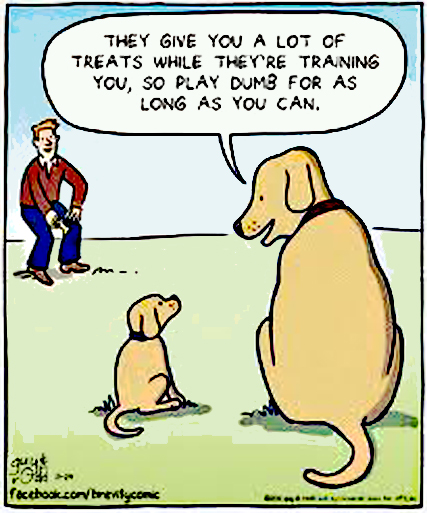
Can Two Training Methods Be Equally Good?

treat training dog cartoon

I receive many emails with questions about animal behavior. Most of them involve practical issues, but, now and then, someone poses a more complex question. Here is my answer to one of the latter, one I’d like to share with you because it addresses crucial issues in our understanding of animal behavior and training.

Dear ….,

Thanks for your comment, which allows me to clarify a few issues. By no means do I see animals as biological robots, nor do I regard the Skinnerian approach as the truth, the only truth, and nothing but the truth; quite the contrary. Please consider the following passages from “Mission SMAF—Bringing Scientific Precision Into Animal Training”.

“In fact, I suspect that [communication] even involves more than what science can describe with the intrinsic limitations of its key concepts and methods, no matter how stringent they are.

It seems to me, therefore, that our goal must not be to oppress or suppress emotions, but rather control them and use them advantageously. Emotional arousal proves to be necessary to learn and the right amount of emotional arousal even shows to increase the efficiency of learning processes.”

A very non-Skinnerian statement, I would say.

As to my own method to analyze learning processes in artificial set-ups (like in animal training), I write: “In a crude sense, SMAF is an oversimplification of complex processes […] certainly not an attempt to reduce complex mechanisms to a few formulas. In the end, [its] value depends solely on its successful application to solving practical problems; beyond that, it has no value.”

Operant conditioning (when we use it correctly) is an efficient model of behavior for animal training because we control the conditionals to some extent (as Pavlov explains in his original writings, not the subsequent translations). Whilst operant conditioning is adequate for analyzing behavior at a particular level, beyond that, it becomes too crude an instrument. To understand behavior in a broader sense, we must turn to evolutionary models and concepts—variation, selection, adaptation, fitness, function, evolutionary strategies, ESS (evolutionarily stable strategy), costs and benefits, and so forth. My approach to behavior is therefore a classical ethological one, in the tradition of von Frisch, Lorenz, and Tinbergen—firmly grounded in evolutionary biology and in philosophically coherent reasoning.

Greetings,

RAA


The core of the argument is reductionism, the view that we can reduce complex processes to the sum of their simpler parts. In a sense, all science is reductionistic. We attempt to explain complex processes with a few notions well organized in little boxes. That is a process that seems to suit our human brain particularly well.

However, we must bear in mind that our interpretations, independently of how good they are, are just our pictures of an elusive reality. They suit our particular umwelten,* but definitely not all of them. They explain parts of it from specific angles so we can make sense of it. Newton and Einstein—the classical example—are (probably) both right, each explaining reality at a different level.

There’s nothing wrong about being a reductionist if only we do not get greedy and attempt to explain far too much with far too little, as in, “That’s it, this is the way things are. Period.” Simplifying often gets us to the point that complicating and oversimplifying have both missed.

In animal training, one theory or method can be as good as another depending on its foundations, approaches, what it attempts to explain, and the practical goals it aims to serve. If both are based on reliable evidence, use well-defined terms, and are logically sound, there’s little to choose between one or the other.

If only animal trainers understood that, I believe we would forgo many senseless disputes. Then again, we can brag about being the most emotional creatures on this big blue marble of ours, can’t we?

___________

* Umwelt (plural umwelten) in ethology means the world as it is experienced by a particular organism.

___________

References

Abrantes, R. (2018). Mission SMAF—Bringing Scientific Precision In to Animal Training. Wanka Tanka Pub.

Lorenz, K. (1937). Über die Bildung des Instinktbegriffes. Naturwissenschaften, 25, 289–300. https://doi.org/10.1007/BF01492648

Павлов, И. П. (1926). Двадцатилетний опыт объективного изучения высшей нервной деятельности (поведения) животных. Ленинград: Научное химико-техническое издательство. (Pavlov, I. P. (1926). Twenty Years of Objective Study of the Higher Nervous Activity (Behavior) of Animals. Leningrad: Scientific Chemical-Technical Publishing House.)

Skinner, B. F. (1938). The Behavior of Organisms: An Experimental Analysis. New York: Appleton-Century-Crofts.

Uexküll, J. von. (1934). Streifzüge durch die Umwelten von Tieren und Menschen: Ein Bilderbuch unsichtbarer Welten. Berlin: Julius Springer. (English translation: A Foray into the Worlds of Animals and Humans: With A Theory of Meaning, translated by Joseph D. O’Neil, University of Minnesota Press, 2010.)

Laughter is the Shortest Distance Between Two People

Laughter

“Laughter is the shortest distance between two people,” Victor Borge presumably once said.* As you have likely figured out by now, I enjoy discovering evidence that humans are not that different from other forms of life. We share many characteristics with the other living creatures with whom we share our planet. Today, I have one more example for you—laughter.

Laughing is an involuntary reaction in humans consisting of rhythmical contractions of the diaphragm and other parts of the respiratory system. External stimuli, like being tickled, mostly elicit it. We associate it primarily with joy, happiness, and relief, but fear, nervousness, and embarrassment may also cause it. Laughter depends on early learning and cultural factors (Davila-Ross & Palagi, 2022).

The study of humor and laughter is called gelotology (from the Greek gelos, γέλιο, meaning laughter).

Chimpanzees, gorillas, bonobos, and orangutans display laughter-like behavior when wrestling, playing, or tickling. Their laughter consists of alternating inhalations and exhalations that sound to us like breathing and panting (Crepaldi et al., 2024; Ross et al., 2010; Winkler et al., 2025)

Rats display extended, high-frequency, ultrasonic vocalizations during play and when tickled. We can only hear these chirping sounds with proper equipment. They are also ticklish, as are we. Particular areas of their body are more sensitive than others. There is an association between laughter and pleasant feelings. Social bonding occurs with the human tickler, and the rats can even become conditioned to seek the tickling (Panksepp & Burgdorf, 2000).

A dog’s laughter sounds similar to a regular pant. A sonograph analysis of this panting behavior shows that the variation of the bursts of frequencies is comparable with the laughing sound. Playing recorded dog laughter to dogs in a shelter can contribute to promoting play, social behavior, and decreasing stress levels (Simonet et al., 2005).

Laughter is the shortest distance between two people.” Maybe it is simply the shortest distance between any two living creatures.

Keep laughing, my friends!

__________

* Victor Borge is widely credited with this quote, although there is no direct evidence linking it to a specific book, performance, or interview.

Related Articles

The Biggest Difference Between Humans and Dogs

The Single Most Damaging Belief of Ours

We Talk Too Much and Say Too Little

Do Dogs Understand What We Say?

References

Crepaldi, F., Rocque, F., Dezecache, G. et al. Orangutans and chimpanzees produce morphologically varied laugh faces in response to the age and sex of their social partners. Sci Rep 14, 26921 (2024). https://doi.org/10.1038/s41598-024-74089-x.

Davila-Ross, M. and Palagi, E. 2022. Laughter, play faces and mimicry in animals: evolution and social functions. Phil. Trans. R. Soc. B37720210177. http://doi.org/10.1098/rstb.2021.0177.

Panksepp, J., & Burgdorf, J. (2000). Laughing rats? Playful tickling arouses high-frequency ultrasonic chirping in young rodents. Consciousness and Cognition, 9(3), 551-572. https://files.eric.ed.gov/fulltext/EJ1069218.pdf.

Ross, MD, Owren, MJ, Zimmermann, E. The evolution of laughter in great apes and humans. Commun Integr Biol. 2010 Mar;3(2):191-4. doi: 10.4161/cib.3.2.10944. PMID: 20585520; PMCID: PMC2889984.

Simonet, P., Murphy, J., & Scaggs, M. (2005). Dog-laughter: Recorded playback reduces stress-related behaviors in shelter dogs. Animal Welfare, Purdue University Center for Animal Welfare Science. https://caninewelfare.centers.purdue.edu/resource/dog-laughter-recorded-playback-reduces-stress-related-aggression-in-shelter-dogs/.

Winkler, S.L., Laumer, I.B., Lyn, H. et al. Bonobos tend to behave optimistically after hearing laughter. Sci Rep 15, 20067 (2025). https://doi.org/10.1038/s41598-025-02594-8.

Evolutionary Strategies

ESS doves hawks

An evolutionarily stable strategy (ESS) is a strategy that no other feasible alternative strategy can better, provided sufficient members of the population adopt it. The best strategy for an individual depends upon the strategies adopted by other members of the population. Since the same applies to all individuals in the population, a mutant gene cannot invade a true ESS successfully.

Evolutionary biologists imagine a time before a particular trait existed. Then, they postulate that a rare gene arises in an individual and ask what circumstances would favor its spread throughout the population. If natural selection favors the gene, then the individuals with the genotypes incorporating that gene will have increased fitness. A gene must compete with the existing members of the gene pool and resist invasion from other mutant genes to become established in a population’s gene pool.

When considering evolutionary strategies that influence behavior, we envision a scenario in which changes in the genotype result in corresponding changes in behavior. By ‘the gene for sibling care’, we mean that genetic differences exist in the population such that some individuals are more likely to aid their siblings than others. Similarly, by ‘dove strategy,’ we mean that animals exist in the population that do not engage in fights and that pass this trait from one generation to the next.

At first sight, it might seem that the most successful evolutionary strategy will always spread through the population and eventually supplant all others. While this may sometimes be the case, it is far from always being so. Sometimes, it may not even be possible to determine the best strategy. Competing strategies may be interdependent. The success of one depends upon the existence of the other and the frequency with which the population adopts the other. For example, the strategy of mimicry has no value if the warning strategy of the model is not efficient.

Game theory belongs to mathematics and economics, and it studies situations where players choose different actions in an attempt to maximize their returns. It is a good model for evolutionary biologists to approach situations in which various decision makers interact. The payoffs in biological simulations correspond to fitness, comparable to money in economics. Simulations focus on achieving a balance that would be maintained by evolutionary strategies. The Evolutionarily Stable Strategy (ESS), introduced by John Maynard Smith in 1973 (and published in 1982), is the most well-known of these strategies. Maynard Smith used the hawk-dove simulation to analyze fighting and territorial behavior. Together with Harper in 2003, he employed an ESS to explain the emergence of animal communication.

An evolutionarily stable strategy (ESS) is a strategy that no other feasible alternative strategy can better, provided sufficient members of the population adopt it.

The traditional way to illustrate this problem is the simulation of the encounter between two strategies, the hawks and the doves. When a hawk meets a hawk, it wins on half of the occasions, and it loses and suffers an injury on the other half. Hawks always beat doves. Doves always retreat against hawks. Whenever a dove meets another dove, there is always a display, and it wins on half of the occasions. Under these rules, populations of only hawks or doves are not an ESS. A hawk can invade a population made up entirely of doves, and a dove can invade a population of hawks only. Both would have an advantage and would spread in the population. A hawk in a population of doves would win all contests. A dove in a population of hawks would never get injured because it wouldn’t fight.

However, it is possible for a mixture of hawks and doves to provide a stable situation when their numbers reach a certain proportion of the total population. For example, with payoffs as winner +50, injury -100, loser 0, display -10, a population consisting of hawks and doves (or individuals adopting hawk and dove strategies) is an ESS whenever 58,3% of the population are hawks and 41,7% doves; or, alternatively, when all individuals behave at random as hawks in 58,3 % of the encounters and doves in 41,7%.

Evolutionarily stable strategies are not artificial constructs. They exist in nature. The Oryx, Oryx gazella, has sharp, pointed horns, which it uses only in defense against predators and never in contests with rivals. They play the dove strategy. Up to 10% per year of MuskoxOvibos moschatus, adult males die as a result of injuries sustained while fighting over females. They play the hawk strategy.

Peer-to-peer file sharing is a good example of an ESS in our modern society. BitTorrent peers use Tit for Tat strategy to optimize their download speed. Cooperation is achieved when upload bandwidth is exchanged for download bandwidth.

Life is a box of wonder and amazement, isn’t it?

 ____________

Featured image: The traditional way to illustrate Evolutionarily Stable Strategies is the simulation of the encounter between two strategies, the hawk and the dove.

References

Dawkins, R. (1980). Good Strategy or Evolutionarily Stable Strategy. In G. W. Barlow & J. Silverberg (Eds.), Sociobiology: Beyond Nature/Nurture (pp. 331-367). Westview Press.
https://doi.org/10.4324/9780429306587-14.

Maynard Smith, J. (1972). Game Theory and the Evolution of Behavior. In R. Lewontin (Ed.), On Evolution (pp. 202–223). Edinburgh: Edinburgh University Press. ISBN: 978-0-85224-248-1.

Maynard Smith, J., & Parker, G. A. (1976). The logic of asymmetric contests. Animal Behaviour, 24(1), 159–175. https://doi.org/10.1016/S0003-3472(76)80110-8

Maynard Smith, J. (1982). Evolution and the theory of games. Cambridge: Cambridge University Press. https://doi.org/10.1017/CBO9780511806292