“I didn’t fail. I discovered 34 ways that don’t work!”
I told them. But allow me to start from the beginning.

Success and failure are not absolutes; they are states of mind—criteria we adopt, perspectives we choose. Success may boost confidence and smooth the path ahead. Failure, conversely, fortifies resolve and builds persistence. Moving from one triumph to the next feels comfortable—perhaps too comfortable. Moving from one setback to another is taxing. So which is better? Let me tell you a story.
Once—young, spirited, and incapable of declining a challenge—I accepted a job trailering a horse. At the time, horse trailering was the number-one complaint among horse owners, much as home-alone issues plague dog owners today, and inappropriate elimination troubles cat owners.
Failing to trailer a horse at home is inconvenient; failing when you are hundreds of miles away is a genuine predicament. These owners were 200 miles from home. Their mare had refused to load after an equestrian event. They tried everything they knew, and everything others had told them, and still failed. Exhausted, they left the horse in a stall and drove home—then called me, offering anything if I could bring the mare back.
In hindsight, after hearing how many seasoned horsemen had tried—and how they had tried—I probably should have declined. But youth thrives on challenges, and so I drove to meet the horse.
We released her into a medium-sized arena, backed the trailer in, and I sat on the fence observing. She was a beautiful four-year-old quarter horse mix—alert, sensitive, and expressive. The owners recounted her history: no issues except trailering. They succeeded perhaps one in twenty attempts, and only after considerable distress. It was getting worse.
I will spare you the long list of misguided attempts employed before my arrival—well-intentioned efforts born more of frustration and inherited habits than of horsemanship. Don’t get me wrong: neither the owners, who were friendly and educated, nor those who tried to help were ill-disposed; they were simply relying on long-standing traditions that were not always gentle and had rarely been questioned.
These days, dog people often spend considerable time passionately disagreeing over training details. I sometimes invite them to visit the horse world, where perspective comes swiftly. Faced with the challenges still common in horse training, many of these canine disputes appear trivial. With a few admirable exceptions—brave horsemen and women who work to demonstrate that there are other, equally (or more) effective ways of handling a horse than sheer force—the field of horse training has long struggled to move beyond methods that rely mainly on force.
I stepped into the arena bare-handed—not even a rope. I liked the mare immediately. As with people, some animals evoke instant affinity; others do not. She seemed comfortable with me, too, if not from the beginning, then soon after. We walked quietly around the arena, each minding our own business. The owners left to run errands, a relief to both of us, I suspect.
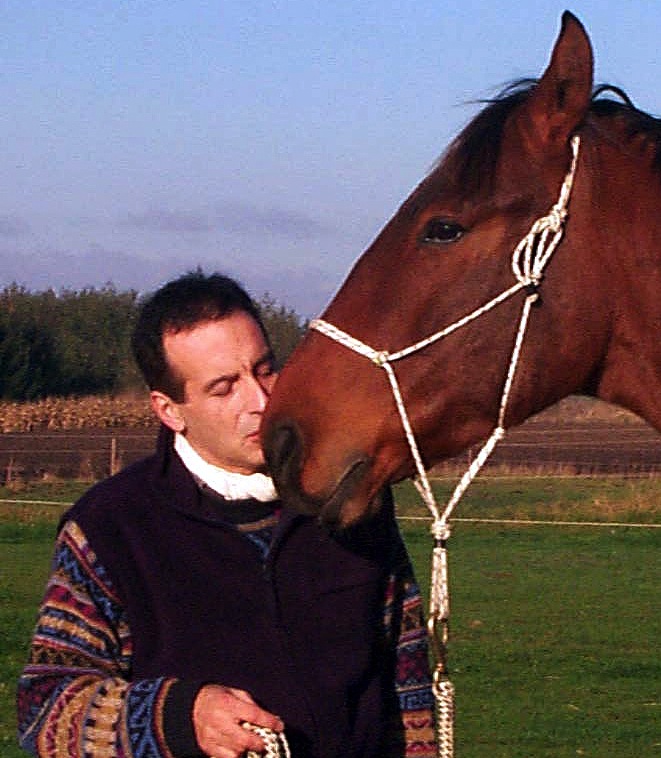
After some time, the mare approached. We paused, inhaling and exhaling deeply. Horses do this when meeting. When in Rome, do as the Romans do;1 with horses, I become as equine as I reasonably can. It may look peculiar to some, but it works, and it matters. The more I attune myself to the animal’s own signals, the more she can evaluate me on her terms rather than mine.
We spent about two hours simply walking together. At times, she followed me slowly, three to four meters behind. At other moments—particularly when we passed a section of the fence where buckets and gardening tools were stored outside—she hesitated. Each time, I waited and behaved as though nothing were amiss. After a while, she would approach, and after six or seven such encounters, she passed the “scary” spot without difficulty. The same pattern emerged near the trailer.
Occasionally, I stopped, leaned against the fence or the trailer, and looked at her. She looked back and then approached slowly until she stood about a meter in front of me, relaxing into that characteristic stance with one hind hoof resting. Gradually, she began to follow me without hesitation. She had discovered, on her own terms, that I posed no threat and was sufficiently trustworthy.
When the owners returned, they asked whether I had loaded her.
“No,” I said.
“Oh, we’re sorry you failed,” they replied, offering polite condolences.
“Oh no,” I said. “I didn’t fail. I discovered 34 ways that don’t work to load a horse.” Strictly speaking, that was not entirely true. I had made a few tentative attempts early on to see how she reacted to the trailer, but I had not tried to load her in earnest. Most of the time was spent observing—learning what unsettled her, what reassured her, and how she chose to follow when she felt safe. There were easily thirty-four or more such small trials, each one teaching me something about her thresholds and preferences. What looked like inaction was, in fact, the slow process of letting the horse teach me how to proceed.
A few hours later, both the mare and I were standing inside the trailer, eating carrots and breathing calmly together. I never used a rope. I never used the halter. I never touched her until we had already been inside the trailer for a while.
So what happened?
In short, applied ethology happened. I relied on the horse’s natural need for companionship and safety, and I tried to provide precisely that. I let her approach in her own time, assess my intentions, and decide whether to come closer. In behavioristic terms, the comfort of social proximity reinforced her tendency to follow me. Falling behind or moving away were aversive experiences that briefly left her feeling exposed, prompting her to return. But the crucial point is that she controlled the reinforcers and inhibitors2 herself, not I.
That insight has shaped all my work with animals, no matter the species, though I hesitate to call it “training,” for what I value is the interaction—the relationship, the shared routines that work for both human and animal. It is a givers/takers game. Both partners must contribute, both must give and take—give what you can, take what you need.
The magic ingredient, I discovered, is humility, though not submission; confidence, though not dominance; being present as a trustworthy guide who points out possibilities and offers choices, while remaining as unobtrusive as possible in the background. It is, in truth, a humbling experience to realize how much one can learn, and how much better one can become, simply by listening to a horse.
Once she, the mare, had reliably chosen my company, walking into the trailer was merely the next natural step. After passing the trailer several times together, I entered it casually—no theatrics, no pressure, no fireworks either, once done. She followed without hesitation.
That day, I learned how to trailer a horse—not because I succeeded after four hours, but because I had uncovered 34 or so approaches that did not work. I thought I knew the procedure already; I was mistaken. Early success had lulled me into complacency.
Success and failure are not properties of events but of perspective. In the end, success came not from doing more, but from doing less—listening more carefully, and allowing the horse to teach me what I needed to know.
Notes
- The expression “When in Rome, do as the Romans do” (Latin: Si fueris Romae, ieiunato sicut Romanum est) is attributed to Saint Ambrose (4th century). When Augustine asked why the Milanese practice differed from that of Rome, Ambrose replied, “When I am in Milan, I do not fast on Saturday; when I am in Rome, I fast on Saturday.” Hence the proverb, meaning that one should adapt to local customs. The practice of adapting and imitating also serves us well when studying and interacting with other species, as Konrad Lorenz and Jane Goodall, among others, have demonstrated. ↩︎
- A reinforcer reinforces—meaning it strengthens behavior (it increases; one gets more). This is intuitive and consistent with standard usage. Likewise, an inhibitor inhibits—meaning it weakens behavior (it decreases; one gets less)—and the term explicitly states this functional effect. By contrast, the technical and classic term punisher refers to a stimulus that also weakens behavior, yet the word itself does not convey that effect. One may “punish” in the everyday sense without actually decreasing the behavior if the intensity or timing is inappropriate. The term inhibitor avoids this ambiguity: by name and by definition, it inhibits, that is, it weakens the behavior—without implying any difference in the underlying behavioral process. It also focuses purely on the functional outcome—a decrease in behavior rate—stripping away the ethical and emotional connotations associated with punishment. I am merely clarifying a conceptual point, not expecting that the established terminology will change. Ultimately, the choice of term is a matter of preference, and whichever term you use will require a clear definition for your readers and for anyone with whom you discuss these concepts. ↩︎
References
Budiansky, S. (1997). The nature of horses: Exploring equine evolution, intelligence and behavior. Free Press. ISBN 9780684827681.
Hempfling, K. F. (1993). Dancing with horses: The art of body language. Trafalgar Square Publishing. ISBN 9781570761517.
Parelli, P., & Parelli, K. (1993). Horsemanship: Theory & horse behavior. Parelli Natural Horsemanship. ISBN 9780965853300.
Roberts, M. (1997). The man who listens to horses: The story of a real-life horse whisperer who revolutionized the way we communicate with horses. Random House. ISBN 9780679456582.
Sinclair, E. (Director). (2016). Taming wild: A girl and a mustang [Film]. Taming Wild Productions.
Featured image: After some time, the mare approached. We paused, inhaling and exhaling deeply. Horses do this when meeting (photo from the EI files).
This article is an expanded and substantially updated version of the original “Animal Training—I Didn’t Fail, I Discovered 34 Ways That Don’t Work!” from June 4, 2014, which is why it is now published under a new title.
 Roger Abrantes