Stress Helps Learning and Bonding

Abstract

Stress is often portrayed as harmful, yet moderate, acute stress can enhance learning, memory retention, and social bonding. Recent epigenetic research reveals that stress hormones modulate gene expression in key brain regions, strengthening memory consolidation and attentional processes. Unpleasant or intense experiences tend to form long-lasting memories, an adaptive mechanism for survival. Beyond cognition, stress can facilitate social bonding through oxytocin-mediated social buffering, as demonstrated in mammals, including domesticated dogs, although effects are highly context-dependent. Excessive or chronic stress, however, disrupts these processes, impairing memory, social interactions, and overall well-being. This paper emphasizes the nuanced, dual role of stress, highlighting its adaptive functions and underscoring the importance of understanding stress within an evolutionary and behavioral framework, not least because such understanding can inform more efficient animal behavior modification.

duckling-climbing-stress-helps-learning

Stress Helps Learning and Bonding

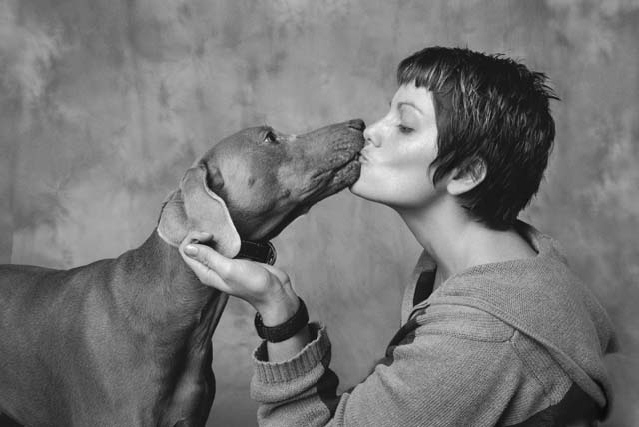
A tough nut to crack is an everlasting memory that binds the parties together, and there is a reason for that. Moderate stress heightens arousal and sharpens attention, facilitating learning and the formation of durable memories (Roozendaal, McEwen, & Chattarji, 2009; McGaugh, 2015). Studies show that stress-related hormones and neuromodulators can also strengthen certain social bonds, depending on context, species, and prior history (Carter, 2014; Hostinar, Sullivan, & Gunnar, 2014).

Fig. 1 — Illustration of the hypothalamic-pituitary-adrenal (HPA) axis during the stress response: the hypothalamus detects stress and releases corticotropin-releasing hormone (CRH), which stimulates the pituitary gland to release adrenocorticotropic hormone (ACTH). ACTH triggers the adrenal glands to produce cortisol, the body’s key stress hormone. Cortisol’s effects on the body feed back to regulate this system, maintaining balance through a negative feedback loop.

The Term Stress Is Dangerously Ambiguous

We need to be careful, though. The term stress is dangerously ambiguous. Richard Shweder once described stress in a 1997 New York Times, Week in Review essay, as “a word that is as useful as a Visa card and as satisfying as a Coke. It’s non-committal and also non-committable.” Here, we adopt a biological definition:

Stress is the organism’s coordinated physiological response to a real or perceived challenge to homeostasis, involving the activation of the sympathetic nervous system and the hypothalamic–pituitary–adrenal axis to restore equilibrium (see fig. 1).

This distinction—between colloquial and biological uses—is crucial because the physiological and behavioral mechanisms engaged differ depending on whether the stressor is acute or chronic, controllable or uncontrollable. In this context, Koolhaas et al. (2011, p. 1291) propose that “the term ‘stress’ should be restricted to conditions where an environmental demand exceeds the natural regulatory capacity of an organism, in particular situations that include unpredictability and uncontrollability,” emphasizing the adaptive and context-dependent nature of the stress response (McEwen & Wingfield, 2010; Koolhaas et al., 2011).

What Is the Function of Stress?

Being an evolutionary biologist, when contemplating a mechanism, I always ask: “What is the function of that? What is that good for?” A mechanism can originate by chance (most do), but unless it provides the individual with some extra benefits in survival and reproduction, it will not spread in the population. From an evolutionary perspective, the stress response and the modulation of memory under stress increase the probability of survival (Nesse & Ellsworth, 2009; McEwen, Nasca, & Gray, 2016).

Why Do Unpleasant Memories Persist?

Emotionally intense, threatening, or highly arousing situations produce stronger, more persistent memory traces. Biologically, remembering potentially harmful events helps self-preservation. Negative or threatening events recruit the amygdala–hippocampal network more strongly, with the amygdala modulating hippocampal consolidation via noradrenergic and glucocorticoid-dependent mechanisms (Johansen, Cain, Ostroff, & LeDoux, 2011; McGaugh, 2015; LeDoux & Pine, 2016).

Stress006
Fig. 2 — Sequence of events from exposure to a stressor through activation of the body’s physiological and behavioral stress response system (including the HPA axis), resulting in molecular and epigenetic changes such as DNA methylation and altered gene expression in stress-related genes. These epigenetic modifications influence future stress responsiveness and can affect health outcomes over the long term.

Epigenetic Effects

One of the most exciting scientific discoveries of late is the role of epigenetics (see fig. 2). Epigenetics—the study of modifications in gene activity that occur without altering the DNA sequence—has become central to contemporary models of learning and memory. Bird defines an epigenetic event as “the structural adaptation of chromosomal regions so as to register, signal or perpetuate altered activity states” (Bird, 2007, p. 398). Within this framework, attention focuses on activity-dependent chromatin modifications that occur during an individual’s lifetime rather than on transgenerational inheritance (Allis & Jenuwein, 2016). Mechanisms such as DNA methylation, histone acetylation, and related chromatin adjustments fine-tune gene expression in response to salient experiences, enabling the formation and stabilization of memory (Sweatt, 2013). Stress hormones act on mineralocorticoid and glucocorticoid receptors in hippocampal and amygdalar circuits, where they modulate plasticity and enhance the consolidation of significant events (Roozendaal, McEwen, & Chattarji, 2009; McEwen et al., 2012). Through interactions with noradrenergic projections from the locus coeruleus, glucocorticoids further shape these epigenetic regulators, influencing transcriptional programs essential for synaptic plasticity (Zovkic, Guzman-Karlsson, & Sweatt, 2013; Gray, Rubin, Hunter, & McEwen, 2014). These coordinated molecular processes, under moderate stress, enhance learning and contribute to the durability of highly arousing or threatening experiences.

Not All Stress Boosts Learning

Not all stress is productive for learning. Excessive stress produces the opposite effect. There is a difference between being stressed and stressed out. When stress becomes excessive or prolonged, the organism enters a state where immediate survival takes priority over other functions, and memory formation decreases. Chronic stress, in particular, undermines learning and cognitive function by disrupting hippocampal structure and impairing synaptic plasticity (de Kloet, Joëls, & Holsboer, 2005). These maladaptive effects highlight that stress is beneficial only within a moderate and context-dependent range; beyond that, it impairs both cognition and emotional regulation.

Stress and Bonding—A Delicate Balance

Stress does more than enhance memory; under certain conditions, it actively promotes social bonding. Oxytocin, a neuropeptide closely linked to affiliation, mediates this effect by dampening the HPA axis response during shared or moderate stress, thereby encouraging proximity and affiliative behaviors (Crockford, Deschner, & Wittig, 2017). In rodents, moderate stress enhances social-seeking behavior among cagemates via oxytocin signaling, though excessively threatening contexts abolish this effect (Burkett et al., 2015). Findings in rodents provide a foundation for understanding oxytocin-mediated bonding, which can also be observed in humans and domesticated dogs, albeit with species-specific nuances.

In domesticated dogs, exogenous oxytocin increases sociability toward humans and conspecifics, and social interactions raise endogenous oxytocin levels (Nagasawa et al., 2015). Just as humans bond emotionally through mutual gaze—a process mediated by oxytocin—Nagasawa et al. demonstrate that a similar gaze-mediated bonding exists between humans and dogs: “These findings support the existence of an interspecies oxytocin-mediated positive loop facilitated and modulated by gazing, which may have supported the coevolution of human-dog bonding by engaging common modes of communicating social attachment” (Nagasawa et al., 2015, p. 333). Longitudinal observations further show that chronic stress markers, such as hair cortisol, can synchronize between dogs and their owners, suggesting a deep physiological linkage (Sundman et al., 2020). Importantly, these bonding effects are highly context-dependent: moderate, predictable stress tends to facilitate affiliation, whereas excessive or prolonged stress may inhibit social bonding.

Caveats: Despite the fascinating discoveries mentioned above, we must be prudent in our conclusions. The effects of stress on bonding are highly context-dependent. Elevated cortisol in dogs can reflect excitement rather than distress (Nagasawa et al., 2015), and the benefits observed in rodents require non-threatening environments (Burkett et al., 2015). Oxytocin’s influence varies with social familiarity; stress may not enhance affiliation with strangers or weakly bonded partners (Crockford et al., 2017). Correlational studies, such as cortisol synchronization in dog–owner dyads, cannot prove causality, though they suggest physiological coupling that may support bonding under shared stress.

Conclusion

We need a balanced view of stress. Acute, manageable challenges—those that elicit adaptive stress responses—support attentional sharpening, facilitate memory consolidation, strengthen social bonds, and promote effective learning. These benefits are highly context-dependent: stress can enhance cognition and affiliation when moderate and predictable, but excessive or prolonged stress can overwhelm these systems, impairing memory, social interactions, and overall well-being. From an evolutionary perspective, stress serves a dual adaptive function—preparing individuals to respond to threats while reinforcing social bonds that increase survival odds. A nuanced understanding is therefore essential for interpreting behavior and guiding sound practice.

For animal trainers, these insights translate into a few practical guidelines. Animals benefit from gradual exposure to manageable, stress-eliciting challenges that promote resilience and adaptive coping. Training sessions should be calibrated so that the stress elicited remains within a range that facilitates attention and learning—enough to trigger mild HPA-axis activation, but not so intense as to be counter-productive. Moreover, designing training sessions that employ an appropriate level of stress can strengthen the trainer–animal bond by allowing the trainer to serve as a social buffer during mildly stressful tasks.

Featured picture: A tough nut to crack is an everlasting memory that binds the parties together (photo by unknown).

References

Allis, C. D., & Jenuwein, T. (2016). The molecular hallmarks of epigenetic control. Nature Reviews Genetics, 17(8), 487–500. https://doi.org/10.1038/nrg.2016.59

Bird, A. (2007). Perceptions of epigenetics. Nature, 447(7143), 396–398. https://doi.org/10.1038/nature05913

Burkett, J. P., Andari, E., Johnson, Z. V., Curry, D. C., de Waal, F. B. M., & Young, L. J. (2016). Oxytocin‑dependent consolation behavior in rodents. Science, 351(6271), 375–378. https://doi.org/10.1126/science.aac4785

Carter, C. S. (2014). Oxytocin pathways and the evolution of human behavior. Annual Review of Psychology, 65, 17–39. https://doi.org/10.1146/annurev-psych-010213-115110

Crockford, C., Deschner, T., & Wittig, R. M. (2017). The role of oxytocin in social buffering of stress: What do primate studies add? Current Topics in Behavioral Neurosciences, 30, 1–33. https://doi.org/10.1007/7854_2017_12

de Kloet, E. R., Joëls, M., & Holsboer, F. (2005). Stress and the brain: From adaptation to disease. Nature Reviews Neuroscience, 6(6), 463–475. https://doi.org/10.1038/nrn1683

Gray, J. D., Rubin, T. G., Hunter, R. G., & McEwen, B. S. (2014). Hippocampal gene expression changes underlying stress sensitization and recovery. Molecular Psychiatry, 19(11), 1171–1178. https://doi.org/10.1038/mp.2013.175

Hostinar, C. E., Sullivan, R. M., & Gunnar, M. R. (2014). Psychobiological mechanisms underlying the social buffering of the stress response: A review of animal models and human studies across development. Psychological Bulletin, 140(1), 256–282. https://doi.org/10.1037/a0032671

Hunter, R. G., & McEwen, B. S. (2013). Stress and anxiety across the lifespan: Structural and molecular correlates. Neuroscience, 255, 1–8. https://doi.org/10.1016/j.neuroscience.2013.09.039

Johansen, J. P., Cain, C. K., Ostroff, L. E., & LeDoux, J. E. (2011). Molecular mechanisms of fear learning and memory. Cell, 147(3), 509–524. https://doi.org/10.1016/j.cell.2011.10.009

Koolhaas, J. M., Bartolomucci, A., Buwalda, B., de Boer, S. F., Flügge, G., Korte, S. M., … Fuchs, E. (2011). Stress revisited: A critical evaluation of the stress concept. Neuroscience & Biobehavioral Reviews, 35(5), 1291–1301. https://doi.org/10.1016/j.neubiorev.2011.02.003

LeDoux, J. E., & Pine, D. S. (2016). Using neuroscience to help understand fear and anxiety: A two-system framework. American Journal of Psychiatry, 173(11), 1083–1093. https://doi.org/10.1176/appi.ajp.2016.16030353

McEwen, B. S., Eiland, L., Hunter, R. G., & Miller, M. M. (2012). Stress and anxiety: Structural plasticity and epigenetic regulation as a consequence of stress. Neuropharmacology, 62(1), 3–12. https://doi.org/10.1016/j.neuropharm.2011.07.014

McEwen, B. S., Nasca, C., & Gray, J. D. (2016). Stress effects on neuronal structure: Hippocampus, amygdala, and prefrontal cortex. Neuropsychopharmacology, 41(1), 3–23. https://doi.org/10.1038/npp.2015.171

McEwen, B. S., & Wingfield, J. C. (2010). What is in a name? Integrating homeostasis, allostasis, and stress. Hormones and Behavior, 57(2), 105–111. https://doi.org/10.1016/j.yhbeh.2009.09.011

McGaugh, J. L. (2015). Consolidating memories. Annual Review of Psychology, 66, 1–24. https://doi.org/10.1146/annurev-psych-010814-014954

Nagasawa, M., Mitsui, S., En, S., Ohtani, N., Ohta, M., Sakuma, Y., … Kikusui, T. (2015). Oxytocin-gaze positive loop and the coevolution of human–dog bonds. Science, 348(6232), 333–336. https://doi.org/10.1126/science.1261022

Nesse, R. M., & Ellsworth, P. C. (2009). Evolution, emotions, and emotional disorders. American Psychologist, 64(2), 129–139. https://doi.org/10.1037/a0013503

Roozendaal, B., McEwen, B. S., & Chattarji, S. (2009). Stress, memory and the amygdala. Nature Reviews Neuroscience, 10(6), 423–433. https://doi.org/10.1038/nrn2651

Sundman, A.-S., Van Poucke, E., Svensson Holm, A.-C., Faresjö, Å., Theodorsson, E., Jensen, P., & Roth, L. S. V. (2020). Long-term stress levels are synchronized in dogs and their owners. Scientific Reports, 10(1), 17112. https://doi.org/10.1038/s41598-020-74204-8

Sweatt, J. D. (2013). The emerging field of neuroepigenetics. Neuron, 80(3), 624–632. https://doi.org/10.1016/j.neuron.2013.10.023

Zovkic, I. B., Guzman-Karlsson, M. C., & Sweatt, J. D. (2013). Epigenetic regulation of memory formation and maintenance. Learning & Memory, 20(2), 61–74. https://doi.org/10.1101/lm.026575.112

Live as If You Were to Die Tomorrow—Learn as If You Were to Live Forever

Sea1byNickGrabowski-1

 I dedicate this short reflection to my students—and, by extension, to all students worldwide.

“Live as if you were to die tomorrow. Learn as if you were to live forever.”
~Mahatma Gandhi

“Live as if you were to die tomorrow. Learn as if you were to live forever” is widely attributed to Mahatma Gandhi. The exact wording is uncertain, yet the sentiment is faithful to his views. Rajmohan Gandhi, in The Good Boatman: A Portrait of Gandhi (1995), summarises his grandfather’s position as “[…] a man should live thinking he might die tomorrow but learn as if he would live forever.” Rajmohan Gandhi, incidentally, is a professor at the University of Illinois at Urbana–Champaign, with whom we established an excellent student exchange in the early 2000s.

The idea itself is far older. Isidore of Seville (c. 560–636 CE): expressed a similar exhortation in the Etymologiae: “Study as if you were to live forever; live as if you were to die tomorrow.”1 Comparable formulations appear in Islamic tradition—for example, in a Hadith often rendered as: “Live for your afterlife as if you will die tomorrow, and live for this life as if you will live forever.” Although popular, this version is not found verbatim in the canonical collections.2

Some scholars have noted parallels in the writings of Desiderius Erasmus (1466 – 1536), who likewise encouraged a readiness for death coupled with the lifelong pursuit of learning, though no primary source confirms the wording frequently attributed to him.3

Jiddu Krishnamurti noted that “the whole of life … is a process of learning,” underscoring that education does not end with formal schooling but accompanies us until death. Seneca argued that time must be used wisely so that life does not slip away unexamined—the core of living fully in the present. Socrates famously declared that “the unexamined life is not worth living,” connecting philosophical inquiry with purposeful existence.

The message is timeless. Continue your quest for knowledge. Do not postpone learning; embrace it today rather than tomorrow, for even your smallest discovery joins the shared store of human knowledge. At times, it may seem no more than a single drop—but then, the vast oceans themselves are born of such drops.


Notes

  1. The maxim “Disce tamquam semper victurus; vive tamquam cras moriturus” has long been attributed to Isidore of Seville and appears in standard editions of the Etymologiae. Chapter numbering may vary slightly by edition, but Book III contains the traditional formulation. ↩︎
  2. The popular saying “Live for your afterlife as if you will die tomorrow, and live for this life as if you will live forever” is not found verbatim in the canonical Hadith collections. It appears in later moralistic literature and is classified by scholars as non-authentic (apocryphal). ↩︎
  3. The widely circulated maxim “Live as if you were to die tomorrow; study as if you were to live forever” does not appear in Erasmus’s authenticated works. Modern quotation collections repeat the attribution without citing an original source, and Erasmus scholars consider it a later invention reflecting themes he discussed but never expressed in this form. ↩︎

References

Gandhi attribution
Gandhi, R. (1995). The good boatman: A portrait of Gandhi. Viking Penguin. ISBN 9780670856150.
— Paraphrase on p. 154.

Isidore of Seville
Isidorus Hispalensis. (2006). Etymologiae (W. M. Lindsay, Ed.; reprint ed.). Oxford University Press. ISBN 9780199266941.
— Book III, Ch. 24.

Hadith attribution (non-canonical)
al-Sakhāwī, M. A. (1996). Al-Maqāṣid al-ḥasana fī bayān kathīr min al-aḥādīth al-mushtahira ʿalā al-alsina. Dār al-Kutub al-ʿIlmiyya. ISBN 9782745122486.

Erasmus attribution (misattribution)
Rummel, E. (Ed.). (2004). The Erasmus reader. University of Toronto Press. ISBN 9780802085841.

Krishnamurti
Krishnamurti, J. (1981). Life Ahead: On Learning and the Search for Meaning. Harper & Row.

Seneca
Seneca. (2010). On the shortness of life (C. D. N. Costa, Trans.). Penguin Classics. (Original work published ca. 49 CE.)

Socrates (via Plato)
Plato. (2002). Apology (G. M. A. Grube & J. M. Cooper, Trans.). In J. M. Cooper (Ed.), Plato: Complete works (pp. 17–36). Hackett Publishing.


Featured image: Even the great oceans are made of many tiny drops (photo by Nick Grabowski).


Les 20 principes que tous les entraîneurs d’animaux doivent connaître

Traduit par Marie-France Langlois (from the original in English “The 20 Principles All Animal Trainers Must Know“).

En supplément : « Seize principes à l’intention des entraîneurs expérimentés » et « Les pratiques exemplaires »

"The 20 Principles" cover.

“The 20 Principles All Animals Trainers Must Know”

C’est la première fois qu’un de mes livres est publié en français et c’est avec grand plaisir que j’offre à mes lecteurs francophones un livre dans leur propre langue.

Ce petit livre de seulement 51 pages comprend des définitions, des explications et des exemples des processus impliqués dans l’entraînement des animaux.  Aux « 20 principes fondamentaux » j’ai ajouté un supplément de 16 principes à l’intention des entraîneurs expérimentés. Bien sûr l’apprentissage chez les animaux ne se réduit pas à ces 36 principes, mais en pratique l’entraîneur qui les comprend et peut les appliquer correctement, réussira sans doute.

Comme toujours, je vais corriger et améliorer ce livre dès que je découvre des erreurs ou de meilleures façons d’expression. Donc, je vous recommande de consulter cette page régulièrement.

Première édition.

J’espère que vous passerez un bon moment avec votre lecture.

R—

PS—Ce livre est gratuit pour votre lecture online sur votre ordinateur. S’il vous plaît, ne me demandez pas d’ajouter la possibilité d’impression; j’aime des livres, mais j’aime aussi bien les arbres de notre planète. Nous prévoyons des versions pour iPad et Kindle bientôt.

Cliquez sur le  « icône mode plein écran » pour une meilleure lisibilité . Zoom avant et arrière comme vous le souhaitez.


Sorry, this book is no longer available here. Please, visit Ethology Institute’s Online Bookstore.


Related articles

Os 20 princípios que todos os treinadores de animais devem conhecer

Traduzido pelo autor e Nor Abrantes (from the original in English “The 20 Principles All Animal Trainers Must Know“).

com os suplementos “Mais 16 princípios para o treinador avançado” e “Melhor prática”

"Os 20 princípios" cover

“Os 20 princípios que todos os treinadores de animais devem conhecer”

É a primeira vez que um livro meu, se bem que pequeno, aparece traduzido em português. É para mim razão de contentamento poder oferecer ao meus leitores um livro na língua dos meus ancestrais.

Este livro é um livro de ciência; não é um livro de moral ou ética. Tudo o que encontrará aqui não reflete uma atitude moral, uma escola de pensamento, nem a minha opinião pessoal. Eu dou-lhe o que a ciência descobriu e sabe sobre a aprendizagem animal tão objetivamente como possível. Cabe a si decidir se intende usar um processo ou outro, formar a sua própria “melhor prática,” resolver os seus conflitos éticos e desenvolver o seu estilo pessoal.

Como sempre, irei corrigir e melhorar este livro assim que descobrir erros ou melhores modos de expressão. Aconselho-o, portanto, a voltar regularmente a esta página.

Esta é a primeira edição.

Espero que passe umas boas horas com a sua leitura.

R—

PS—Este livro é grátis para ler no seu computador online. Por favor, não me peça para adicionar a possibilidade de o imprimir; por muito que goste de livros, também gosto muito das árvores do nosso planeta. Estamos a planear versões para iPad e Kindle para breve.

Clique o “full-screen view icon” para uma melhor leitura. Zoom in and out como deseja.


Sorry, this book is no longer available here. Please, visit Ethology Institute’s Online Bookstore.


Related articles

The 20 Principles All Animal Trainers Must Know

with “16 More Principles For The Advanced Animal Trainer” and “Best Practice”

"The 20 Principles" cover.

“The 20 Principles All Animals Trainers Must Know”

This is the first edition of “The 20 Principles That All Animal Trainers Must Know.” This booklet is in a way a super concentrated course in animal learning and, although only 28 pages long, it will take you time to read and digest. Don’t rush thru it.

I wrote “The 20 Principles” in plain English so it should be accessible to all readers. Of course, I use technical terms, but they shouldn’t pose any problem for any reader because I define them all carefully and with examples.

I will update this booklet as necessary. Come back regularly to check if there are any updates.

v. 3 uploaded 09.03.13: clarification of the difference between conditional/unconditional and conditioned/unconditioned.

v. 2 uploaded 04.03.13: new cover and back cover, minor text improvements to improve clarity.

First edition v. 1 uploaded 04.02.13

Enjoy your reading!

R—

PS—This is a free e-book for you to read on your computer. Please, don’t ask me for the possibility to print it, for as much as I love books, I also care for the trees of our planet. We’re planning versions for iPad and Kindle to be available soon.

Click the full-screen view icon for better reading. Zoom in and out as you please.


Sorry, this book is no longer available here. Please, visit Ethology Institute’s Online Bookstore.


Related articles

Handler Beliefs Do Not Affect Police Dog Detection Outcomes

GNR Officer and Police Dog

GNR officer and police dog (image by Roger Abrantes)

This is a scientific study, which is relevant to law enforcement, police dog handlers and anyone concerned with scent detection and particularly canine scent detection.

This study was conducted in 2011 at the GNR in Portugal by Roger Abrantes (PhD in Evolutionary Biology and Ethology, Ethology Institute Cambridge and special advisor to the GNR), Marco Costa Pinto (Major, Company Commander, GNR) Miguel Rodrigues (Captain, GNR) and Tiago Costa Pinto (Captain, GNR). The GNR (Guarda Nacional Republicana) is the Portuguese Military Academy trained Police.

Summary (abstract)

Our goal in this study was to evaluate how handler beliefs and other environmental stimuli influenced the indications given by police detection dogs.

We tested 16 teams: eight specialists in narcotics and eight specialists in explosives. The handlers were told that two conditions indicated with a paper marker could contain the target scent. Two of the search conditions contained decoy scents (food/toy) in order to test whether they would produce indications from the dogs. The search conditions were as follows: (1) no scent, (2) paper marker (red tape), (3) decoy scent, (4) paper marker at decoy scent, (5) target scent. The last condition was our way of controlling that the dogs were adequately trained and able to detect and indicate the desired target scents.

The dogs gave 59 incorrect indications. There were more clean runs in unmarked areas. In contrast, the distribution of clean runs did not differ between runs with or without decoy scents. No difference proved statistically significant.

Our conclusion is, therefore, that the dogs indicated the target scents independently of handler beliefs and decoy scents. Handler beliefs do seem to increase the number of false positives, but not in a statistically significant way. Decoy scents do not influence the number of indications given by the dogs.

In the condition containing a target scent, only one dog failed to detect or indicate it (the youngest, a one year old Labrador). This condition produced 10 false positives. These results are statistically significant, showing that the dogs do detect and indicate target scents and the handlers make the right calls.

You can read more about the parameters and conclusions of this study here.

Click the full-screen view icon for better reading. Zoom in and out as you please.

Odie The Pekinese: Awaiting On Death Row

Pekinese

Odie, an ugly duckling of a Pekinese, was awaiting his turn on death row. A twist of fate meant Odie survived his death sentence and, one year later, he had turned into a beautiful wolf.

Odie came to me on an odd day, one of those rainy, grey days, when the only thing you want to do is stay at home, listen to good music, watch the fire roaring in the fireplace, hold a hot cup of punch in your hands and feel sorry for yourself. Odie, an ugly duckling of a Pekinese, was awaiting his turn on death row. A twist of fate meant Odie survived his death sentence and, one year later, he had turned into a beautiful wolf.

I was sitting in my office at my desk, gazing absent-mindedly at a blank piece of paper lodged in my typewriter, which, unfortunately had been stuck there for far too long. I was suddenly wrenched from my thoughts when our vet knocked at the door. “Have you got a minute? ” she asked. I debated saying “No,” but overcame the temptation. She came in, accompanied by Odie’s owners, and explained the situation. Odie’s owners wanted to euthanize him, because they were sick of a particularly annoying behavior of his. He urinated all over the house and, when one day they found him cocking his leg up the impeccable flower arrangement they had proudly positioned in the middle of their much cherished, antique mahogany dining table, that was the last straw.

“Right on top of the table?” I asked them and they nodded solemnly.

I glanced down at Odie with newfound respect for it was no mean feat for an eight inch (20 cm) tall Pekinese to climb on top of a dining table in order to accomplish a vital mission. So I asked them if I could keep the dog instead of them euthanizing him. I would try to solve his problem and find a good home for him. They were overjoyed at my proposal and I thus found myself being the improbable owner of a Pekinese for the first, and no doubt last, time in my life.

I was on a very tight deadline to write an article. After giving Odie a quick once over, I turned back to my typewriter and the embarrassingly blank sheet of paper. I remember thinking “Gee, you’re a really ugly little fellow, I understand why they wanted to get rid of you.” Odie grunted once in return. I think he could take a bit of humor. I would take care of Odie later. My first priority was to fill that all too white sheet of paper with some wise words.

Once deeply submerged in writing my article (or not writing it as the case may be), it was then I heard an almost imperceptible sound that took a couple of seconds to register and identify. I spun round to the source of the sound and, to my astonishment, my suspicion was confirmed. Odie was peeing on my books on my bookshelf.

I am a peaceful person and it takes a lot to upset me. Being a child of the sixties, I accept everyone and almost everything; all is good as long as it doesn’t restrict my freedom. However, one thing I must confess I can’t take is having someone peeing on my beloved books. I don’t discriminate: nobody urinates on my books, period! My reaction was therefore pure reflex. I reached for the first thing I had at hand, ironically enough it was my first book about dog training and behavior “Psychology Rather Than Power” and, before I knew it, I had thrown it at Odie.

The book, a good quality hardback, landed with a smack right behind Odie. Taken by surprise, he yelped, performed a beautiful pirouette in the air and stood there looking baffled and bewildered, staring at my book. For my part, I remained quiet as a mouse, holding my breath. After a few seconds, Odie managed to compose himself. He approached the book, sniffed at it in a noisy, Pekinese manner, then sniffed at the books on my book shelf, before returning to my book on the floor, giving it another long and even noisier sniff and then, smacking his lips, he decided to lie down right next to the book. I returned to my tauntingly clean sheet of paper whilst keeping one eye on Odie.

Odie fell asleep, or so it seemed, and I finally began filling the blank sheet of paper with some meaningful words. A little later, whilst searching for something on my desk, I happened to knock a pencil over the edge and it fell on the floor, between the desk and that same book shelf, a source of so much knowledge and inspiration for me. Odie opened his big, bulging eyes, one looking right and the other looking left, and approached the pencil. I couldn’t see him or the pencil, but could hear him clearly, grunting, snuffling, puffing and panting. A few seconds later, maybe 15, he came around the desk directly towards me. He was holding the pencil in his mouth, each eye still looking in a different direction, one as wet as the other, dribble all over his face, with his head covered in balls of dust and fluff, reminding me that my office needed a good hoovering.

I stretched out my hand to him and automatically said “tak” (which means “thanks” in the Scandinavian languages and was my sound signal for “release”). Odie, with a grunt, promptly dropped the slimy pencil into my hand. I was impressed. Was that a “retrieval”? Did he really retrieve that pencil for me?

I was so baffled and curious that I proceeded to do something that fellow pencil lovers regard as the ultimate sin towards pencils. You never drop a pencil as it is highly likely you’ll break the lead inside, rendering it useless once sharpened a couple of times. I tossed the pencil so it fell in the same place between my desk and the book shelf; and once again, Odie ran (I think he was running, but don’t know for sure as I couldn’t see his short legs for all the fur), he grunted, snuffled, puffed and panted, rubbing one eye then the other along the floor in an effort to pick up the pencil and, in doing so, collected even more dust fluff. He wouldn’t give up, finally managed to take the pencil in his mouth and promptly returned it to me just as he had done before.

“Hallelujah!” I exclaimed despite my lack of religious conviction, “We have a retriever!” Joy filled my heart. The misery and self-pity the dull, grey day had imposed upon me ever since I had got out of bed that morning were gone like magic. Of all the activities I have undertaken with dogs, the one that has most amused me, and my dogs too it would seem, is without a shadow of doubt search and retrieve.

Odie never again urinated indoors, a fact we have discussed at some length. We are convinced it was the book incident that did it, due to the optimal coincidence of a series of conditions. Firstly, he was caught in the act (perfect timing), secondly, he did not associate the book falling behind him with me (instead with his own behavior), thirdly, the smack of the book falling on the floor had the right intensity to startle him (not too much, not too little), and fourthly, he associated the book aversive with his urinating behavior and nothing else (it happened when he urinated, it stopped when he stopped). No bad feelings towards books and (of course) no bad feelings from books towards him. Of course, the moral of this story is not that you should throw books at your dog. Let me say this loudly and clearly so no one gets it wrong: I do not recommend people throw books at their dogs. It worked in this case because of the coincidence of the many necessary conditions for it to work (as I explained) and that’s it.

I kept Odie and we all trained him. Sit, stand and, down were no problem at all, only difficult to observe for all the fur and short legs. We used treats as unconditioned reinforcers and my “dygtig” (as a semi-conditioned reinforcer), but he would do anything as long as we held a pencil in our hands (this was his reinforcer of choice). He would take the treats only because he was hungry. We put him on a program where he had to work for all his food and he worked a lot: no free food at all. Odie became very popular. His odd looks combined with his skills were an improbable combination in most people’s eyes. The staff at the Ethology Institute sometimes asked if they could take him home to show visiting friends. Odie never disappointed.

At the time, I was living in one of those enormous, old European mansions, like small castles, with three floors and endless of rooms. One particularly cold winter when the fields were covered by snow and ice, our cellar (basement) became a refuge for mice. This is very normal and we all know how to deal with the problem, except that I thought at the time it was more dignified for a mouse to die in battle than to be trapped or poisoned. Therefore, I introduced a hunting session every night at 8 pm after having read my son Daniel his bedtime story.

The nightly hunting session began with the troops, Petrine, Elanor (English Cocker Spaniels) and myself, assembling at the door to the cellar. Petrine and Elanor were skilled hunters so this was a good opportunity to stimulate them. Every evening we enacted the age-old game of predator and prey in the cellar of that big, old mansion house. Odie was always very keen to join us on our mission and, one evening, I decided to let him give it a go. Odie experienced his first hunt.

Odie quickly learned the rules of the game, although learn is perhaps the wrong term as it looked like he had always known and just had to be reminded. The first time, he went under a couch to chase a mouse, he took a long time. All I could hear was his usual grunting, snuffling, puffing, panting and the occasional high-pitched squeak from a mouse. I guess the mice were terrified of Odie’s looks combined with the spluttering, snorting and grunting. He came to me carrying his first mouse by a hind leg, the mouse completely stiff and wet, but very much alive. Odie became an efficient mouse hunter. He was quick and could squeeze into confined spaces for which the cockers were too big. Every evening, he was the first to reach our rendezvous point. He was there from around seven onwards, waiting patiently. He insisted on being the first to reach the bottom of the stairs to the cellar which was quite a spectacle for the steps were too steep for his all too short legs. He somehow managed to overtake the cockers on the way down, not running, but tumbling down amidst a cloud of dust and much snorting and grunting. The cockers just looked at him bemused. Up until then, our mission had been a well-planned military operation. Stealth, discipline, training, dedication and precise timing were our weapons. After Odie joined us, it all looked more like Asterix and Obelix against the Romans.

The days passed, one year passed, and Odie grew older and more experienced. I bet he could have won all kinds of competitions, but we never subjected him to that. By then he had become a great hunter, only limited by his physical characteristics, the ones us humans have bestowed upon him through selective breeding.

It was bound to happen sooner or later: one day someone came along that wanted to keep Odie. It was love at first sight when they saw his antics. When they asked me about his original problem, I couldn’t even remember what it was. I had completely forgotten, as had we all. After that first “attack” by my book, he had never again urinated indoors. Odie found a good home, one year after he had entered our lives.

I was sad to see him go. We all were. We often spoke fondly of him and made each other laugh by telling Odie stories. Odie had taught us invaluable lessons. First, that we should never judge anyone by their appearance. He was a little dog, short-legged, furry, flat-faced and cross-eyed, but he was a dog at heart like any other. None of us thought he was ugly, despite my initial horror. He was further evidence that many dogs develop problems because they are not treated as dogs; they are understimulated and their excess energy causes them to engage in any kind of activity, be it desirable or undesirable for the owners. He was a quick learner and an impeccable hunter with an enormous joy for life. Without words, he told us: “Respect and you shall be respected. I’m not a toy, not a thing, not a little human. I’m Odie, a Pekinese dog.”

14 years later, I went to give a talk in a town about 50 km from where I lived. During the break, a couple approached me and asked me if I remembered them. It took me a while, but I did recognize them. They were the new owners we had found for Odie. He was still alive, they informed me, but very old and tired by then. He no longer had any front teeth, as his love for retrieving hard objects had not waned over the years. They said they were getting ready for the day they would have to say goodbye to Odie and I saw their eyes well up.

Thinking of him, my eyes welled up too, Odie, the ugly duckling of a Pekinese that had turned into a beautiful wolf in my eyes and in the eyes of all those who had the privilege to know him. Thanks, Odie, my friend!

Be happy!

R—

PS—I know that metamorphosis does not occur in canids and that a dog cannot turn into a wolf. I also know that a dog is a dog (Canis lupus familiaris) and not a wolf (Canis lupus lupus). Since this is a story with a point written for a blog, not a scientific article, I allow myself some artistic license when I write “Odie turned into a beautiful wolf.”

The First Ten Skills You Should Teach Your Puppy

A male Bulldog puppy.

Bulldog puppy (Image via Wikipedia)

There are many skills that your puppy must learn in order to enjoy a good doggy life in our human world. It is your responsibility to teach your puppy these skills. Opinions may differ as to what are the most fundamental skills to teach your puppy. In my opinion, you should focus on the ten skills I describe here so that both you and your puppy enjoy being together and can safely begin to discover the world.

There are many ways to teach your puppy the skills I mention below and one method is not necessarily better than another. There are many ways to reach the same goal and you should choose the method or variation that best suits you, your lifestyle and your puppy’s temperament. The training methods I describe here have worked very well for the many owners and puppies we have coached at the Ethology Institute Cambridge over the years, but remember that they are only rough guidelines and you should adapt them to your own puppy as you see fit.

Dog friendly facial expression.

Dogs understand our friendly facial expressions (a slight pouty mouth and slightly closed eyes). They may even offer us a ‘lick,’ which is a friendly behavior in dogs (Picture from PetTastics)

The first ten skills

1. The puppy’s name

2. Yes

3. No

4. Come

5. Sit

6. Walking on leash

7. Hygiene

8. Socialization

9. Environmental habituation

10. Home alone

Two principles (=> means implies or is followed by)

One signal => one behavior: Give only one signal for each behavior that you want the puppy to display. Example: you give the signal ‘sit’ by means of ‘sound’ and ‘hand movement’ and expect the behavior of your puppy sitting. Strictly speaking, you’re giving two signals, but they both intend to produce the same behavior, which is all right.

One signal => one behavior => one consequence: Your puppy’s behavior will change according to the consequences immediately following the behavior. If you give it a treat when it sits, it will sit more often. If you don’t give it a treat and ignore it, it will sit less frequently.

Your training tools

signal is everything that changes a behavior. It indicates to your puppy that if it does something, it will get something. Remember: One signal => one behavior => one consequence. A signal can be a sound (a word), a hand movement, a body posture, and a facial expression.

A reinforcer is everything that increases the frequency, intensity and/or duration of a behavior of your puppy—it reinforces the behavior and that’s why it is called so. You use reinforcers to reinforce the behavior you wish to be repeated. Reinforcers are, therefore, the consequences of what you consider to be good behavior. They can be a food treat or a word of your choice. Most people say “good-dog,” or “good-job.” My chosen word is  “dygtig,” (which means “clever” or “competent” in Danish) as I find that the sound of it works efficiently as a reinforcer. A “click-sound” can also be a reinforcer if you have repeatedly associated it with a treat, but you won’t need the clicker for these first skills. Remember that a treat is only a reinforcer if the puppy is hungry and that your chosen word is only a reinforcer if you associate it with a doggy friendly body language and facial expression and say it in a pleasant tone.

Doggy friendly body language consists of deliberate movements (not quick, not jerky and not as slow as stalking). Don’t bend too much over the dog. Give the dog some personal space. When you walk, do it rhythmically: don’t change pace or direction abruptly. A doggy friendly facial expression consists of a quiet and self-confident expression. Don’t make big eyes. Dogs interpret closed mouths with lips together (as when you are going to give a kiss) as a friendly expression (I think this is why the sound dygtig works so well).

Important: Treats, toys and training devices are useful and sometimes necessary, but the greatest learning tool of all is the way you use yourself, your body language and your facial expressions.

You will need treats (if you use dry food, use some of it as treats), a collar and a leash (for skill 6).

Some terms and expressions:

  • DLO means Desired Learning Objective.
  • POA means Plan of Action
  • QC means Quality Control and indicates the number of times in a row (or similar criteria) you must have accomplished your DLO successfully before you move to the next level.
  • => means implies.

To fail to plan is to plan to fail. Therefore, you’ll find that I’ve organized each plan to train a skill like a ‘quick guide.’ Read each one carefully and make sure that you know exactly what you must do before you begin a training session.

1. The Puppy’s Name

DLO — to teach the puppy to look at you when you say its name.

The puppy’s name is important because you’ll need to have the puppy look at you on many occasions. The name of the puppy is not the same as “come,” but you can give it that meaning if you want, in which case, you don’t need to teach the puppy the signal “come.” However, I recommend you keep these two signals separate. Later on, depending on how much you would like to teach your puppy, you may need a signal for the puppy to look at you without coming to you.

Tools you need:

Name (means look at me) — choose a clear sounding name; a name with two syllables works well (in our example the name is “Bongo”).

Reinforcers — You’ll need two types of reinforcers, a word (I use “dygtig” in the examples below) and food treats.

Your POA:

Level 1 — Stay close to the puppy, no leash.

  1. Say, “Bongo” and clap your hands.
  2. The puppy looks at you => say “dygtig,” show doggy friendly body language and a doggy friendly facial expression, and give the puppy a treat.

QC: Repeat until the puppy looks at you ten consecutive times. Take a small break and then continue.

Level 2 — Move 5-6 steps away from the puppy and repeat steps 1 and 2.

QC: Repeat until the puppy looks at you ten consecutive times. Again, take a break.

Level 3 — Move 5-6 steps away from the puppy and repeat steps 1 and 2, but without clapping your hands. Just say the puppy’s name.

QC: Repeat until the puppy looks at you ten consecutive times.

2. Yes

DLO — to teach the puppy the meaning of the sound “Yes.”

“Yes” is a very important signal. It means, “continue doing what you are doing.” It is a signal you teach the puppy from day one by using it. Initially it does not mean much to the puppy but, as the puppy associates it with your body language, it will begin to understand what you want.

Your POA:

You teach the puppy “yes” by using it repeatedly any time the puppy does what you want, such as running towards you.

  • When the puppy responds to your “yes,” say “dygtig” and show doggy friendly body language and a doggy friendly facial expression. You can give it a treat, if you have one, but it not necessary. Your friendly body language and facial expression are enough reinforcement.

3. No

DLO — to teach the puppy the meaning of the sound “No.”

“No” is also a very important signal. It means, “stop what you’re doing.”

Your POA:

You teach the puppy “no” by using it any time the puppy does something you don’t want it to do.

  • If and when the puppy stops, say “dygtig” and show doggy friendly body language and a doggy friendly facial expression.
  • If the puppy doesn’t stop, say “no” again with a harsher voice and maybe a slight foot stamp on the floor. As soon as the puppy stops, say “dygtig” and assume doggy friendly body language and a doggy friendly facial expression.

Important: Don’t shout “no.” You don’t want to scare the puppy, only startle it slightly so that it looks as you. Remember that no is a signal as any other and it should not elicit any unpleasant connotations. You should always say your “no” confidently and politely as in “No, sir,” or “No, ma’am.”

4. Come

DLO — to teach the puppy the meaning of the sound “Come.”

Tools you need:

Name (means look at me) — Teach the puppy “come” once the puppy is reacting promptly to its name, which it should be doing after skill 1.

Come (means move directly towards me).

Yes (means continue what you’re doing) — already taught in skill 2.

Reinforcers — You’ll need two types of reinforcers, “dygtig” and food treats.

Your POA:

Level 1 — Indoors in a quiet environment. Stand 5-6 steps from the puppy, no leash.

  1. Say “Bongo” and then when the puppy looks at you, say, “come” clapping your hands.
  2. While the puppy runs to you, repeat the signal “yes” as many times as necessary.
  3. Say “dygtig” when the puppy is in front of you, show doggy friendly body language and a doggy friendly facial expression and give it the treat you are holding between your fingers.

QC: Repeat until the puppy comes to you ten consecutive times.

Level 2 — Indoors with one or two other people present, no leash. Repeat steps 1 and 2.

QC: Repeat until the puppy comes to you ten consecutive times.

Level 3 — Outdoors in a quiet, closed environment, no leash. Repeat steps 1 and 2.

QC: Repeat until the puppy comes to you ten consecutive times.

5. Sit

DLO — to teach the puppy the meaning of the sound “Sit.”

Tools you need:

Sit means put your butt on the floor and keep it there until you get another signal. You will be using two signals for sit, one is the sound “sit” and the other is your hand movement.

Free (means move now). You say “free” and, initially, you move around a bit to encourage the puppy to move as well. In the beginning, you are therefore using two signals—the sound “free” and your movement.

Reinforcers — You’ll need two types of reinforcers, “dygtig” and food treats.

Your POA:

Level 1 — Indoors in a quiet environment, no leash. Stand or kneel in front of the puppy.

  1. With a treat between your thumb and pointing finger make a smooth movement upwards right in front of the puppy’s nose and say “siiit” at the same time.
  2. When the puppy sits, say “dygtig” and give the puppy the treat you are holding.
  3. Wait a couple of seconds, say “free” and when the puppy moves, say “dygtig” and give it a treat.

QC: Repeat until the puppy sits five consecutive times and moves on your “free.”

Level 2 — Indoors, stand 2-3 steps away from the puppy, no leash. Repeat steps 1 and 2.

QC: Repeat until the puppy sits five consecutive times and moves on your “free.”

Level 3 — Outdoors in a quiet, closed environment, no leash. Repeat steps 1 and 2.

QC: Repeat until the puppy sits five consecutive times and moves on your “free.”

6. Walking on Leash

DLO — to allow the puppy to get used to walk with a collar and leash.

Tools you need:

Reinforcers — You’ll need two types of reinforcers, “dygtig” and food treats.

Collar and leash.

Your POA:

  • Walk 3-4 slow, but steady, steps in one direction and then change direction several times, all in a smooth, rhythmical movement.
  • Don’t wait for the puppy—the puppy will understand after a few trials that it has to follow you.
  • In the beginning, for every change of direction, give the puppy a treat, then for every second change of direction give the puppy a treat.
  • Keep eye contact with the puppy and show friendly body language and facial expression.
  • Say “dygtig” whenever the puppy follows you.
  • QC: Repeat until the puppy follows you freely 8-10 steps.

7. Hygiene

DLO: to teach your puppy not to urinate and defecate indoors.

Your POA:

There is no standard way to teach your dog cleanliness. However, the following advice has helped many puppy owners, including myself. Dogs develop preferences for spots as well as surfaces on which to urinate and defecate. It is important we give them these preferences early on. You need to choose a suitable place outside your house where your puppy can relieve itself. This place should be relatively quiet, without too many distractions. Get your puppy acquainted with that area, but don’t make it a play area. When your dog has relieved itself, move away from the area. Allow the puppy to relieve itself without disturbing it. Do not reinforce the behavior. If you do, the puppy may associate the behavior of urinating and defecating with getting attention from you and will do it later to achieve that.

  • Take the puppy to its chosen doggy toilet area as soon as it has eaten, played vigorously for a while or has just woken up.
  • If you discover that the puppy has urinated or defecated indoors, just clean it up thoroughly, removing all odor. There is no point scolding the puppy or giving it any explanations.
  • If you see the puppy urinating elsewhere, pick it up right away and go to your chosen doggy toilet area.

Be patient.

8. Socialization

DLO: to teach your puppy how to live in our human world.

Your POA:

Socialization is the process by which individuals acquire the knowledge and skills necessary to conform to the norms required for integration into a group or community.

There is no standard way to socialize your puppy.

You must start socializing your puppy from day one, as soon as you get it. The opportunity for socialization is at its peak between 8 and 16 weeks of age and remains until the puppy is about six months of age. You must not waste this period. If you do, you will not be able to re-gain what you lost, only attempt to repair it.

  • It is not enough for your puppy to feel comfortable at home and in your favorite dog park where it goes for a walk every day, plays with the same playmates and greets the same people. You need to expose the puppy to (many) strangers, people as well as dogs, and to new environments.
  • Exposure to novel stimuli should happen gradually.
  • Allow your puppy to play with other puppies as well as (sociable) adult dogs. Growling, snarling, barking are all normal canine expressions and there’s nothing wrong with it. Rough play with other puppies teaches your puppy the boundaries of social interactions. Your puppy learns self-control by playing with others. It learns good manners and when enough is enough.
  • Your puppy should go out every day and have pleasant experiences with all different types of friendly people (adults and children) and friendly dogs (of many different sizes, shapes and ages).

9. Environmental habituation

DLO: to habituate your puppy to the environment.

Your POA:

Since our world contains many different stimuli, you should habituate your puppy to as many stimuli as possible, such as sounds, motions, people, animals, objects. Allow the puppy to discover the world. Do not control everything. You should coach, not control.

  • If the puppy has a bad experience, your role is to downplay it. Don’t give the puppy explanations that it cannot understand. Just proceed engaging it in some other familiar activity.

10. Home alone

To teach your dog to be home alone, please read “Teach Your Dog to be Home Alone in Five Steps” at http://wp.me/p1J7GF-6P.

Remember that your puppy is a living being with its own characteristics and that, independently of how well or badly it fares in its learning process, it deserves to be respected.

Enjoy your puppy training!

R-

FAQ

Q. When can I begin training my puppy?

A. Right away. The methods I describe here are so doggy friendly that you can use them as soon as your puppy comes home, when the puppy is eight weeks of age.

Q. What is the most important to teach a puppy?

A. To learn how to learn, which means to learn how to change its behavior in order to achieve the desired consequences, and to feel good about it. Life is a challenge and you should teach your puppy to enjoy being challenged. Coach your puppy; don’t solve all its problems for it.

Q. When can I go out and let my puppy meet other puppies?

A. Preferably right away. Socialization is a crucial factor in the puppy’s development and is time limited. Talk to your vet about vaccinations and other health precautions you should take.

Q. What about punishment? —Surely I will need to punish the puppy occasionally?

A. A punisher is everything that decreases the frequency, intensity and/or duration of a behavior. Remember that punishment has nothing to do with violence, pain or revenge; and it has nothing to do with the individual, only the behavior. You punish the behavior, but never the puppy. If your puppy is hungry, you can offer it a treat if it sits. If it doesn’t sit, you don’t give it the treat (this is called a negative punisher because you negate, take away something). If your puppy is not hungry, not giving it the treat will not be a punisher. Sometimes, to have the puppy stop doing something, you may need to use a startling sound, like a foot stamp or a particularly loud clapping of your hands. This is called a positive punisher because you posit, put forward, add something. However you may occasionally need to punish a behavior, remember that the best strategy is always prevention rather than cure. Creating good habits from day one will considerably decrease your need to punish unwanted behavior. Warning: violent or painful stimuli may not decrease the behavior (hence, are not punishers), but may elicit evasive behavior, traumas, or aggressive behavior.

Q. Do I need to train every day?

A. It depends on what you consider training to be. Living with a puppy you are training it constantly. Beware: the most important training happens when you are not training your puppy. Everything you do has consequences.

Q. Do I need a lot of time to train my puppy?

A. Again, it depends on what you consider training to be. Initially, your puppy will require a lot of your attention because you should be preventing unwanted behavior and creating good habits, which means that you’ll have to watch the puppy most of the time. If your life is stressful, you have too many responsibilities and you don’t think you can allow yourself enough time-out to dedicate yourself solely to the puppy with a relaxed, positive mindset, you shouldn’t get a puppy.

Q. Do I need to be bossy for my puppy to respect me?

A. You should lead by example. If you show your puppy that you are good at solving problems, the puppy will follow your directions more readily. If you lead by force, you create animosity that may one day turn against you. If you lead by example, you’ll be active and create opportunities for the puppy to expend its energy and develop its skills. If you do not, the puppy will find other ways to stimulate itself, which you might not find appropriate (the first step in creating a problem dog).

Q. Do I need to join a dog training class?

A. You don’t need to, but it’s a good idea. Good dog training classes are beneficial to both you and your puppy. You will receive coaching and your puppy will have a wonderful opportunity to meet a variety of dogs and people as well as be challenged. Be critical when you choose a dog training class, or a dog trainer to coach you, and remember that you are the one who decides in the end. Like in all professions, there are many excellent dog trainers out there, using different methods but all with good results—whilst, unfortunately, there are also many bad dog trainers, using bad methods with bad results. Choose carefully.

Related articles

SMAF Manual

SMAF Cover Page

SMAF Cover Page

Mission SMAF—Bringing Scientific Precision Into Animal Training

This is the SMAF manual, latest update. The SMAF manual is in a way a super concentrated course in animal learning. This is only a booklet, but it will take you time to read and digest. Don’t rush thru it.

We update this manual regularly, sometimes even daily. Come back often to check if there are any new updates. Each manual has a version number (v.YYMMDD).

Changes in this version v.120302:

  • Updated and improved syntax with some new symbols.
  • Updated examples of how to transcribe the teaching of skills in SMAF.
  • New Chapter 4 “Quick guide to designing a POA in SMAF.”

Enjoy your reading!

R-

Click the full-screen view icon for better reading. Zoom in and out as you please.

Related articles

Updates

Changes in version v.111023:

  • Definition of command with example, page 10: “While a signal is everything that intentionally changes the behavior of the receiver, a cue is everything that unintentionally changes the behavior of the receiver. A command is a signal that changes the behavior of the receiver in a specific way with no variations or only extremely minor variations.”
  • SMAF syntax corrected, page 22: “25.2. Example 1: Sit,sound + Sit,hand + γSit,treat  ⇒ The dog sits ⇒ “!+sound” + “!-food”.” (The second ⇒ was missing).
  • Minor typos corrected.

Changes in version v.111017:

  • Semi-conditioned reinforcers have their own code.
  • Non-SD has its own code.
  • New code for reinforcers and punishers.
  • Signal and cue slightly redefined.
  • A new POA example (POA example 3).
  • New photos.

Signal and Cue—What is the Difference?

Male Lion (Panthera leo) and Cub eating a Cape...

Secondary sexual traits, as the mane of the male lion, are powerful cues (Image via Wikipedia).

In the behavioral sciences, there is some confusion about the meaning of the terms signal and cue (as with so many other terms) and some authors use it interchangeably. To make it even more difficult, communication theory also uses the same terms with slightly different meanings and in the theatre and movies world a ‘cue’ is actually a ‘signal.’

However, in behavioral sciences, the general consensus (see references below) is that signal and cue have the following meanings.

signal is a perceivable behavior or feature that has evolved and has acquired the specific characteristic of conveying information about the signaler or the signaler’s environment. Information (communication) changes the behavior or the beliefs of the receiver.

This definition of signal implies that if a signal changes the behavior of an organism, this change of behavior must be profitable to both sender and receiver more often than not, or otherwise, signalers would cease to send the signal and receivers would cease to respond. This definition distinguishes, in principle, a signal from coercion, although some signals may be coercive, e.g. threats.

In general, signals must be honest and reliable, or otherwise they cease to have any effect (receivers don’t behave appropriately) and they undermine communication (honest senders will not benefit from sending the signals). However, some signals can tolerate a certain degree of dishonesty, all depending on the costs and benefits for all parties. H. W. Bates discovered in 1861 that some (palatable) butterflies had an advantage in mimicking (Batesian mimicry) poisonous butterflies, which is detrimental to the poisonous butterflies inasmuch as it turns their signals of unpalatability less reliable. On the other side, some species use the same signals to convey the same information and they all benefit from it (Mullerian mimicry).

cue is any feature that an organism can use as a guide to display a particular behavior or series of behaviors. The classical example is the mosquito seeking a mammal to bite and flying up wind when it detects CO2. The CO2 is a cue for the mosquito, but it is surely not a signal sent by the mammal, which would prefer to remain undetected and not be bitten. Intentionality is the key element to distinguish signals from cues.

A cue is a regularity, a pattern that either is permanently ‘on,’ or is ‘on’ and ‘off” depending on specific conditions, e.g. a rock, a tree, or the position of the sun in the sky cues us of directions, and dark clouds cues us of impending rain. The rock, the tree, the sun and the clouds are not there to give us information, but they do if we interpret them correctly. A signal is more malleable, more intentional and we can turn it ‘on’ and ‘off’ in response to relevant cues in the environment, e.g. the warning cry that many species (signal) issue in response to the appearance (cue) of a feared predator.

Cues are traits or actions that benefit the receiver exclusively. The sun and the rock do not profit from us getting our bearings. When a mouse by accident makes a rustling sound in the leaves and attracts a predator increasing the risk of being killed, the sound is a cue for the predator about the location of its prey. When an alert animal deliberately gives a warning call to a stalking predator resulting in the predator giving up the hunt, this sound, the alert call, is a signal both for conspecifics and the predator. Different species can, thus, communicate by means of signals which both recognize and behave accordingly.

Secondary sexual traits are features that distinguish the two sexes of a species, but that are not directly part of the reproductive system. They are probably the product of sexual selection for traits, which give an individual an advantage over its rivals in courtship and competitive interactions. Secondary sexual traits are also cues for the opposite sex. They are not directly related to a better production of offspring, but are normally good indicators of better sperm quality or egg production, e,g, manes of male lions (Panthera leo) and long feathers of male peacocks (Pavo cristatus). In humans, visible secondary sexual traits include enlarged breasts of females and facial hair on males.

The study of signals and cues is more complex that it may appear at first sight. Cues can become signals. In 1952, Niko Tinbergen described ritualization as the evolutionary process whereby a cue may be converted into a signal, e.g. the canine behavior of baring teeth. In 1975, Zahavi described the handicap principle where the reliability of some signals is ensured because they advertise greater costs than absolutely necessary, e.g. the exaggerated plumage of the peacock.

We must understand correctly what the intentionality of signals means and not to confound the intentionality of the signal itself with its origin, development and evolution. Signals do not origin by design with a determined purpose. Some features or behaviors just happen at a certain time to be efficient for an organism in generating in another organisms the right behavior at the right time. If they convey an advantage to these organisms in their struggle for survival (and reproduction), they will spread in the population (provided these organisms reproduce). With time, they gain intentionality and become true signals, but their origin was accidental like everything else. This is the reason why I had to modify (some extensively) the definitions I use in this text and I had to create new ones—to make them compatible with the Darwinian theory of evolution.

Applying the principle of simplicity, as always, I suggest the following definitions:

signal is everything that intentionally changes the behavior of the receiver. A cue is everything that unintentionally changes the behavior of the receiver.

These definitions open for the possibility to better distinguish between the intentional signals (proper signals) we send and the unintentional ones (which are cues). For example, many dog owners say “no” to their dogs meaning “stop what you are doing,” but their (unintentional) body language (cue) says “yes.”

In conclusion: signal is the most correct term to denominate what we use when we communicate with our animals; and signals may assume many forms, auditory (the words we use), visual (the hand movements and body language we use), olfactory (in canine detection work), tactile (a touch, very common in horse training) and probably also palatable.

So, enjoy the consequence of your (intentional) signals and be careful with any cues you may be (inadvertently) sending to your favorite animal. Enjoy as well your further studies of this fascinating topic: animal communication.

Keep smiling!

R-


References and further readings

  • Dawkins, M. S., and T. Guilford (1991). The corruption of honest signalling. Animal Behaviour 41:865–873.
  • Donath, J. (2007). Signals, cues and meaning (February draft for Signals, Truth and Design. MIT Press)
  • Hasson, Oren (1997). Towards a general theory of biological signaling. Journal of Theoretical Biology 185: 139-156.
  • Hauser, Marc D. and Mark Konishi, eds. (1999). The design of animal communication. Cambridge: Bradford/MIT Press.
  • Maynard Smith, John and David Harper (1995). Animal signals: Models and terminology. Journal of Theoretical Biology 177: 305-311.
  • Maynard Smith, John and David Harper (2003). Animal signals. Oxford University Press, UK.
  • McFarland, D. (1999). Animal Behaviour. Pearson Education Limited, UK.
  • Otte, D. (1974). Effects and functions in the evolution of signaling systems. Annual Review of Ecology and Systemat- ics 5:385–417.
  • Saleh, N et al. (2007) Distinguishing signals and cues: bumblebees use general footprints to generate adaptive behaviour at flowers and nest. Arthropod-Plant Interactions, 2007, 1:119–127
  • Schaefer, H. M. and  Braun, J. (2009). Reliable cues and signals of fruit quality are contingent on the habitat in black elder (Sambucus nigra). Ecology, 90(6), 2009, pp. 1564–1573.
  • Searcy, W. A., and S. Nowicki (2005). The evolution of animal communication. Princeton University Press, Princeton, New Jersey, USA.
  • Tinbergen, N. (1952). The curious behavior of the stickleback. Scientific American December 1952.
  • Zahavi, A. (1975). Mate selection: a selection for a handicap. Journal of Theoretical Biology 53:204–214.


Related articles