The Principle of Simplicity

Blue sea, blue sky

It dawned on me the other day, while at sea, one of those days with scattered clouds on the horizon and a fair wind barely sufficient to keep the boat sailing. Simplicity, that’s what makes it so soothing and scaringly beautiful. The sea invites you to dream, but make no promises; it is what it is, neither more or less. Be wise, and it will reward you; be foolish, and it will punish you.

You can’t hide at sea; you’ll encounter yourself whether you want it or not. The only viable strategy is honesty and integrity. It’s all so simple. The sea possesses this power, I discovered—the pertinent appears suddenly as frivolous, and the complex reveals itself in all its simple parts.

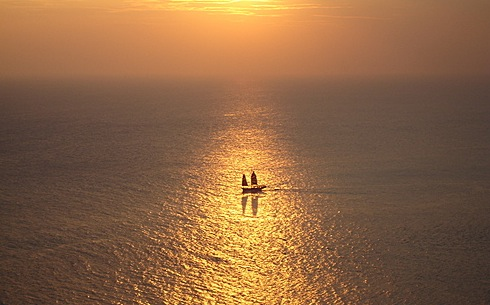
I felt absolutely ecstatic, like something major was happening, yet nothing particular stood out. As far as the eye could see, the world was an endless expense of blue, only slightly interrupted by a thin line, far, far away. Sea and sky, a few clouds on the horizon, the sun to the west, no birds, no fish, no sounds but the slight, rhythmic splashes of the boat gracefully cutting through the water, almost as silently as the flight of the owl.

Simplicity—I suppose, is what fascinates me most about Darwin’s brilliant concept of evolution by means of natural selection. The algorithm the survival of the fittest is the simplest idea one can conceive, and yet so powerful that it cuts through everything our understanding touches.

I have come to view the principle of simplicity as an old friend, always by my side as long as I can remember. From my young student days to the times of book writing or when on practical commissions, my friend Simplicity has been there, unobtrusively muttering, “Seek the simple…”

The principle of simplicity, as such, was first propounded by the English philosopher, William of Occam (1300-1349). We also know it as Occam’s Razor: “Entia non sunt multiplicanda praeter necessitatem,” which is Latin for “Entities should not be multiplied more than necessary,” or “If two assumptions seem to be equally valid, the simpler one should be preferred.”

Simple is beautiful and simpler is beautifuller—and the sea has this influence on you. Thus, I took the liberty to apply the principle of simplicity to its own definition, and three corollaries emerged.

If you have more than one option, choose the simplest.

  • First corollary: “If you have only one option, you don’t have a problem; don’t waste your time complaining, just accept it and keep smiling!”
  • Second corollary: “If you don’t like having only one option, work to create more; then you’ll have the problem of choosing one.”
  • Third corollary: “If you don’t like having problems, don’t create options.” Return, then, to the first corollary, don’t complain, and keep smiling!

And so it is that I continue sailing across this vast sea of blue, feeling my heart beating for every, ever-so-gentle splash of the hull against the water. It all seems so simple: I am just a little ripple in the immense ocean, yet I am alive, and hence I must embrace life fully for as long as I can.

________________

Featured image: A few clouds on the horizon and a fair wind, barely enough to keep the boat sailing.

Note: This blog is an updated version of the original post “I’m Alive and I Have Only One Option” published on April 21, 2014. I made minor adjustments to the language to better convey my thoughts, for I had struggled with a few sentences in the original. The text is now more to my liking; however, upon re-reading it, I noticed a slight but significant change in its undertone, which is why I felt it deserved a new title. And yes, I kept the term “beautifuller.”  It’s archaic from the 1800s, I know, but since I’m getting pretty archaic myself, I feel it’s fitting.

References

McFadden, J. (2023). Razor sharp: The role of Occam’s razor in science. Annals of the New York Academy of Scienceshttps://doi.org/10.1111/nyas.15086 (PMC article: https://www.ncbi.nlm.nih.gov/pmc/articles/PMC10952609/).

Walsh, D. (1979). Occam’s razor: A principle of intellectual elegance. American Philosophical Quarterly16(3), 241–244. https://www.jstor.org/stable/20009764.
The Illusive Free Will

—Do We Think Before We Act, or Do We Act Before We Think?

The Illusive Free Will

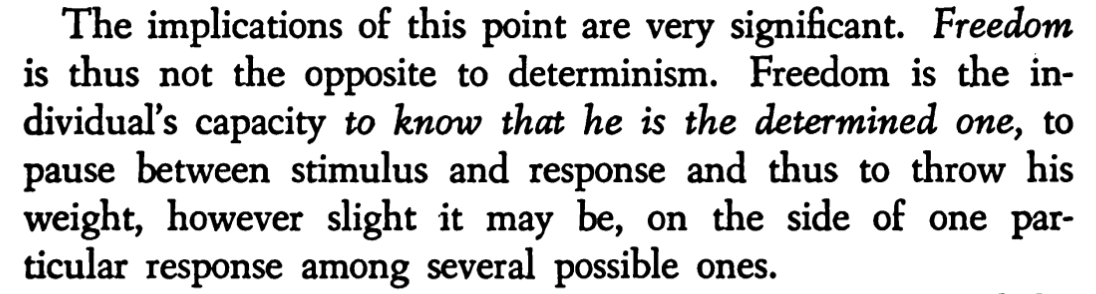
Freedom is the individual’s capacity to know that he is the determined one, to pause between stimulus and response and thus to throw his weight, however slight it may be, on the side of one particular response among several possible ones.” This quote is from page 103 (of which I give you a photo below) of Lloyd-Jones, E., Westervelt, E. M. (1963) Behavioral science and guidance: proposals and perspectives. New York: Bureau of Publications, Teachers College, Columbia University.


Freedom Quote


We find this text frequently misattributed, misquoted, modified, and adulterated to suit various purposes and agendas on today’s overwhelming social media, where everybody knows everything—and nobody knows nothing (as they say).

Let’s take a moment to ponder and analyze what’s behind the (original) quote, without the social media razzle-dazzle.

There is a space—a tangible time gap—between the moment of an event and our reaction that we might use productively if we intentionally allow it to be there and engage it critically. That is, in other words, what the author means. It is an enticing proposition, grounded in solid research from previous decades.

The question of free will is a millennia-long one, in which neurophysiology only recently entered the fray. Theories of free will focus on two fundamental questions: its possibility and nature. Some define free will as the capacity to make choices undetermined by past events. Determinism, on the other hand, sustains that only one sequence of events is possible and is inconsistent with free will. In contrast, compatibilism maintains that free will is consistent with determinism.

For over twenty years, experiments have suggested that, unbeknownst to us, a substantial part of mental processing occurs unconsciously, i.e., even before we know we plan to act. When we become aware of the brain’s actions, we ponder and mistakenly believe our intentions have caused them. “Your decisions are strongly prepared by brain activity. By the time consciousness kicks in, most of the work has already been done,” according to Haynes (2013).

Many brain processes occur automatically and without involving our consciousness. That is a defensive mechanism preventing our minds from being overloaded by basic routine chores.

We assume our conscious mind makes decisions. Our current findings question this. Researchers—using fMRI brain scans—could predict participants’ decisions up to seven seconds before the subjects had consciously made them.

If we decide before we are even aware of it, then the question is what mechanism decides for us. The prevailing view in neuroscience is that consciousness is an emergent neural phenomenon. The firing of the brain’s neurons gives rise to consciousness and the sensation of free will or intentional action. These findings (Libet 1985) may not surprise neuroscientists who believe consciousness arises from brain activity (rather than brain activity originating from consciousness) since they view the conscious experience of free will as an emergent phenomenon of brain activity.

Researchers conclude that cerebral initiation of a spontaneous voluntary act begins unconsciously. However, within about 150 ms after the precise, conscious purpose emerges, we can still deliberately control the ultimate decision to act. Subjects can “veto” motor function for roughly 100–200 ms before a set time to act. That is the gap, the pause, so quoted and misquoted. 

Whether that gap suffices to overcome the centuries-old free will quandary is highly arguable.

________________

References

  • Dennett, DC (2003). Freedom Evolves. Viking Press.
  • Fischer, JM & Ravizza, M (1998). Responsibility and Control: A Theory of Moral Responsibility. Cambridge University Press.
  • Haynes, J-D (2013). World.Minds: Do We Have Free Will? (Charité Berlin).
  • Libet, B (1985). Unconscious cerebral initiative and the role of conscious will involuntary action. Behavioral and Brain Sciences, 8(4), 529-539. doi:10.1017/S0140525X00044903.
  • Park, H-D et al. (2020). Breathing is coupled with voluntary action and the cortical readiness potential. Nature Communications, 2020; 11 (1) DOI: 10.1038/s41467-019-13967-9.
  • Pereboom, D (2001). Living Without Free Will. Cambridge University Press.
  • Soon, C, Brass, M, Heinze, HJ, et al. (2008). Unconscious determinants of free decisions in the human brain. Nat Neurosci 11, 543–545. https://doi.org/10.1038/nn.2112
  • Soon, CS, He, AX, Bode, S, Haynes, J-D (2013). Decoding abstract intentions, Proceedings of the National Academy of Sciences. March.
  • Strawson, GJ (1994). The impossibility of moral responsibility. Philosophical Studies 75 (1-2):5-24. 

___________________

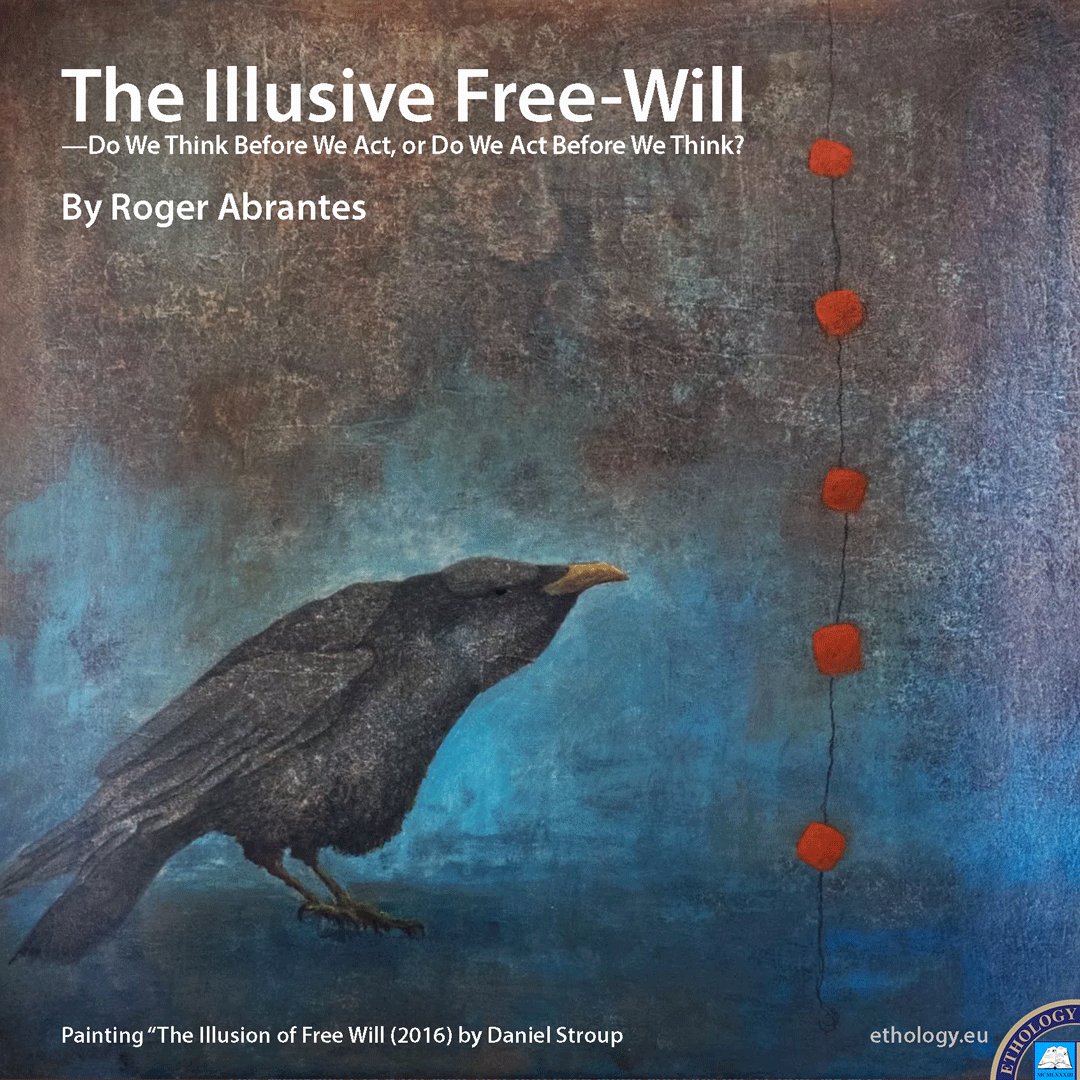
Photo: Painting “The Illusion of Free Will (2016) by Daniel Stroup.

Your comments are welcome. Please feel free to leave a reply.

Live as If You Were to Die Tomorrow—Learn as If You Were to Live Forever

Sea1byNickGrabowski-1

 I dedicate this short reflection to my students—and, by extension, to all students worldwide.

“Live as if you were to die tomorrow. Learn as if you were to live forever.”
~Mahatma Gandhi

“Live as if you were to die tomorrow. Learn as if you were to live forever” is widely attributed to Mahatma Gandhi. The exact wording is uncertain, yet the sentiment is faithful to his views. Rajmohan Gandhi, in The Good Boatman: A Portrait of Gandhi (1995), summarises his grandfather’s position as “[…] a man should live thinking he might die tomorrow but learn as if he would live forever.” Rajmohan Gandhi, incidentally, is a professor at the University of Illinois at Urbana–Champaign, with whom we established an excellent student exchange in the early 2000s.

The idea itself is far older. Isidore of Seville (c. 560–636 CE): expressed a similar exhortation in the Etymologiae: “Study as if you were to live forever; live as if you were to die tomorrow.”1 Comparable formulations appear in Islamic tradition—for example, in a Hadith often rendered as: “Live for your afterlife as if you will die tomorrow, and live for this life as if you will live forever.” Although popular, this version is not found verbatim in the canonical collections.2

Some scholars have noted parallels in the writings of Desiderius Erasmus (1466 – 1536), who likewise encouraged a readiness for death coupled with the lifelong pursuit of learning, though no primary source confirms the wording frequently attributed to him.3

Jiddu Krishnamurti noted that “the whole of life … is a process of learning,” underscoring that education does not end with formal schooling but accompanies us until death. Seneca argued that time must be used wisely so that life does not slip away unexamined—the core of living fully in the present. Socrates famously declared that “the unexamined life is not worth living,” connecting philosophical inquiry with purposeful existence.

The message is timeless. Continue your quest for knowledge. Do not postpone learning; embrace it today rather than tomorrow, for even your smallest discovery joins the shared store of human knowledge. At times, it may seem no more than a single drop—but then, the vast oceans themselves are born of such drops.


Notes

  1. The maxim “Disce tamquam semper victurus; vive tamquam cras moriturus” has long been attributed to Isidore of Seville and appears in standard editions of the Etymologiae. Chapter numbering may vary slightly by edition, but Book III contains the traditional formulation. ↩︎
  2. The popular saying “Live for your afterlife as if you will die tomorrow, and live for this life as if you will live forever” is not found verbatim in the canonical Hadith collections. It appears in later moralistic literature and is classified by scholars as non-authentic (apocryphal). ↩︎
  3. The widely circulated maxim “Live as if you were to die tomorrow; study as if you were to live forever” does not appear in Erasmus’s authenticated works. Modern quotation collections repeat the attribution without citing an original source, and Erasmus scholars consider it a later invention reflecting themes he discussed but never expressed in this form. ↩︎

References

Gandhi attribution
Gandhi, R. (1995). The good boatman: A portrait of Gandhi. Viking Penguin. ISBN 9780670856150.
— Paraphrase on p. 154.

Isidore of Seville
Isidorus Hispalensis. (2006). Etymologiae (W. M. Lindsay, Ed.; reprint ed.). Oxford University Press. ISBN 9780199266941.
— Book III, Ch. 24.

Hadith attribution (non-canonical)
al-Sakhāwī, M. A. (1996). Al-Maqāṣid al-ḥasana fī bayān kathīr min al-aḥādīth al-mushtahira ʿalā al-alsina. Dār al-Kutub al-ʿIlmiyya. ISBN 9782745122486.

Erasmus attribution (misattribution)
Rummel, E. (Ed.). (2004). The Erasmus reader. University of Toronto Press. ISBN 9780802085841.

Krishnamurti
Krishnamurti, J. (1981). Life Ahead: On Learning and the Search for Meaning. Harper & Row.

Seneca
Seneca. (2010). On the shortness of life (C. D. N. Costa, Trans.). Penguin Classics. (Original work published ca. 49 CE.)

Socrates (via Plato)
Plato. (2002). Apology (G. M. A. Grube & J. M. Cooper, Trans.). In J. M. Cooper (Ed.), Plato: Complete works (pp. 17–36). Hackett Publishing.


Featured image: Even the great oceans are made of many tiny drops (photo by Nick Grabowski).


The Evolution of Life in 60 Seconds

rinjani_1994

Today, I have a short film for you—sixty seconds that captures the evolution of life. It puts everything into perspective, doesn’t it?

I remain fascinated by that remarkable algorithm, “the survival of the fittest.” As Daniel Dennett writes (Dennett, 1995, p. 21), “I say if I could give a prize to the single best idea anybody ever had, I’d give it to Darwin—ahead of Newton, ahead of Einstein, ahead of everybody else. Why? Because Darwin’s idea put together the two biggest worlds, the world of mechanism and material, and physical causes on the one hand (the lifeless world of matter), and the world of meaning, purpose, and goals.”

Allow me to quote from my own modest book, Evolution:

“When we say that natural selection favors the fittest, we do not mean the one and only champion, but the fitter (or best-fitted) in the population. How fit they will have to be depends on the environmental circumstances. In times of food abundance, more individuals will be fit enough to survive and play another round. In times of famine and scarce resources, maybe only the champions will have a chance. In any case, the algorithm ‘the fittest’ is always at work.

Most objections to the theory of evolution by natural selection fail to realize the function of time. Given enough time, whenever there is variation, natural selection will come up with all imaginable forms of life—always the fittest for the given environment and period.”

There’s no perfection in evolution, only adaptation—a constant fine-tuning between what is and what works. Evolution is not a march toward perfection, but a dance with circumstance—graceful when time allows, ruthless when it doesn’t.

It’s all rather simple, really. You, reading these lines, are living proof of natural selection’s quiet verdict. How do I know? I’ll let you ponder it.

Keep smiling.

A minute well spent: four billion years of life condensed into a single breath of time. Watch it—and remember how brief, yet extraordinary, our moment in evolution truly is.

Featured image: Simulations of the ‘volcano hypothesis’ were able to create organic molecules. Life could have originated in a ‘warm little pond’ in similar ways. (From “Evolution” by Roger Abrantes. Picture: Mount Rinjani, Indonesia by Oliver Spalt).

References

Abrantes, R. (2010) Evolution. Wakan Tanka Publishers (online book).

Dennett, D. C. (1995). Darwin’s Dangerous Idea: Evolution and the meanings of life. New York, NY: Simon & Schuster. (Original work published 1995)

“Life of Pi” — Read the Book, Watch the Movie

Life of Pi

“Just beyond the ticket booth Father had painted on a wall in bright red letters the question: DO YOU KNOW WHICH IS THE MOST DANGEROUS ANIMAL IN THE ZOO? An arrow pointed to a small curtain. There were so many eager, curious hands that pulled at the curtain that we had to replace it regularly. Behind it was a mirror.” (1.8.4)

I read Yann Martel’s “Life of Pi” many years ago. I took the book to bed, my intention being to read 10-12 pages before falling asleep. This was one of the few books I’ve read from one end to the other in one go. I went to sleep at five in the morning.

The other day, I revisited “Life of Pi,” not the book from 2001, but the movie from 2012 directed by Ang Lee with screenplay by David Magee.

The movie gets my five stars. It’s a near perfect screenplay adaptation of a book. It misses a bit of the first part of the book that would be too cumbersome to render in pictures anyway, but it presents the second part magnificently. It’s a beautiful 3D movie, a thrilling adventure, an experience for afterthought—you can take it as you wish.

“Life of Pi,” book and movie, is not intrusive, does not force you to think or accept anything in particular. It leaves you with your freedom to draw your conclusions, or ask your questions, as the case may be.

Take a break, read the book and savor it. Yann Martel succeeded in writing a book that you want to read word by word, not by paragraphs.

The following quotations indicate “Part.Chapter.Paragraph.”

The most dangerous animal in the zoo is the human being maybe because of the relationship of danger with unpredictable evil.

“Rank determines whom it can associate with and how; where and when it can eat; where it can rest; where it can drink; and so on. Until it knows its rank for certain, the animal lives a life of unbearable anarchy. It remains nervous, jumpy, dangerous. Luckily for the circus trainer, decisions about social rank among higher animals are not always based on brute force.” (1.13.3)

Here, Pi is (between lines) talking more about human relationships than human-animal relationships, one suspects. He’s also thinking about how to train Richard Parker.  Throughout his misery, Pi comes to see cleverness and willpower as two remarkable human skills, but the question is, do not these skills also bring about evil?

“There are many examples of animals coming to surprising living arrangements. All are instances of that animal equivalent of anthropomorphism: zoomorphism, where an animal takes a human being, or another animal, to be one of its kind.” (1.32.1)

Zoomorphism (in a way, the opposite of anthropomorphism) means that animals treat another species (almost) like their own. Our dogs are great zoomorphists.  This is more philosophical that it may seem and definitely more obscure in the movie than in the book, which, as I’ve mentioned, is more elaborated in its first pre-boat part. One suspects that Pi is talking about his own struggle: Pi the Hindu, Pi the Muslim, and Pi the Christian all in one and the same Pi, not only tolerating one another but living in harmony.

I leave you with one last quote without any comment. Read the book, watch the movie.

“I had to tame him. It was at that moment that I realized this necessity. It was not a question of him or me, but of him and me.” (2.57.8)

As always, I wish you a great day.

How Difficult Can It Be to Be a Dog Owner?

man dog laughing grass

You don’t have to excuse yourself or your dog for the way you are. As long as you’re both happy and you don’t bother anyone, you are entitled to do what you like and be the way you are.

You don’t need to be good at anything, whether it be Obedience, Agility, Musical Free Style, Heel Work to Music, Flyball, Frisbee Dog, Earth Dog, Ski-Joring, Bike-Joring, Earthdog, Rally-O, Weight Pulling, Carting, Schutzhund, Herding, Nose Work, Therapy, Field Trials, Dock Dogs, Dog Diving, Disc Dogs, Ultimate Air Dogs, Super Retriever, Splash Dogs, Hang Time, Lure Course Racing, Sled Dog Racing or Treibball; and you don’t need excuses as to why not.

We are over-swamped by labels because labels sell, but they only sell if you buy them. Should you be a positive, force-free, balanced, R+, R+P-, naturalistic, moralistic, conservative, realistic, progressive, or a clicker dog owner?

Labels are not a guarantee of high morals, quality of life, or scientific correctness. They are trademarks, devised by people who want to sell you a product and control you.

Stop caring about labels. A label is a burden; it restricts you; it limits your freedom. Labels are for insecure people who need to hide behind a mask. Harmony and serenity don’t need labels.

Be skeptical of everything that spreads like fire on the step. Be suspicious of anything with a broad mass appeal. Think, question everything, control your emotions, be open-minded, but constantly use your critical reasoning. Believe in yourself, be yourself. Be the person and the dog owner you want to be, and you won’t need labels.

Forget labels and focus instead on knowledge, empathy, reciprocity, and respect. These are the pillars of any healthy relationship you may develop with any individual, independently of species.

Life is great—enjoy it!

Featured image: Just do whatever you and your dog enjoy, whichever way you like it, so that both of you feel good. It’s as simple as that!

The Single Most Damaging Belief of Ours

wolfmuzzlegrab-1

The single most damaging belief of ours is that everything is one-sidedly good or bad, right or wrong.

Good or bad, right or wrong depend on the conditions. A strategy is only good at a specific time and under particular circumstances. Behavior is dynamic and changeable. An individual displays one behavior at one given moment and another a while later. It is the ability to adopt the most beneficial strategy in the prevailing conditions that ultimately sorts the fittest from the less fit—moral strategies included—and decides whose genes will prevail in the next generation, and which memes will play in the following round.

Opposing strategies—such as honesty versus deception, dominance versus submission, or aggression versus fearfulness—hold one another at bay. Whether it pays off to play one role or the other is ultimately a function of costs and benefits, as well as the number of individuals adopting each particular strategy.

In the game of life, no strategy wins alone.

Featured image: The single most damaging belief of ours is that everything is one-sidedly good or bad, right or wrong. (Photo by Monty Sloan).

I’m a Citizen of the World

childdogcatwide-1

I’m a citizen of the World,” I say when asked where I come from—and I am, in mind and heart.

Diogenes, in about 412 BC, was probably the first to use the expression and express the very same sentiment. Socrates (469-399 BC) concurred: “I am not an Athenian or a Greek, but a citizen of the world.” Kaniyan Poongundran, the Tamil poet, wrote (at least 2000 years ago), “To us all towns are one, all men our kin.” Thomas Paine (English-American philosopher, 1737 – 1809), said, “The world is my country, all mankind are my brethren and to do good is my religion.” Albert Einstein (1879-1955) thought of himself as a world citizen, “Nationalism is an infantile disease. It is the measles of mankind.”

I’m a citizen of the world. I’ve traveled over most of our beautiful planet, seen mountains above the clouds with perennial snow tops, and oceans reaching far beyond the eye can see. I’ve lived in temperatures from 40ºC below zero to 40ºC above. I’ve eaten all kinds of food prepared by humans and spent many a day and night enjoying the company of people with the most exceptional cultures and habits.

What’s my favorite place? I don’t have one. Everywhere I’ve been, I’ve discovered new pieces in this amazing puzzle of life. Everywhere I’ve been, from the most glamorous cities to the poorest war-torn areas, I’ve met kind and gentle people. I’ve shared water with the Maasai in the African desert and rice with the Chhetris in the Nepalese mountains. With all of them, I felt a strong kinship: no country, no culture, no language, no divide—we were family, we were humans, we were sentient living beings. Yes, I’m a citizen of the world.

Life is great!


Featured image: Everywhere I’ve been, I’ve discovered new pieces in this amazing puzzle of life.

A Newborn is Perfect and You are a Survivor

A newborn is as perfect as it will ever get (Image: FreeDigitalPhotos.net at http://www.freedigitalphotos.net).

A newborn is as perfect as it will ever get, its brain and senses wide open. From then on, it can only go downwards. Some go dramatically down (most), repressed and oppressed by the environmental conditions. They survive, though, some better than others. Others (the few lucky ones) only get their potential reduced by a margin dictated by the inexorable selective environmental exposure. Like a mirage, they develop into balanced, happy adults.

Paradoxically enough (inevitable as well), the loving parents, even the educated and well-intentioned, are the cause number one of the newborn’s fall. From day one, parents begin teaching the newborn the science and art of survival, encompassing a variety of skills. They begin limiting the newborn’s potential, creating likes and dislikes, fears and phobias, ambitions and illusions, as well as notions of good and evil, and fixed patterns of thinking, feeling, and behaving. Some of it is inevitable and will serve the newborn well for the rest of its life. Most of it is harmful, serves no practical purpose, and will be excess baggage in adulthood for which one will continually have to pay a high price.

For the balanced, well-intentioned parents, the challenge is to train the newborn to succeed in a world that is not yet there. Parents train their offspring to be successful adults in their own world, not in the world where the offspring will reach adulthood and have to fend for themselves. Most parents teach their offspring particular skills and norms that will be obsolete once they become adults. Partly, this is inevitable once the cultural environment changes faster than any genetic evolution can cope with, which is our case. Our brain is still roughly the same as the brain of our Stone Age ancestors. The environmental and social pressures it has to cope with are not.

So what can we do?  It seems to me that a solid agenda for any parent, one resistant to time and change, is to create for their young a close contact to nature, of which we are a part. We must awaken our sense of the beautiful and the good, of wondering rather than rejecting, of ‘living it’ rather than ‘analyzing it,’ of open-mindedness and acceptance rather than pettiness and oppression. We must re-awaken our values long obscured and repressed by scientism, technomorphia, and political correctness; re-awaken our perception of entirety before particularity.

You are a survivor. You’ve done well, but you don’t need to stop there, no matter the odds. The next step, alas, is the most difficult: to take away the ‘sur’ in ‘survive’, leaving only ‘vive’ behind, which means ‘to live’. ‘Living,’ rather than ‘living despite,’ seems to me to be the ultimate goal.

Keep smiling. Life is great!