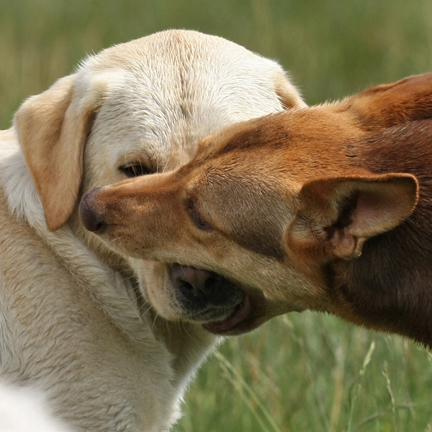
A “Muzzle grasp” (or muzzle grab) is a common behavior shown by social canines, e.g., wolves (Canis lupus lupus), dingoes (Canis lupus dingo), and dogs (Canis lupus familiaris). The primary function of this behavior is to confirm a relationship rather than to settle a dispute. The more self-confident or higher-ranking individual will muzzle-grasp a more insecure or lower-ranking partner to assert its social position. The more insecure individual does not resist the grasp; on the contrary, it often displays submissive behavior, literally inviting its partner to muzzle-grasp it. Even though we sometimes see this behavior at the end of a dispute, wolves and dogs only use it toward individuals they know well—pack members—as a kind of saying, “You’re still a cub (pup).” The dispute itself tends not to be serious, merely a low-key challenge, often over access to a resource. Youngsters, cubs, and pups sometimes solicit adults to muzzle-grasp them. This behavior appears reassuring to them.
The muzzle-grasp behavior emerges early in development. Canine mothers muzzle-grasp their puppies (sometimes accompanied by a growl) to deter them from suckling during weaning. Field observations confirm this mechanism. As Packard, Mech, and Ream (1992, p. 1274) report, “In the context of playing, begging, and sharing, pups did not leave when another wolf muzzled, snapped, or lunged. In contrast, the muzzling by the nurser in the context of suckling terminated the pups’ attempts to gain access to nipples.” This observation illustrates the early communicative value of the muzzle contact as both a mild inhibitory and relational signal. Cubs and pups also muzzle-grasp one another during play, typically between six and nine weeks of age. They probably learn through play that the muzzle-grasp is an effective way of stopping an opponent from doing something, while also learning bite inhibition. If they bite too hard, they elicit a fight and risk injury. A muzzle-grasp, therefore, does not involve biting, only grasping. This behavior helps develop a relationship of trust between both parties—“we don’t hurt one another.”
Similar tactile interactions, including muzzle-to-muzzle contact, also occur in post-conflict and affiliative contexts among wolves. Cordoni and Palagi (2019) describe reciprocal muzzle-licking between adults and immature pack members following mild conflicts—acts that function as “consolation” and reinforce social bonds. Although a muzzle-grasp differs mechanically from muzzle-licking, both share an underlying functional value: the restoration or affirmation of trust within a dyad. These tactile gestures exemplify the nuanced physical vocabulary through which canids maintain cohesion and mitigate tension within the pack.
Classic naturalist observations (Zimen, 1981) describe frequent muzzle-to-muzzle contacts and note adults seizing pups’ muzzles during play and weaning; together with quantitative field data (Packard, Mech, & Ream, 1992), this supports the view that muzzle contact is an early-emerging, ritualised tactile signal rather than an aggressive act.
When used to settle a dispute, a muzzle-grasp may appear more violent and usually ends with the individual being muzzle-grasped exhibiting passive, submissive behavior. Yet participants very seldom, if ever, get hurt, an occurrence that would undermine the behavior’s function.
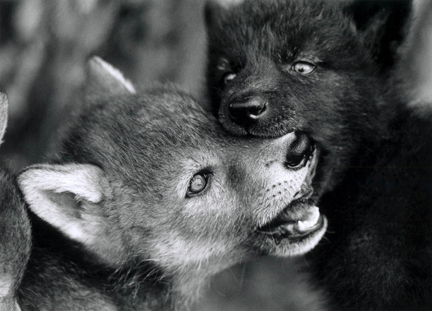

Left: Cubs and pups muzzle grasp one another during play. Right: Muzzle grasp in adult wolves (photos by Monty Sloan).
A muzzle-grasp requires self-control. Higher-ranking wolves and dogs muzzle-grasp their pack members (teammates) and, by doing so, confirm their rank while displaying restraint. Lower-ranking wolves and dogs often engage in muzzle-grasping behavior to affirm their social position and reassure themselves that they remain included in the group.
The muzzle-grasp behavior probably originated as both a form of maternal (and later paternal) control and as a play behavior among cubs. As it appears to have been beneficial to all parties involved, it may have become a factor favored by natural selection, spreading from generation to generation and evolving as any other trait that enhances the fitness of individuals within cohesive social groups.
In domestic dogs, when puppies are about five to seven weeks old, their mother regularly muzzle-grasps them to deter suckling. At first, her behavior frightens them, and they may whimper excessively, even though she does not harm them. Later, when grasped by the muzzle, the puppy immediately shows passive submissive behavior—lying on its back and exposing its ventral side. Previously, it was assumed that the mother needed to pin the puppy to the ground; however, Packard et al. (1992) observed that, in wolves, in practice, “[…] on the occasions when the nurser winced or muzzled the pups, the pups did not persist” and that “[…] counter-tactics for overcoming nurser rejection did not occur (pp. 1271–1272).” Most puppies submit voluntarily. Over time, this behavior pattern assumes variations. Wolf cubs and puppies often invite the alpha male (the leader of the pack and, in wolves, usually their father) as well as other adults to grasp them by the muzzle, thereby soliciting a demonstration of their elders’ superiority and self-control while simultaneously showing their own acceptance and submissiveness. This is among the most reassuring behaviors an adult can show a youngster.
Domestic dogs sometimes approach their owners puffing gently with their noses. By gently placing a hand around their muzzle, we may reassure them of acceptance, demonstrate self-control, and convey that they can trust us. That is speaking dog-language to the best of our abilities. After being muzzle-grasped for a while, the dog will usually show a nose-lick, perhaps yawn, and then walk calmly away. It is as if the dog were saying, “I’m still your puppy,” and the owner replied, “I know—and I’ll take good care of you.”
The muzzle-grasp behavior can be challenging to classify. Some researchers see it as social or affiliative, others as agonistic, and still others as pacifying. Because its primary function is to confirm and maintain relationships, it may best be considered a social behavior—a ritualized, low-intensity interaction that reinforces trust and cohesion within the group.
Next time your dog gently nudges or invites a muzzle‑grasp, pause for a moment—what you see as a simple dog behavior is, in canine language, a subtle conversation of trust and understanding.
References
Abrantes, R. (1987). Hundesprog. Borgen Forlag, Copenhagen.
Abrantes, R. (1997). The Evolution of Canine Social Behavior. Naperville, IL: Wakan Tanka Publishers.
Abrantes, R. (2011, December 11). Dominance—Making sense of the nonsense. Roger Abrantes Blog. https://rogerabrantes.wordpress.com/2011/12/11/dominance-making-sense-of-the-nonsense/
Cordoni, G., & Palagi, E. (2019). Back to the future: A glance over wolf social behavior to understand dog–human relationship. Animals, 9(11), 991. https://doi.org/10.3390/ani9110991
Packard, J. M., Mech, L. D., & Ream, R. R. (1992). Weaning in an Arctic wolf pack: Behavioral mechanisms. Canadian Journal of Zoology, 70(7), 1269–1275. https://doi.org/10.1139/z92-177. USGS+1 PDF (scanned article, pages shown above): https://www.wolf.org/wp-content/uploads/2013/09/172weaningarcticwolf.pdf
Zimen, E. (1981). The wolf: His place in the natural world. Souvenir Press Ltd. ISBN 9780285624115
Note: I first wrote about the muzzle grasp behavior in canids in my Danish book Hundesprog (1987), where I called it “mund om snuden,” which translates directly as “mouth around the snout.” This term became “muzzle grasp” in the first English edition of the book, titled Dog Language. I later wrote Muzzle Grab Behavior in Canids on April 25, 2012. Two years afterward, on March 13, 2014, I revised it as Canine Muzzle Grasp Behavior—Advanced Dog Language. True to my philosophy of updating articles and papers as new evidence emerges, I have once again revised this work. The latest version, published in November 2025, appears here under the title Muzzle Grasp Behavior in Canids.
 Roger Abrantes