The Function of Champing Behaviour: An Ethological Account in Canines

Abstract

Champing refers to a conspicuous chewing or jaw-working motion performed in the absence of food and observed in social contexts in dogs and other canids. This short paper provides a descriptive ethological account of champing, interprets its function as a pacifying signal, and places it within established frameworks of social interaction and ontogenetic development. The behaviour is defined as a distinct ethological category based on the author’s long-term observations and comparative analysis.

Champing (also termed chomping) refers to a conspicuous, often audible chewing or jaw-working motion performed in the absence of food. In dogs and other canids, this behaviour is typically observed in social contexts. It is associated with affiliative intent, pacifying, insecurity, or submissiveness, depending on its intensity, timing, and accompanying signals.1

To the best of the author’s knowledge, this behaviour has not previously been described or formally defined as a distinct ethological category, despite being intermittently observed and subsumed under broader classes of pacifying or displacement behaviours.2

Across contexts, champing possesses a clear pacifying function. Pacifying behaviour (from Latin pacificare, pax = peace, facere = to make) comprises actions whose function is to reduce social tension, inhibit aggressive or dominant behaviour in another individual, or restore a state of social calm, as defined within an interactional framework of social behaviour (Hinde, 1976). In dogs, commonly described pacifying behaviours include licking, muzzle nudging, nose touching, pawing, yawning, body twisting, and head turning, all of which may be directed toward conspecifics or humans.

Champing is widely employed by canids in situations ranging from mild uncertainty to more pronounced social stress. Its acoustic and rhythmic properties appear to contribute to its communicative value, functioning as a low-risk, non-confrontational signal that advertises non-threatening intent (Lorenz, 1966).

janegoodallandchimp1
Jane Goodall used to break a branch and pretend to chomp on it to pacify chimpanzees, showing some unease (photo by Derek Bryceson/National Geographic Creative).

Ontogenetically, champing has a plausible developmental basis. One of the earliest repetitive oral sounds in mammalian neonates is produced during suckling and is closely linked to satisfaction, warmth, and social contact. In puppies, early oral motor patterns tied to nursing occur in a context of comfort and need fulfilment. As development continues, elements of this behaviour are redirected into social functions, where champing helps turn uncomfortable or ambiguous interactions into more benign ones. Initially, the behaviour is closely tied to hunger reduction; later, it becomes separate from feeding and acquires a distinct communicative function (Hinde, 1982).

In adult dogs, champing is a clear and effective signal of affiliative or conciliatory intent. Similar patterns appear across mammals, where oral behaviours linked to nursing and sucking are associated with reduced arousal and resting states. This suggests early sensory–motor associations may keep a tension-reducing function throughout life.3

Comparable observations exist in primates. Jane Goodall reported deliberately mimicking chewing movements—such as breaking a twig and pretending to chew it—to pacify chimpanzees displaying signs of unease (Goodall, 1971).

In applied animal contexts, the author has often used champing with apparent success when interacting with dogs or horses, consistent with its proposed pacifying function.


Footnotes

  1. In ethology, the formal identification and naming of behavioural patterns commonly precede their experimental isolation or quantification. Descriptive classification based on repeated observation, functional context, and comparative consistency has historically been a primary means by which distinct behavioural units are recognised, refined, and later subjected to experimental analysis. ↩︎
  2. The present account is based on the author’s long-term ethological observations and comparative analyses of canine social behaviour, first described in Dog Language (Abrantes, 1986 and 1997). It is descriptive and functional in scope and does not claim experimental isolation, quantitative prevalence estimates, or phylogenetic exclusivity for champing behaviour. In the absence of prior formal treatment of this behaviour as a distinct category, these observations constitute the primary empirical basis for the description and interpretation presented here. ↩︎
  3. Evidence for the calming or arousal-reducing effects of suckling and related oral behaviours in mammals is well established in the developmental and comparative literature. Studies of non-nutritive sucking and nursing behaviour report associations with reduced behavioural arousal and increased resting or quiet states in a range of species (e.g. Blass, 1980; Veissier et al., 2002). While these works do not address champing or later social signalling directly, they provide developmental support for the inference that early oral sensory–motor patterns may retain residual tension-reducing properties when redeployed in other behavioural contexts. ↩︎

References

Abrantes, R. (1997). Dog language: An encyclopedia of canine behaviour. Wakan Tanka, Publishers. (Original work published as Hundesprog in 1986).

Blass, E. M. (1980). Suckling. Science, 210(4472), 729–735. https://doi.org/10.1126/science.6997992

Goodall, J. (1971). In the shadow of man. London: Collins.

Hinde, R. A. (1976). Interactions, relationships and social structure. Man, 11(1), 1–17. https://doi.org/10.2307/2800384

Hinde, R. A. (1982). Ethology: Its nature and relations with other sciences. Oxford: Oxford University Press.

Lorenz, K. (1966). On aggression. London: Methuen.

Veissier, I., de Passillé, A. M., Després, G., Rushen, J., Charpentier, I., Ramirez de la Fe, A. R., & Pradel, P. (2002). Does nutritive and non-nutritive sucking reduce other oral behaviors and stimulate rest in calves? Journal of Animal Science, 80(10), 2574–2587. https://doi.org/10.1093/ansci/80.10.2574


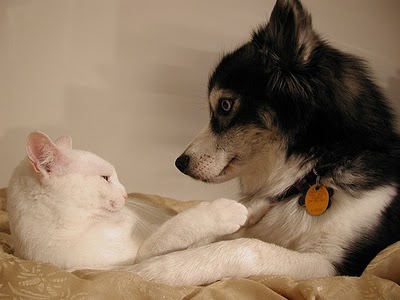
Featured image: Champing behaviour has a pacifying function—attempting to turn an unpleasant situation into a pleasant one.


This article is originally written on April 12, 2017 and slightly edited on January 2, 2026.

Pacifying Behavior—Origin, Function and Evolution

Roger Abrantes and Rottweiler

This Rottweiler female shows me friendly behavior licking my face and ear. I show that I accept her friendly behavior by turning my face away from her, closing my eyes and mouth and making champing noises. Mostly, dogs show friendly and pacifying behavior to humans as they do to other dogs (photo by Lisa J. Bain).

Pacifying behavior (Latin pacificare, from pax = peace and facerefacio = to make) is all behavior with the function of decreasing or suppressing an opponent’s aggressive or dominant behavior. There are two ways of classifying pacifying behavior: (1) to include all behaviors with the function of diffusing social conflict, and (2) to restrict it to a particular range within the broader spectrum of conflict decreasing behavior (see diagram below). This author prefers the latter because the broad use of the term in the first option makes it synonymous with conflict decreasing behavior in general, without reference to any particular sub-class of this behavior.

Pacifying behavior is closely related to friendly behavior (including greeting behavior), insecuresubmissive and fearful behavior. In general, the differences between these behavior displays are quantitatively small, but we can classify them separately and qualitatively according to their respective sub-functions. An animal pacifies another by means of a complex sequence of different behaviors as we can see in the diagram below. An animal very seldom shows a single behavior. Also, the same behavior may achieve different functions depending on its intensity and the sum of all behaviors displayed at a given moment.

Pacifying behavior did not originate as a deliberate and well-thought strategy to manipulate an opponent. Initially, it was probably just a reflex. Like all phenotypes, it happened by chance and evolved thereafter.

Pacifying Behavior Canids

Pacifying behavior in dogs: licking own lips, licking and pawing (images by Alanic05 and Colorado Great Pyrenee Rescue Community).

Natural selection favors behaviors that prolong the life of an animal and increase its chance of reproducing; over time pacifying behavior spread throughout the population. Evolution favors a systematic bias, which moves behavior away from maximization of utility and towards maximization of fitness.

Pacifying Behavior Animals

Many species show pacifying displays in their behavior repertoire (photos by J. Frisch, AFP and Aleixa).

The origin of pacifying behavior—Animal A facing aggressive opponent B registers (sensory system) B’s behavior, processes it (neurological system) and responds with a behavior. This behavior (probably an infantile behavior) is then registered by aggressive animal B; some behaviors tend to pacify it (probably eliciting parental behavior) while others do not. The pacified state of B benefits A and reinforces its behavior, i.e. it is likely it will repeat the same behavior in similar circumstances. Most importantly, animals that show appropriate pacifying behavior (such as A) survive conflicts and avoid injury more often than not and subsequently pass their genes onto the next generation.

Pacifying behavior also pacifies the pacifier, which is an important feature of this behavior. By displaying pacifying behavior, an insecure animal attempts to regain some security (homeostasis) by displaying a behavior it knows well and has previously served to reassure it.

Dog and Cat

Cat and dog use the pacifying behavior of their own species to communicate with one another successfully because of the common characteristics of the behavior (photo by Malau).

Some pacifying behavior has its origins in neonatal and infantile behavior and only becomes pacifying behavior through redirection and eventually ritualization. Other forms of pacifying behavior rely on concealing all signs of aggressive behavior. Sexual behavior can also function as pacifying. Young animals of social species learn pacifying behavior at a very early age; it is important that young animals are able to pacify adults when they begin interacting with them. The disposition (genotype) to display the behavior is innate (otherwise the phenotype  would not be subject to natural selection and evolution), although it requires reinforcement for the young animal to be able to apply it successfully. In canines, adults (initially the mother at the time of weaning) teach the cubs/pups the intricacies of pacifying behavior, a skill they will need to master in order to prevent or resolve hostilities that could cause serious injuries.

Even though pacifying behavior is more relevant and developed in social species, we also find pacifying displays in the behavior repertoire of less social species. Animals use successfully the pacifying behavior characteristic of their own species with individuals belonging to other species (if possible) because of the common elements of pacifying behavior across species. It is not unusual to see our domestic animals, dogs, cats and horses interacting peacefully and exchanging pacifying signals. Dogs also show friendly, insecure, pacifying or submissive behavior to their owners and other humans with species characteristic displays; licking, nose poking, muzzle nudging, pawing and twisting are common behaviors that dogs offer us.

This diagram shows the placement of pacifying behavior in the spectrum of behavior in canids. The diagram does not include a complete list of behaviors. A conflict is any serious disagreement, dispute over a resource, which may lead to one or both parts showing aggressive behavior. Resources are what an organism perceives as life necessities, e.g. food, mating partner, or a patch of territory. What an animal perceives to be its resources depends on both the species and the individual; it is the result of evolutionary processes and the history of the individual.

Pacifying Spectrum

The spectrum of pacifying behavior in canids (by R. Abrantes). The colored background illustrates and emphasizes that behavior is a continuum with fading thresholds between the various behaviors. The vertical lines are our artificial borders, a product of definition and convention.

As always, enjoy a peaceful day,

R—

References

  • Abrantes, R. 1997. The Evolution of Canine Social Behavior. Wakan Tanka Publishers.
  • Abrantes, R. 1997. Dog Language. Wakan Tanka Publishers.
  • Coppinger, R. and Coppinger, L. 2001. Dogs: a Startling New Understanding of Canine Origin, Behavior and Evolution. Scribner.
  • Darwin, C. 1872. The Expressions of the Emotions in Man and Animals. John Murray (the original edition).
  • Fox, M. 1972. Behaviour of Wolves, Dogs, and Related Canids. Harper and Row.
  • Lopez, Barry H. (1978). Of Wolves and Men. J. M. Dent and Sons Limited.
  • Mech, L. D. 1970. The wolf: the ecology and behavior of an endangered species. Doubleday Publishing Co., New York.
  • Mech, L. David (1981). The Wolf: The Ecology and Behaviour of an Endangered Species. University of Minnesota Press.
  • Mech, L. D. 1988. The arctic wolf: living with the pack. Voyageur Press, Stillwater, Minn.
  • Mech. L. D. and Boitani, L. 2003. Wolves: Behavior, Ecology, and Conservation. University of Chicago Press.
  • Scott, J. P. and Fuller, J. L. 1998. Genetics and the Social Behavior of the Dog. University of Chicago Press.
  • Zimen, E. 1975. Social dynamics of the wolf pack. In The wild canids: their systematics, behavioral ecology and evolution. Edited by M. W. Fox. Van Nostrand Reinhold Co., New York. pp. 336-368.
  • Zimen, E. 1982. A wolf pack sociogram. In Wolves of the world. Edited by F. H. Harrington, and P. C. Paquet. Noyes Publishers, Park Ridge, NJ.