The Principle of Simplicity

Blue sea, blue sky

It dawned on me the other day, while at sea, one of those days with scattered clouds on the horizon and a fair wind barely sufficient to keep the boat sailing. Simplicity, that’s what makes it so soothing and scaringly beautiful. The sea invites you to dream, but make no promises; it is what it is, neither more or less. Be wise, and it will reward you; be foolish, and it will punish you.

You can’t hide at sea; you’ll encounter yourself whether you want it or not. The only viable strategy is honesty and integrity. It’s all so simple. The sea possesses this power, I discovered—the pertinent appears suddenly as frivolous, and the complex reveals itself in all its simple parts.

I felt absolutely ecstatic, like something major was happening, yet nothing particular stood out. As far as the eye could see, the world was an endless expense of blue, only slightly interrupted by a thin line, far, far away. Sea and sky, a few clouds on the horizon, the sun to the west, no birds, no fish, no sounds but the slight, rhythmic splashes of the boat gracefully cutting through the water, almost as silently as the flight of the owl.

Simplicity—I suppose, is what fascinates me most about Darwin’s brilliant concept of evolution by means of natural selection. The algorithm the survival of the fittest is the simplest idea one can conceive, and yet so powerful that it cuts through everything our understanding touches.

I have come to view the principle of simplicity as an old friend, always by my side as long as I can remember. From my young student days to the times of book writing or when on practical commissions, my friend Simplicity has been there, unobtrusively muttering, “Seek the simple…”

The principle of simplicity, as such, was first propounded by the English philosopher, William of Occam (1300-1349). We also know it as Occam’s Razor: “Entia non sunt multiplicanda praeter necessitatem,” which is Latin for “Entities should not be multiplied more than necessary,” or “If two assumptions seem to be equally valid, the simpler one should be preferred.”

Simple is beautiful and simpler is beautifuller—and the sea has this influence on you. Thus, I took the liberty to apply the principle of simplicity to its own definition, and three corollaries emerged.

If you have more than one option, choose the simplest.

  • First corollary: “If you have only one option, you don’t have a problem; don’t waste your time complaining, just accept it and keep smiling!”
  • Second corollary: “If you don’t like having only one option, work to create more; then you’ll have the problem of choosing one.”
  • Third corollary: “If you don’t like having problems, don’t create options.” Return, then, to the first corollary, don’t complain, and keep smiling!

And so it is that I continue sailing across this vast sea of blue, feeling my heart beating for every, ever-so-gentle splash of the hull against the water. It all seems so simple: I am just a little ripple in the immense ocean, yet I am alive, and hence I must embrace life fully for as long as I can.

________________

Featured image: A few clouds on the horizon and a fair wind, barely enough to keep the boat sailing.

Note: This blog is an updated version of the original post “I’m Alive and I Have Only One Option” published on April 21, 2014. I made minor adjustments to the language to better convey my thoughts, for I had struggled with a few sentences in the original. The text is now more to my liking; however, upon re-reading it, I noticed a slight but significant change in its undertone, which is why I felt it deserved a new title. And yes, I kept the term “beautifuller.”  It’s archaic from the 1800s, I know, but since I’m getting pretty archaic myself, I feel it’s fitting.

References

McFadden, J. (2023). Razor sharp: The role of Occam’s razor in science. Annals of the New York Academy of Scienceshttps://doi.org/10.1111/nyas.15086 (PMC article: https://www.ncbi.nlm.nih.gov/pmc/articles/PMC10952609/).

Walsh, D. (1979). Occam’s razor: A principle of intellectual elegance. American Philosophical Quarterly16(3), 241–244. https://www.jstor.org/stable/20009764.

The Illusive Free Will

—Do We Think Before We Act, or Do We Act Before We Think?

The Illusive Free Will

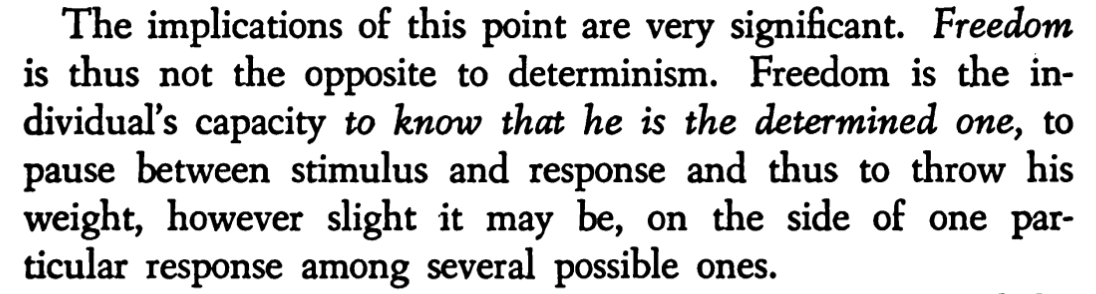
Freedom is the individual’s capacity to know that he is the determined one, to pause between stimulus and response and thus to throw his weight, however slight it may be, on the side of one particular response among several possible ones.” This quote is from page 103 (of which I give you a photo below) of Lloyd-Jones, E., Westervelt, E. M. (1963) Behavioral science and guidance: proposals and perspectives. New York: Bureau of Publications, Teachers College, Columbia University.


Freedom Quote


We find this text frequently misattributed, misquoted, modified, and adulterated to suit various purposes and agendas on today’s overwhelming social media, where everybody knows everything—and nobody knows nothing (as they say).

Let’s take a moment to ponder and analyze what’s behind the (original) quote, without the social media razzle-dazzle.

There is a space—a tangible time gap—between the moment of an event and our reaction that we might use productively if we intentionally allow it to be there and engage it critically. That is, in other words, what the author means. It is an enticing proposition, grounded in solid research from previous decades.

The question of free will is a millennia-long one, in which neurophysiology only recently entered the fray. Theories of free will focus on two fundamental questions: its possibility and nature. Some define free will as the capacity to make choices undetermined by past events. Determinism, on the other hand, sustains that only one sequence of events is possible and is inconsistent with free will. In contrast, compatibilism maintains that free will is consistent with determinism.

For over twenty years, experiments have suggested that, unbeknownst to us, a substantial part of mental processing occurs unconsciously, i.e., even before we know we plan to act. When we become aware of the brain’s actions, we ponder and mistakenly believe our intentions have caused them. “Your decisions are strongly prepared by brain activity. By the time consciousness kicks in, most of the work has already been done,” according to Haynes (2013).

Many brain processes occur automatically and without involving our consciousness. That is a defensive mechanism preventing our minds from being overloaded by basic routine chores.

We assume our conscious mind makes decisions. Our current findings question this. Researchers—using fMRI brain scans—could predict participants’ decisions up to seven seconds before the subjects had consciously made them.

If we decide before we are even aware of it, then the question is what mechanism decides for us. The prevailing view in neuroscience is that consciousness is an emergent neural phenomenon. The firing of the brain’s neurons gives rise to consciousness and the sensation of free will or intentional action. These findings (Libet 1985) may not surprise neuroscientists who believe consciousness arises from brain activity (rather than brain activity originating from consciousness) since they view the conscious experience of free will as an emergent phenomenon of brain activity.

Researchers conclude that cerebral initiation of a spontaneous voluntary act begins unconsciously. However, within about 150 ms after the precise, conscious purpose emerges, we can still deliberately control the ultimate decision to act. Subjects can “veto” motor function for roughly 100–200 ms before a set time to act. That is the gap, the pause, so quoted and misquoted. 

Whether that gap suffices to overcome the centuries-old free will quandary is highly arguable.

________________

References

  • Dennett, DC (2003). Freedom Evolves. Viking Press.
  • Fischer, JM & Ravizza, M (1998). Responsibility and Control: A Theory of Moral Responsibility. Cambridge University Press.
  • Haynes, J-D (2013). World.Minds: Do We Have Free Will? (Charité Berlin).
  • Libet, B (1985). Unconscious cerebral initiative and the role of conscious will involuntary action. Behavioral and Brain Sciences, 8(4), 529-539. doi:10.1017/S0140525X00044903.
  • Park, H-D et al. (2020). Breathing is coupled with voluntary action and the cortical readiness potential. Nature Communications, 2020; 11 (1) DOI: 10.1038/s41467-019-13967-9.
  • Pereboom, D (2001). Living Without Free Will. Cambridge University Press.
  • Soon, C, Brass, M, Heinze, HJ, et al. (2008). Unconscious determinants of free decisions in the human brain. Nat Neurosci 11, 543–545. https://doi.org/10.1038/nn.2112
  • Soon, CS, He, AX, Bode, S, Haynes, J-D (2013). Decoding abstract intentions, Proceedings of the National Academy of Sciences. March.
  • Strawson, GJ (1994). The impossibility of moral responsibility. Philosophical Studies 75 (1-2):5-24. 

___________________

Photo: Painting “The Illusion of Free Will (2016) by Daniel Stroup.

Your comments are welcome. Please feel free to leave a reply.

The Ethology of Trial and Error: Thirty-Four Illuminating Failures

“I didn’t fail. I discovered 34 ways that don’t work!”
I told them. But allow me to start from the beginning.

Success and failure are not absolutes; they are states of mind—criteria we adopt, perspectives we choose. Success may boost confidence and smooth the path ahead. Failure, conversely, fortifies resolve and builds persistence. Moving from one triumph to the next feels comfortable—perhaps too comfortable. Moving from one setback to another is taxing. So which is better? Let me tell you a story.

Once—young, spirited, and incapable of declining a challenge—I accepted a job trailering a horse. At the time, horse trailering was the number-one complaint among horse owners, much as home-alone issues plague dog owners today, and inappropriate elimination troubles cat owners.

Failing to trailer a horse at home is inconvenient; failing when you are hundreds of miles away is a genuine predicament. These owners were 200 miles from home. Their mare had refused to load after an equestrian event. They tried everything they knew, and everything others had told them, and still failed. Exhausted, they left the horse in a stall and drove home—then called me, offering anything if I could bring the mare back.

In hindsight, after hearing how many seasoned horsemen had tried—and how they had tried—I probably should have declined. But youth thrives on challenges, and so I drove to meet the horse.

We released her into a medium-sized arena, backed the trailer in, and I sat on the fence observing. She was a beautiful four-year-old quarter horse mix—alert, sensitive, and expressive. The owners recounted her history: no issues except trailering. They succeeded perhaps one in twenty attempts, and only after considerable distress. It was getting worse.

I will spare you the long list of misguided attempts employed before my arrival—well-intentioned efforts born more of frustration and inherited habits than of horsemanship. Don’t get me wrong: neither the owners, who were friendly and educated, nor those who tried to help were ill-disposed; they were simply relying on long-standing traditions that were not always gentle and had rarely been questioned.

These days, dog people often spend considerable time passionately disagreeing over training details. I sometimes invite them to visit the horse world, where perspective comes swiftly. Faced with the challenges still common in horse training, many of these canine disputes appear trivial. With a few admirable exceptions—brave horsemen and women who work to demonstrate that there are other, equally (or more) effective ways of handling a horse than sheer force—the field of horse training has long struggled to move beyond methods that rely mainly on force.

I stepped into the arena bare-handed—not even a rope. I liked the mare immediately. As with people, some animals evoke instant affinity; others do not. She seemed comfortable with me, too, if not from the beginning, then soon after. We walked quietly around the arena, each minding our own business. The owners left to run errands, a relief to both of us, I suspect.

After some time, the mare approached. We paused, inhaling and exhaling deeply. Horses do this when meeting. When in Rome, do as the Romans do;1 with horses, I become as equine as I reasonably can. It may look peculiar to some, but it works, and it matters. The more I attune myself to the animal’s own signals, the more she can evaluate me on her terms rather than mine.

We spent about two hours simply walking together. At times, she followed me slowly, three to four meters behind. At other moments—particularly when we passed a section of the fence where buckets and gardening tools were stored outside—she hesitated. Each time, I waited and behaved as though nothing were amiss. After a while, she would approach, and after six or seven such encounters, she passed the “scary” spot without difficulty. The same pattern emerged near the trailer.

Occasionally, I stopped, leaned against the fence or the trailer, and looked at her. She looked back and then approached slowly until she stood about a meter in front of me, relaxing into that characteristic stance with one hind hoof resting. Gradually, she began to follow me without hesitation. She had discovered, on her own terms, that I posed no threat and was sufficiently trustworthy.

When the owners returned, they asked whether I had loaded her.

“No,” I said.

“Oh, we’re sorry you failed,” they replied, offering polite condolences.

“Oh no,” I said. “I didn’t fail. I discovered 34 ways that don’t work to load a horse.” Strictly speaking, that was not entirely true. I had made a few tentative attempts early on to see how she reacted to the trailer, but I had not tried to load her in earnest. Most of the time was spent observing—learning what unsettled her, what reassured her, and how she chose to follow when she felt safe. There were easily thirty-four or more such small trials, each one teaching me something about her thresholds and preferences. What looked like inaction was, in fact, the slow process of letting the horse teach me how to proceed.

A few hours later, both the mare and I were standing inside the trailer, eating carrots and breathing calmly together. I never used a rope. I never used the halter. I never touched her until we had already been inside the trailer for a while.

So what happened?
In short, applied ethology happened. I relied on the horse’s natural need for companionship and safety, and I tried to provide precisely that. I let her approach in her own time, assess my intentions, and decide whether to come closer. In behavioristic terms, the comfort of social proximity reinforced her tendency to follow me. Falling behind or moving away were aversive experiences that briefly left her feeling exposed, prompting her to return. But the crucial point is that she controlled the reinforcers and inhibitors2 herself, not I.

That insight has shaped all my work with animals, no matter the species, though I hesitate to call it “training,” for what I value is the interaction—the relationship, the shared routines that work for both human and animal. It is a givers/takers game. Both partners must contribute, both must give and take—give what you can, take what you need.

The magic ingredient, I discovered, is humility, though not submission; confidence, though not dominance; being present as a trustworthy guide who points out possibilities and offers choices, while remaining as unobtrusive as possible in the background. It is, in truth, a humbling experience to realize how much one can learn, and how much better one can become, simply by listening to a horse.

Once she, the mare, had reliably chosen my company, walking into the trailer was merely the next natural step. After passing the trailer several times together, I entered it casually—no theatrics, no pressure, no fireworks either, once done. She followed without hesitation.

That day, I learned how to trailer a horse—not because I succeeded after four hours, but because I had uncovered 34 or so approaches that did not work. I thought I knew the procedure already; I was mistaken. Early success had lulled me into complacency.

Success and failure are not properties of events but of perspective. In the end, success came not from doing more, but from doing less—listening more carefully, and allowing the horse to teach me what I needed to know.

Notes

  1. The expression “When in Rome, do as the Romans do” (Latin: Si fueris Romae, ieiunato sicut Romanum est) is attributed to Saint Ambrose (4th century). When Augustine asked why the Milanese practice differed from that of Rome, Ambrose replied, “When I am in Milan, I do not fast on Saturday; when I am in Rome, I fast on Saturday.” Hence the proverb, meaning that one should adapt to local customs. The practice of adapting and imitating also serves us well when studying and interacting with other species, as Konrad Lorenz and Jane Goodall, among others, have demonstrated. ↩︎
  2. A reinforcer reinforces—meaning it strengthens behavior (it increases; one gets more). This is intuitive and consistent with standard usage. Likewise, an inhibitor inhibits—meaning it weakens behavior (it decreases; one gets less)—and the term explicitly states this functional effect. By contrast, the technical and classic term punisher refers to a stimulus that also weakens behavior, yet the word itself does not convey that effect. One may “punish” in the everyday sense without actually decreasing the behavior if the intensity or timing is inappropriate. The term inhibitor avoids this ambiguity: by name and by definition, it inhibits, that is, it weakens the behavior—without implying any difference in the underlying behavioral process. It also focuses purely on the functional outcome—a decrease in behavior rate—stripping away the ethical and emotional connotations associated with punishment. I am merely clarifying a conceptual point, not expecting that the established terminology will change. Ultimately, the choice of term is a matter of preference, and whichever term you use will require a clear definition for your readers and for anyone with whom you discuss these concepts. ↩︎

References

Budiansky, S. (1997). The nature of horses: Exploring equine evolution, intelligence and behavior. Free Press. ISBN 9780684827681.

Hempfling, K. F. (1993). Dancing with horses: The art of body language. Trafalgar Square Publishing. ISBN 9781570761517.

Parelli, P., & Parelli, K. (1993). Horsemanship: Theory & horse behavior. Parelli Natural Horsemanship. ISBN 9780965853300.

Roberts, M. (1997). The man who listens to horses: The story of a real-life horse whisperer who revolutionized the way we communicate with horses. Random House. ISBN 9780679456582.

Sinclair, E. (Director). (2016). Taming wild: A girl and a mustang [Film]. Taming Wild Productions.


Featured image: After some time, the mare approached. We paused, inhaling and exhaling deeply. Horses do this when meeting (photo from the EI files).


This article is an expanded and substantially updated version of the original “Animal Training—I Didn’t Fail, I Discovered 34 Ways That Don’t Work!” from June 4, 2014, which is why it is now published under a new title.

Live as If You Were to Die Tomorrow—Learn as If You Were to Live Forever

Sea1byNickGrabowski-1

 I dedicate this short reflection to my students—and, by extension, to all students worldwide.

“Live as if you were to die tomorrow. Learn as if you were to live forever.”
~Mahatma Gandhi

“Live as if you were to die tomorrow. Learn as if you were to live forever” is widely attributed to Mahatma Gandhi. The exact wording is uncertain, yet the sentiment is faithful to his views. Rajmohan Gandhi, in The Good Boatman: A Portrait of Gandhi (1995), summarises his grandfather’s position as “[…] a man should live thinking he might die tomorrow but learn as if he would live forever.” Rajmohan Gandhi, incidentally, is a professor at the University of Illinois at Urbana–Champaign, with whom we established an excellent student exchange in the early 2000s.

The idea itself is far older. Isidore of Seville (c. 560–636 CE): expressed a similar exhortation in the Etymologiae: “Study as if you were to live forever; live as if you were to die tomorrow.”1 Comparable formulations appear in Islamic tradition—for example, in a Hadith often rendered as: “Live for your afterlife as if you will die tomorrow, and live for this life as if you will live forever.” Although popular, this version is not found verbatim in the canonical collections.2

Some scholars have noted parallels in the writings of Desiderius Erasmus (1466 – 1536), who likewise encouraged a readiness for death coupled with the lifelong pursuit of learning, though no primary source confirms the wording frequently attributed to him.3

Jiddu Krishnamurti noted that “the whole of life … is a process of learning,” underscoring that education does not end with formal schooling but accompanies us until death. Seneca argued that time must be used wisely so that life does not slip away unexamined—the core of living fully in the present. Socrates famously declared that “the unexamined life is not worth living,” connecting philosophical inquiry with purposeful existence.

The message is timeless. Continue your quest for knowledge. Do not postpone learning; embrace it today rather than tomorrow, for even your smallest discovery joins the shared store of human knowledge. At times, it may seem no more than a single drop—but then, the vast oceans themselves are born of such drops.


Notes

  1. The maxim “Disce tamquam semper victurus; vive tamquam cras moriturus” has long been attributed to Isidore of Seville and appears in standard editions of the Etymologiae. Chapter numbering may vary slightly by edition, but Book III contains the traditional formulation. ↩︎
  2. The popular saying “Live for your afterlife as if you will die tomorrow, and live for this life as if you will live forever” is not found verbatim in the canonical Hadith collections. It appears in later moralistic literature and is classified by scholars as non-authentic (apocryphal). ↩︎
  3. The widely circulated maxim “Live as if you were to die tomorrow; study as if you were to live forever” does not appear in Erasmus’s authenticated works. Modern quotation collections repeat the attribution without citing an original source, and Erasmus scholars consider it a later invention reflecting themes he discussed but never expressed in this form. ↩︎

References

Gandhi attribution
Gandhi, R. (1995). The good boatman: A portrait of Gandhi. Viking Penguin. ISBN 9780670856150.
— Paraphrase on p. 154.

Isidore of Seville
Isidorus Hispalensis. (2006). Etymologiae (W. M. Lindsay, Ed.; reprint ed.). Oxford University Press. ISBN 9780199266941.
— Book III, Ch. 24.

Hadith attribution (non-canonical)
al-Sakhāwī, M. A. (1996). Al-Maqāṣid al-ḥasana fī bayān kathīr min al-aḥādīth al-mushtahira ʿalā al-alsina. Dār al-Kutub al-ʿIlmiyya. ISBN 9782745122486.

Erasmus attribution (misattribution)
Rummel, E. (Ed.). (2004). The Erasmus reader. University of Toronto Press. ISBN 9780802085841.

Krishnamurti
Krishnamurti, J. (1981). Life Ahead: On Learning and the Search for Meaning. Harper & Row.

Seneca
Seneca. (2010). On the shortness of life (C. D. N. Costa, Trans.). Penguin Classics. (Original work published ca. 49 CE.)

Socrates (via Plato)
Plato. (2002). Apology (G. M. A. Grube & J. M. Cooper, Trans.). In J. M. Cooper (Ed.), Plato: Complete works (pp. 17–36). Hackett Publishing.


Featured image: Even the great oceans are made of many tiny drops (photo by Nick Grabowski).


Can Two Training Methods Be Equally Good?

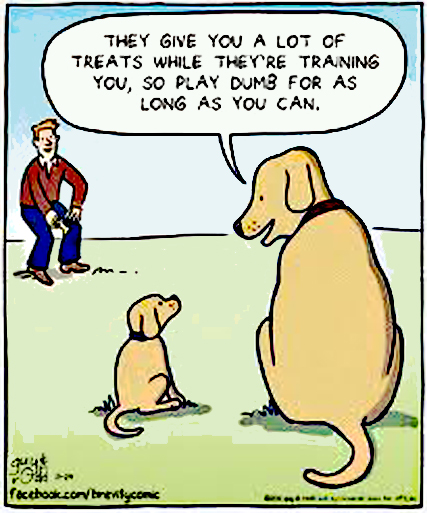
treat training dog cartoon

I receive many emails with questions about animal behavior. Most of them involve practical issues, but, now and then, someone poses a more complex question. Here is my answer to one of the latter, one I’d like to share with you because it addresses crucial issues in our understanding of animal behavior and training.

Dear ….,

Thanks for your comment, which allows me to clarify a few issues. By no means do I see animals as biological robots, nor do I regard the Skinnerian approach as the truth, the only truth, and nothing but the truth; quite the contrary. Please consider the following passages from “Mission SMAF—Bringing Scientific Precision Into Animal Training”.

“In fact, I suspect that [communication] even involves more than what science can describe with the intrinsic limitations of its key concepts and methods, no matter how stringent they are.

It seems to me, therefore, that our goal must not be to oppress or suppress emotions, but rather control them and use them advantageously. Emotional arousal proves to be necessary to learn and the right amount of emotional arousal even shows to increase the efficiency of learning processes.”

A very non-Skinnerian statement, I would say.

As to my own method to analyze learning processes in artificial set-ups (like in animal training), I write: “In a crude sense, SMAF is an oversimplification of complex processes […] certainly not an attempt to reduce complex mechanisms to a few formulas. In the end, [its] value depends solely on its successful application to solving practical problems; beyond that, it has no value.”

Operant conditioning (when we use it correctly) is an efficient model of behavior for animal training because we control the conditionals to some extent (as Pavlov explains in his original writings, not the subsequent translations). Whilst operant conditioning is adequate for analyzing behavior at a particular level, beyond that, it becomes too crude an instrument. To understand behavior in a broader sense, we must turn to evolutionary models and concepts—variation, selection, adaptation, fitness, function, evolutionary strategies, ESS (evolutionarily stable strategy), costs and benefits, and so forth. My approach to behavior is therefore a classical ethological one, in the tradition of von Frisch, Lorenz, and Tinbergen—firmly grounded in evolutionary biology and in philosophically coherent reasoning.

Greetings,

RAA


The core of the argument is reductionism, the view that we can reduce complex processes to the sum of their simpler parts. In a sense, all science is reductionistic. We attempt to explain complex processes with a few notions well organized in little boxes. That is a process that seems to suit our human brain particularly well.

However, we must bear in mind that our interpretations, independently of how good they are, are just our pictures of an elusive reality. They suit our particular umwelten,* but definitely not all of them. They explain parts of it from specific angles so we can make sense of it. Newton and Einstein—the classical example—are (probably) both right, each explaining reality at a different level.

There’s nothing wrong about being a reductionist if only we do not get greedy and attempt to explain far too much with far too little, as in, “That’s it, this is the way things are. Period.” Simplifying often gets us to the point that complicating and oversimplifying have both missed.

In animal training, one theory or method can be as good as another depending on its foundations, approaches, what it attempts to explain, and the practical goals it aims to serve. If both are based on reliable evidence, use well-defined terms, and are logically sound, there’s little to choose between one or the other.

If only animal trainers understood that, I believe we would forgo many senseless disputes. Then again, we can brag about being the most emotional creatures on this big blue marble of ours, can’t we?

___________

* Umwelt (plural umwelten) in ethology means the world as it is experienced by a particular organism.

___________

References

Abrantes, R. (2018). Mission SMAF—Bringing Scientific Precision In to Animal Training. Wanka Tanka Pub.

Lorenz, K. (1937). Über die Bildung des Instinktbegriffes. Naturwissenschaften, 25, 289–300. https://doi.org/10.1007/BF01492648

Павлов, И. П. (1926). Двадцатилетний опыт объективного изучения высшей нервной деятельности (поведения) животных. Ленинград: Научное химико-техническое издательство. (Pavlov, I. P. (1926). Twenty Years of Objective Study of the Higher Nervous Activity (Behavior) of Animals. Leningrad: Scientific Chemical-Technical Publishing House.)

Skinner, B. F. (1938). The Behavior of Organisms: An Experimental Analysis. New York: Appleton-Century-Crofts.

Uexküll, J. von. (1934). Streifzüge durch die Umwelten von Tieren und Menschen: Ein Bilderbuch unsichtbarer Welten. Berlin: Julius Springer. (English translation: A Foray into the Worlds of Animals and Humans: With A Theory of Meaning, translated by Joseph D. O’Neil, University of Minnesota Press, 2010.)

“Life of Pi” — Read the Book, Watch the Movie

Life of Pi

“Just beyond the ticket booth Father had painted on a wall in bright red letters the question: DO YOU KNOW WHICH IS THE MOST DANGEROUS ANIMAL IN THE ZOO? An arrow pointed to a small curtain. There were so many eager, curious hands that pulled at the curtain that we had to replace it regularly. Behind it was a mirror.” (1.8.4)

I read Yann Martel’s “Life of Pi” many years ago. I took the book to bed, my intention being to read 10-12 pages before falling asleep. This was one of the few books I’ve read from one end to the other in one go. I went to sleep at five in the morning.

The other day, I revisited “Life of Pi,” not the book from 2001, but the movie from 2012 directed by Ang Lee with screenplay by David Magee.

The movie gets my five stars. It’s a near perfect screenplay adaptation of a book. It misses a bit of the first part of the book that would be too cumbersome to render in pictures anyway, but it presents the second part magnificently. It’s a beautiful 3D movie, a thrilling adventure, an experience for afterthought—you can take it as you wish.

“Life of Pi,” book and movie, is not intrusive, does not force you to think or accept anything in particular. It leaves you with your freedom to draw your conclusions, or ask your questions, as the case may be.

Take a break, read the book and savor it. Yann Martel succeeded in writing a book that you want to read word by word, not by paragraphs.

The following quotations indicate “Part.Chapter.Paragraph.”

The most dangerous animal in the zoo is the human being maybe because of the relationship of danger with unpredictable evil.

“Rank determines whom it can associate with and how; where and when it can eat; where it can rest; where it can drink; and so on. Until it knows its rank for certain, the animal lives a life of unbearable anarchy. It remains nervous, jumpy, dangerous. Luckily for the circus trainer, decisions about social rank among higher animals are not always based on brute force.” (1.13.3)

Here, Pi is (between lines) talking more about human relationships than human-animal relationships, one suspects. He’s also thinking about how to train Richard Parker.  Throughout his misery, Pi comes to see cleverness and willpower as two remarkable human skills, but the question is, do not these skills also bring about evil?

“There are many examples of animals coming to surprising living arrangements. All are instances of that animal equivalent of anthropomorphism: zoomorphism, where an animal takes a human being, or another animal, to be one of its kind.” (1.32.1)

Zoomorphism (in a way, the opposite of anthropomorphism) means that animals treat another species (almost) like their own. Our dogs are great zoomorphists.  This is more philosophical that it may seem and definitely more obscure in the movie than in the book, which, as I’ve mentioned, is more elaborated in its first pre-boat part. One suspects that Pi is talking about his own struggle: Pi the Hindu, Pi the Muslim, and Pi the Christian all in one and the same Pi, not only tolerating one another but living in harmony.

I leave you with one last quote without any comment. Read the book, watch the movie.

“I had to tame him. It was at that moment that I realized this necessity. It was not a question of him or me, but of him and me.” (2.57.8)

As always, I wish you a great day.

The Single Most Damaging Belief of Ours

wolfmuzzlegrab-1

The single most damaging belief of ours is that everything is one-sidedly good or bad, right or wrong.

Good or bad, right or wrong depend on the conditions. A strategy is only good at a specific time and under particular circumstances. Behavior is dynamic and changeable. An individual displays one behavior at one given moment and another a while later. It is the ability to adopt the most beneficial strategy in the prevailing conditions that ultimately sorts the fittest from the less fit—moral strategies included—and decides whose genes will prevail in the next generation, and which memes will play in the following round.

Opposing strategies—such as honesty versus deception, dominance versus submission, or aggression versus fearfulness—hold one another at bay. Whether it pays off to play one role or the other is ultimately a function of costs and benefits, as well as the number of individuals adopting each particular strategy.

In the game of life, no strategy wins alone.

Featured image: The single most damaging belief of ours is that everything is one-sidedly good or bad, right or wrong. (Photo by Monty Sloan).

I Do Enjoy Being Kind to Other Animals

(First published April 13, 2014, edited February 26, 2018)


I Do Enjoy Being Kind to Other Animals

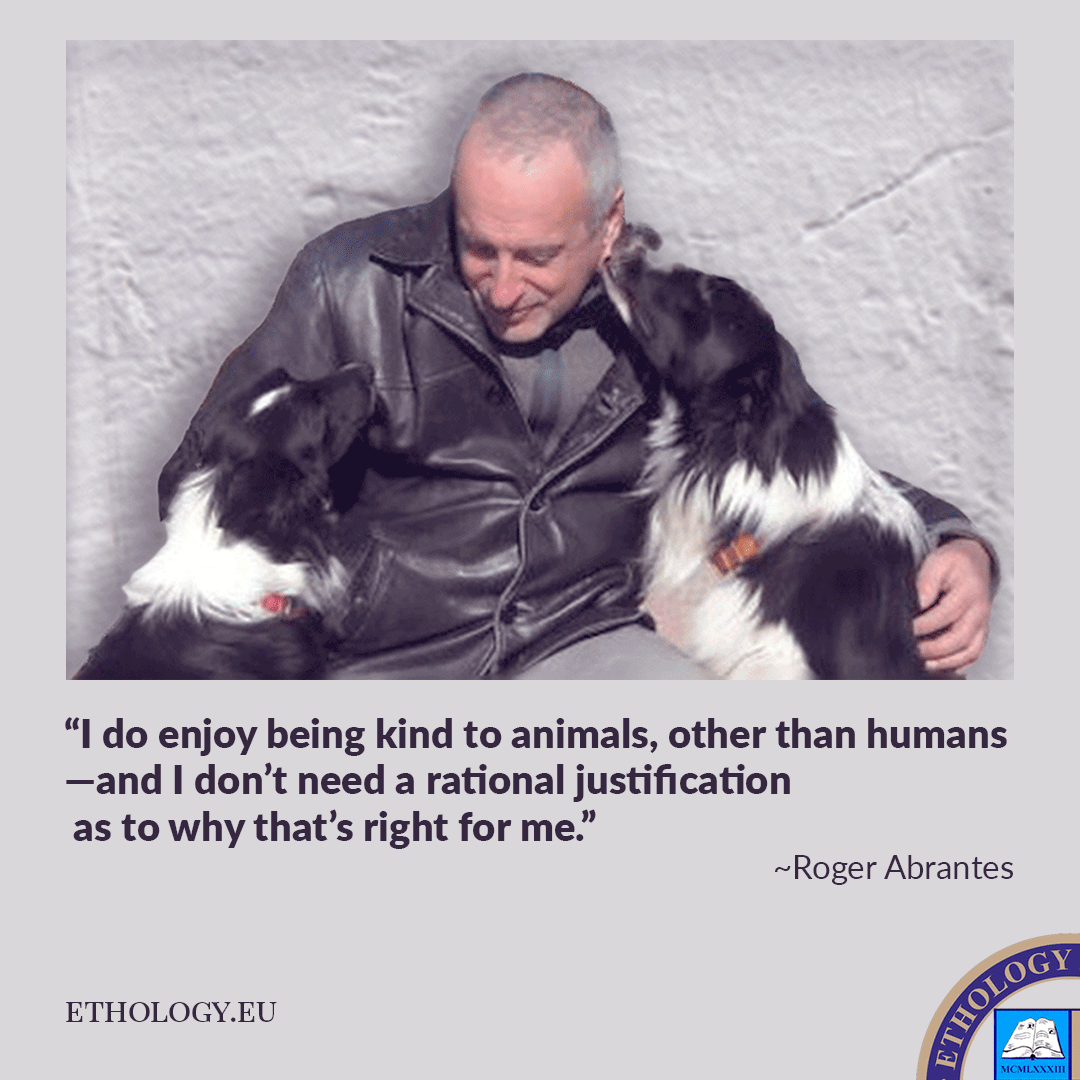
I do enjoy being kind to animals, other than humans—and I don’t need a rational justification as to why that feels right for me. I respect them for what they are and interact with them on equal terms. I don’t believe it is right to subjugate them to my will, to control them, to change them.

Yes, I do enjoy being kind to animals, as it brings a sense of harmony to my life. While I can’t force anyone to choose harmony or define it in a specific way, I can demonstrate how bullying does not lead to stability. Because of this, I find it difficult to argue with people who believe that bullying others—whether human or non-human—is acceptable. Nor can I argue with people who think it’s justifiable to hurt others in order to achieve their goals since I find such actions objectionable. I cannot discuss with people who deny or affirm a particular matter of fact to justify their moral decisions, because my mind rejects invalid, unsound arguments.

Morality and science are two separate disciplines. I may not like the conclusions and implications of some scientific studies, and I may even find their application to be immoral; yet, my responsibility as a scientist is to report findings objectively. Stating a fact does not oblige me to adopt any particular moral stance. While science does influence my perceptions, it does not dictate how I feel about that fact. Ultimately, my moral decisions are independent of scientific facts.

G. E. Moore coined the term naturalistic fallacy in 1903 in “Principia Ethica.” In 1739, David Hume described, in “A Treatise of Human Nature,” the ‘is-ought problem,’ also called ‘Hume’s Law’ or ‘Hume’s Guillotine.’ The ‘is-ought fallacy’ consists of deriving an ‘ought’ conclusion from an ‘is’ premise. We cannot deduct ‘ought’ from ‘is.’

As an ethologist, my focus is on understading what is, not what ought to be. Echoing Satoshi Kanazawa, if I conclude something that is not supported by evidence, I commit a logical fallacy, which I must correct, and that’s my problem. However, if my conclusion offends your beliefs, then that’s your problem.

With time, the rational principles that govern my mind and the ethical ones that regulate my conduct may or may not prove to be the fittest. Meanwhile, due to genetic pre-programming, social conditioning, and evolutionary biology, I do enjoy being kind to animals. I respect them for what they are and interact with them on equal terms—and I don’t need a rational justification as to why that feels right for me.

Featured image: I do enjoy being kind to other animals, respecting them for what they are and interacting with them on equal terms.

I’m a Citizen of the World

childdogcatwide-1

I’m a citizen of the World,” I say when asked where I come from—and I am, in mind and heart.

Diogenes, in about 412 BC, was probably the first to use the expression and express the very same sentiment. Socrates (469-399 BC) concurred: “I am not an Athenian or a Greek, but a citizen of the world.” Kaniyan Poongundran, the Tamil poet, wrote (at least 2000 years ago), “To us all towns are one, all men our kin.” Thomas Paine (English-American philosopher, 1737 – 1809), said, “The world is my country, all mankind are my brethren and to do good is my religion.” Albert Einstein (1879-1955) thought of himself as a world citizen, “Nationalism is an infantile disease. It is the measles of mankind.”

I’m a citizen of the world. I’ve traveled over most of our beautiful planet, seen mountains above the clouds with perennial snow tops, and oceans reaching far beyond the eye can see. I’ve lived in temperatures from 40ºC below zero to 40ºC above. I’ve eaten all kinds of food prepared by humans and spent many a day and night enjoying the company of people with the most exceptional cultures and habits.

What’s my favorite place? I don’t have one. Everywhere I’ve been, I’ve discovered new pieces in this amazing puzzle of life. Everywhere I’ve been, from the most glamorous cities to the poorest war-torn areas, I’ve met kind and gentle people. I’ve shared water with the Maasai in the African desert and rice with the Chhetris in the Nepalese mountains. With all of them, I felt a strong kinship: no country, no culture, no language, no divide—we were family, we were humans, we were sentient living beings. Yes, I’m a citizen of the world.

Life is great!


Featured image: Everywhere I’ve been, I’ve discovered new pieces in this amazing puzzle of life.

Dog Training—Let Reason Prevail Over Force!

Roger Abrantes and Boxer doing retrieve

“Whether you (or I) follow a particular line of morality is not a necessary consequence of any model of social behavior. Moral stances are solely your (or my) decision” (Picture by Lisa J. Bains).

The dog trainers’ dispute about training methods blazes on unabated, with the erroneous and emotive use of terms such as dominance, punishment and leadership only adding fuel to the fire. There is no rational argumentation between the two main factions, one of which advocates a “naturalistic” approach and the other a “moralistic” stance. The term ‘dominance’ generates particular controversy and is often misinterpreted. We can detect, in the line of arguing about this topic, the same fundamental mistakes committed in many other discussions. By taking the controversy over dominant behavior as my example, I shall attempt to put an end to the feud by proving that neither side is right and by presenting a solution to the problem. Plus ratio quam vis—let reason prevail over force!

I shall demonstrate that the dispute is caused by:

(1) Blurring the boundaries between science and ethics. While ethics and morality deal with normative statements, science deals with factual, descriptive statements. Scientific statements are not morally right or wrong, good or bad.

(2) Unclear definitions. We cannot have a rational discussion without clear definitions of the terms used. Both sides in the dispute use unclear, incomplete definitions or none at all.

(3) Logical fallacies. The opposing sides commit either the ‘naturalistic fallacy,’ ‘the moralistic fallacy,’ or both. We cannot glean normative statements from descriptive premises, nor can we deduce facts from norms. The fact that something is does not imply that it ought to be; conversely, just because something ought to be does not mean that it is.

(4) Social conditioning and emotional load. As a result of inevitable social conditioning and emotional load, some terms develop connotations that can affect whether we like or dislike, accept or reject them, independent of their true meaning.

(5) Unclear grammar. The term dominance (an abstract noun) leads us to believe it is a characteristic of certain individuals, not an attribute of behavior. The correct use of the term in the behavioral sciences is as an adjective to describe a behavior, hence dominant behavior.

Bottom line: We need to define terms clearly and use them consistently; otherwise rational discussion is not possible. We must separate descriptive and normative statements, as we cannot derive what is from what ought to be or vice versa. Therefore, we cannot use the scientific concept of dominant behavior (or any descriptive statement) to validate an ethical principle. Our morality, what we think is right or wrong, is a personal choice; what is, or is not, is independent of our beliefs and wishes (we don’t have a choice).

Solution to the problem: The present dispute focuses on whether we believe it is right or wrong to dominate others (as in, totally control, have mastery over, command). It is a discussion of how to achieve a particular goal, about means and ends. It is a moral dispute, not a scientific quest. If both sides have similar goals in training their dogs, one way of settling the dispute is to prove that one strategy is more efficient than the other. If they are equally efficient, the dispute concerns the acceptability of the means. However, if either side has different goals, it is impossible to compare strategies.

My own solution of the problem: I cannot argue with people who believe it is right to dominate others (including non-human animals) as, even though I can illustrate how dominating others does not lead to harmony, I can’t make anyone choose harmony or define it in a particular way. I cannot argue with people who think it acceptable to hurt others in order to achieve their goals because such means are inadmissible to me. I cannot argue with people who deny or affirm a particular matter of fact as a means of justifying their moral conduct, because my mind rejects invalid, unsound arguments. With time, the rational principles that govern my mind and the moral principles that regulate my conduct may prove to be the fittest. Meanwhile, as a result of genetic pre-programming, social conditioning and evolutionary biology, I do enjoy being kind to other animals, respecting them for what they are and interacting with them on equal terms; I don’t believe it is right to subjugate them to my will, to command them, to change them; and I don’t need a rational justification as to why that’s right for me*.

Roger Abrantes and Bulldog

“I do enjoy being kind to other animals, respecting them for what they are and interacting with them on equal premises; I don’t find it right to subjugate them to my will and dispositions, to command them, to change them; and I don’t need a rational justification for why that’s right for me” (Picture by Lisa J. Bain).

Argument

1 Science and ethics are not the same

Science is a collection of coherent, useful and probable predictions. All science is reductionist and visionary in a sense, but that does not mean that all reductionism is equally useful or that all visions are equally valuable or that one far-out idea is as acceptable as any other. Greedy reductionism is bound to fail because it attempts to explain too much with too little, classifying processes too crudely, overlooking relevant detail and missing pertinent evidence. Science sets up rational, reasonable, credible, useful and usable explanations based on empirical evidence, which is not connected per se. Any connections are made via our scientific models, ultimately allowing us to make reliable and educated predictions. A scientist needs to have an imaginative mind in order to think the unthinkable, discover the unknown and formulate initially far-fetched but verifiable hypotheses that may provide new and unique insights; as Kierkegaard writes, “This, then, is the ultimate paradox of thought: to want to discover something that thought itself cannot think.”

There are five legitimate criteria when evaluating a scientific theory or model: (1) evidence, (2) logic, (3) compatibility, (4) progression, and (5) flexibility.

(1)  Evidence: a scientific theory or model must be based on credible and objective evidence. If there is credible evidence against it, we dismiss it. It must be testable and falsifiable.

(2)  Logic: If a theory or model is based on logically invalid arguments or its conclusion are logically unsound, e.g. drawing valid conclusions from false premises, we must also dismiss it.

(3)  Compatibility:  If a theory or model shows crucial incompatibility with the whole body of science, then it is probably incorrect. If it is incompatible with another model, then we have a paradox. Paradoxes are not to be discarded, instead worked on and solved (or not solved as the case may be). Since “Paradoxes do not exist in reality, only in our current models of reality,  […] they point the way to flaws in our current models. They therefore also point the way to further research to improve those models, fix errors, or fill in missing pieces.” In short, “scientists love paradoxes,” in the words of Novella.

(4)  Progression: A scientific theory or model must explain everything that has already been explained by earlier theories, whilst adding new information, or explaining it in simpler terms.

(5)  Flexibility: A theory or model must be able to accept new data and be corrected. If it doesn’t, then it is a dogma, not a scientific theory. A dogma is a belief accepted by a group as incontrovertibly true.

Science provides facts and uncovers important relationships between these facts. Science does not tell us how we should behave or what we ought to do. Science is descriptive, not normative. In other words: we decide what is right or wrong, good or bad, not necessarily depending on what science tells us.

Morality and science are two separate disciplines. I may not like the conclusions and implications of some scientific studies, I may even find their application immoral; yet, my job as a scientist is to report my findings objectively. Reporting facts does not oblige me to adopt any particular moral stance. The way I feel about a fact is not constrained by what science tells me. I may be influenced by it but, ultimately, my moral decision is independent of scientific fact. Science tells me men and women are biologically different in some aspects, but it does not tell me whether or not they should be treated equally in the eyes of the law. Science tells me that evolution is based on the algorithm “the survival of the fittest,” not whether or not I should help those that find it difficult to fit into their environment. Science informs me of the pros and cons of eating animal products, but it does not tell me whether it is right or wrong to be a vegetarian.

Ethologists study behavior on a biological and evolutionary basis, define the terms they use, find causal relationships, construct models for the understanding of behavior and report their findings. Ethologists are not concerned with morality. They simply inform us that the function of x behavior is y. They don’t tell us that because animal x does y, then y is right or wrong, good or bad, or that we ought or ought not do y.

The model I present in “Dominance—Making Sense of the Nonsense” is a scientific model that complies with all five of the requirements listed above.

(1)  It is based on overwhelming data, i.e. given my definition of ‘dominant behavior,’ one cannot argue that it does not exist.

(2)  The conclusions are logically consistent with the premises.

(3)  It is consistent with our body of knowledge, particularly in the fields of biology and evolutionary theory.

(4)  It explains what has been explained before and in more carefully defined terms.

(5)  It accepts new data, adjustments and corrections (the current version is an updated version of my original from 1986). The model tells us nothing about morality. No single passage suggests that we should classify any particular relationship with our dogs as morally right or wrong. You will have to decide that for yourself. As an ethologist, I’m not concerned with what ought to be, only with what is. Echoing Satoshi Kanazawa, if I conclude something that is not supported by evidence, I commit a logical fallacy, which I must correct, and that’s my problem, but if my conclusion offends your beliefs, then that’s your problem.

Therefore, whether you (or I) follow a particular line of morality is not a consequence of any model of social behavior. Moral stances are solely your (or my) decision. It is not correct to draw normative judgments from descriptive claims. If you do so, you either commit the ‘naturalistic fallacy,’ the ‘moralistic fallacy’ or both, as I shall explain below (see point 3).

2 Unclear definitions

Having just pointed out the rigors of science, I must concede that the scientific community does bear some responsibility for the present dispute in as much as definitions and use of terms have sometimes been sloppy. Some researchers use particular terms (in this case ‘dominance’) without defining them properly and with slightly different implications from paper to paper.

Wikipedia writes: “Dominance (ethology) can be defined as an ‘individual’s preferential access to resources over another’ (Bland 2002). Dominance in the context of biology and anthropology is the state of having high social status relative to one or more other individuals, who react submissively to dominant individuals. This enables the dominant individual to obtain access to resources such as food or access to potential mates, at the expense of the submissive individual, without active aggression. The opposite of dominance is submissiveness. […] In animal societies, dominance is typically variable across time, […] across space […] or across resources. Even with these factors held constant, perfect dominant hierarchies are rarely found in groups of any size” (Rowell 1974 and Lorenz 1963).

It explains a dominance hierarchy as follows: “Individuals with greater hierarchical status tend to displace those ranked lower from access to space, to food and to mating opportunities. […] These hierarchies are not fixed and depend on any number of changing factors, among them are age, gender, body size, intelligence, and aggressiveness.”

Firstly, defining ‘dominance’ instead of ‘dominant behavior’ seems somewhat imprudent for a science that is intrinsically based on observational facts. It suggests we are dealing with an abstract quality when in fact we are referring to observable behavior (see point 5 below). Secondly, it implicitly equates ‘dominance’ with hierarchy (social status), which is misleading because some hierarchies may be supported by conditions other than dominant behavior. The use of the term ‘dominance hierarchy’ creates a false belief. Clearly, the terms dominance and dominant behavior are attributed with varying meanings, a highly unadvisable practice, particularly in stringently scientific matters.

As John Locke wrote in 1690 (An Essay Concerning Human Understanding),  “The multiplication and obstinacy of disputes, which have so laid waste the intellectual world, is owing to nothing more than to this ill use of words. For though it be generally believed that there is great diversity of opinions in the volumes and variety of controversies the world is distracted with; yet the most I can find that the contending learned men of different parties do, in their arguings one with another, is, that they speak different languages. ”This has contributed […] to perplex the signification of words, more than to discover the knowledge and truth of things.”

To remedy this, I propose in “Dominance—Making Sense of the Nonsense” a set of carefully constructed definitions that are compatible with behavioral science and evolutionary theory, whilst paying special attention to the logical validity and consistency of the arguments. I’m convinced that we would avoid many pointless disputes if all those dealing with the behavioral sciences were to adopt such definitions.

Roughly speaking, there are currently two main schools of thought in dog training. For our present purpose, we shall call them ‘Naturalistic Dog Training’ and ‘Moralistic Dog Training.’ Of course, there are various other stances in between these two extremes, including a significantly large group of bewildered dog owners who do not adhere to any particular ideology, not knowing which way to turn.

Naturalistic Dog Training (aka the old school) claims their training echoes the dog’s natural behavior. They don’t provide a proper definition of dominance, but use it with connotations of ‘leader,’ ‘boss,’ ‘rank,’ implying that dominance is a characteristic of an individual, not of a behavior. In their eyes, some dogs are born dominant, others submissive, but all dogs need to be dominated because their very nature is to dominate or be dominated. They use this belief to justify their training methods that often involve punishment, flooding, coercion, and even shock collars, if deemed necessary, by the more extreme factions. For them, a social hierarchy is based on (assertive) dominance and (calm) submission, the leader being the most dominant. Their willingness to accept the existence of dominant behavior is motivated by their desire to validate their training theories, but their interpretation of the term is far from what ethologists understand by it.

Moralistic Dog Training (aka positive reinforcement training) distances itself from punishment, dominance, and leadership. They don’t define ‘dominance’ properly either, but use it with connotations of ‘punishment,’  ‘aggression,’  ‘coercion,’  ‘imposition.’ They claim dominance does not exist and regard it as a mere construct of philosophers and ethologists aimed at justifying the human tendency to dominate others. Their view is that we should nurture our dogs as if they were part of our family and should not dominate them. Therefore, they also distance themselves from using and condoning the use of terms like ‘alpha,’  ‘leader’ and ‘pack.’ The more extreme factions claim to refrain from using any aversive or signal that might be slightly connected with an aversive (like the word ‘no’) and deny their using of punishers (which, given the consensually accepted scientific definition of punishment, is a logical impossibility). Their refusal to accept the existence of dominant behavior is motivated by their desire to validate their training morality, but their interpretation of the term is again far from what ethologists understand by it.

An ethological definition of ‘dominant behavior’ is (as I suggest in “Dominance—Making Sense of the Nonsense”): “Dominant behavior is a quantitative and quantifiable behavior displayed by an individual with the function of gaining or maintaining temporary access to a particular resource on a particular occasion, versus a particular opponent, without either party incurring injury. If any of the parties incur injury, then the behavior is aggressive and not dominant. Its quantitative characteristics range from slightly self-confident to overtly assertive.”

This is a descriptive statement, a classification of a class of behaviors, so we can distinguish it from other classes of behaviors, based on the observable function of behavior (according to evolutionary theory). It is clearly distinguishable from the statements of both opposing mainstream dog-training groups in that it does not include any normative guidance.

3 Logical fallacies

logical fallacy is unsound reasoning with untrue premises or an illogical conclusion. Logical fallacies are inherent in the logic structure or argumentation strategy and suit irrational desires rather than actual matters of fact.

An argument can be valid or invalid; and valid arguments can be sound or unsound. A deductive argument is valid if, and only if, the conclusion is entailed by the premises (it is a logical consequence of the premises). An argument is sound if, and only if, (1) the argument is valid and (2) all of its premises are true. The pure hypothetical syllogism is only valid if it has the following forms:

If P ⇒ Q and Q ⇒ R, then P ⇒ R

If P ⇒ ~R and ~R ⇒ ~Q, then P ⇒ ~Q

This mixed hypothetical syllogism has two valid forms, affirming the antecedent or “modus ponens” and denying the consequent or “modus tollens”:

If P ⇒ Q and P, then Q (modus ponens)

If P ⇒ Q and ~Q, then ~P (modus tollens)

It has two invalid forms (affirming the consequent and denying the antecedent).

The naturalistic fallacy is the mistake of identifying what is good with a natural property. In this fallacy, something considered natural is usually considered to be good, and something considered unnatural is regarded as bad. The structure of the argument is “P is natural, therefore P is moral” or “P is natural and non-P is unnatural, natural things are moral and unnatural things immoral, therefore P is moral and non-P immoral.” G. E. Moore coined the term naturalistic fallacy in 1903 in “Principia Ethica.” It is related to the ‘is-ought problem,’ also called ‘Hume’s Law’ or ‘Hume’s Guillotine,’ described for the first time by David Hume in 1739 in “A Treatise of Human Nature.” The ‘is-ought fallacy’ consists of deriving an ought conclusion from an is premise. The structure of the argument is “P is, what is ought to be, therefore P ought to be.”

The moralistic fallacy is the reverse of the naturalistic fallacy. It presumes that what ought to be preferable is what is, or what naturally occurs. In other words: what things should be is the way they are. E. C. Moore used the term for the first time in 1957 in “The Moralistic Fallacy.” The structure of the argument is, “P ought to be, therefore P is.”

Roger Abrantes and Shakira

“There is no evidence that dogs attempt to dominate others or that they don’t. On the contrary, all evidence suggests that dogs (as most animals) use different strategies depending on conditions including costs and benefits. Sometimes they display dominant behavior, other times they display submissive behavior, and yet other times they display some other behavior” Picture by (L’Art Au Poil École).

The line of argumentation of Naturalistic Dog Training is: Dogs naturally attempt to dominate others; therefore, we ought to dominate them. We can transcribe this argument in two ways (argument 1a and 1b):

Argument 1a

(A) If the nature of dogs is to attempt to dominate others, then I ought to train dogs according to their nature. (P⇒Q)

(B) It is the nature of dogs to attempt to dominate others. (P)

Therefore: I ought to train dogs by attempting to dominate them. (Q)

Argument 1b

(A) If dogs dominate others, then it’s right to dominate others. (P⇒Q)

(B) If it’s right to dominate others, then I have to do the same to be right. (Q⇒R)

Therefore: If dogs dominate others, then I have to do the same to be right. (P⇒R)

We cannot derive ‘ought’ from ‘is.’ Arguments 1a and 1b commit the ‘naturalistic fallacy.’ Both arguments seem formally valid, except that they derive a norm from a fact. There is no logical contradiction in stating, “I ought not to train dogs according to their nature.” They are also unsound (the conclusions are not correct) because premises P are not true.

There is no evidence that dogs attempt to dominate others or that they don’t. On the contrary, all evidence suggests that dogs (like most animals) use different strategies depending on conditions, which include costs and benefits. Sometimes they display dominant behavior, other times they display submissive behavior, and other times they display other behavior. Even when particular dogs are more prone to use one strategy rather than another, we are not entitled to conclude that this is the nature of dogs.

Conclusion: whether science proves that dogs display or don’t display dominant behavior has nothing to do with whether or not it is morally right for us to dominate our dogs.

The line of argumentation of Moralistic Dog Training is: We ought not to attempt to dominate our dogs; therefore, dogs do not attempt to dominate us. We can transcribe this argument in two ways (argument 2a and 2b):

Argument 2a

(A) Dominance is bad. (P⇒Q)

(B) Dogs are not bad. (R⇒~Q)

Therefore: Dogs do not dominate. (R⇒~P)

Argument 2b

(A) If [dominance exists], it is . (P⇒Q)

(B) If it is , [dogs don’t do it]. (Q⇒R)

Therefore: if [dominance exists], [dogs don’t do it]. (P⇒R)

We cannot derive ‘is’ from ‘ought.’ Arguments 2a and 2b commit the ‘moralistic fallacy.’ Argument 2a is formally invalid even if the premises were true because the conclusion is not entailed in the premises (it is the same as saying red is a color, blood is not a color, so blood is not red). Argument 2b sounds a bit odd (in this form), but it is the only way I have found of formulating a valid argument from the moralistic trainers’ argument. It is formally valid but it is unsound because it commits the moralistic fallacy: in its second line, it derives a fact from a norm. It assumes that nature doesn’t do wrong (or what is good is natural), but there is no contradiction in assuming the opposite.

Conclusion: the fact we believe it is morally wrong to dominate our dogs does not mean that dogs do not display dominant behavior. We are entitled to hold such a view, but it does not change the fact that dogs display dominant behavior.

4 Social conditioning and emotional load

The choice of word by ethologists to coin the behavior in English, i.e. ‘dominant,’ also contributes to the dispute. Curiously enough, the problem does not exist in German where dominant and submissive behaviors are ‘überlegenes verhalten’ and ‘unterlegenes verhalten.’

All words we use have connotations due to accidental social conditioning and emotional load. A scientist knows he** cannot afford his judgment to be clouded by his own accidental social conditioning or emotions. A defined term means that and only that. It’s not good, not bad, not right, not wrong, and the issue of whether he likes it or not does not even enter the equation. As an individual he may have his own personal opinion and moral viewpoint, but he does not allow them to affect his scientific work. As individuals, we all have our own likes and dislikes because we are constantly being conditioned by our environment. Culture, trends, movements, environments, relationships and moods, all bias our attitudes towards particular terms. Nowadays, for reasons I will leave to historians and sociologists to analyze, the words ‘dominance’ and ‘submission’ have negative connotations for many people. When people, all of whom are subject to social conditioning, fail to distinguish between the scientific meaning of the words and their everyday connotations, they repudiate them, which is understandable.

Conclusion: a class of behavior that animals use to solve conflicts without harming one another is what ethologists call dominant and submissive behavior. This behavior, in the way I describe and define, exists (see above). You may not like the terms or indeed the behaviors, but that doesn’t mean they don’t exist. ‘Red’ is a characteristic of an object that provides particular information to our eyes as a result of the way it reflects or emits light. We can argue (and we do) about the definition of ‘red,’ what is red, what is not, when it becomes orange, but we do not deny that red exists. You may object to the name ‘red’ but objects will continue to reflect or emit light in a particular way that produces what we call red (or whatever we choose to call it). A ‘red flower’ (or a display of ‘dominant behavior’) is not an abstract concept, but a real, detectable thing, whilst the concept of ‘redness’ is an abstract notion, as are the concepts of ‘dominance,’  ‘height,’  ‘weight,’  ‘strength,’ etc…

5 Unclear grammar

Another problem is that we use the word dominance as a noun (an abstract noun in contrast to a concrete noun) when in this case it is (or should be) a ‘disguised adjective.’ Adjectives don’t make sense without nouns (except for adjectival nouns). Dominance is an abstract noun, something that by definition does not exist (otherwise it wouldn’t be abstract), except as an abstract notion of ‘showing dominant behavior’ and as in ‘dominant allele,’  ‘dominant trait,’  ‘dominant ideology,’ ‘dominant eye,’ etc. However, the behavior of alleles, traits, ideologies and eyes, which we call dominant or classify as dominant, exists. For example, the question “Do dogs show dominance towards humans?” uses the abstract noun ‘dominance’ as an adjectival noun instead of the more correct ‘dominant behavior’. This can be confusing for some as it suggests that dominance is an intrinsic quality of the individual, not the behavior. Therefore, I suggest that, in the behavioral sciences, we henceforth drop the adjectival noun and only use the term as an adjective to behavior. This is a very important point and a source of many misunderstandings and misconceptions regarding the character of behavior.

Behavior is dynamic and changeable. An individual displays one behavior at one given moment and another a while later. The popular view maintains the notion of a ‘dominant individual’ as the one that always shows dominant behavior and the ‘submissive individual’ as the one that always shows submissive behavior, which is not true. Dominant and submissive (dominance and submission) are characteristics of behavior, not individuals. Individuals may and do change strategies according to a particular set of conditions, although they may exhibit a preference for one strategy rather than another.

It is the ability to adopt the most beneficial strategy in the prevailing conditions that ultimately sorts the fittest from the less fit—moral strategies included.

Have a great day,

R

______________

* This is my normative judgment and as such no one can contest it.

** The most correct form would be ‘he/she,’ or ‘he or she,’ but since I find it extremely ugly from a linguistic point of view (my normative judgment) to use this expression repeatedly, I chose to write, ‘he’ though not by any means neglecting the invaluable and indisputable contribution of my female colleagues.

References

  • Abrantes, R. 1986. The Expression of Emotions in Man And Canid. Waltham Symposium, Cambridge, 14th-15th July 1986.
  • Abrantes, R. 1997. The Evolution of Canine Social Behavior. Wakan-Tanka Publishers (2nd ed.  2005).
  • Abrantes, R. 2011. Dominance—Making Sense Of The Nonsense.
  • Ayer, A. J. 1972. Probability and Evidence. Macmillan, London.
  • Bekoff, M. & Parker, J. 2010. Wild Justice: The Moral Lives of Animals. Univ. Of Chicago Press.
  • Bland J. 2002 About Gender: Dominance and Male Behaviour.
  • Copi, I. M. and Cohen, C. 1990. Introduction to Logic (8th ed.). Macmillan.
  • Dennet, D. 1996. Darwin’s Dangerous Idea: Evolution and the Meanings of Life. Simon & Schuster.
  • Dennet, D. 2003. Freedom Evolves. Viking Press 2003.
  • Futuyma, D. J. 1979. Evolutionary Biology. Sinauer Assoc.
  • Galef, J. 2010. Hume’s Guillotine.
  • Hewitt, S. E., Macdonald, D. W., & Dugdale, H. L. 2009. Context-dependent linear dominance hierarchies in social groups of European badgers, Meles melesAnimal Behaviour, 77, 161-169.
  • Hume, D. 1739. A Treatise of Human Nature. Oxford University Press, Oxford, 1967, edition.
  • Locke, J. 1690. An Essay Concerning Human Understanding
  • Kanazawa, S. 2008. Two Logical Fallacies That We Must Avoid.
  • Kierkegaard, S. 1844. Philosophiske Smuler eller En Smule Philosophi (Philosophical Fragments). Samlede Værker, Nordisk Forlag, 1936.
  • Lorenz, K. 1963. Das sogenannte Böse. Zur Naturgeschichte der Aggression. Wien, Borotha-Schoeler Verlag, 1969.
  • Moore, E. C. 1957. The Moralistic Fallacy. The Journal of Philosophy 54 (2).
  • Moore, G. E. 1903. Principia Ethica.
  • Novella, S. 2012. The Paradox Paradox.
  • Pinker, S. How the Mind Works. New York: W. W. Norton & Company, 1997.
  • Popper, K. 1963. Conjectures and Refutations.  Routledge and Kegan Paul, London, UK.
  • Popper, K. Objective Knowledge: An Evolutionary Approach. Oxford University Press.
  • Rachels, J. 1990. Created From Animals. Oxford University Press.
  • Rowell, T. E. 1974. The Concept of Social Dominance. Behavioral Biology, 11, 131-154.
  • Ruse, M. 1986. Taking Darwin seriously: a naturalistic approach to philosophy. Prometheus Books.

Thanks to Anabela Pinto-Poulton (PhD, Biology), Simon Gadbois (PhD, Biology), Stéphane Frevent (PhD, Philosophy), Victor Ross (Graduate Animal Trainer EIC), Parichart Abrantes (MBA), and Anna Holloway (editor) for their suggestions to improve this article. The remaining flaws are mine, not theirs.