(First published April 13, 2014, edited February 26, 2018)
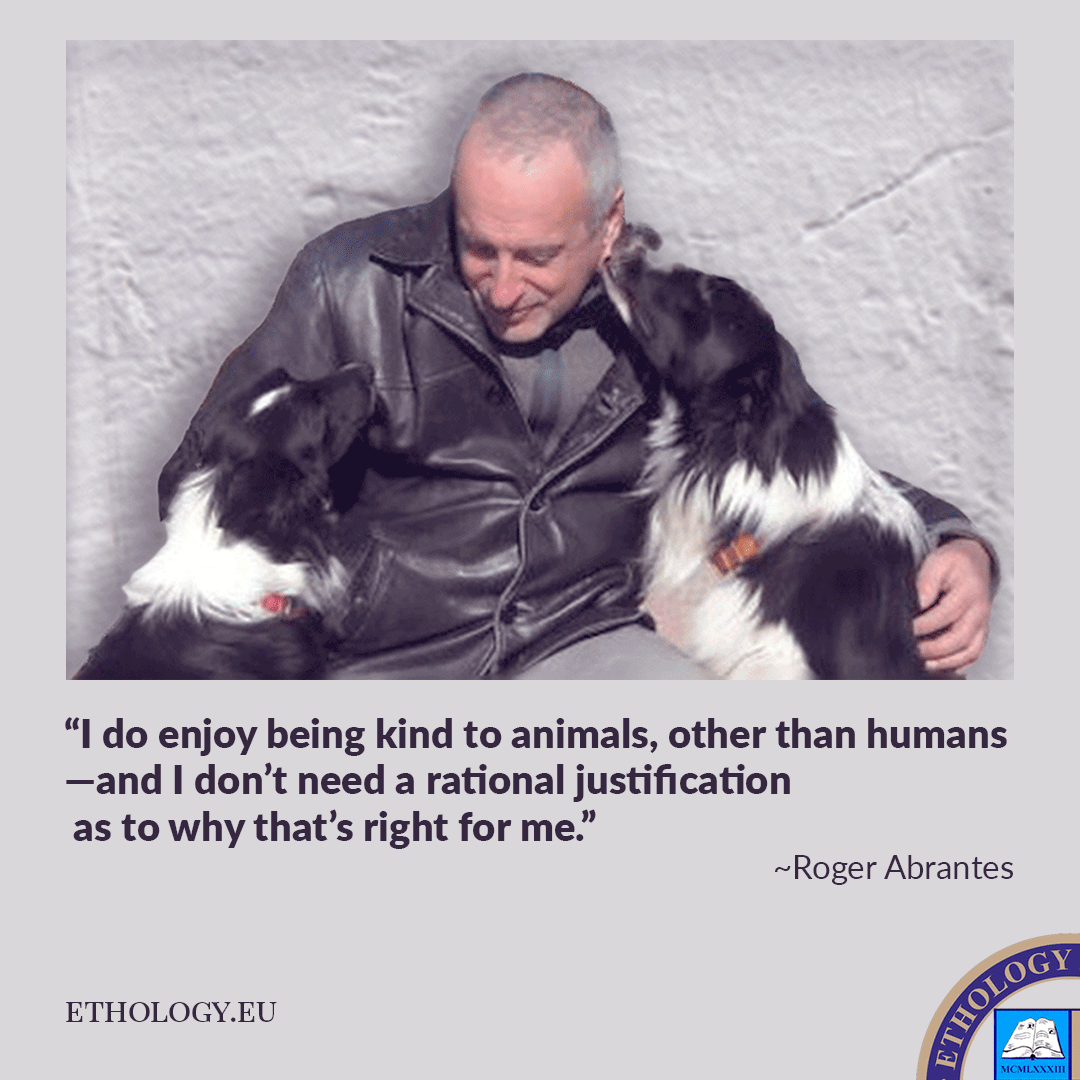
I do enjoy being kind to animals, other than humans—and I don’t need a rational justification as to why that feels right for me. I respect them for what they are and interact with them on equal terms. I don’t believe it is right to subjugate them to my will, to control them, to change them.
Yes, I do enjoy being kind to animals, as it brings a sense of harmony to my life. While I can’t force anyone to choose harmony or define it in a specific way, I can demonstrate how bullying does not lead to stability. Because of this, I find it difficult to argue with people who believe that bullying others—whether human or non-human—is acceptable. Nor can I argue with people who think it’s justifiable to hurt others in order to achieve their goals since I find such actions objectionable. I cannot discuss with people who deny or affirm a particular matter of fact to justify their moral decisions, because my mind rejects invalid, unsound arguments.
Morality and science are two separate disciplines. I may not like the conclusions and implications of some scientific studies, and I may even find their application to be immoral; yet, my responsibility as a scientist is to report findings objectively. Stating a fact does not oblige me to adopt any particular moral stance. While science does influence my perceptions, it does not dictate how I feel about that fact. Ultimately, my moral decisions are independent of scientific facts.
G. E. Moore coined the term naturalistic fallacy in 1903 in “Principia Ethica.” In 1739, David Hume described, in “A Treatise of Human Nature,” the ‘is-ought problem,’ also called ‘Hume’s Law’ or ‘Hume’s Guillotine.’ The ‘is-ought fallacy’ consists of deriving an ‘ought’ conclusion from an ‘is’ premise. We cannot deduct ‘ought’ from ‘is.’
As an ethologist, my focus is on understading what is, not what ought to be. Echoing Satoshi Kanazawa, if I conclude something that is not supported by evidence, I commit a logical fallacy, which I must correct, and that’s my problem. However, if my conclusion offends your beliefs, then that’s your problem.
With time, the rational principles that govern my mind and the ethical ones that regulate my conduct may or may not prove to be the fittest. Meanwhile, due to genetic pre-programming, social conditioning, and evolutionary biology, I do enjoy being kind to animals. I respect them for what they are and interact with them on equal terms—and I don’t need a rational justification as to why that feels right for me.
Featured image: I do enjoy being kind to other animals, respecting them for what they are and interacting with them on equal terms.


 Roger Abrantes