
Do dogs see colors? Does that affect our dog training in any way?
In the early 1980s, we conducted tests at the Ethology Institute to determine whether dogs were colorblind, as popular opinion held. The conclusion of our experiments was that they could distinguish some colors but could not discriminate others. They were not completely color blind (seeing only shades of gray). They were more like some people who see colors, though not the whole spectrum. However, at the time, we could not determine whether the dogs’ color discrimination was due to distinguishing between real colors or to distinguishing between various shades of gray. Meanwhile, more modern research has cast some light on these questions.
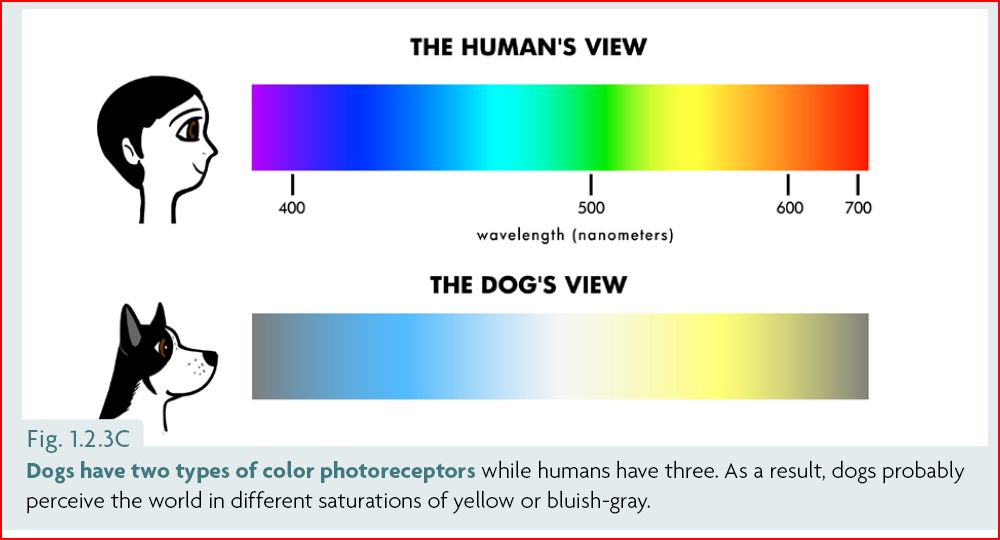
Eyes contain light-catching cells (cones) that respond to color. Canines have fewer cones than humans, which implies that, in principle, their color vision cannot be as good as ours. To see colors, we need different types of cones that detect different wavelengths of light. We have three types of cones, which allow us to register the full range of color vision. Dogs, in contrast, have only two types of cones.
Researchers at the University of California, Santa Barbara, tested dogs’ color vision in the late 1980s. Their studies confirm that dogs see color, though not as well differentiated as humans do. For us, the rainbow looks violet, blue, blue-green, green, yellow, orange, and red. For a dog, we presume it looks dark blue, light blue, gray, light yellow, darker yellow, and very dark gray. Violet and blue are both perceived largely within the blue range (Neitz, Geist, & Jacobs, 1989).
Studies performed by Russian scientists demonstrated that dogs tend to discriminate real color rather than brightness cues (Kasparson, Badridze & Maximov, 2013). They match any color they register with no more than two pure spectral lights.
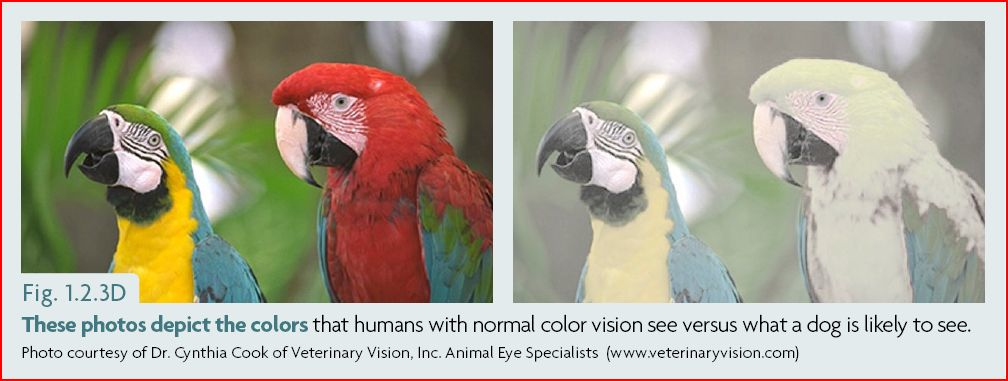
Dogs are dichromatic, as are most placental mammals. The ability to see long wavelengths necessary to distinguish red from green seems to have disappeared during evolution, probably during early mammalian evolution in the Mesozoic, likely under strong nocturnal selection pressures (Jacobs, 2009). Dichromatic vision, though, is good at distinguishing colors in dim light, favoring the most nocturnal animals.
Trichromats, like most humans, have three color-detecting cones (blue, green, and red) and can distinguish a vastly expanded range of color discriminations compared with dichromats. Trichromacy in humans is not ancestral to mammals. It is a derived re-evolution in Old World primates, an adaptation to a foraging ecology in which red–green discrimination provides a direct foraging advantage (Dulai et al., 1999). So human trichromacy is an exception produced by a very specific ecological niche, not the mammalian norm. Humans are visual outliers among mammals. When we treat human color perception as ‘normal,’ we are committing a deep phylogenetic bias.
Similar ecological pressures have shaped trichromatic vision independently in other, very distant lineages. The honeybee, Apis mellifera, is also trichromatic, seeing ultraviolet, blue, and green instead of blue, green, and red. Honeybee trichromacy is an adaptation shaped by the coevolution of pollinators and flowering plants, as many floral signals are specifically tuned to ultraviolet patterns invisible to human vision (Peitsch et al., 1992).

The term “colorblind” is therefore misleading. Dogs are not deficient humans—they retain the ancestral mammalian visual condition. Some animals developed the ability to see certain colors, and others to see others, all depending on ecological pressures, mutations, and the subsequent costs and benefits each strategy implied for their struggle for survival (Jacobs, 1993).
What does this mean for our communication and training of our dogs? Since dogs find it difficult to distinguish between certain reds and greens (like some humans do), we should choose toys and training aids in other colors. For example, light blue or yellow are much easier colors for a dog to detect (Neitz, Geist, & Jacobs, 1989). On the other hand, when training them in any scent-detection discipline (Gazit & Terkel, 2003; Horowitz, 2009), we should use colors for targets that are difficult for them to see to compel them to use their noses rather than their eyes.
Training an animal entails altering its behavior, a process that can profoundly affect the individual and, if misapplied, lead to unintended and undesirable side effects. It is therefore sound practice to examine how the animal perceives and interacts with its world, as well as the evolutionary mechanisms that have shaped both the species and the individual under consideration. In other words, we should strive to see the world through the animal’s eyes—however imperfect that vision of ours may be. Only then can training be both effective and respectful for the animal and for us.
References
Dulai, K. S., von Dornum, M., Mollon, J. D., & Hunt, D. M. (1999). The evolution of trichromatic colour vision by opsin gene duplication in New World and Old World primates. Genome Research, 9(7), 629–638. https://doi.org/10.1101/gr.9.7.629
Gazit, I., & Terkel, J. (2003). Domination of olfaction over vision in explosives detection by dogs. Applied Animal Behaviour Science, 82(1), 65–73. https://doi.org/10.1016/S0168-1591(03)00051-0
Horowitz, A. (2009). Inside of a dog: What dogs see, smell, and know. Scribner.
Jacobs, G. H. (1993). The distribution and nature of colour vision among the mammals. Biological Reviews, 68(3), 413–471. https://doi.org/10.1111/j.1469-185X.1993.tb00738.x
Kasparson, A. A., Badridze, J., & Maximov, V. V. (2013). Colour cues proved to be more informative for dogs than brightness. Proceedings of the Royal Society B, 280(1766), 20131356. https://doi.org/10.1098/rspb.2013.1356
Neitz, J., Geist, T., & Jacobs, G. H. (1989). Color vision in the dog. Visual Neuroscience, 3(2), 119–125. https://doi.org/10.1017/S0952523800004430
Peitsch, D., Fietz, A., Hertel, H., de Souza, J., Ventura, D. F., & Menzel, R. (1992). The spectral input systems of hymenopteran insects and their receptor-based colour vision. Journal of Comparative Physiology A, 170, 23–40. https://doi.org/10.1007/BF00190398
_________________
Featured image: Since dogs find it difficult to distinguish between certain reds and greens (like some humans do), we should choose toys and training aids in other colors (photo by Oleghz). Other illustrations from Dr. Cynthia Cook of Veterinary Vision Inc.

 Roger Abrantes