Muzzle Grasp Behavior in Canids

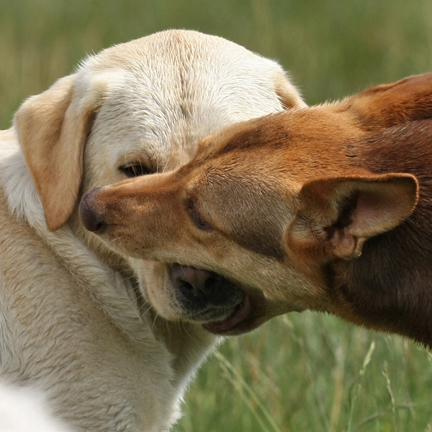
Dog muzzle grab.
Dogs also exhibit the muzzle grasp behavior (photo by Marco de Kloet).

A “Muzzle grasp” (or muzzle grab) is a common behavior shown by social canines, e.g., wolves (Canis lupus lupus), dingoes (Canis lupus dingo), and dogs (Canis lupus familiaris)The primary function of this behavior is to confirm a relationship rather than to settle a dispute. The more self-confident or higher-ranking individual will muzzle-grasp a more insecure or lower-ranking partner to assert its social position. The more insecure individual does not resist the grasp; on the contrary, it often displays submissive behavior, literally inviting its partner to muzzle-grasp it. Even though we sometimes see this behavior at the end of a dispute, wolves and dogs only use it toward individuals they know well—pack members—as a kind of saying, “You’re still a cub (pup).” The dispute itself tends not to be serious, merely a low-key challenge, often over access to a resource. Youngsters, cubs, and pups sometimes solicit adults to muzzle-grasp them. This behavior appears reassuring to them.

The muzzle-grasp behavior emerges early in development. Canine mothers muzzle-grasp their puppies (sometimes accompanied by a growl) to deter them from suckling during weaning. Field observations confirm this mechanism. As Packard, Mech, and Ream (1992, p. 1274) report, “In the context of playing, begging, and sharing, pups did not leave when another wolf muzzled, snapped, or lunged. In contrast, the muzzling by the nurser in the context of suckling terminated the pups’ attempts to gain access to nipples.” This observation illustrates the early communicative value of the muzzle contact as both a mild inhibitory and relational signal. Cubs and pups also muzzle-grasp one another during play, typically between six and nine weeks of age. They probably learn through play that the muzzle-grasp is an effective way of stopping an opponent from doing something, while also learning bite inhibition. If they bite too hard, they elicit a fight and risk injury. A muzzle-grasp, therefore, does not involve biting, only grasping. This behavior helps develop a relationship of trust between both parties—“we don’t hurt one another.”

Similar tactile interactions, including muzzle-to-muzzle contact, also occur in post-conflict and affiliative contexts among wolves. Cordoni and Palagi (2019) describe reciprocal muzzle-licking between adults and immature pack members following mild conflicts—acts that function as “consolation” and reinforce social bonds. Although a muzzle-grasp differs mechanically from muzzle-licking, both share an underlying functional value: the restoration or affirmation of trust within a dyad. These tactile gestures exemplify the nuanced physical vocabulary through which canids maintain cohesion and mitigate tension within the pack.

Classic naturalist observations (Zimen, 1981) describe frequent muzzle-to-muzzle contacts and note adults seizing pups’ muzzles during play and weaning; together with quantitative field data (Packard, Mech, & Ream, 1992), this supports the view that muzzle contact is an early-emerging, ritualised tactile signal rather than an aggressive act.

When used to settle a dispute, a muzzle-grasp may appear more violent and usually ends with the individual being muzzle-grasped exhibiting passive, submissive behavior. Yet participants very seldom, if ever, get hurt, an occurrence that would undermine the behavior’s function.
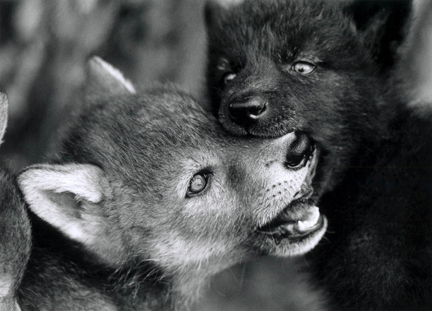
wolf cubs muzzle grasp
Wolf Adult Muzzle Grasp

Left: Cubs and pups muzzle grasp one another during play. Right: Muzzle grasp in adult wolves (photos by Monty Sloan).

A muzzle-grasp requires self-control. Higher-ranking wolves and dogs muzzle-grasp their pack members (teammates) and, by doing so, confirm their rank while displaying restraint. Lower-ranking wolves and dogs often engage in muzzle-grasping behavior to affirm their social position and reassure themselves that they remain included in the group.

The muzzle-grasp behavior probably originated as both a form of maternal (and later paternal) control and as a play behavior among cubs. As it appears to have been beneficial to all parties involved, it may have become a factor favored by natural selection, spreading from generation to generation and evolving as any other trait that enhances the fitness of individuals within cohesive social groups.

In domestic dogs, when puppies are about five to seven weeks old, their mother regularly muzzle-grasps them to deter suckling. At first, her behavior frightens them, and they may whimper excessively, even though she does not harm them. Later, when grasped by the muzzle, the puppy immediately shows passive submissive behavior—lying on its back and exposing its ventral side. Previously, it was assumed that the mother needed to pin the puppy to the ground; however, Packard et al. (1992) observed that, in wolves, in practice, “[…] on the occasions when the nurser winced or muzzled the pups, the pups did not persist” and that “[…] counter-tactics for overcoming nurser rejection did not occur (pp. 1271–1272).” Most puppies submit voluntarily. Over time, this behavior pattern assumes variations. Wolf cubs and puppies often invite the alpha male (the leader of the pack and, in wolves, usually their father) as well as other adults to grasp them by the muzzle, thereby soliciting a demonstration of their elders’ superiority and self-control while simultaneously showing their own acceptance and submissiveness. This is among the most reassuring behaviors an adult can show a youngster.

Domestic dogs sometimes approach their owners puffing gently with their noses. By gently placing a hand around their muzzle, we may reassure them of acceptance, demonstrate self-control, and convey that they can trust us. That is speaking dog-language to the best of our abilities. After being muzzle-grasped for a while, the dog will usually show a nose-lick, perhaps yawn, and then walk calmly away. It is as if the dog were saying, “I’m still your puppy,” and the owner replied, “I know—and I’ll take good care of you.”

The muzzle-grasp behavior can be challenging to classify. Some researchers see it as social or affiliative, others as agonistic, and still others as pacifying. Because its primary function is to confirm and maintain relationships, it may best be considered a social behavior—a ritualized, low-intensity interaction that reinforces trust and cohesion within the group.

Next time your dog gently nudges or invites a muzzle‑grasp, pause for a moment—what you see as a simple dog behavior is, in canine language, a subtle conversation of trust and understanding.

References

Abrantes, R. (1987). Hundesprog. Borgen Forlag, Copenhagen.

Abrantes, R. (1997). The Evolution of Canine Social Behavior. Naperville, IL: Wakan Tanka Publishers.

Abrantes, R. (2011, December 11). Dominance—Making sense of the nonsense. Roger Abrantes Blog. https://rogerabrantes.wordpress.com/2011/12/11/dominance-making-sense-of-the-nonsense/

Cordoni, G., & Palagi, E. (2019). Back to the future: A glance over wolf social behavior to understand dog–human relationship. Animals, 9(11), 991. https://doi.org/10.3390/ani9110991

Packard, J. M., Mech, L. D., & Ream, R. R. (1992). Weaning in an Arctic wolf pack: Behavioral mechanisms. Canadian Journal of Zoology, 70(7), 1269–1275. https://doi.org/10.1139/z92-177. USGS+1 PDF (scanned article, pages shown above): https://www.wolf.org/wp-content/uploads/2013/09/172weaningarcticwolf.pdf

Zimen, E. (1981). The wolf: His place in the natural world. Souvenir Press Ltd. ISBN 9780285624115

Note: I first wrote about the muzzle grasp behavior in canids in my Danish book Hundesprog (1987), where I called it “mund om snuden,” which translates directly as “mouth around the snout.” This term became “muzzle grasp” in the first English edition of the book, titled Dog Language. I later wrote Muzzle Grab Behavior in Canids on April 25, 2012. Two years afterward, on March 13, 2014, I revised it as Canine Muzzle Grasp Behavior—Advanced Dog Language. True to my philosophy of updating articles and papers as new evidence emerges, I have once again revised this work. The latest version, published in November 2025, appears here under the title Muzzle Grasp Behavior in Canids.

Your Most Powerful Animal Training Tool

Roger Abrantes and wolf cub Silas in 1985.

Your most powerful animal training tool is yourself. The featured picture shows yours truly in 1985 with Silas, the wolf cub. Notice the whistle hanging around my neck. I used it to produce a sound as a conditioned positive reinforcer (yes, the precursor of the click sound from Karen Pryor’s clicker). Silas preferred, though, my personal verbal reinforcer (dygtig)* because I always associated it with friendly body language and facial expressions. Thus, ‘dygtig’ meant acceptance. For wolves, more sensitive to social situations than dogs, being accepted is the ultimate social reinforcer; for the cubs, it is vital.

These were the first observations leading me to suspect that verbal and mechanical conditioned positive reinforcers had different applications. Parts of the verbal reinforcer (the body language and facial expression) do not require conditioning. Therefore, I later coined the term semi-conditioned reinforcer.

I’ll say without hesitation that our most powerful animal training tool is ourselves. If we control ourselves, our body language, our facial expressions, and the little that we say, we’ll achieve what we pretend and more.

Interacting with someone is, after all, not merely conditioning a series of behaviors—it is creating a relationship.

* “Dygtig” [ˈdøgdi] is a Danish word that means “capable,” “skilled,” or “competent,” and can also mean “clever” depending on context. It is, apparently, a good sound as a reinforcer, as I discovered many years ago.

Featured image: Roger Abrantes in 1985 interacting with Silas, the wolf cub—creating a relationship.

The Wolf Within—The Truth About Why We Fear the Wolf

Wolf (dier) (soort is nog gewenst)

We never fought the wolf, never the enemy, we fought ourselves—and the enemy within us (Image via Wikipedia).

Our love-hate relationship with the wolf, the animal that shares 15 thousand years of common ancestry with man’s best friend, the dog, suggests a deep conflict, one that is well hidden and maybe closer to each of us than we dare to admit. Are we hiding a skeleton in the closet? Why do we take great pains to understand and be good to our dogs whilst we hunt the wolf mercilessly?

Back in time, there were no wolves or dogs, only Canis lupus perantiquus (my name), the common ancestor of Canis lupus lupus, Canis lupus familiars, and 37 other subspecies. Humans, by then Homo sapiens sapiens, developed, not surprisingly, a particularly healthy relationship with this Canis lupus perantiquus. Both shared common interests and humans were still just one of many species. The relationship was mutually beneficial and resulted in some humans favoring certain perantiquus and certain perantiquus finding human company particularly rewarding.

Natural selection favored the fittest and, as usual, species changed over the years. These changes can be so extensive that some species turn into new ones; others only into new subspecies. The Canis lupus perantiquus changed under selective pressure from humans and their environment and became Canis lupus familiaris. In a sense, we created this subspecies and all its variations to serve and protect us.

Some species react strongly to stimuli they have not experienced for thousands of years, the scent of a predator, for example. These alarming and life saving key stimuli remain in the species’ gene pool, a kind of genetic memory. It is very unlikely that our fear of wolves stems from this kind of genetic memory; if we were that afraid of the wolf, we would never have gotten as close to it as we did. Perhaps we were afraid of the wolf in primitive times, but thousands of years of living in close proximity and cooperating would have changed that, as the least fearful members of both species would have benefited from the other. In those days, we can presume that the wolves that were least afraid of humans and capable of cooperating had better chances of survival and propagation (and ultimately turned into dogs); and conversely, the humans that were least afraid of wolves and were better at cooperating were more successful hunters, therefore survived and propagated (and ultimately turned into dog owners). Our fear of the wolf makes no sense from an evolutionary perspective, but perhaps it does from a psychological one. After all, we seem to fear what most resembles us—the enemy within!

Our fear and hatred of the wolf began long after the domestication, when humans took the first steps to distance themselves from nature, to enslave and exploit it—it happened when we invented agriculture. In the beginning, there was no war, only small-scale feuds provoked by the occasional domestic animal being taken by a wolf. The large-scale extermination of the wolf is not due to a single factor, but to an intermingled combination of factors that include mythology, religious zeal, environmental changes economic incentives, and a deep psychological scar, as we shall see.

Mythology, such as Grimm’s fairytales and Aesop’s fables, evoke the wolf as evil, untrustworthy, conniving and cowardly, a greedy thief that will go to great lengths to devour a poor, little lamb, child or old person. Tales of werewolves also exacerbated our fear and hatred of the wolf.

Religious convictions support our hatred of the wolf. “Then God said, ‘Let us make man in our image, after our likeness; and let them have dominion over the fish of the sea, and over the birds of the air, and over the cattle, and over all the earth, and over every creeping thing that creeps upon the earth.'” (Genesis 1:26-29). European farmers and American settlers were devout Christians and they didn’t need a clearer incentive to declare war on all that crept upon the Earth. “Be fruitful and multiply, and fill the earth and subdue it; and have dominion over the fish of the sea and over the birds of the air and over every living thing that moves upon the earth.” (Genesis 1:26-29)—and the wolf became the ultimate target and symbol of their mission.

There is a clear association between the wolf and the wild, the wilderness and the untamed. As Burbank puts it, “The New World wilderness, where the Pilgrims found themselves, was a sinister adversary, home of tribal savages who practiced evil. The Puritans regarded the wilderness itself as a howling beast, a wolf inspired by the Devil. In their desolation, they sojourned and their journey reminded them that believers wandered in a world of sin, a spiritual wilderness replete with Godless enemies and insane beasts that wanted only to consume the righteous.” (Burbank 1990:80)

Farming and the keeping of domestic animals in enclosures combined with the decimation of the wolf’s natural prey, forced the wolf to get closer to human settlements and to feed upon the occasional livestock. Today, most wolves avoid livestock when they have enough wild prey, but the wolves of the 1800s faced extreme food shortages and preyed upon cattle and sheep. This wasn’t a problem for rich farmers and even the smaller family farms could have survived the subsequent economic loss, nevertheless, governments attempted to solve the supposed problem by creating bounties in return for the head of a wolf. Besides shooting them, wolf hunters used traps, poison, denning (excavating a den and killing the cubs) and biological warfare (infecting captive wolves with sarcoptic mange and releasing them into the wild)—and so wolfing became a lucrative business.

Mythology, religious zeal and economy go a long way towards explaining the hatred but don’t explain everything. One thing is to control competition (it happens all the time in nature), another is to embark on radical extermination and what’s more, find pleasure in the practice of torture (such as setting wolves on fire, skinning them alive, hanging them, etc.). Such barbarism suggests the real reason for our hatred is well hidden and maybe closer to our hearts than we care to believe, or dare to face.

As with all organisms, human evolution happens quietly and slowly unless some sudden, drastic environmental change prompts the selection of unusual traits. The human brain was the sudden, single, dramatic cause that prompted a huge leap in the evolution of the species—and it was not an external cause, it came indeed from deep within us. The human brain enabled man to devise farming, then science and technology, and ultimately an anthropocentric religion. Farming enabled us to multiply far beyond the average rate up until that time and to colonize the entire world. Advancements in science and technology gave us the tools to subdue all life on the planet. Religious convictions provided us with motive and momentum beyond all rationality.

There is a high price to pay when evolution equals revolution. The (relatively) quick adoption of dualism and a mechanistic view of the world forced us to part with holism and animism, and left us with deep scars. In order to obey God, conquer the world and subdue all that crept upon our planet, we had to sever our connection with the natural, unruly, uncivilized world. To live up to the moral laws of Christianity, we had to go against our nature, denying who we were and where we came from. We had to cover our tracks. All that reminded us of our holistic past had to be oppressed, suppressed, forgotten. The wilderness in general and the wolf in particular reminded us of our true nature, the very same nature we despised. It became them and us, they were symbols of the unruly, the untamed and we, the purveyors of God’s wishes and civilized order. They symbolized what we were, not what we wanted to be. We had to subdue our own wild side, a legacy from our ancestors from many millions of years ago, which had proved highly efficient for survival, yet was despised and denied by the Holy Church. We were imprinted with religious zeal, which elicited the need to stifle the symbolic wild wolf inside each one of us; and we denied our origins, a strategy that was always only going to work on a short-term basis. A conflict of identity was inevitable; the werewolf perhaps represents our struggle to switch from an organic to a mechanistic worldview.

While the dog represents what we aspire to be, the wolf stands for what we refuse to acknowledge as part of us. The dog represents control, reminds us of our power, and is testimony to our ability to tame the wild. The wolf is our guilty conscience, it reminds us of our humble origins, represents the freedom we gave up, the togetherness we abandoned.

Through his fables, Aesop contributed to the creation of many myths that were detrimental to the wolf by depicting it with all the characteristics we despise most. Unknowingly, hence most ironically, in one uncharacteristic fable, he epitomizes our age-old conflict. In “The Dog and the Wolf,” the dog invites the starving wolf to live with him and his master, but when the wolf discovers it involves being chained, the wolf replies “Then good-bye to you Master Dog. Better starve free than be a fat slave.”

We became fat slaves by our own choice; and the wolf poignantly reminds us that there was a time when we had other options—herein the dog (wolf) lies buried*.

“Looking back, we did not fight the enemy, we fought ourselves—and the enemy was in us,” says Private Chris Taylor in Oliver Stone’s movie Platoon from 1986. Echoing Taylor, I’d say: we never fought the wolf, never the enemy, we fought ourselves—and the enemy within us. As long as we will remain in denial of our inheritance, the scar won’t heal and the enemy will remain well entrenched within us—and so will we keep fighting the wolf.

Keep howling!

R—


* “That’s where the dog lies buried,” means “that’s what lies behind.” This idiomatic expression exists in many languages, e.g. “da liegt der Hund begraben” (German), “siinä on koira haudattuna,” (Finish), “där är en hund begraven” (Swedish), but not in English. Most interestingly, the Swedish expression “att ana ugglor i mossen” (to suspect owls in the bog) meaning almost the same, comes from the Danish expression “der er ugler i mosen.” Originally it wasn’t “ugler,” but “ulver” (wolves), which makes more sense since an owl in the bog is nothing special. Since the two words in some spoken Danish dialects are difficult to distinguish from one another, it was translated incorrectly into Swedish, and the expression re-introduced in Denmark with owls substituting wolves. The expression and its history was too good for me not to use it in the context of this article. I hope the native English speakers will regard it as an enrichment of the language, rather than a nuisance.

Wolves in France—The Hunt Is On

A wolf (canis lupus)

The wolf risks extermination in France (Image via Wikipedia).

It seems we are on the verge of declaring a new war against the wolf in France. If so, we could exterminate them in the region once and for all. Antoine Agasse writes on July 28, 2011, on physorg.com, the article “Ravenous  wolves  colonise France,  terrorise  shepherds.”

He writes, “Regional authorities estimate the French wolf population at between 170 and 200 this year, up from 140 to 170 last year. The government says wolves killed 1,329 animals, mostly sheep, in France this year up to July 22.” (203 days)

This means the wolves killed almost exactly one sheep per wolf a month (if all 1329 were sheep). Estimating the average weight of a sheep at 150 pounds (68 Kg), each wolf should be eating about 4.9 pounds (2.23 Kg) per day.

Gray wolves, Canis lupus lupus, can survive on about 2.5 pounds (1.1 Kg) of food per wolf per day, but they need about 7 pounds (3,2 Kg) per wolf per day to reproduce successfully. Adult wolves can survive for days and even weeks without food if they have to.

This implies that, either the French wolves are not (cannot) be ravenous as the article claims (“Ravenous  wolves  colonise  France,  terrorise  shepherds”), each wolf consuming 4.9 pounds (2.23 Kg) sheep meat per day (plus high probably also supplementing their sheep diet with other food sources,) or the estimated number of wolves and killed sheep is wrong.

“One such pack of fearless wolves swooped on a flock in broad daylight under the noses of two shepherds and five sheep dogs (…)”

Wolves don’t do that unless they are sick, e.g. rabid, which has not been reported. My guess is that either (1) they didn’t, or (2) they were not wolves, but maybe hybrids or even feral or stray dogs (as earlier confirmed on other locations. e.g. on the Abruzzi mountains in Italy).

“Police in the Alps told AFP they had authorised one such hit last weekend after a wolf devoured 10 sheep and sent a further 62 in panic plunging to their deaths in a ravine. Thirty went missing in the overnight attack.”

10 sheep equals about 1500 pounds (680 Kg) of meat. The most a large gray wolf can eat at one time is about 22.5  pounds (10.2 Kg). An animal that devours 10 sheep and is still hungry to send 62 away in panic (plus 30 missing) is not a wolf, but maybe a fiction-wolf!

“The state has already paid out 364,000 euros (530,000 dollars) to farmers and shepherds such as Vignon this year to compensate them for their mauled sheep.”

364,000 EUR for 1329 sheep gives a price of 273.90 EUR per sheep (if all the 1326 animals killed by wolves were sheep). Not a bad price at all and better than to sell sheep on the market where a good purebred will fetch no more than 200 EUR.

“The head of the regional council, Jean-Louis Bianco, insisted however: “The wolf is no longer an endangered species.”

The wolves were extinct in France until recently. 200 wolves in France with an annual growth rate of 30 (15%) is no guaranty that they won’t be extinct soon again. This population growth has had a narrow genetic base, similar to the Scandinavian wolves, which  are more closely related to one another than full siblings. In Sweden the wolf population has grown in the last five years at a rate of about 19% and the Swedish government wants to keep them under 210 individuals.

He continues, “The shepherds and their flocks are the endangered species.”

Maybe by the EU subsidies, certainly not by the wolf!

Keep smiling and howling.

R-