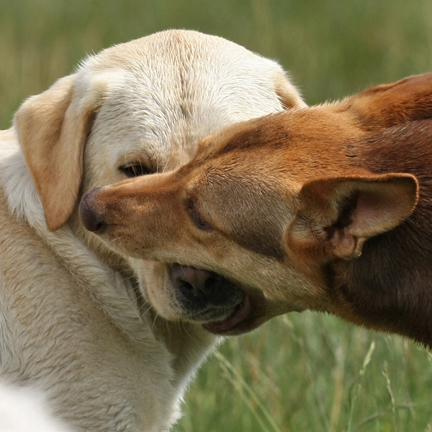
A “Muzzle grasp” (or muzzle grab) is a common behavior shown by social canines, e.g., wolves (Canis lupus lupus), dingoes (Canis lupus dingo), and dogs (Canis lupus familiaris). The primary function of this behavior is to confirm a relationship rather than to settle a dispute. The more self-confident or higher-ranking individual will muzzle-grasp a more insecure or lower-ranking partner to assert its social position. The more insecure individual does not resist the grasp; on the contrary, it often displays submissive behavior, literally inviting its partner to muzzle-grasp it. Even though we sometimes see this behavior at the end of a dispute, wolves and dogs only use it toward individuals they know well—pack members—as a kind of saying, “You’re still a cub (pup).” The dispute itself tends not to be serious, merely a low-key challenge, often over access to a resource. Youngsters, cubs, and pups sometimes solicit adults to muzzle-grasp them. This behavior appears reassuring to them.
The muzzle-grasp behavior emerges early in development. Canine mothers muzzle-grasp their puppies (sometimes accompanied by a growl) to deter them from suckling during weaning. Field observations confirm this mechanism. As Packard, Mech, and Ream (1992, p. 1274) report, “In the context of playing, begging, and sharing, pups did not leave when another wolf muzzled, snapped, or lunged. In contrast, the muzzling by the nurser in the context of suckling terminated the pups’ attempts to gain access to nipples.” This observation illustrates the early communicative value of the muzzle contact as both a mild inhibitory and relational signal. Cubs and pups also muzzle-grasp one another during play, typically between six and nine weeks of age. They probably learn through play that the muzzle-grasp is an effective way of stopping an opponent from doing something, while also learning bite inhibition. If they bite too hard, they elicit a fight and risk injury. A muzzle-grasp, therefore, does not involve biting, only grasping. This behavior helps develop a relationship of trust between both parties—“we don’t hurt one another.”
Similar tactile interactions, including muzzle-to-muzzle contact, also occur in post-conflict and affiliative contexts among wolves. Cordoni and Palagi (2019) describe reciprocal muzzle-licking between adults and immature pack members following mild conflicts—acts that function as “consolation” and reinforce social bonds. Although a muzzle-grasp differs mechanically from muzzle-licking, both share an underlying functional value: the restoration or affirmation of trust within a dyad. These tactile gestures exemplify the nuanced physical vocabulary through which canids maintain cohesion and mitigate tension within the pack.
Classic naturalist observations (Zimen, 1981) describe frequent muzzle-to-muzzle contacts and note adults seizing pups’ muzzles during play and weaning; together with quantitative field data (Packard, Mech, & Ream, 1992), this supports the view that muzzle contact is an early-emerging, ritualised tactile signal rather than an aggressive act.
When used to settle a dispute, a muzzle-grasp may appear more violent and usually ends with the individual being muzzle-grasped exhibiting passive, submissive behavior. Yet participants very seldom, if ever, get hurt, an occurrence that would undermine the behavior’s function.
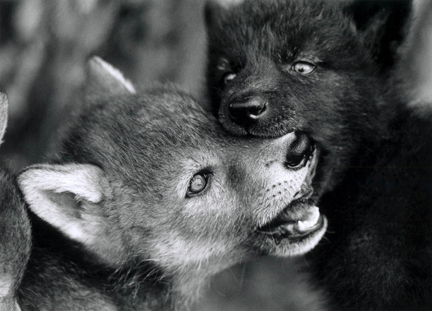

Left: Cubs and pups muzzle grasp one another during play. Right: Muzzle grasp in adult wolves (photos by Monty Sloan).
A muzzle-grasp requires self-control. Higher-ranking wolves and dogs muzzle-grasp their pack members (teammates) and, by doing so, confirm their rank while displaying restraint. Lower-ranking wolves and dogs often engage in muzzle-grasping behavior to affirm their social position and reassure themselves that they remain included in the group.
The muzzle-grasp behavior probably originated as both a form of maternal (and later paternal) control and as a play behavior among cubs. As it appears to have been beneficial to all parties involved, it may have become a factor favored by natural selection, spreading from generation to generation and evolving as any other trait that enhances the fitness of individuals within cohesive social groups.
In domestic dogs, when puppies are about five to seven weeks old, their mother regularly muzzle-grasps them to deter suckling. At first, her behavior frightens them, and they may whimper excessively, even though she does not harm them. Later, when grasped by the muzzle, the puppy immediately shows passive submissive behavior—lying on its back and exposing its ventral side. Previously, it was assumed that the mother needed to pin the puppy to the ground; however, Packard et al. (1992) observed that, in wolves, in practice, “[…] on the occasions when the nurser winced or muzzled the pups, the pups did not persist” and that “[…] counter-tactics for overcoming nurser rejection did not occur (pp. 1271–1272).” Most puppies submit voluntarily. Over time, this behavior pattern assumes variations. Wolf cubs and puppies often invite the alpha male (the leader of the pack and, in wolves, usually their father) as well as other adults to grasp them by the muzzle, thereby soliciting a demonstration of their elders’ superiority and self-control while simultaneously showing their own acceptance and submissiveness. This is among the most reassuring behaviors an adult can show a youngster.
Domestic dogs sometimes approach their owners puffing gently with their noses. By gently placing a hand around their muzzle, we may reassure them of acceptance, demonstrate self-control, and convey that they can trust us. That is speaking dog-language to the best of our abilities. After being muzzle-grasped for a while, the dog will usually show a nose-lick, perhaps yawn, and then walk calmly away. It is as if the dog were saying, “I’m still your puppy,” and the owner replied, “I know—and I’ll take good care of you.”
The muzzle-grasp behavior can be challenging to classify. Some researchers see it as social or affiliative, others as agonistic, and still others as pacifying. Because its primary function is to confirm and maintain relationships, it may best be considered a social behavior—a ritualized, low-intensity interaction that reinforces trust and cohesion within the group.
Next time your dog gently nudges or invites a muzzle‑grasp, pause for a moment—what you see as a simple dog behavior is, in canine language, a subtle conversation of trust and understanding.
References
Abrantes, R. (1987). Hundesprog. Borgen Forlag, Copenhagen.
Abrantes, R. (1997). The Evolution of Canine Social Behavior. Naperville, IL: Wakan Tanka Publishers.
Abrantes, R. (2011, December 11). Dominance—Making sense of the nonsense. Roger Abrantes Blog. https://rogerabrantes.wordpress.com/2011/12/11/dominance-making-sense-of-the-nonsense/
Cordoni, G., & Palagi, E. (2019). Back to the future: A glance over wolf social behavior to understand dog–human relationship. Animals, 9(11), 991. https://doi.org/10.3390/ani9110991
Packard, J. M., Mech, L. D., & Ream, R. R. (1992). Weaning in an Arctic wolf pack: Behavioral mechanisms. Canadian Journal of Zoology, 70(7), 1269–1275. https://doi.org/10.1139/z92-177. USGS+1 PDF (scanned article, pages shown above): https://www.wolf.org/wp-content/uploads/2013/09/172weaningarcticwolf.pdf
Zimen, E. (1981). The wolf: His place in the natural world. Souvenir Press Ltd. ISBN 9780285624115
Note: I first wrote about the muzzle grasp behavior in canids in my Danish book Hundesprog (1987), where I called it “mund om snuden,” which translates directly as “mouth around the snout.” This term became “muzzle grasp” in the first English edition of the book, titled Dog Language. I later wrote Muzzle Grab Behavior in Canids on April 25, 2012. Two years afterward, on March 13, 2014, I revised it as Canine Muzzle Grasp Behavior—Advanced Dog Language. True to my philosophy of updating articles and papers as new evidence emerges, I have once again revised this work. The latest version, published in November 2025, appears here under the title Muzzle Grasp Behavior in Canids.
 Roger Abrantes
Reblogged this on EQUILIBRE Gaiá and commented:
Absolutely amazing behavior! Very well explained and illustrated! A must for ethologists or anyone interested behavior.
What a truly amazing behavior! Beautifully written with corresponding images. It does not get any better….does it? A fine critical job in the description of the function of muzzle grabbing. Gracias Roger!
P.S. Keep them coming!
Amazing…Not a very common behavior, but may be of interest as a way to strengthen our relationship with the dog. It is a clear sign of security that can accept if used at the right time. You consider it possible?
I live with 7 German Shepherds in my home. I see this behavior all the time, daily and usually more often. I will also use it to my advantage in my own communication with them. I see this as a very valuable training and socialization tool.
I see this behavior on a daily basis on my 3 Brazilian Terrier pack. However my most insecure dog is the one that grabs the muzzle of my younger but more confident dog. They always had a parental relationship since the day they met.
Awesome info about the canids behavior. I have seen this many times and now have a explanation! Thank you and as always I look forward greatly to your posts
Pingback: Muzzle grabbing in dogs and wolves. | Our Life, Plus Dogs
Wonderful article as usual. Thanks!
Pingback: Muzzle Grab Behavior in Canids | Roger Abrantes « Animal Magic Dog Training
Love this, great explanation. I also like that you acknowledged there are slightly different interpretations. I’m glad to hear the behavior does not need to be looked at as “correction” but rather when this behavior is used, it serves the function or reassurance and trust. There is however, one concern, what does it mean when dogs do this to their humans and actually inflict pain and/or bite them? I get bite inhibition as being part of it, but i’m looking at how does the dog view the human especially in a context when the human does not have the dogs trust and respect.
For example, a dog/dog fight ensues. The dogs owner, either one and/or both dogs, reaches in to grab one of the dogs. Lets say, they try to grab the dog who might actually be correcting the other dogs behavior. The owner has not established a leadership role, the dog correcting the other rude dogs behavior, bites the owner. This happens all the time. What does this say about the owners control over their dog/s. I do not consider the dog biting the owner attempting to intervene as being redirected aggression or as implied in many cases the dog bit the person but didn’t mean it.
I love this article, what great information! I have had Rotties for over 25 yrs, they have all been well trained, and when they put their teeth on me I tell them “No Bite”, but I do notice that when they walk loose with me on the ranch they try to hold my hand with their mouth, I was wondering if this is a related behavior to this article. My German Shepherd did this too and now the Pitbull we rescued in June of 2011 is doing the same thing.
Reblogged this on and commented:
This is a wonderfulexplanation for a behavior that I’m certain most multi-dog families have observed. My only question is, how can we use this in our training sessions? …or, can we use this at all? Hope to see follow-ups on this artocle in the future!
Thank you very much for sharing the article, digestible for any reading level and with lots of information. Greetings!
Pingback: The First Ten Skills You Should Teach Your Puppy | Roger Abrantes
Pingback: Pacifying Behavior—Origin, Function and Evolution | Roger Abrantes
Interesting. I’m glad you mentioned that there are different kinds of muzzle grabs. Maybe one of the early lessons pups need from us is a muzzle hold. Certainly in teaching a dog to hold something we do this, not to mention getting it to hold still for ear and eye meds and popping pills. Teaching them to hold still will help everyone who handles a dog.
Pingback: Canine Ethogram—Social and Agonistic Behavior | Roger Abrantes
Pingback: Genes, Environment, Breeding (The 20 Principles) | Roger Abrantes
This is how I correct behaviour in my dogs when they are pups. I grab muzzle with a light shake while saying NO!!. It has works brilliantly for 30yrs on all breeds. I do not believe in hitting under any circumstance, and have never needed to.As the dog matures, I reduce muzzle grabbing unless a new unwanted behaviour arises. By the time my dogs are 8mths old, a firm NO!! stops them dead in their tracks. It is a brilliant training tool for puppies, and I have had many years of success using the “muzzle grab”.
Pingback: Muzzle Grab Behavior in Canids | Roger Abrantes « TheWorkingPup
Pingback: 16 Things You Should Stop Doing In Order To Be Happy With Your Dog | Roger Abrantes
Very thought provoking. Thank you.
Pingback: A Dog’s Self-Respect | Roger Abrantes
Pingback: 16 cosas que debería dejar de hacer para tener una vida más feliz con tu perro | Roger Abrantes
Pingback: Dog Training—Let Reason Prevail Over Force! | Roger Abrantes
A truly magical article; wonderfully written, as all your blog posts are. Thank you so much for sharing your insights freely with everyone. I am grateful for this and for the tone and skill of your writing. Please accept my very best regards.
Hi Joy,
Thank you so much for your kind words.
R—
Hey Roger..thanks for the explanation. What say you about licking inside the mouth of another dog?..an older bitch caringly licking, sometimes far back, into the mouth of a yearling young dog. The recipient to the licking is quite tolerant and with acceptance to the licking.
Pingback: 為了讓你跟狗狗可以快樂地在一起 “16件別再這麼做的事情” | Roger Abrantes
Reblogged this on Zerobites Dog Training.
Pingback: The Canine Companion | Muzzle Grab Behavior in Canids | Roger Abrantes
Jolanda is such a great maternal example of this!
Great article! We have a Cattle Dog, a Dutch Shepard and a Malinois under our roof. This behavior is very common in our house between the Dutch and the ACD. The Mal does not let either of the other do this but seeks it out from the humans in the pack. Nice to know where we stand. Thank you!
Pingback: Kevin, you keep using that word. | Science of Dogs
Pingback: Canine Maternal Behavior | Roger Abrantes
Excellent. Thank you.
Pingback: How Dogs Enrich Our Lives | Aspenbloom Pet Care
Pingback: Submission and Dominance Among Friends – Veritas Reporters
I grew up on at farm and worked at a humane society for years. The only time I saw a muzzle grab was with mother to puppies on the farm. We did introduction for dogs between current dog to shelter dog (including puppies) and I never saw muzzle grab. At the off leash park never saw it. During play time (during training) never saw it.
Hi Crystal, it’s a behavior you see in various canine species, only among individuals that know one another very well. It’s not a behavior used with strangers.
I have seen this in my dogs, usually an older dog doing it after over excited play from the younger.
I willl watch more closely from now on.
Hi Liz, thank you for your input.
The most amazing muzzle grab I had the privilege to observe was many years and many dogs ago. I was relaxing on my couch with my adult Border collie girl, and my puppy Pyrenean Shepherd. He kept harassing her, jumping and nipping at her, as she kept lifting her lip at him and softly growling. She was done playing and wanted to relax with me. I kept telling him to leave it, but of course he would not.
Suddenly, she muzzle grabbed him INCHES FROM MY FACE! He froze in place while she held his muzzle while lightly growling for a few seconds. (Felt like forever!) Then she let go and did a little sneezy sound as she turned away. (This sneeze is another behavior I’d love to see you write about!) Of course, puppy left her alone and went off to do something else. I wish I’d had that on video!
Thanks for sharing your experiences.
A very interesting article. Thanks so much for posting. Please, keep up posting about canine behavior.
Thanks, Ashely, I promise, I will keep posting articles. 😊 By the way, you can subscribe to get new writings by email.
Thank you! Very interesting article. I’ve taught hundreds of off-leash puppy and adolescent training classes with 8-12 puppies per class and really never saw this among them but they are all relative strangers to each other.
I’ve seen it between mom and puppy and siblings or dogs that live together but always as a, “stop already!”.
In adult to adult/adolescents I have always seen it as the dog that ends up getting “muzzled” has been just pestering and pestering the other with pokes, and shoulder shoves, and pawing at them to get them to play. The “victim” just ignores and ignores until, after a period of time, they give a whine of exasperation and grab the muzzle. The pest immediately freezes and often drops to the ground. I can see this now as being seen as soliciting, but I need to give that more thought.
In mother to puppy I have seen it as you describe: to stop nursing but also to interrupt bullying another puppy or herself. The grab is sometimes less gentle between mother and puppy.
In my mind, I have always thought of it as a, “take a breath, junior! Get ahold of yourself and slow down” “yes, we’re family but, sheesh, ya big galoot” move (please forgive my non-technical interpretation). It is always pretty gentle as far as the pressure of the jaws but can start off with a pretty dramatic display sometimes
As a tool to stop a dog having a moment of seemingly over-the-top behavior, I’ve seen it work well; I wonder why we humans don’t use it. Or do some and I’m just behind (esp groomers)? In the few cases where I’ve seen a human grab a muzzle it’s almost always to hold the mouth shut because of barking and the dog resists, sometimes almost frantically, is that because it is done so differently as to be unrecognizable?
Anyway, thank you for the thought provoking topic!
Thanks, Trish, for your comment. I can confirm your observations, and I’m glad you shared them—there is still so little written about this peculiar behavior, the canine muzzle grasp. Don’t worry about your non-technical interpretations. I often do the same, and it’s perfectly fine as long as we remain aware that it is only a figurative way for us to relate to another species’ behavior, and probably has little—or nothing—to do with what is actually happening.
As per your request on FB, I leave my comment here.
It’s a correction with motherly affection. Think of a human mum poking a child’s hand trying to stick a finger in the plug. It’s a brain reset for the puppy, it orients its attention span to mum and escapes the faulty behaviour without causing trauma. It’s very common within canines, and I use it when I train young dogs who bite or become boisterous.
I loved the article.
Thank you, Καλλιόπη, for your comment and for posting it here.
I accidentally noticed that doing something similar, gently grasping the muzzle and teeth with one hand, soothed my dogs when they were having conflict (two males who would get into quarrels over resources they wanted). Or course I would not recommend this, as it could be quite dangerous. I only did it because I knew those dogs very well and was reading their body language carefully. When they would be growling at each other, calmly holding their muzzle and teeth like this would make them calm down in turn and be a bit apologetic to me. With a bit of patience they could be brought out of their quarrel and settle.
Hi Estelle, it’s a good observation and you’re right to be careful. The muzzle grasp is a behavior used only among intimate individuals—social canines that know one another very well. I’ve seen it in wolves and domestic dogs.